


If you live in Cumming, GA or Alpharetta and you are thinking about adding your husband or wife to the title of your home, the decision feels simple at first. You got married, you want shared ownership, or you want the house to pass smoothly if something happens. Then you start reading online and realize many guides treat this like a paperwork task when it is often a family law, tax, estate planning, and asset protection decision all at once.
In North Georgia, that matters. A deed change can affect what happens in a divorce, whether the property stays separate, how probate works, whether a lender needs notice, and whether a future sale creates avoidable tax problems. In Forsyth County and Fulton County, I regularly see people assume a quitclaim deed is harmless because it is common. Common does not mean low risk.
If you searched for “add a spouse to deed near me” because you want a clear answer before signing anything, the practical answer is this: sometimes it is the right move, sometimes it is the wrong one, and DIY is frequently where costly mistakes begin.
Considering Adding a Spouse to Your Deed in Cumming GA?
Many homeowners in Cumming, GA call about this after a marriage, a refinance, a move into a pre-marital home, or a basic estate planning conversation. The question sounds narrow. The broader issue is: what rights are you creating, and what rights are you giving up?

In North Georgia, I would not treat this as a routine form if any of these apply:
- You owned the home before marriage
- You have substantial equity
- You have children from a prior relationship
- You run a business from the home
- You are trying to avoid probate
- You have concerns about creditor exposure or divorce risk
People in Alpharetta, Johns Creek, Milton, Suwanee, and Dawsonville often come in expecting a quick signature process. Sometimes that is all that is needed. Often it is not. The deed language has to match the goal. If the goal is survivorship, the wording has to do that. If the goal is tax efficiency, a deed may not be the best tool. If the goal is protection in a potential high-asset divorce, adding a spouse can create the opposite result.
Why this decision is bigger than it looks
A deed does more than add a name. It changes ownership. In Georgia, ownership changes can affect marital property analysis, estate administration, creditor rights, and how a judge may later view the asset in a divorce case.
That is especially important in local practice. A family dealing with a pending separation in Forsyth County Superior Court or a property dispute tied to Fulton County Superior Court needs strategy, not just forms. The same is true for families working through Georgia no-fault divorce issues, temporary hearings, mediation, or property division discussions while trying to preserve stability.
Practical takeaway: If the home matters in your long-term financial picture, do not sign a deed until you know how it affects divorce exposure, inheritance, lender requirements, and taxes.
When a consultation makes sense
You should get legal advice before you add a spouse to deed if the house is a major asset, if one spouse brought the property into the marriage, or if your larger plan includes wills, trusts, or business ownership. That is not overkill. It is basic protection.
If you are weighing this decision in Cumming, Alpharetta, or anywhere in Forsyth County or Fulton County, schedule a consultation before you record anything.
Understanding Georgia’s Deed and Property Ownership Options
Georgia homeowners make two separate choices when they add a spouse to deed. First, they choose the type of deed. Second, they choose the form of ownership created by that deed. People often focus on the first and ignore the second. The second choice is often where significant consequences live.
Quitclaim deed versus limited warranty deed
A quitclaim deed is the document many spouses use because it is simple. It transfers whatever interest the current owner has, without broad title promises. That simplicity is exactly why it is common in family transfers.
A limited warranty deed also transfers ownership, but it gives a narrower form of assurance tied to the grantor’s period of ownership. In practice, some families prefer it because it can feel cleaner than a bare quitclaim. Others want the speed and directness of a quitclaim. Neither is automatically right.
The better question is: what is the deed supposed to accomplish, and what risks are already attached to the property?
The ownership language often carries more weight than many initially recognize.
In Georgia, many couples want joint tenancy with right of survivorship, often shortened to JTWROS. If that language is properly created, the surviving spouse receives the property automatically when the other spouse dies. That can avoid probate for the house.
The other common structure is tenants in common. That arrangement does not create automatic survivorship. If one owner dies, that owner’s share passes through the estate instead of going automatically to the surviving spouse.
Here is the practical difference:
| Ownership form | What happens at death | Why families choose it |
|---|---|---|
| JTWROS | Surviving spouse takes ownership automatically | Probate avoidance and simplicity |
| Tenants in common | Deceased spouse’s share passes under estate rules | More control for blended families or separate inheritance planning |
What goes wrong in DIY drafting
The most common mistake is assuming that adding a spouse’s name alone creates survivorship rights. It does not. The deed has to say the right thing, in the right way, under Georgia law.
Another problem is using a generic online form that was not built for Georgia. That is especially risky in Cumming, Alpharetta, Forsyth County, and Fulton County, where the local recording office will expect proper execution and a complete legal description, but the larger danger is not just rejection. A recorded deed with bad ownership language can still create years of avoidable conflict.
Estate planning and property rights have to match
If a couple wants to avoid probate for one asset but still preserve flexibility in the broader estate plan, a deed may or may not be the best answer. In many households, the better analysis includes trusts, wills, beneficiary designations, and title review together. Property rights issues also overlap with related questions, including what an easement is and how it affects property rights, because ownership on paper is only one part of the legal picture.
Key point: In Georgia, the wrong vesting language can defeat the entire reason you changed the deed in the first place.
How to Prepare and File a Deed in Forsyth and Fulton County
A couple in Cumming signs an online quitclaim form at the kitchen table, files it, and assumes the house is now “shared.” Two years later, during a refinance or divorce, they learn the deed language was incomplete, the lender was never addressed, and the transfer changed more than they intended. I see versions of that problem often enough that I do not treat deed changes as clerical work.
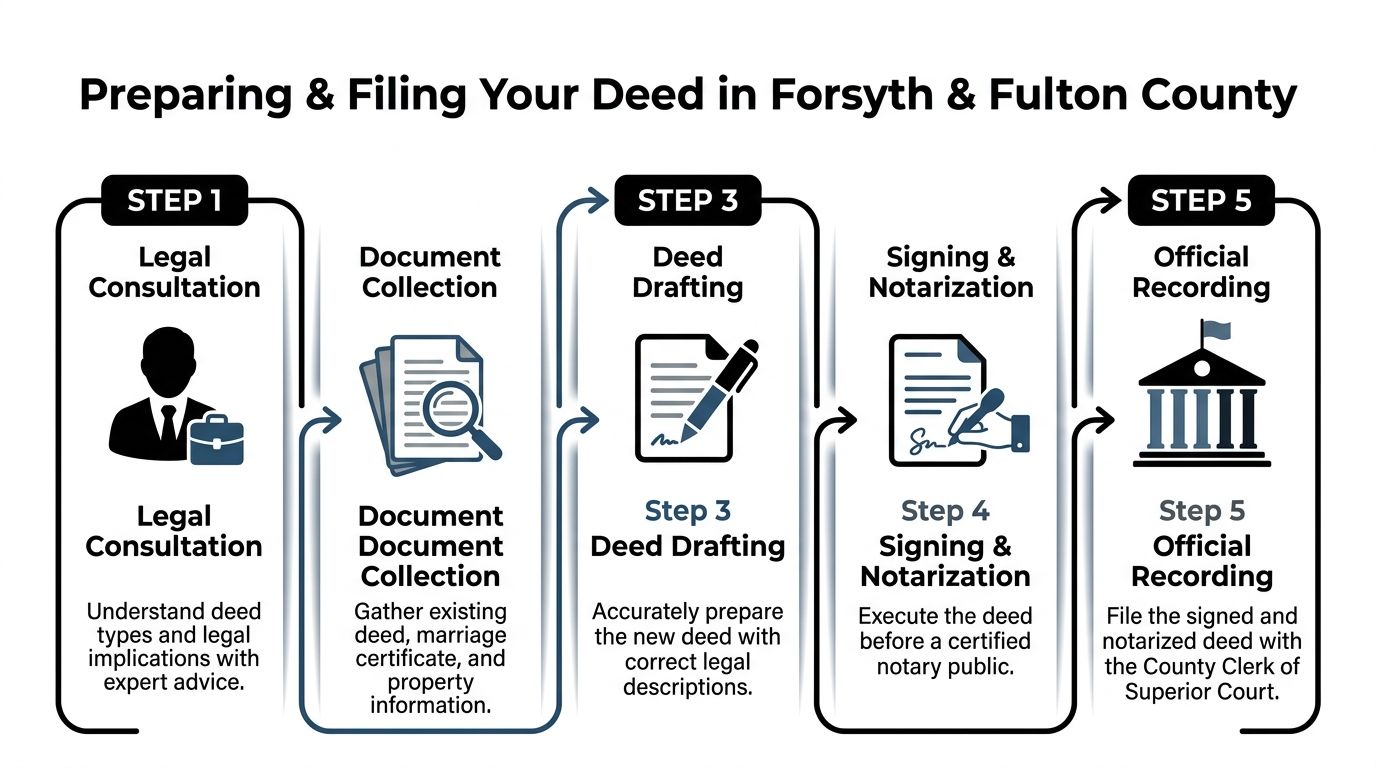
The filing steps themselves are straightforward. The risk is in the details. In Forsyth County and Fulton County, the clerk’s office records documents. It does not review your deed for divorce exposure, creditor problems, or whether you just turned separate property into an asset that will be fought over later.
Start with the current recorded deed.
Do not pull the legal description from a tax bill, listing sheet, or mortgage statement. Use the last recorded deed or another reliable title source. A street address is not enough, and an abbreviated legal description can create a recording problem or a title problem that surfaces later, usually when money is on the line.
The new deed needs more than names added to a form. It should correctly identify the current owner as grantor, the post-transfer owners as grantee, the mailing addresses, the return address, and the full legal description. The vesting language also has to match the couple’s actual goal. If survivorship is intended, the deed must say that clearly under Georgia practice. If the spouses want a different arrangement because of children from a prior marriage, liability concerns, or estate-planning reasons, the wording should reflect that decision instead of defaulting to a generic form.
Execution rules matter too. Georgia deeds are typically signed by the grantor before a notary and an additional witness. Missing signatures, missing witness lines, or sloppy acknowledgments can stop recording or create a challenge later. A rejected deed is annoying. A recorded deed with bad language is worse because people assume it solved the problem.
Forsyth and Fulton filings also usually require the PT-61 transfer tax form as part of the package, even in transfers between spouses where little or no tax is expected. That is one of the points DIY filers miss. They focus on whether tax is owed and skip whether the filing packet is complete.
Where to file depends on where the property sits, not where the spouses live:
- Cumming and most Forsyth County property go to the Forsyth County Clerk of Superior Court
- Alpharetta, Johns Creek, Roswell, Sandy Springs, and other North Fulton property may go to the Fulton County Clerk of Superior Court, depending on the property location
Recording fees are usually modest compared with the legal consequences of getting the deed wrong. The primary cost appears later if the deed conflicts with a loan, an estate plan, or a divorce position. Homeowners watching Georgia's real estate market outlook often focus on equity growth. They should give the same attention to how title is being held, especially in high-value North Atlanta property.
A lender issue is easy to miss. Adding a spouse to title does not remove the existing mortgage, and some loan documents restrict transfers without lender consent. Many lenders never call the loan due over an intra-family transfer, but relying on that assumption without reviewing the note and security deed is not good practice.
This is also the point where DIY often stops making financial sense. If the house is premarital property, if one spouse owns a business, if there are children from another relationship, or if a trust-based plan may fit better, the deed should be reviewed as part of the larger strategy. In many households, a deed is not the cleanest answer. A revocable living trust for Georgia property planning can sometimes address probate concerns without creating the same title and family-law issues.
For straightforward title corrections, a simple deed may be fine. For Forsyth and Fulton couples with significant equity, separate-property concerns, or any chance of future litigation, careful drafting is cheaper than repairing the mistake later.
Hidden Costs and Financial Risks for Alpharetta Homeowners
A spouse signs a deed at the kitchen table in Alpharetta because it feels like a cleanup step. Years later, the same deed shows up in a sale, a refinance, or a divorce file, and the cost is far higher than expected.

Basis problems usually stay hidden until the house is sold
The tax issue that catches many North Fulton homeowners off guard is basis. If one spouse adds the other to title during life, the transferred interest generally carries the original basis instead of receiving a new fair-market-value basis. In the example discussed by SmartAsset, a home bought for $200,000 and later sold for $800,000 can leave the added spouse’s half with substantial taxable gain, and the article also notes that common-law states like Georgia do not offer the same whole-property step-up treatment often discussed in community property states.
That matters more in Alpharetta than many couples expect. Appreciating property magnifies old basis decisions. A deed filed for convenience can become an expensive tax choice.
The main financial question is whether the deed solves the right problem
Homeowners often say they want to avoid probate or make ownership feel more equal. Those are understandable goals. The problem is that adding a spouse to title is a blunt tool. It can affect taxes, refinancing options, later negotiations over equity, and the house itself if the marriage breaks down.
For higher-equity homes in Alpharetta, Milton, and Roswell, I usually tell clients to ask a harder question first. If the concern is what happens to the house in a future split, the better starting point is usually to understand who gets the house after divorce in Georgia, then decide whether changing title helps or hurts that position.
Gift tax usually is not the danger. Other exposure is.
Federal gift tax is usually not what makes this transfer risky for a married couple. The more practical concerns are the ones people do not see on the deed itself. A transfer can complicate later record-keeping, create confusion over ownership shares, and increase the number of parties who must sign off when the property is sold, refinanced, or used in broader planning. The same source discussing those risks also notes that transfers to a spouse are generally protected from due-on-sale enforcement under the Garn-St. Germain framework, which is why lender acceleration is often less of a problem than title and planning consequences (fiffiklaw.com).
Servicing confusion can still happen. Recording a deed does not rewrite the loan file, escrow setup, or insurance instructions by itself.
Rising values make small title mistakes expensive
Homeowners following Georgia's real estate market outlook usually focus on price trends, inventory, and timing. They should also focus on exit cost. In a rising market, the wrong deed choice can increase tax friction, weaken a separate-property argument, or force a spouse’s involvement in a transaction that used to be simple.
That is why DIY often stops making sense once the house has serious equity, one spouse owned it before marriage, or either spouse has creditor or business risk. In Forsyth and Fulton County, the filing itself is usually the easy part. Living with the consequences is harder.
Impact on Divorce, Creditors, and Estate Plans in Cumming GA
A common North Georgia scenario looks like this. One spouse bought the house years before the wedding, the equity has grown fast, and now the couple wants to “put both names on it” because it feels fair or simpler. In Forsyth and Fulton County, that simple step can reshape a later divorce case, open the door to a spouse’s creditors, and disrupt an estate plan that used to be clean.
Separate property issues start here
In Georgia, title matters, but title is not the whole analysis. A home owned before marriage may begin as separate property, yet adding a spouse to the deed can seriously weaken that separate-property position in a divorce. Courts still look at source of funds, intent, appreciation, and commingling, but a recorded deed placing the home in both names gives the other side a much better argument that the property, or at least part of its value, should be divided under Georgia’s equitable division rules in O.C.G.A. § 19-5-13.
That risk is easy to underestimate in high-equity homes in Cumming, Alpharetta, Milton, and Johns Creek. I have seen owners focus on the filing fee and overlook the litigation value of the house itself. Once title changes, negotiating position often changes with it.
For a fuller discussion of how courts handle the marital residence, see who gets the house after divorce in Georgia.
Creditor exposure is a real Georgia problem
Georgia does not give married couples tenancy by the entirety protection. That point gets missed all the time because homeowners read articles from Florida, Tennessee, or other states and assume the same shield applies here. It does not.
If you add a spouse with business liability, professional exposure, collection problems, or unresolved judgments, the house may become easier to reach than you expected. That concern is sharper for physicians, contractors, developers, small-business owners, and families where one spouse signs personal guarantees.
A practical consumer read on whether a spouse's debt could become yours can help frame the right questions before changing title.
One more point matters. Georgia’s homestead protection is limited, so substantial equity in a Forsyth or Fulton County home is not protected solely because the property is owner-occupied. Homeowners with serious equity, a closely held business, or a pending dispute should treat deed changes as asset-exposure decisions, not clerical updates. Guidance commonly cited for spouse deed transfers also notes the related risks of converting separate property, increasing creditor exposure in Georgia, and relying too heavily on homestead protection (LegalZoom).
Estate planning can get worse, not better
Couples often add a spouse to the deed because they want to avoid probate or “make sure the house passes automatically.” Sometimes that works. Sometimes it creates a bigger problem.
The deed language has to match the estate plan. A blended family, children from a prior marriage, or a large gap in separate assets can make joint title a poor fit. If the goal is to provide housing for a surviving spouse while preserving the ultimate inheritance for children, a will or trust may do that job better than a quick deed filed at the courthouse.
The divorce angle and the estate angle often point in opposite directions. A transfer that feels generous during a stable marriage can become expensive during a divorce or after a death.
Business owners should be especially careful
Homes tied loosely or directly to a business create extra evidentiary problems. If the house was purchased with one spouse’s premarital funds, later used for business records, guaranteed debt, or home-office operations, adding the other spouse to title can muddy the paper trail in ways that are hard to clean up in litigation.
DIY is usually where this goes wrong. The filing itself is rarely the hard part. The hard part is understanding what argument you may be giving up before the deed is signed.
Key point: If the house has substantial equity, one spouse owned it before marriage, either spouse has creditor exposure, or the family has estate-planning concerns, adding a spouse to deed without legal advice is often a costly mistake.
Why North Georgia Families Trust Miles Hansford for Property and Family Law
A deed transfer rarely stays “just a deed transfer” for long. It reaches into divorce strategy, probate avoidance, asset protection, tax planning, and practical court realities in North Georgia.

Local knowledge changes the advice
A lawyer who only looks at the recording step may miss the family-law consequence. A lawyer who only looks at the divorce angle may miss the title problem. North Georgia families need advice that sees both.
That is especially true in:
- Cumming and Forsyth County
- Alpharetta and North Fulton
- Johns Creek, Milton, Suwanee, Roswell, Sandy Springs, Canton, and Dawsonville
What works for a newly married couple with no children may fail badly for a blended family. What works for a modest home may be dangerous in a high-equity property. What works for a salaried household may be the wrong move for a business owner facing liability concerns.
DIY mistakes usually follow a pattern
The most common problems are familiar:
- The deed says the wrong thing about survivorship
- The legal description is incomplete
- The spouse gets added to title without a broader estate review
- The owner accidentally converts separate property into a divisible marital asset
- The family assumes probate avoidance is always worth the trade-off
Each of those mistakes can be expensive to unwind. Some cannot be fully undone once a divorce, death, or creditor issue arrives.
Court experience matters when problems surface
If title choices later become part of a divorce, support dispute, temporary hearing, or mediation, local court experience matters. Families in Forsyth County Superior Court and Fulton County Superior Court are not looking for abstract legal theory. They want practical, strategic counsel that fits local procedure and real-world pressure.
That includes knowing when to negotiate, when to preserve claims, when to push for temporary relief, and when a deed transfer should never have happened in the first place.
Frequently Asked Questions About Changing a Deed in Georgia
A deed change looks simple until the wrong wording turns a premarital house into a divorce fight or creates a title problem that surfaces during refinancing, probate, or litigation. These are the questions I hear most often from homeowners in Cumming, Alpharetta, Forsyth County, and North Fulton.
Q: How do I add a spouse to deed in Cumming, GA?
A: The usual approach is to sign a new deed transferring the property from one spouse alone to both spouses in the form of ownership you want. In Forsyth County, that means getting the legal description right, using the correct names, signing with the required formalities, and recording it with the Clerk of Superior Court.
The paperwork is the easy part. The harder question is whether adding a spouse helps your broader plan or creates exposure you did not intend.
Q: Can I add my spouse to the deed without adding them to the mortgage?
A: Yes. Title and the mortgage are separate. A spouse can become an owner without becoming a borrower.
That does not mean the loan can be ignored. The promissory note, security deed, and lender servicing rules still matter. I tell clients to review the loan documents before filing anything, because trouble often shows up later, during a refinance, sale, assumption request, or missed-payment dispute.
Q: Is a quitclaim deed always the best way to add a spouse in Alpharetta?
A: No. A quitclaim deed is common because it is fast and inexpensive to prepare, but it is not automatically the best choice. The right deed depends on what you are trying to accomplish, whether the house was owned before marriage, whether there are creditor concerns, and whether the transfer needs to fit an estate plan.
For higher-asset households in Alpharetta and Milton, that decision deserves more care than a downloaded form usually gets.
Q: Will adding my spouse to the deed help avoid probate in Georgia?
A: Sometimes. It depends on how the deed is written and whether the ownership language clearly creates survivorship rights. If the wording is wrong or incomplete, the property may still need to pass through estate administration.
Families often focus on probate avoidance and miss the trade-off. A deed that helps at death can still create problems during life, especially if one spouse later faces creditor claims or the marriage breaks down.
Q: What happens if I add my spouse to the deed and later file for divorce in Georgia?
A: This is one of the biggest Georgia-specific risks. Adding a spouse to title can support an argument that separate property was turned into marital property, at least in whole or in part. In a divorce, that can change settlement value, bargaining power, and trial strategy.
That risk is not theoretical in Forsyth and Fulton County cases. If the house had substantial equity before marriage, or one spouse used inherited funds or separate money to acquire it, a deed change can blur lines that were once clear.
Q: Does adding a spouse to deed affect a home office or business use in Alpharetta?
A: It can. Business owners and self-employed professionals should slow down before changing title. If part of the property is tied to business use, liability concerns, or exemption planning, the transfer can affect how that property is treated later. As noted earlier, Georgia law can create added complications for owners with business-related exposure.
This is a common DIY mistake. The deed gets filed first, and the owner asks questions only after a lawsuit, bankruptcy issue, or divorce claim appears.
Q: How long does a divorce take if the house becomes disputed in Cumming or Alpharetta?
A: A house dispute usually makes the case take longer. Even where the divorce itself could have resolved quickly, fights over title, equity credits, exclusive use of the home, reimbursement claims, or whether a transfer changed the character of the property can extend the timeline.
Local court calendars matter too. So do temporary hearings, discovery, mediation, and appraisal disputes.
Q: Do Georgia courts require anything special when children are involved in a divorce tied to property issues?
A: Yes. The court still has to address parenting issues, and housing questions often overlap with those decisions. The judge may need to consider who stays in the home temporarily, how school stability is preserved, and whether a sale or refinance is realistic while the custody and parenting schedule are still being worked out.
That is one reason deed changes should be considered as part of the full family picture, not as isolated title paperwork.
If you are deciding whether to add a spouse to deed in Cumming, Alpharetta, Forsyth County, or Fulton County, do not rely on a generic form and hope for the best. Miles Hansford Law Firm helps North Georgia families evaluate the divorce, property, creditor, and estate-planning consequences before a simple deed change becomes a major problem. Schedule a consultation to speak with a family law attorney and protect your home, your rights, and your long-term plan.
Meta Title
Add Spouse to Deed in Cumming GA
Meta Description
Add a spouse to deed in Cumming, GA with care. Learn Georgia deed steps, tax risks, and divorce issues in Forsyth and Fulton County.
Suggested URL slug
/add-a-spouse-to-deed-cumming-ga
Internal link suggestions
- /who-gets-the-house-after-divorce-in-georgia/
- /how-to-establish-a-revocable-living-trust/
- /what-is-an-easement-and-how-does-it-affect-property-rights/
- /family-law/
- /divorce-attorney-cumming-ga/
- /divorce-attorney-alpharetta-ga/
Schema recommendations
- Attorney
- LegalService
- FAQPage