


When you’re facing a family law dispute in Cumming, GA, the stress of what lies ahead can be overwhelming. The thought of a public court battle in Forsyth County Superior Court often adds to the anxiety. But what if there was a better, more private path to resolution? For most families in Cumming, Alpharetta, and across North Georgia, the solution isn't found in a crowded courtroom. It's found through alternative dispute resolution—a process that gives you control, privacy, and a more strategic path forward.
The two primary methods are mediation and arbitration. Understanding the difference is your first step toward taking control of your divorce, custody, or other family law matter. In short, mediation is a guided negotiation where you and the other party retain the final say, while arbitration is a private trial where a neutral decision-maker makes the final, binding ruling for you.
Choosing the right path is a critical strategic decision that impacts the cost, timeline, privacy, and outcome of your case. Whether you are navigating a high-asset divorce in Alpharetta, a child custody dispute in Johns Creek, or a legitimation action in Roswell, knowing the difference is essential. Schedule a consultation with Miles Hansford today to discuss the best strategy for your specific situation.
Why This Matters for Families in Cumming, GA
The choice between mediation and arbitration isn't just legal jargon; it's a decision with real-world consequences for your family's future. For residents of Cumming, Alpharetta, and surrounding cities like Milton and Suwanee, the local court systems in Forsyth and Fulton County strongly encourage resolving disputes outside of a formal trial. This local preference for alternative dispute resolution can be a significant advantage if you have the right legal strategy.

To make the right choice for your family, it helps to see the core differences side-by-side. This is one of the first and most critical strategic decisions you and your attorney at Miles Hansford will make.
| Factor | Mediation in Forsyth County | Arbitration in Fulton County |
|---|---|---|
| Who Decides? | You and the other party. A mediator facilitates discussion but has zero power to force a decision. | A neutral arbitrator. This person acts much like a private judge, and their ruling is legally binding. |
| Control | You keep 100% of the control. An agreement only happens if you consent to every single term. | You give up control over the outcome. The arbitrator's decision, known as an "award," is final. |
| Process | Informal and collaborative. Think of it as a structured conversation aimed at finding common ground. | Formal and structured. It operates like a mini-trial with evidence, witness testimony, and legal arguments. |
| Privacy | Completely confidential. Nothing said in mediation can be used against you later in a Forsyth or Fulton County court if you don't reach an agreement. | Private, but not entirely confidential. The hearings are held behind closed doors, but the final award is often filed with the court to become an enforceable order. |
The biggest mistake people make is thinking a public court fight is inevitable. For families in Cumming, Alpharetta, and nearby cities like Roswell or Suwanee, choosing an alternative path can save an incredible amount of time, money, and emotional energy.
Your decision should align with your goals. Do you need to maintain a civil co-parenting relationship for your children? Mediation is often the best fit. Are you in a high-conflict dispute over complex business assets and just need a definitive, private ruling to end it? Arbitration may be the better strategy. An experienced Cumming family law attorney can help you weigh these factors against the specifics of your case and local court procedures, such as those of the Forsyth County Superior Court.
The Legal Process of Mediation in Forsyth and Fulton County
For many North Georgia families facing divorce or custody disagreements, mediation is not just an option—it is often a required first step. Courts in both Forsyth County and Fulton County mandate mediation for most contested family law cases, believing it is the most productive way to resolve issues without a lengthy court battle. The entire process is designed to be less adversarial and more cooperative, giving you a chance to shape the outcome.
Mediation provides a structured, private setting where you and the other party can work toward your own solutions. Guided by a neutral third-party mediator, you hold the power to craft an agreement that fits your family's unique needs—something a judge following rigid Georgia statutes often cannot do. For families in Cumming, Alpharetta, Roswell, and surrounding areas, this approach protects your privacy and preserves your financial resources.
What to Expect in a Cumming, GA Mediation Session
While mediation is flexible, it generally follows a predictable path. Each step is designed to encourage a productive outcome that you control.
Here is a general outline of what the mediation process looks like in a North Georgia family law case:
- Selecting the Mediator: With guidance from your Miles Hansford attorney, you and the other party will mutually agree on a neutral mediator. This person is typically an experienced family law attorney or a retired judge from the North Georgia area with specific training in dispute resolution.
- Pre-Mediation Strategy Session: Your attorney will work with you to prepare. This involves gathering financial documents, defining your goals for child custody and property division under Georgia's equitable division laws, and identifying areas for potential compromise.
- The Mediation Session: The session usually occurs at the mediator's office or another neutral location near Cumming or Alpharetta. You, your attorney, the other party, and their lawyer will be present. The mediator starts with an opening statement to explain the ground rules and goals.
- Joint and Private Sessions (Caucuses): The day will include joint sessions with everyone present and private meetings called "caucuses." During a caucus, the mediator speaks privately with you and your attorney to discuss offers and strategy. This confidentiality allows for candid conversations that move negotiations forward.
The Mediator's Role: A Facilitator, Not a Judge
It is essential to understand that the mediator is not a judge. Their purpose is not to issue a ruling or decide who is right. A mediator's sole job is to guide the conversation, manage emotions, and help both sides explore creative solutions that a court might not be able to order.
A core skill in mediation is mastering calm, connected conversations, and a good mediator keeps the discussion on track even when disagreements arise.
A successful mediation in Forsyth or Fulton County lets you create a custom agreement tailored to your family's needs—an outcome a one-size-fits-all court order can rarely provide. This is especially valuable for drafting the detailed Parenting Plans required by Georgia courts.
Because the process is confidential, nothing you say during mediation can be used against you later in Forsyth County Superior Court or Fulton County Superior Court if you don't settle. This protection encourages honest negotiations. To learn more, read our detailed guide on what divorce mediation can do for you.
Ultimately, mediation empowers you to resolve conflict on your own terms. It is an invaluable tool for protecting your privacy and preserving a functional co-parenting relationship—critical assets during a divorce in Alpharetta, Cumming, or anywhere in North Georgia.
Arbitration: A Private Trial for Your Georgia Case
After trying mediation, many people in Cumming or Alpharetta believe a public trial is their only remaining option. However, there is another strategic choice that avoids the crowded dockets of the Fulton and Forsyth County Superior Courts: arbitration. Arbitration serves as a structured and private alternative, effectively functioning as a private trial.
Arbitration is a formal process where both sides agree to present their case to a neutral third-party arbitrator. This person acts as a private judge—a key distinction from a mediator. The arbitrator hears testimony, reviews evidence, and then issues a legally binding decision to resolve the dispute permanently.
The Arbitration Process in Cumming and Alpharetta, GA
For North Georgia families, arbitration offers finality and privacy. It follows a structure similar to a trial but occurs entirely out of the public eye, a significant benefit for sensitive custody cases or high-asset divorces in communities like Johns Creek or Milton.
The process generally unfolds in these stages:
- Selecting the Arbitrator: Guided by your attorneys, you and the other party select a qualified arbitrator. This is often a respected retired judge or a highly experienced Alpharetta family law attorney known for their specific expertise. You get to choose your judge—a powerful advantage you don't have in court.
- Setting the Rules: The parties agree on procedural rules before the hearing, including how evidence is presented, witness protocols, and firm deadlines. This allows the process to be customized to your case's needs.
- The Arbitration Hearing: The hearing takes place in a private setting, such as a law office in Cumming. Your attorney will present your case, submit evidence, and make legal arguments just as they would in the Forsyth County Superior Court, but without a public audience.
- The Arbitrator's Award: Following the hearing, the arbitrator delivers a final, binding decision called an "award." This written ruling resolves the dispute and is fully enforceable under Georgia law.
The Finality of an Arbitration Award in Georgia
It is critical to understand the finality of an arbitrator's decision. An arbitration award in Georgia carries the same legal weight as a court order and is legally binding. The grounds for appealing an award are extremely narrow, typically limited to proven fraud or arbitrator misconduct—not simply disagreeing with the outcome.
This finality is arbitration's greatest strength and its most significant risk. It provides definitive closure, preventing the endless appeals and ongoing litigation that can drain a family's financial and emotional resources for years.
This strategic approach is particularly effective for complex situations common in our area, such as high-asset divorces in Alpharetta involving intricate business valuations. Choosing an arbitrator with specific financial expertise ensures your case is heard by someone who truly understands the issues. For those considering this path, you can learn more by reviewing our guide on drafting an effective arbitration clause template.
Choosing arbitration means choosing certainty and privacy. For our clients in Suwanee, Milton, and across North Georgia, it is often the most strategic way to protect privacy, control the process, and achieve a final resolution.
What to Expect in Forsyth and Fulton County Courts
Whether you choose mediation or arbitration, understanding the local court context is vital. Procedures in the Forsyth County Superior Court can differ from those in the North Fulton courts. For example, both counties require mediation in most contested family law cases before a final hearing will be scheduled. Temporary hearings, where judges issue orders for custody and support while the divorce is pending, are also a critical early phase. The orders from these hearings can significantly shape the final outcome of your case. An attorney who practices in these courts daily, like the team at Miles Hansford, knows the judges, procedures, and strategies that work locally.
Key Differences: A Head-to-Head Comparison
Choosing between mediation and arbitration is a decision that will directly shape the future for your family. For our clients in Cumming, Alpharetta, and the surrounding North Georgia communities, this choice often comes down to control, formality, and finality.
Control Over the Final Outcome
The most important difference is who makes the final decision.
In mediation, you and the other party retain 100% control. A mediator guides the conversation but cannot impose a solution. An agreement is reached only if you both voluntarily consent to all its terms.
In arbitration, you delegate that decision-making power to a neutral arbitrator who acts as a private judge. They hear the evidence and issue a binding decision. You give up control over the final outcome.
Formality and Procedure in Cumming and Alpharetta
The atmosphere of each process is also distinct.
In the Alpharetta area, mediation is an informal and flexible process. The primary goal is confidential discussion to find creative solutions that work for your unique family, which a Forsyth County judge might not be able to order.
Arbitration, on the other hand, is more formal. It resembles a private trial, with evidence, witnesses, and legal arguments. While less rigid than a public courtroom, it follows established rules. Understanding the differences between arbitration and litigation helps clarify this structured approach.
If your priority is a custom parenting plan and a functional co-parenting relationship, mediation’s collaborative style is often best. If you are at a stalemate and need a firm, private ruling on complex assets, arbitration's structure provides that finality.
Finality and Your Right to Appeal
A mediated agreement, once signed, becomes a binding contract that can be filed with the local Superior Court in Fulton or Forsyth County. Since you both agreed to the terms, there is no appeal.
An arbitrator's decision, or "award," is also legally binding. Under Georgia law, the reasons for appeal are extremely limited, typically only involving proven fraud or arbitrator misconduct. You cannot appeal just because you disagree. This provides a conclusive end.
For a more detailed look, read about alternative dispute resolution in Georgia civil litigation and its pros and cons.
Comparing Mediation and Arbitration for Georgia Family Law
This table breaks down the key factors for choosing between mediation and arbitration in a Georgia family law dispute.
| Factor | Mediation (Facilitative) | Arbitration (Adjudicative) |
|---|---|---|
| Decision-Maker | You and the other party. You have 100% control over the final outcome. | The arbitrator, a neutral third party you select. |
| Process | Informal, collaborative conversation focused on finding common ground. | Formal, structured proceeding similar to a private trial. |
| Outcome | A mutually agreed-upon, signed settlement agreement. | A legally binding decision ("award") issued by the arbitrator. |
| Enforceability | Enforceable as a contract and can become a court order. | Legally binding and enforceable by the court. |
| Appeal Rights | None. You agreed to the terms, so there is nothing to appeal. | Extremely limited, usually only for fraud or arbitrator misconduct. |
| Confidentiality | Completely confidential. Discussions cannot be used in court. | Private, but not confidential. The outcome may be filed with the court. |
| Best For | Parties willing to communicate and compromise; creating custom solutions. | High-conflict cases or when a final, binding decision is needed quickly. |
Ultimately, whether you are in Roswell, Johns Creek, or anywhere in the North Atlanta area, your specific circumstances will determine the best path.
Strategic Cost and Timeline Considerations in North Georgia
When you're dealing with a legal dispute, the stress isn't just emotional—the financial and time commitments are equally draining. For families in Alpharetta and Cumming, understanding the real-world cost differences between mediation and arbitration is crucial.
For most North Georgia families, mediation is significantly faster and more affordable than litigation. Mediations are often scheduled and completed within weeks, helping you resolve the case quickly and avoid the long wait on crowded court dockets in Forsyth or Fulton County. Costs are also more predictable, typically a flat fee for a session split between the parties.
The Financial Realities of Arbitration in Georgia
Arbitration is almost always faster than a traditional trial but is a bigger financial commitment than mediation. Because it's a private trial, the costs are higher.
Arbitration carries higher expenses than mediation because it is more formal. You and the other party are responsible for the arbitrator's hourly rate, filing fees, and your own attorney's fees. With expert witnesses, costs can climb significantly.
Mediation is more accessible. Mediators charge by the hour or session, and those costs are typically split, making it a more budget-friendly option for families in communities from Dawsonville to Canton. You can discover more insights about these cost differences from legal experts.
Visualizing the Differences for Your Alpharetta Case
This chart breaks down the key trade-offs between mediation and arbitration.
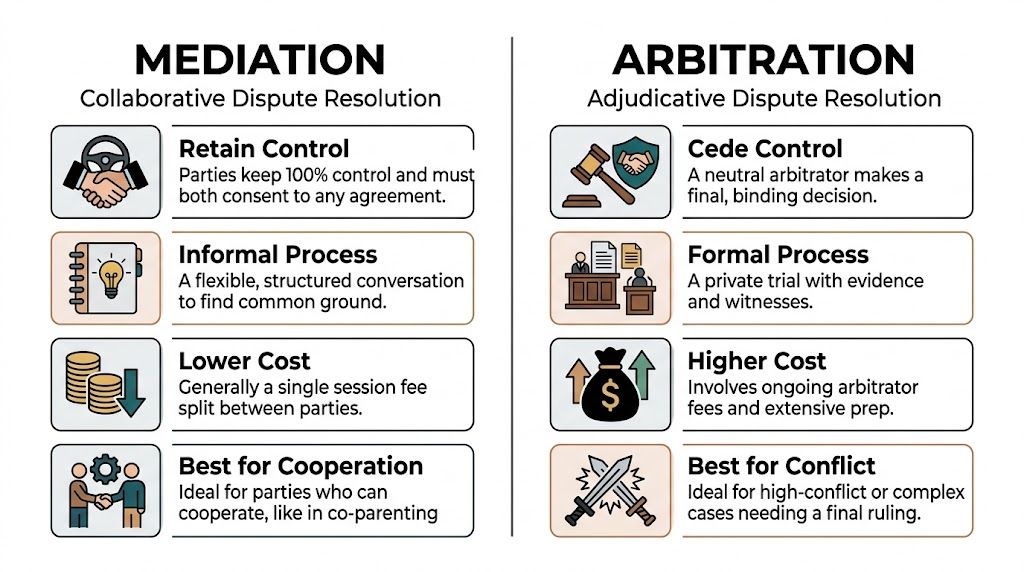
It comes down to a balance of control versus finality and cost. This is why we often find that mediation is the best starting point for parties in cities like Johns Creek, Milton, and Suwanee.
The most significant financial advantage of mediation is its predictability. You know the cost upfront, removing the uncertainty of escalating legal fees common in prolonged court battles.
An informed decision now can protect your assets and provide peace of mind. Speaking with an experienced attorney is the critical first step.
Why Choose Miles Hansford? Strategic Counsel for Your Cumming and Alpharetta Case
Deciding between mediation and arbitration is a strategic choice that defines the direction of your case in Cumming, Alpharetta, and across North Georgia. The best path depends entirely on your goals. At Miles Hansford, our mission is to provide the calm, strategic, and protective counsel you need to align your legal strategy with your personal objectives.
Our firm is deeply experienced in both arenas. As skilled negotiators, we thrive in the collaborative setting of mediation, consistently securing favorable settlements that protect our clients' parental rights and financial futures in Forsyth and Fulton counties.
However, we are also proven litigators, always prepared to advocate fiercely for you when a cooperative approach is not possible. Whether your case requires the finality of arbitration or must proceed to trial in the Forsyth County Superior Court, our attorneys have the trial experience to protect your rights.
Protecting your parental rights, securing your financial future, and preserving your business interests requires more than just knowing the law. It demands a deep understanding of local court procedures, judicial preferences, and the legal community in Alpharetta and Cumming.
Our deep roots in the North Georgia legal community give our clients a distinct advantage. We practice in the courts of Forsyth and Fulton Counties daily, from Cumming to Johns Creek and Roswell. We know how to connect your goals—whether it’s protecting assets or securing parenting time—to the most effective legal path.
Your family’s future is too important to leave to chance. Schedule a consultation with our team so we can build a strategy to protect what matters most to you.
Frequently Asked Questions About Mediation and Arbitration in Cumming, GA
Q: Is mediation required for a divorce in Cumming, GA?
A: In most cases, yes. The Forsyth County Superior Court, which serves Cumming, requires parties in contested divorces to attempt mediation before a final trial can be held. This is an opportunity to resolve issues like child custody and property division on your own terms, outside of a public courtroom.
Q: What if we can't reach an agreement in mediation?
A: If you cannot agree on all issues, your case simply proceeds through the Forsyth or Fulton County court system. All discussions in mediation are confidential under Georgia law and cannot be used against you in court. Your attorney will then prepare for the next steps, such as a temporary hearing or trial on the remaining unresolved issues.
Q: Can I be forced into arbitration for my Alpharetta family law case?
A: Yes, if you previously signed a contract with a binding arbitration clause. Prenuptial or postnuptial agreements, for example, often contain these clauses. An experienced attorney must review all your agreements to determine if you are required to resolve your dispute through arbitration rather than in a Fulton County courtroom.
Q: Is an arbitrator's decision final in Georgia?
A: Yes, an arbitrator's decision, known as an "award," is legally binding and carries the same weight as a court order. Grounds for appeal under Georgia law are extremely narrow, usually limited to proven fraud or arbitrator misconduct. You cannot appeal simply because you are unhappy with the outcome. This finality provides closure.
Q: What is the difference between mediation and arbitration in terms of cost in Forsyth County?
A: Mediation is almost always less expensive than arbitration. In mediation, you typically split the mediator's hourly fee for a session that may last a few hours to a full day. Arbitration is a private trial, so you pay the arbitrator's fee (which is much higher), along with costs for evidence presentation and potentially expert witnesses, making it significantly more expensive.