


When a legal dispute escalates, it can sometimes lead to situations where terms like bail and bond become relevant, even in contexts that touch upon civil matters. While people often use these terms interchangeably, they represent two very different financial paths, with significant consequences for families and their assets.
The fundamental distinction is this: bail is the full cash amount you pay directly to the a court, while a bond is a deal you make with a bail bondsman, paying them a non-refundable fee to post the full bail amount on your behalf. Simply put, one path allows for your money to be returned, and the other does not.
The Core Difference Between Paying Bail and Securing a Bond
When a court sets a bail amount in counties like Fulton or Forsyth, it serves as a financial guarantee that a person will appear for all required court dates. Meeting this financial requirement is often the first hurdle families face, and understanding your options is critical to protecting your financial stability.
The infographic below lays out the two primary routes for securing a release before a court date.
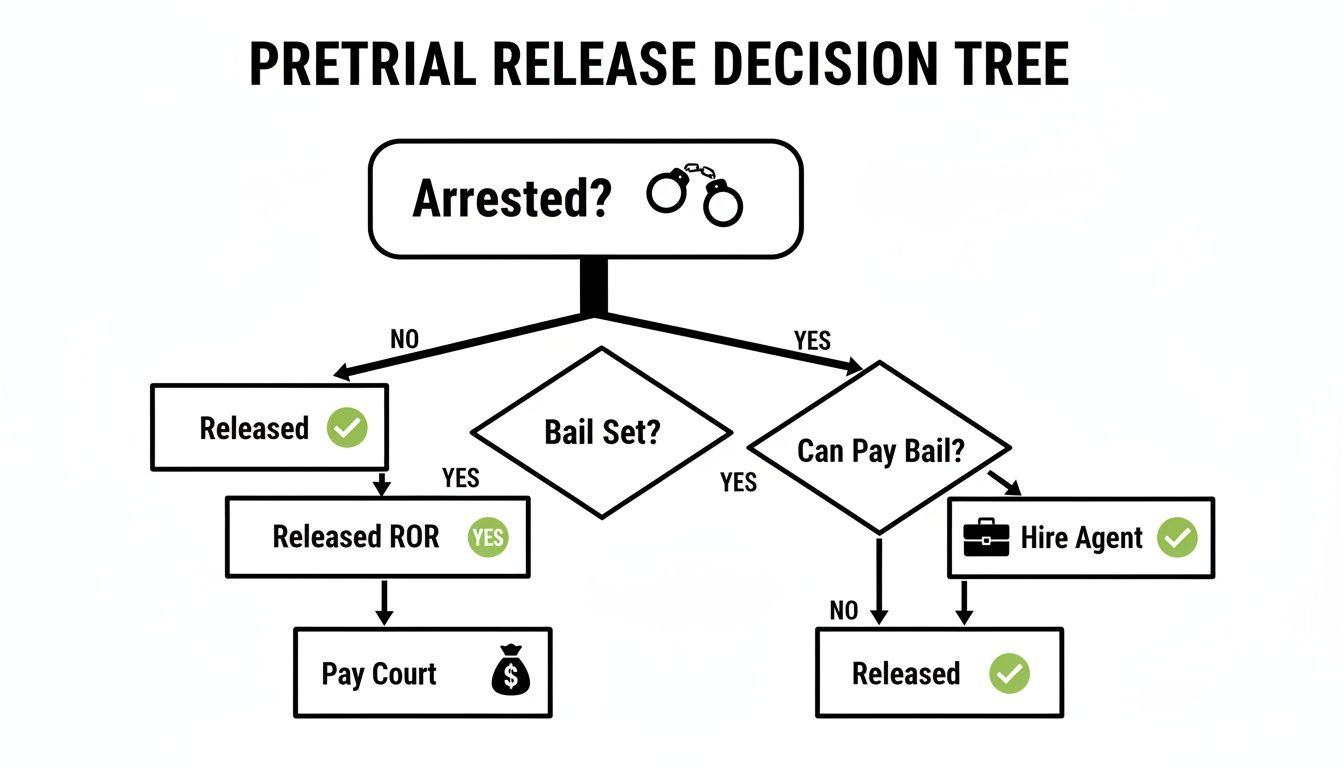
As you can see, paying the court directly opens the door for a refund. Working with a bail bond agent, however, means the money you pay is gone for good.
Cash Bail Explained
Paying cash bail is the most direct method. You, a family member, or a friend takes the full bail amount—in cash or certified funds—to the court. If the judge sets bail at $10,000, you have to hand over the entire $10,000.
- It's Refundable: This is the biggest upside. Once the individual makes all required court appearances and the case concludes, the court returns the full bail amount to whoever paid it.
- It's a Huge Financial Hurdle: The major downside is coming up with that much cash on short notice. For many families in communities like Cumming or Alpharetta, this is simply not possible.
The court is essentially holding your money as collateral to ensure the person shows up. Follow the rules, and you get your money back, usually minus a small administrative fee.
Surety Bond Explained
A surety bond, which is what most people mean when they say "bail bond," brings a third party into the equation: a bail bondsman. Instead of paying the court, you pay the bondsman a fee, which is a percentage of the total bail. In Georgia, this fee is typically between 10% and 15%.
- Lower Upfront Cost: For that same $10,000 bail, you'd pay a bondsman a non-refundable fee of $1,000 to $1,500. The bondsman then gives the court a "surety bond," which guarantees the full $10,000 if the defendant fails to appear.
- The Fee is Non-Refundable: This is the bondsman's payment for taking on the financial risk. You will never see that money again, even if the case is resolved the very next day.
- Collateral is Often Required: The bondsman will likely require collateral—like a car title or a deed to a house—to secure the bond. If the person misses a court date, the bondsman can take that collateral to cover their loss.
The use of commercial bail bonds has surged over the past few decades. Back in the early 1990s, only 24% of felony defendants were released on financial conditions. By 2009, that number had jumped to 61%, an increase driven almost entirely by the private bail bond industry.
While this article focuses on financial mechanisms related to court appearances, it's worth noting that the legal world has other types of bonds. You can learn more about the fundamental distinctions between criminal bail bonds and immigration bonds to see how different legal processes operate.
Understanding these financial options is a critical first step. For a deeper dive into the civil and family law challenges that can arise from these situations, you can learn more about our firm's approach.
Bail vs Bond At a Glance
To make the choice clearer, here is a straightforward comparison of the two options.
| Feature | Cash Bail | Bail Bond (Surey Bond) |
|---|---|---|
| Payment Recipient | Directly to the court | A private bail bondsman |
| Amount Paid | 100% of the set bail amount | A non-refundable fee (typically 10-15%) |
| Refundability | Yes, the full amount is returned after the case | No, the fee is the bondsman's payment and is never returned |
| Financial Risk | You risk losing the entire bail amount if the person flees | The bondsman assumes the primary financial risk with the court |
| Collateral | Not required (the cash itself serves as collateral) | Often required by the bondsman to secure the bond |
Ultimately, the decision comes down to your financial situation and your confidence in the person's commitment to seeing their case through.
How the Georgia Bail Bond Process Works
Securing a bail bond in Georgia can feel like a frantic race against the clock, but knowing the steps involved can bring some much needed order. At its core, the process is a formal agreement between you, a bail bondsman, and the court system. For families in Alpharetta, Cumming, and across North Georgia, having a clear picture of what's coming can make a world of difference.

It all starts the moment you reach out to a bail bond company. This is your first real move after a judge has set a bail amount. The bondsman then steps in to act as a surety, essentially promising the court that the person involved will show up for all their required hearings.
Initial Contact and Application
When you first talk to a bail bondsman, they are going to need some specific information to get the ball rolling. This first conversation is key to figuring out if they can help and what the terms of the agreement will be.
You should have these details ready:
- The person’s full legal name and date of birth.
- The facility where they are being held, whether it's in Forsyth County or another facility in Fulton County.
- The total bail amount that the court has set.
- The specific reasons for their detention.
From there, the bondsman will walk you through their application. This isn't just paperwork—it’s a legally binding contract. Make sure you understand every single thing you're signing, as it will clearly state your financial duties, the non-refundable fee (or premium), and any collateral you might need to put up.
Understanding Collateral Requirements
For larger bond amounts, a bondsman is almost definitely going to ask for collateral to secure the deal. Collateral is a valuable asset you pledge to the bonding company, which protects them from losing money if the person decides not to show up for court.
Common examples of collateral include:
- Real estate deeds
- Vehicle titles
- Jewelry or other valuable personal property
- Cash or stocks
If the person skips a court date, the bondsman has the legal right to seize and sell your collateral to pay the full bail amount to the court. This is the biggest risk for the person co-signing the bond.
Putting up collateral is a serious decision with potentially huge financial downsides. It really highlights how important it is to be absolutely sure the person will meet all their legal obligations. These situations can get even trickier when an event happens unexpectedly.
The Role of the Co-Signer or Indemnitor
The person who signs the bail bond contract and pays the fee or provides collateral is known as the co-signer or indemnitor. This person takes on the full legal and financial responsibility for making sure the person follows the rules of their release.
By signing that contract, you're making a promise to the bail bondsman that you will:
- Make sure the person is present at every single court hearing.
- Pay the full bail amount if the person doesn't show up.
- Help the bondsman find the person if they disappear.
The weight of this responsibility can't be overstated. A bondsman will not hesitate to use aggressive collection actions against a co-signer, including lawsuits and property liens, to get their money back. You, the co-signer, are carrying the entire financial risk. Before you commit, you need to have complete trust in the person's reliability and their understanding of what's at stake.
Taking a Look at Different Types of Pretrial Release Bonds
While a surety bond is a common route, it's not the only one. Georgia courts actually have several different pathways for release, and the one a judge chooses often hinges on the specifics of the case, the person's connection to the community, and whether they are seen as a flight risk. Getting a handle on all the options is crucial when you're trying to make a smart decision under pressure.
For families in places like Roswell, Canton, or Johns Creek, knowing these differences can be a game changer. The goal is always to secure a release in the most financially responsible way, and that doesn't always mean paying a non-refundable fee to a bondsman.
Cash Bonds: The Direct Approach
We've touched on this, but it's simple: a cash bond means paying the full bail amount directly to the court. If the judge sets bail at $20,000, you have to hand over $20,000. It’s a huge financial hurdle for most people, but it’s the only way to get a full refund (minus some minor court fees) once the case is over and all court dates have been met.
This option really only works for people who have that kind of liquid cash ready to go. The money itself is the collateral, so you don't need a third party agent or their permanent fees.
Property Bonds: Using Real Estate as Collateral
A property bond is exactly what it sounds like—it lets a person or their family use real estate as collateral instead of cash. To do this in Georgia, the property has to be in-state and have enough equity to cover the entire bail. So, if bail is set at $50,000, the property needs at least $50,000 in clear equity, with no other liens against it.
Be warned, the process for a property bond is much slower and more involved than getting a cash or surety bond. It usually requires:
- A recent property appraisal to prove what it's worth.
- A title search to confirm ownership and check for any outstanding liens.
- Filing a lien with the court, which legally ties the property to the bail.
If the person skips a court date, the court can start foreclosure proceedings to seize and sell the property to get the forfeited bail money.
Recognizance Bonds: A Release Based on Trust
A recognizance bond, often called an "Own Recognizance" or "OR" bond, is the best case scenario. With this type of release, no money changes hands. Instead, the person is released based on their written promise to show up for all their court dates.
A judge will typically only grant an OR bond when they feel confident the person isn't a flight risk or a danger to others. Things like strong local ties in Forsyth or Fulton County, a steady job, and a clean history are all big factors.
This kind of release actually gets back to the original idea behind the bail system. Bail wasn't always about money. English common law started bail as a surety's promise, and early American practices often guaranteed release through affordable, non-monetary pledges. The system we see today, with commercial bondsmen at the center, came along much later. You can read more about the history from legal researchers at Advancing Pretrial Justice.
Understanding these different ways to secure a release is incredibly important. While getting out of custody is the immediate goal, the choice you make can have serious financial and legal consequences down the road.
The True Financial Impact of Your Choice
Choosing between paying cash bail and using a bail bond service isn't just about getting someone out of custody—it's a decision with long-term financial consequences that can ripple through your family’s finances for years. To really understand the cost, you have to look beyond the initial 10% fee and see the entire financial picture.

A surety bond fee isn’t a down payment. It is a permanent, non-refundable charge for a service, and that single distinction is the most critical financial factor you need to consider.
Cash Bail: The Refundable Option
When you pay the full bail amount directly to the court, that money essentially works like a security deposit. Let's say bail is set at $20,000. You provide the court with that amount, and as long as every court appearance is made, the full $20,000 is returned to you when the case is over, no matter the outcome.
While coming up with that kind of cash can be incredibly difficult, the key takeaway is that your money eventually comes back to you. Those funds can then be used for other critical needs down the road.
Bail Bonds: The Non-Refundable Cost
Using a bail bondsman creates a completely different financial reality. For that same $20,000 bail, you would pay a bondsman a fee of roughly $2,000 to $3,000. This payment is their profit for taking on the risk, and it is never returned.
This non-refundable premium is a sunk cost. Even if the case is dismissed the very next day, the bondsman keeps the entire fee. Over time, these payments drain significant wealth from families, with no chance of recovery.
This system can easily create a cycle of debt, especially when you factor in hidden administrative fees or other charges that some bonding companies might add on. For many, these escalating fees and fines become a trap that's hard to escape.
Long-Term Financial Strain and Opportunity Cost
The real impact of using a bond service is what economists call an "opportunity cost." The thousands of dollars you pay to a bondsman is money that is permanently gone from your household. That $2,000 to $3,000 is money that could have been used for:
- Securing legal representation: That same money could go toward retaining an attorney for another legal matter.
- Household expenses: It could cover mortgage payments, utility bills, or childcare costs for families in communities like East Cobb or Kennesaw.
- Business needs: For a business owner, that capital could be crucial for making payroll or buying inventory.
This financial strain can be felt disproportionately. Research consistently shows that disparities often plague the bail system, with some communities facing much higher financial hurdles. The non-refundable nature of bond fees only makes this worse by extracting wealth without offering any long term benefit.
In fact, data from The Bail Project, which has helped over 27,000 people, shows that clients appeared for over 91% of court dates without any financial incentive. This really calls into question the necessity of cash bail in the first place. You can find more insights on these findings from the Indiana University Public Policy Institute.
Ultimately, while a bail bond offers a path to immediate release for a lower upfront cost, it comes at a permanent financial loss. In contrast, paying cash bail, though more difficult at first, preserves your family’s capital for the challenges that lie ahead. The choice you make right at the beginning can significantly impact your ability to handle other legal and financial obligations.
When Legal Issues Extend Beyond Pretrial Release
Securing a release from custody is a critical first step, but it’s often just the beginning of a much larger legal battle. The circumstances leading to a detention can create significant ripple effects, extending far beyond the immediate situation and into the sensitive areas of civil and family law. For families and business owners in North Georgia, what starts as a bail or bond issue can quickly complicate every facet of their lives.
This is where legal needs can unexpectedly broaden. The immense stress and financial burden of a detention can easily ignite disputes that demand skilled civil representation—which is the core focus of our team at Miles Hansford Law Firm.
How These Situations Complicate Civil and Family Law Matters
A pending legal issue, long before it is ever resolved, can introduce tremendous complexity into existing legal situations or create entirely new ones. The fallout is rarely contained, often requiring a strategic legal approach that addresses multiple fronts at once.
Consider these common scenarios for residents in Fulton County and Forsyth County:
- Divorce Proceedings: A pending legal matter can dramatically shift the dynamics of a divorce. It may be used as leverage in negotiations over alimony or the division of assets, with one spouse arguing the other's conduct has jeopardized marital property or warrants a different spousal support arrangement.
- Child Custody Disputes: When a parent is detained, it immediately raises questions about their fitness and stability. The other parent might file for an emergency modification to a parenting plan, arguing the situation creates an unsafe environment for the children. This is especially true in areas like Alpharetta and Johns Creek, where family courts prioritize the child's best interests above all else.
- Business and Contractual Issues: For business owners, a legal entanglement can trigger clauses in partnership agreements or commercial contracts. It can damage a professional reputation, put business licenses at risk, and lead to serious disputes with partners, investors, or clients who may try to dissolve agreements.
These aren't criminal issues; they are civil litigation matters that demand a completely different set of legal skills and experience.
Protecting Your Interests in Civil Court
The civil challenges that follow a detention require an attorney focused on protecting your family, your assets, and your business. A civil litigator’s job is to manage this fallout, making sure your rights are defended in family court or during a contract dispute.
The core issue moves from securing release to securing your future. This means protecting your parental rights, safeguarding your share of marital property, or defending your business against opportunistic legal challenges.
Navigating these interconnected legal problems requires careful planning. To better understand the complexities of bail laws and related legal matters, an AI legal case researcher can provide helpful context. However, that information is no substitute for guidance from an experienced attorney who understands the local courts in communities like Cumming and Canton.
At Miles Hansford Law Firm, we focus exclusively on these civil and family law matters. Our role is to build a firewall around the other parts of your life, providing the steady, experienced representation needed to handle contract disputes, custody modifications, and complex divorce proceedings with clarity and confidence. We address the aftermath, ensuring one difficult situation doesn't unravel everything you've worked so hard to build.
A Few Common Questions About Bail and Bonds in Georgia
When you're trying to navigate the release process, a lot of questions pop up. It's a stressful time, and the terminology and procedures can feel overwhelming. We hear these same questions from families all over Fulton and Forsyth Counties, so let's clear up a few of the most common ones.
If I Pay a Bail Bond Fee, Do I Get That Money Back?
No, you don't. That fee, which is usually between 10% and 15% of the total bail, is the bondsman's non-refundable payment for their service. Think of it as their earned income for fronting the full bail amount to the court and taking on all the financial risk if the person doesn't show up.
Once you pay that premium, it's gone for good, no matter what happens with the case. Even if the case is resolved the very next day, the bondsman keeps their fee. This is the biggest difference between using a bondsman and posting the full cash bail yourself directly with the court—that cash bail is refundable once the case is over.
What Happens If the Person Out on Bond Misses a Court Date?
Things get serious, fast. The moment a person misses a required court date, the judge will issue a bench warrant for their arrest. At the same time, the bail bond is forfeited.
This means the bondsman is now on the hook for paying the entire bail amount to the court. They will immediately take action to get that money back from whoever co-signed the bond. That usually means seizing and selling any collateral that was put up, like a car title or a deed to a house. They can also file a civil lawsuit against the co-signer to collect the full debt.
Can I Use Property Instead of Cash to Post Bail in Georgia?
Yes, Georgia law does allow you to use a property bond. This is where you use real estate you own in the state as collateral directly with the court. Be warned, though—it's often a much more complicated and slow-moving process than a standard cash or surety bond.
For a property to qualify, it needs to have enough equity to cover the full bail amount, and it can't have other liens on it. You'll typically have to get a certified property appraisal, run a thorough title search to prove ownership and equity, and then file a legal lien against the property with the court.
And if the person misses a court date? The court can start foreclosure proceedings on your property to get the forfeited bail money.
How Long Does It Take to Get Released After Posting a Bond?
This one really varies. A good bail bondsman can get their paperwork done quickly, but the actual release time comes down to the detention facility's own internal process and how backed up they are.
Once the bond is officially filed and accepted by the staff at a facility in Alpharetta or Cumming, the administrative "out-processing" procedure starts. This can take just a few hours, but in some cases, it might stretch to more than 12 hours. It's important to have realistic expectations and know that once the paperwork is in, the timeline is pretty much out of the bondsman's hands.
While securing a release is the first hurdle, the legal journey is often just beginning. At Miles Hansford Law Firm, we focus on helping clients navigate the complex civil and family law issues that can spin out of these situations. We're here to protect your assets, your family, and your future with experienced legal guidance. If you're facing a related civil dispute in North Georgia, contact us to understand your options.