


If you're reading this after an arrest in Alpharetta, Cumming, or nearby, you're probably dealing with two problems at once. First, the charge sounds worse than you expected. Second, nobody has explained what the State must prove.
A burglary of conveyance charge is serious, but a charge isn't a conviction. In North Georgia, the early decisions matter. What you say to police, whether you try to "explain" the situation yourself, and how quickly a lawyer gets the reports, video, and witness statements can shape the entire case.
Facing a Burglary of Conveyance Charge in Alpharetta
In Alpharetta, this charge often starts with a familiar set of facts. A parked car. A door handle pulled. A center console opened. Property missing, or allegedly about to be taken. By the time police make an arrest, the accusation may already be framed as a felony instead of a simple trespass or theft case.
Under Georgia law, prosecutors generally focus on three core points in a burglary of conveyance case:
- Unlawful entry
- Into a vehicle or other covered conveyance
- With intent to commit a theft or felony inside
That third part is where many people get blindsided. Burglary law in the United States developed around unlawful entry plus criminal intent, and many jurisdictions don't require force. The legal question often isn't whether a window was smashed. It's whether the entry was unauthorized and whether the State claims there was criminal intent at that moment, as reflected in this burglary offense definition background.
What prosecutors try to turn into a burglary case
In practice, the State may argue burglary even if the vehicle was not secured. They may also rely on circumstantial evidence, such as:
- Stealthy behavior like checking multiple parked cars in an apartment lot
- Selective movement toward the glove box, console, or visible bags
- Possession issues involving items the owner says were taken from inside
- Flight from the scene after contact with police or a witness
Practical rule: A vehicle case becomes much more dangerous when the prosecutor can argue not just presence, but purpose.
That is why people in Alpharetta and Cumming shouldn't assume, "Nothing was damaged, so this can't be burglary." That's often wrong.
Property owners and managers also respond to these risks with stronger surveillance and parking-area controls. For context on how these incidents are approached from a prevention standpoint, Palo Alto parking lot security offers a useful example of the kinds of access-control and observation measures that can create evidence in vehicle-related cases.
If you're already charged, the immediate job is to test the State's proof, not to panic. A felony allegation can often be attacked at the level of intent, identification, entry, and admissibility of evidence. For a broader look at the stakes after an arrest, see guidance on facing a felony charge.
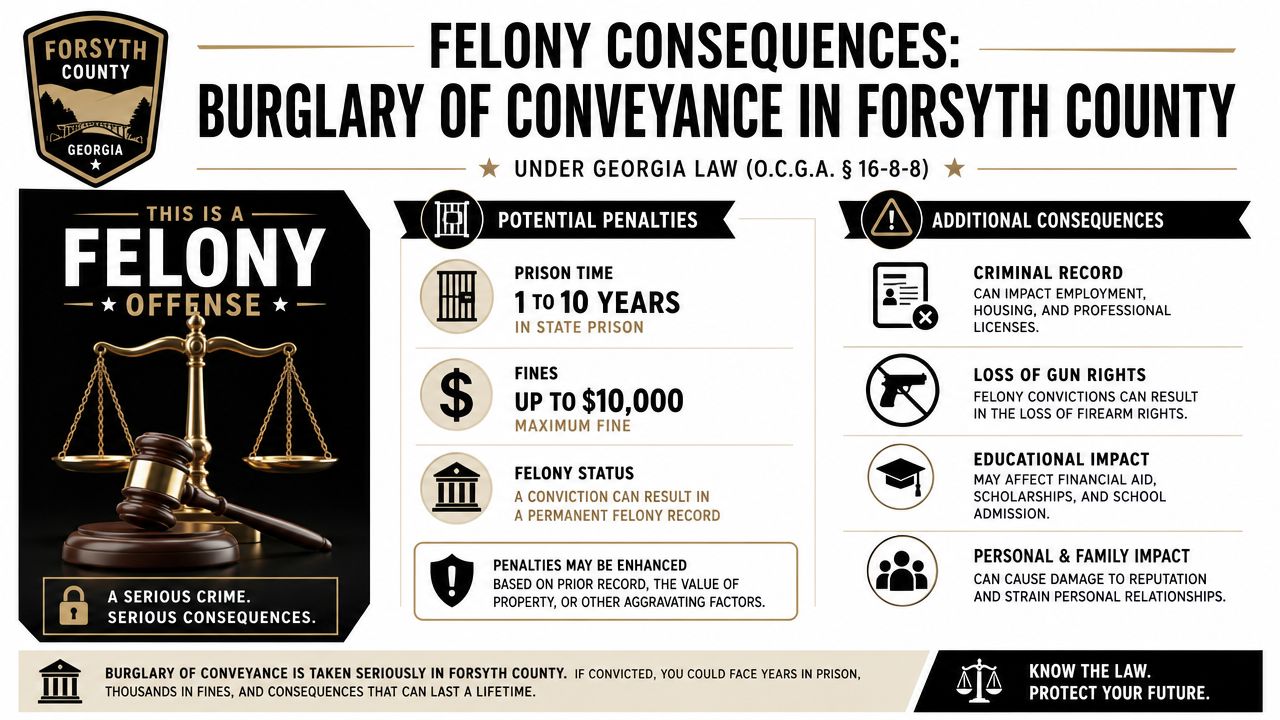
Penalties and Why This Charge Is Serious in Forsyth County
A burglary of conveyance charge isn't a paperwork problem. In Georgia, it's treated as a felony-level accusation, and that changes how prosecutors, judges, employers, and background-screening systems view the case from the start.
In Forsyth County, that matters. A person charged in Cumming, Milton, Johns Creek, or nearby may be walking into court thinking this is "just a car break-in" allegation. The court will not treat it that way if the State believes it can prove unlawful entry with criminal intent.
Why prosecutors take these cases seriously in Forsyth County
Burglary remains a major property-crime category nationwide. The FBI reported 847,522 burglaries in 2022, equal to 269.8 per 100,000 people, according to The Zebra's summary of burglary statistics. Even with long-term declines, that volume keeps burglary high on the priority list for law enforcement and district attorneys.
That national context matters locally. In Forsyth County, prosecutors often look at vehicle-entry cases through a community-safety lens. If the accusation involves apartment complexes, neighborhood mail areas, school parking lots, or repeated entries into multiple vehicles, the State may press hard to frame the case as a felony burglary rather than a lesser property offense.
What raises the practical risk
Some facts tend to make the State less flexible in negotiations:
- Multiple vehicles involved in the same incident
- Neighborhood or apartment-lot patterns that suggest planned conduct
- Statements to police that can be read as admissions
- Video evidence showing targeted movement inside the vehicle
- Prior record concerns that make a prosecutor less interested in informal resolution
The biggest mistake I see early is assuming the absence of force makes the case minor. It doesn't.
In North Georgia, judges and prosecutors know that vehicle-related property crimes create strong reactions from victims. People feel personally violated when someone enters their car, even without damage. That emotional reality affects charging, bond arguments, and plea discussions.
If you want a Georgia-specific overview of how burglary is classified, review Georgia burglary as a felony-level offense. The important point is simple. The sooner the defense starts shaping the facts, the more options usually remain.
The Legal Process After an Arrest in North Georgia
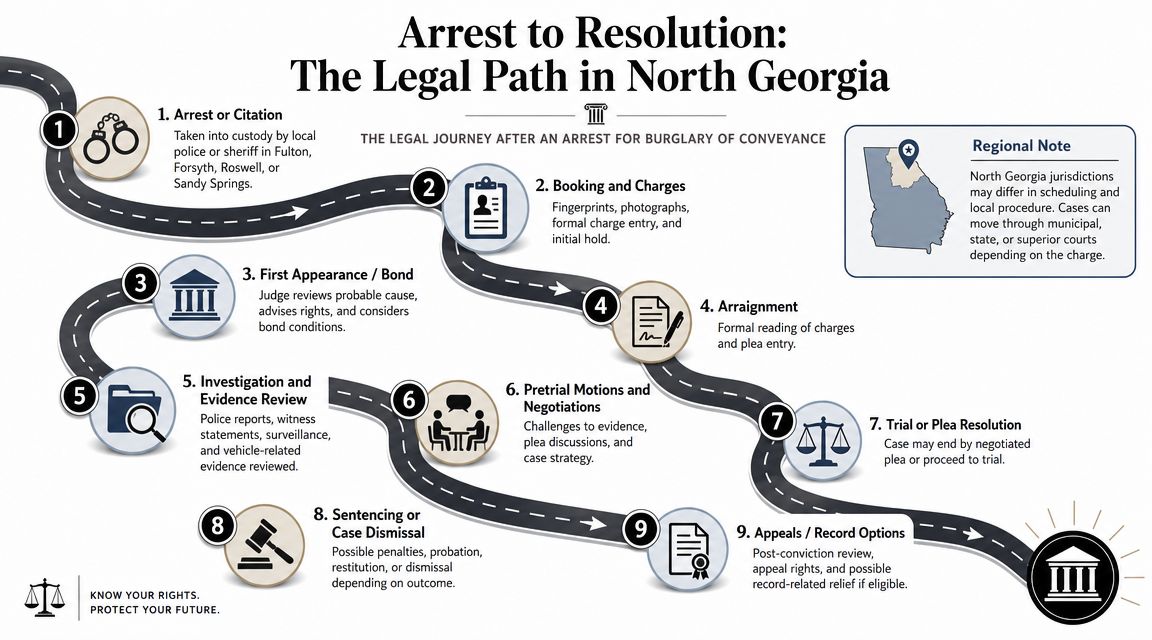
After an arrest in Alpharetta, Roswell, Sandy Springs, Cumming, or elsewhere in North Georgia, individuals often feel like the case is moving faster than they can understand it. It helps to slow the process down into stages. A burglary of conveyance case doesn't go from arrest straight to trial.
The first days after arrest
The case usually begins with arrest, booking, and a first appearance. Bond conditions may be set early, and those conditions can affect where you live, who you contact, and how you handle work while the case is pending.
In some situations, people hurt themselves immediately by calling the alleged victim, returning to the scene, or posting online about what happened. Those choices can create new evidence for the State.
A more disciplined first step is to stop discussing facts with anyone except your lawyer. If you need a general checklist for those first decisions after an arrest, steps to take after a drug arrest in Alpharetta is about a different charge, but the early defense logic is similar. Preserve your rights, say less, and get the case file moving.
How the case develops in Forsyth County and Fulton County
In Superior Court, including Forsyth County Superior Court and Fulton County Superior Court, the prosecution has to move beyond the arrest narrative and commit to formal charges. That may happen through accusation or indictment, depending on the case and procedural posture.
Then comes discovery. Here, the defense gets access to key materials such as:
- Body-camera footage
- Dash-camera video
- Incident reports
- Witness statements
- Surveillance from homes, stores, or apartment complexes
- Property logs and recovered-item documentation
A careful defense review often finds gaps between what officers assumed at the scene and what the evidence shows.
The part most people underestimate
Plea discussions don't begin only after everything is over. They often begin while the defense is still testing the prosecution's case. The best negotiation position usually comes from preparation, not from asking for mercy.
Case reality: A strong pretrial posture can change how a prosecutor values intent, identity, and proof problems.
Some cases resolve through reduction, dismissal, or a negotiated outcome. Others need motions practice, evidentiary challenges, or trial preparation. The key point for anyone in North Fulton, Alpharetta, or Cumming is that there are several opportunities to improve the case before a jury ever hears it.
Common Defenses to Burglary of Conveyance Charges in Cumming
In Cumming, Canton, Dawsonville, and the surrounding courts, effective defense work usually starts with one question. Can the State really prove every element of burglary beyond a reasonable doubt, or is it stretching a theft or suspicious-circumstances case into something bigger?
That's where many burglary of conveyance cases become defensible.

The defense that often matters most
The hardest element for prosecutors is often intent. It's one thing to show that someone touched a car door or reached into a vehicle. It's another to prove that the person did so with the intent to commit a theft or felony inside.
That distinction matters because force isn't always the deciding issue in conveyance burglary analysis. In Florida, for example, courts have recognized that a whole-body entry isn't required and that a hand or arm can satisfy the entry element, while intent may be inferred from circumstances even if nothing was stolen, as discussed in this analysis of burglary of a conveyance and entry. The lesson is practical, not jurisdictional. If prosecutors can argue intentional entry into the protected space of the vehicle, the fight often shifts to why the person entered and what they meant to do.
Common defense themes in Cumming courts
Some defenses are factual. Others are legal. Good cases often involve both.
| Defense issue | Why it matters |
|---|---|
| Lack of intent | Opening a door or being near a vehicle isn't automatically burglary |
| Consent | Permission to enter defeats the unlawful-entry theory |
| Mistaken identity | Video, lighting, and witness reliability often break down under scrutiny |
| No true entry | Attempted access is not always the same as completed entry |
| Bad search or seizure | Suppression issues can weaken the State's evidence dramatically |
What works and what doesn't
The most effective defense approach usually includes:
- Early video review so the State's assumptions can be tested against actual movement
- Timeline reconstruction using receipts, phone records, or witness location evidence when available
- Statement control by preventing damaging follow-up admissions
- Ownership and permission analysis in cases involving shared vehicles, family disputes, or borrowed cars
What usually doesn't work is hoping the case will "clear itself up." It usually won't. Prosecutors read silence differently than proof problems, and courts won't fix weak defense presentation on their own.
If the case turns on circumstantial intent, the defense has to give the judge or prosecutor a competing explanation grounded in facts, not wishful thinking.
What to Expect in Fulton and Forsyth County Courts
The law on paper is only part of the problem. The other part is how courts in Fulton County and Forsyth County handle these cases. That's where local practice matters.
A burglary of conveyance accusation in Fulton County Superior Court may move differently than one in Forsyth County Superior Court. The personalities change. Screening decisions change. Negotiation posture changes. Even the practical value assigned to a first-offender background or weak victim cooperation can vary from one courtroom to another.
What local prosecutors tend to focus on
In both counties, prosecutors often look closely at a short list of aggravating facts before deciding how hard to push:
- Repeat conduct allegations
- Entries into several vehicles in one area
- Recovered property tied to multiple victims
- Body-camera statements that suggest knowledge or intent
- Any fact pattern that makes the case feel organized rather than impulsive
If those details are present, the State may treat the matter as a higher-risk property case. If they are absent, there may be more room for reduction or structured negotiation.
Why local court knowledge matters
Available legal commentary on burglary of conveyance repeatedly points to the same practical truth. The risk assessment depends on local prosecutorial priorities, plea practices, and whether a first-time offender may be considered for diversion or another negotiated path, as noted in this discussion of courtroom handling and diversion considerations.
That doesn't mean diversion is automatic. It isn't. It means courtroom reality often turns on local judgment calls, not just statutory language.
In North Fulton courts and Forsyth County courts, a lawyer who knows how certain judges handle bond compliance, restitution discussions, suppression issues, and plea calendars can often make better strategic choices early. That includes deciding when to push, when to wait, and when to package mitigation in a way the prosecutor will consider.
Collateral Consequences and Protecting Your Record in Georgia
A felony burglary accusation can affect far more than jail exposure. Even before a case ends, people start feeling the pressure in ordinary parts of life. Job applications become harder. Professional licensing questions come up. Housing screenings get uncomfortable. Family members start asking questions you don't want to answer yet.
A conviction creates the most serious long-term damage, but the public record of an arrest can cause problems on its own. That's why the defense goal shouldn't be limited to "getting through court." It should include protecting your record and your future options in Georgia.
Where people feel the damage first
The practical fallout usually shows up in a few places:
- Employment checks for office jobs, healthcare roles, school systems, and licensed professions
- Housing applications where landlords screen for felony accusations
- Educational opportunities involving background reviews
- Firearms rights and other civil consequences that can be affected by felony convictions
For some clients in Alpharetta and Cumming, the reputational side becomes urgent, especially if online arrest information spreads quickly. Public-facing professionals sometimes need to think not only about the courthouse record but also about digital visibility. For that reason, guidance on digital privacy for public figures can be a helpful supplemental resource when arrest information is circulating online.
Record protection in Georgia
Georgia law may allow record restriction in some situations, depending on how the case ends and the exact charge history. Eligibility is very fact-specific. An arrest doesn't automatically disappear, and not every case qualifies.
That is why early strategy matters. A negotiated outcome that looks acceptable in the moment may create unnecessary record problems later.
A smart defense asks two questions at the same time. How do we resolve the charge, and what will this outcome look like on a background check years from now?
In some cases, the better result is dismissal. In others, the critical move is avoiding a disposition that permanently closes off better record options. People often focus only on the next court date. The more important focus is the long trail that may follow the case unless it is handled carefully.
Why Choose Miles Hansford for Your Defense in Alpharetta
A burglary of conveyance case in Alpharetta needs more than a generic criminal-defense response. It requires a lawyer who can read the file the way a prosecutor reads it, isolate the facts that inflate the charge, and press on the weak points before the case hardens.
That local, strategic approach matters in Alpharetta, Cumming, Forsyth County, Fulton County, Johns Creek, Milton, Roswell, Sandy Springs, Suwanee, and Dawsonville because court culture isn't identical across North Georgia. A defense that fits one courtroom may be poorly timed in another.
What a strong defense should deliver
A useful defense plan should do three things well:
- Challenge the charge theory by testing intent, entry, identification, and admissibility
- Manage local court reality through informed negotiation and pretrial positioning
- Protect the long-term record so today's decision doesn't create years of avoidable damage
Miles Hansford Law Firm handles criminal defense matters in North Georgia and includes attorneys with former prosecutor experience, which can be relevant in evaluating how the State is likely to build and present a felony property case.
If you've been charged in Alpharetta, Cumming, or a nearby court, the next move should be deliberate. Schedule a consultation, get the facts reviewed early, and avoid making the case harder than it already is.
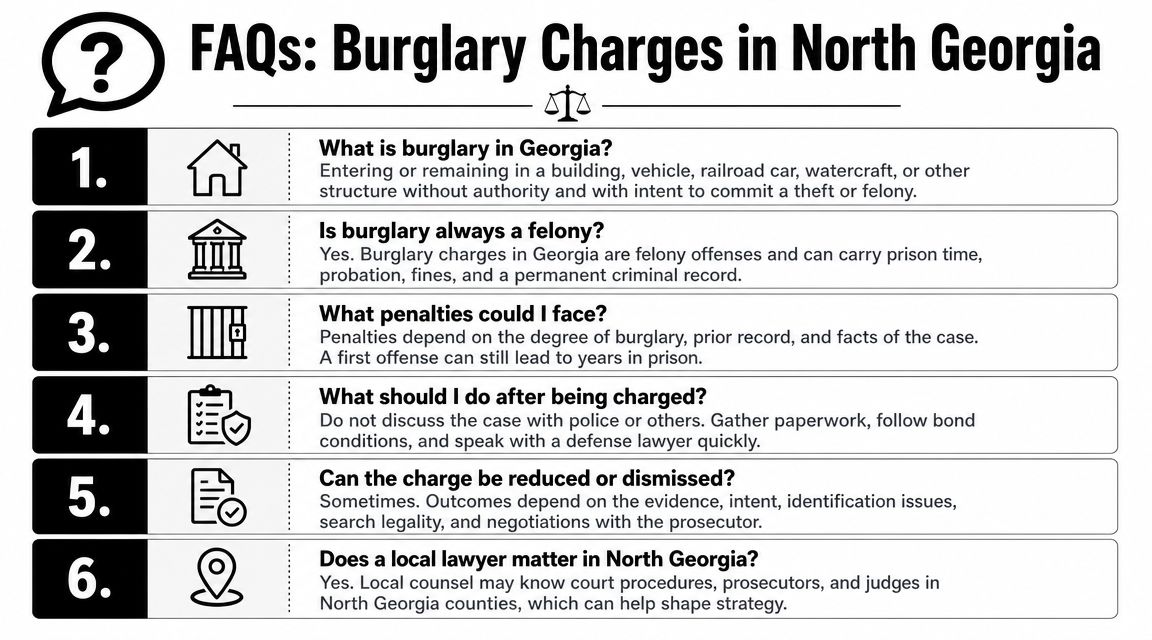
Frequently Asked Questions About Burglary Charges in North Georgia
Arrested clients in Alpharetta and Cumming usually have the same immediate concern. What happens now, and how bad is this really? Direct answers help.
Common questions from Alpharetta and Cumming clients
Q: Can entering a car that is not locked still lead to a burglary charge in Georgia?
A: Yes, it can. The absence of forced entry doesn't automatically prevent a burglary-style theory. The main fight is usually over unauthorized entry and intent. In Forsyth County and Fulton County, prosecutors may still file a felony if they believe the facts support criminal purpose inside the vehicle.
Q: Is burglary of conveyance the same as stealing a car?
A: No. They are different allegations. Burglary of conveyance focuses on unlawful entry into the vehicle with intent to commit a theft or felony inside. Taking the entire vehicle raises a different set of charges. The exact facts in the police reports usually determine how the State frames it.
Q: Will my case stay in municipal court?
A: Usually not for final resolution if it's charged as a felony. Early appearances may happen in a lower court setting, but felony prosecution typically moves into Superior Court. In this region, that often means Forsyth County Superior Court or Fulton County Superior Court depending on where the arrest occurred.
Q: Should I talk to police if I think I can clear it up?
A: Usually no. Trying to explain it alone rarely improves one's case. Doing so often provides details the State later uses to argue intent. If police want a statement in Alpharetta, Roswell, or Cumming, speak with a defense lawyer first.
Q: Can a first-time offender avoid a conviction?
A: Sometimes, but it depends on the facts, the person's record, and the local prosecutor's approach. In Fulton County and Forsyth County, first-offender style outcomes, negotiated resolutions, or diversion-related possibilities may exist in some cases, but they are never automatic.
Q: What if I only reached into the vehicle for a moment?
A: Short duration doesn't end the issue. Prosecutors may still argue entry and criminal intent based on movement, location of the hand, and surrounding circumstances. That's why video review and witness testing are so important in these cases.
For readers trying to understand lawful versus unlawful vehicle access in non-criminal emergencies, emergency car entry methods provides practical context on legitimate access situations. In a criminal case, though, the legal question is permission and intent, not just whether entry was physically easy.
If you're facing a burglary of conveyance charge in Alpharetta, Cumming, Forsyth County, or Fulton County, take the next step before the case gets harder to defend. Speak with a lawyer, protect your record, and get clear advice about your options. To schedule a consultation with Miles Hansford Law Firm, call today. Protect your rights early.