


If you're trying to move a loved one from one county to another, or a funeral home has told you the body can't go anywhere yet, you're probably dealing with a burial transit permit. That's the document that lets the next step happen legally, and in North Georgia it's often the difference between a plan that moves and a plan that stalls.
In Cumming and Alpharetta, families usually aren't asking for legal theory. They want to know who gets the permit, what gets rejected, and what to do when the clock is already running. The answer is simple. Get the death certificate process moving, make sure the funeral director has the right facts, and do not assume the county will bend the rules because the family is grieving.
What a Burial Transit Permit Is
A burial transit permit is the legal document that authorizes the movement of human remains for final disposition. That means burial, cremation, or transport to the place where those steps will happen. It is not the death certificate, and it is not a piece of paperwork the funeral home can ignore because the family wants everything handled fast.
In Cumming, GA and Alpharetta, GA, the permit sits in the middle of the legal chain of custody. State rules treat it as the paper that ties together death registration, transport, and final disposition. That is why a funeral director cannot just treat it as a clerical extra. The permit is the release that lets the next lawful step happen.
Georgia families run into trouble when they assume the same label means the same process everywhere. Other states show how tightly this document can control timing and responsibility. A funeral director who first takes custody may have to secure the permit before final disposition, and some states treat it as a transportation control when remains cross jurisdictional lines. For a broader look at why probate and estate administration can overlap with death paperwork, see what probate is and why it occurs.
Why families should care about the permit
This is not busywork. It is the document that lets the funeral home lawfully move ahead. County and state systems use it to keep death registration, transport, and final disposition connected.
Practical rule: if the funeral director says the permit is pending, treat that as a real legal stop sign, not a scheduling delay.
The permit may show up under a different label in another office, such as a removal permit or disposition permit, but the function stays the same. For searches from Forsyth County or Fulton County, use the words burial transit permit and the city name together, because local offices care about what the document does, not what a family happens to call it.
Situations Requiring a Burial Transit Permit
The first mistake families make is assuming every transfer needs the same document. It does not. The permit question turns on how the remains move and whether the final disposition is burial or cremation.
County guidance from Erath County shows the practical rule. A burial transit permit is required when a body is transported over county lines by common carrier, but not when it is moved by other means. The same county says every cremation there still requires one because there is no crematory in the county (Erath County guidance). That is a useful reminder for families in Cumming, Alpharetta, Johns Creek, Milton, Suwanee, Roswell, Sandy Springs, Dawsonville, and Canton, local rules and logistics matter more than generic internet advice.
Situations that usually trigger the permit
Expect the permit to be required when the remains are:
- Crossing county lines by commercial transport, especially if a common carrier is involved.
- Leaving Georgia, where another jurisdiction's acceptance rules may apply.
- Being cremated, because cremation is a final disposition and the permit path usually has to be finished first.
- Being disinterred, since removal from a burial site creates a new transport issue.
- Stored for an extended period, where local rules may treat delayed disposition differently.
Maine's statute is a good comparison because it shows how broad these rules can become. Maine requires a burial-transit permit for almost every transport of a dead body, including transport by an authorized person, transport from a funeral director's establishment to another location, disinterment, and even transport or disposition of a body stored in a vault for more than eight months (Maine statute).
Families also need to think about estate authority if the next of kin is not the person signing every paper. A Georgia small estate affidavit can help in some probate situations, but it does not replace the funeral home's need for the right death and transport paperwork.
What usually does not need a permit
If the movement stays inside a funeral home's controlled process, the family may not be dealing with a separate transport permit yet. That said, do not guess. Ask the funeral director to say exactly when the permit becomes necessary, because the answer changes with the destination and the method of transport.
Georgia families should also know that the permit belongs before burial or cremation, not after. California county guidance makes that point plainly, saying a disposition permit must be issued before cremation, ground burial, entombment, transportation of human remains, or burial at sea can legally occur (San Diego County guidance).
How the Permit Process Works in Cumming and Alpharetta
In Cumming and Alpharetta, the permit usually moves through the funeral home first, then the local vital records office, then back to the funeral director. The family usually does not stand in a line and handle this alone unless the arrangement is unusual. The funeral director prepares and files the request, and the county releases the permit after the death certificate work is far enough along.
What happens first
The funeral director gathers the facts of death, completes the death certificate information, and sends the paperwork through the proper vital records channel. County and state offices treat this as a records process, not a private shortcut, which is why timing and completeness control the pace.
For North Fulton families, the key question is simple. Is the office open, is the death certificate complete enough, and has the permit been released?
Cumming and Alpharetta realities
If you are also dealing with Forsyth County divorce filings or other family court work, you already know county offices are strict about documents and timing. Burial permit work follows the same rule. The county side wants clean paperwork, proper signatures, and no guessing.
San Diego County rejects incomplete requests that contain corrections or white-out, and Erath County asks for a completed Facts of Death sheet before it issues the permit (San Diego County guidance, Erath County guidance). That is the practical lesson for Cumming parenting plan requirements too. The office does not care how hard the week has been. It cares whether the packet is complete.
Direct advice: if the funeral home says the permit is delayed, ask one question, “What exact item is missing, the death certificate, the facts-of-death information, or the county release?”
That same document-first approach shows up in probate too. If a family is still sorting out authority, a probate hearing overview is a better guide than guesswork, because the court wants the right paperwork in the right order.
Where the permit gets issued
Permit issuance usually runs through the vital records office, not the courtroom. Los Angeles County routes burial permits through its Vital Records Office during weekday business hours and lists a $12.00 burial permit fee (Los Angeles County guidance). I am using that only as a reference point, not as a Georgia fee schedule.
For Fulton County Superior Court and Forsyth County Superior Court families, the practical point is the same. The permit work sits with vital records and the funeral director, and the file has to be complete before anyone expects a release.
Documents, Fees, and Form Fields to Expect
Families usually run into trouble on the intake side, not the legal side. If the information on the death certificate package is sloppy or incomplete, the burial transit permit stalls with it. The funeral director should read the form back before submission, because a missed spelling, a wrong county, or an incomplete destination can send the packet back to the start.
The core documents
The funeral home should gather a clean set of documents and details before asking for the permit:
- Completed death certificate information, including the decedent's legal name and date of death.
- Funeral director and establishment details, because the permit follows the party handling the remains.
- Disposition information, meaning burial, cremation, or another lawful final disposition.
- Transport destination, if the body is leaving the county or the state.
- Any county-specific worksheets or facts-of-death forms, if the local office requires them.
County offices reject messy submissions. Corrections, blank fields, and missing facts slow the file down fast. Families dealing with Alpharetta family court procedures already know how one wrong line can hold everything up, and burial paperwork works the same way.
What the fee usually looks like
Georgia fee handling is county-specific, so there is no single statewide price to quote with confidence. The only fee reference in the record here is Los Angeles County's $12.00 burial permit fee, which appears in its own guidance and should be treated as a California reference point, not a Georgia rule (Los Angeles County guidance). In practice, Georgia families should ask the funeral director or the county vital records office what the local charge is before they assume how it will be collected.
What to check line by line
The form fields deserve a careful review before anyone submits the packet. Check the name spelling first, especially if the decedent used a suffix, a middle initial, or a maiden name. Then confirm the county of death and the county of final disposition, because a mismatch can slow the release. The transport method, destination address, cemetery, crematory, or receiving funeral home should all be accurate. Certifier information also needs to match the death certificate workflow, since county staff want proof that the file has moved through the right channel.
If the family is also handling estate matters, the same attention to detail applies. A probate hearing overview shows why courts care about order, authority, and clean paperwork. Burial transit permits follow that same logic.
Common Pitfalls That Delay or Derail the Permit
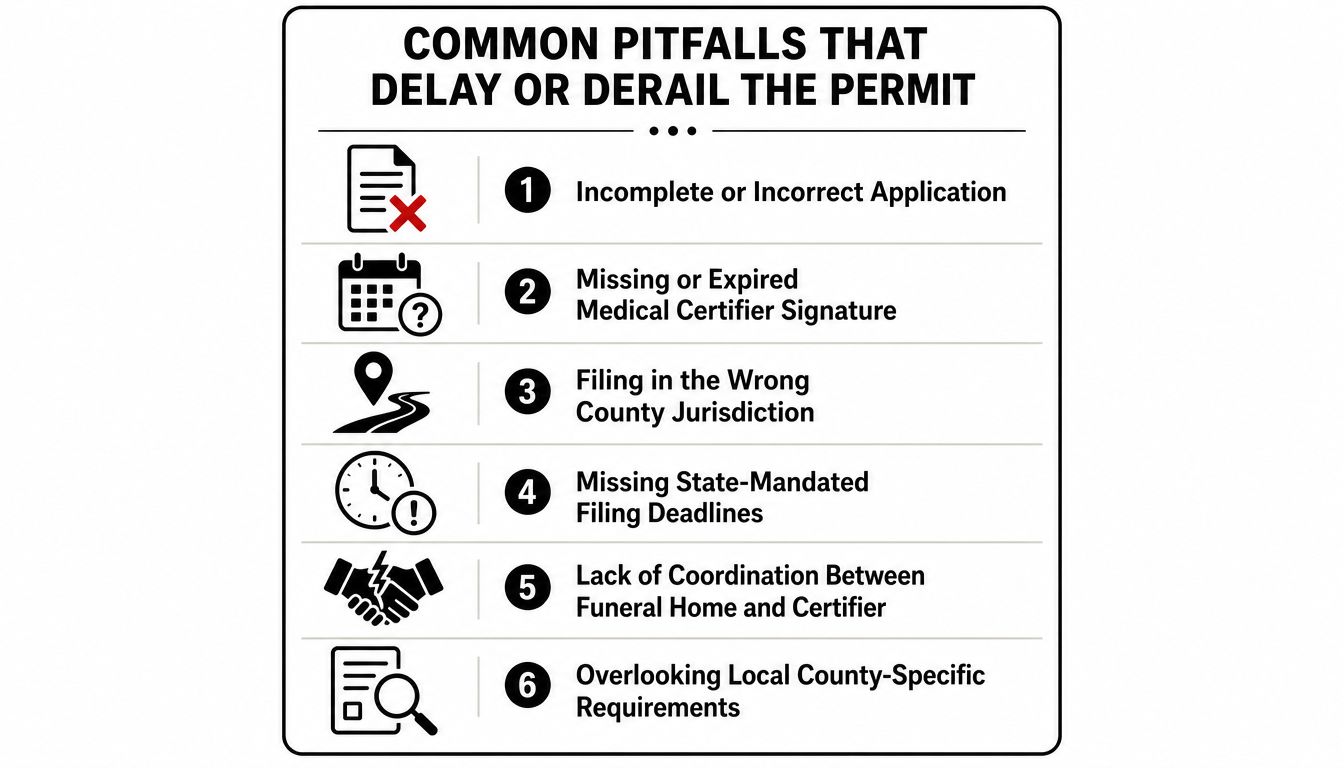
Most delays come from basic breakdowns, not dramatic fights. Grief makes simple tasks harder, and county offices do not adjust for that. They review the packet, check the records, and either issue the permit or send it back.
The problems that stop the file
The usual trouble starts with the paperwork itself. A wrong spelling, a missing destination, or a mismatch between the death certificate and the permit packet can stop the file cold. A missing or expired certifier signature does the same thing. So does sending the request to the wrong county office.
Families also get tripped up by timing. If the filing goes in late, or the funeral home and certifier are not working from the same facts, the county has no reason to push it through. Local requirements create another layer of delay, because a general guide does not always match what the actual office wants at the counter.
County guidance from other states shows the same pattern. San Diego County rejects incomplete requests, and Erath County requires a completed Facts of Death sheet before it will issue the permit (San Diego County guidance, Erath County guidance). Georgia counties work the same way in practice. They want the packet complete, readable, and filed with the right office.
After-hours is where families get trapped
Timing causes a second round of problems. If the death happens late Friday, on a holiday, or after the county office closes, the funeral home may have to wait for the next business day or follow a local after-hours procedure. Public-health offices control the process, and they do not issue a valid permit just because the family needs movement to happen quickly.
Keep the remains in place until the permit is confirmed. A shortcut here creates a bigger problem later.
What families should do immediately
- Verify the spelling of every name before the funeral home submits anything.
- Ask whether the death certificate is complete enough for permit issuance.
- Confirm the destination county or state before transport starts.
- Request the office's after-hours procedure if the death happened outside business hours.
- Keep one person in charge of communication, so the funeral home, certifier, and county are working from the same facts.
For families also dealing with property, custody, or post-death disputes, this paperwork bottleneck is a warning sign. If the transport problem is really about who has legal authority, a funeral director alone will not fix it.
Realistic Timeline and When an Attorney Adds Value
A clean case can move fast once the death certificate information is ready and the county office is open. A messy case can stall because one signature, one field, or one office step is missing. Families in Forsyth County and Fulton County feel that delay right away, because timing and procedure both matter at the counter.
What the timeline usually depends on
The practical sequence is medical certification, death registration, then permit issuance. In the broader death-registration process, the death certificate is generally filed within a short window after death, and the permit follows after the required information is complete. If cremation, out-of-state transport, or medical examiner review is involved, the timeline stretches.
That is the part families miss. The permit does not sit around because someone forgot to press a button. It waits because the legal record underneath it is not ready yet.
When legal counsel adds value
Legal counsel matters when the problem stops being administrative. That happens when:
- There is a dispute over who controls disposition.
- A family wants disinterment and the burial location has to be addressed legally.
- A will, trust, or family conflict affects authority.
- Transport crosses jurisdictional lines and there is a real legal question about consent or control.
- There is a broader probate conflict that affects who can act.
North Georgia probate and family disputes often spill into burial paperwork. If the issue over remains is tied to an estate fight, a lawyer can cut through the noise and focus the argument on authority, not emotion.
What an attorney won't do
A lawyer will not speed up a closed office or create a missing signature. Counsel can tell you whether the delay is just paperwork or a real dispute. That distinction keeps families from spending time on the wrong fix.
If you are already fighting about assets, custody, or who gets final say, the same discipline that applies in Georgia equitable division laws applies here too. Identify the controlling issue, then act on it. If your situation is tied to probate or authority questions, what happens at a probate hearing is worth reading.
Bottom line: if the funeral home can fix it with a corrected form, let them. If the problem is authority, conflict, or a court issue, bring in counsel right away.
Local Questions Families Ask About Burial Transit Permits
Q: Who usually gets the burial transit permit in Cumming or Alpharetta, GA?
A: Usually the funeral director gets it through the county's vital records process. In North Georgia, families should expect the funeral home to handle the filing and then wait for the permit to be issued before transport or final disposition.
Q: Can a family apply for the permit directly?
A: Sometimes, but not usually in a standard funeral-home arrangement. If you're handling things yourself, the local vital records office will tell you what they accept. The safer move is to ask whether the office wants the funeral director, the family, or both involved.
Q: What happens if someone dies on a weekend in Forsyth County or Fulton County?
A: The permit may have to wait until the office opens unless there's an emergency process. After-hours timing is a common bottleneck, so call the funeral home first and ask what the county accepts outside weekday business hours.
Q: Is the burial transit permit the same as a death certificate?
A: No. The death certificate records the death. The permit authorizes transport and final disposition. Families need both pieces handled correctly, especially when cremation or cross-county movement is involved.
Q: When does a lawyer need to step in?
A: When the issue is a legal dispute, not paperwork. If people are arguing over control of remains, disinterment, or authority under an estate plan, get counsel involved quickly instead of waiting on the funeral home to solve it.
Q: What should I ask the funeral director right now?
A: Ask whether the death certificate information is complete, whether the permit has been submitted, and whether any county-specific form is missing. Those three questions usually reveal the primary delay quickly.
A CTA for Miles Hansford Law Firm. If your family is dealing with a burial transit permit issue alongside a divorce, custody dispute, probate problem, or another Georgia family law conflict, contact Miles Hansford Law Firm in Alpharetta today and speak with a family law attorney who handles North Georgia cases with calm, direct guidance.