


Meta Title: Can Police Search Your Car in Alpharetta, GA?
Meta Description: Can police search your car without consent in Alpharetta, GA? Learn Georgia rules, Forsyth and Fulton court issues, and what to do next.
Suggested URL Slug: /alpharetta-ga-can-police-search-your-car-without-consent
Internal Link Suggestions:
- Is a warrantless police search lawful?
- Georgia's implied consent law and refusing a chemical test
- Defending against illegal search and seizure in Alpharetta
Schema Recommendations:
- Attorney
- LegalService
- FAQPage
You were stopped on GA-400, in downtown Alpharetta, or on a road that cuts through Roswell, Johns Creek, or Milton. The officer asks a question that changes the tone of the stop immediately: “Do you mind if I take a look in your car?” Most drivers feel pressure in that moment. They want to stay respectful, avoid making things worse, and get home.
That's exactly why this issue matters. If you're wondering can police search your car without consent, the short answer is yes, sometimes. But not whenever they want, and not because refusing makes you look suspicious.
Georgia drivers have real protections. The challenge is that those protections sit next to several technical exceptions that officers rely on every day in Alpharetta, Cumming, Forsyth County, Fulton County, and across North Georgia. Knowing the difference between a lawful search and an overreach can affect whether evidence comes in, whether charges hold up, and whether a case can be challenged in court.
Your Fundamental Right to Privacy During a Georgia Traffic Stop
The starting point is simple. The Fourth Amendment protects people from unreasonable searches and seizures. The default rule is that police generally need legal authority before searching private property, and that principle applies in Georgia traffic stops just as it does anywhere else.
A car isn't treated exactly like a house. That's where drivers get caught off guard. Once you're on the road in Alpharetta or heading through Cumming toward Forsyth County, the law gives officers more room to act than is commonly expected.
What your refusal still does for you in Georgia
Even with those exceptions, your rights don't disappear. In Georgia, your explicit refusal to consent to a vehicle search cannot be used by police to establish probable cause, which means a simple “no” blocks a consent-based search. You can also revoke consent by stating, “Officer, I am revoking my consent to search,” according to this Georgia vehicle search discussion.
That matters in real roadside encounters. Drivers often think they have to pick between politeness and protecting themselves. You don't. You can be calm, respectful, and clear at the same time.
Practical rule: If an officer asks for permission, answer with a direct sentence. “I do not consent to a search.”
Why the vehicle setting changes the analysis
Cars move. Officers stop them in public. Courts treat that mobility as one reason vehicle searches work differently from searches of homes or offices. So the legal question during a stop in North Fulton or Forsyth County usually isn't just whether you agreed. It's whether the officer had some other legal basis to search.
That's why general “know your rights” advice often falls short. A useful guide has to account for what happens during a Georgia stop, including requests for consent, claims of odor, plain-view allegations, arrest-based searches, and impound situations.
For a plain-English overview of Georgia traffic laws that often come up during roadside encounters, Georgia DUI Schools' driving law resources can help drivers understand the broader rules officers enforce. It won't replace legal advice for a pending case, but it gives helpful context.
What drivers in Alpharetta and North Georgia should remember first
Before you worry about exceptions, remember the baseline:
- Your privacy is the default: Police still need a lawful reason to search.
- Consent is optional: You don't have to say yes.
- Refusal is not probable cause: In Georgia, saying no does not create probable cause.
- Revocation matters: If you previously agreed, you can revoke that consent clearly.
That baseline gives you something important during a stressful stop. It gives you footing.
The Major Exceptions Permitting a Warrantless Search in Alpharetta
Most roadside searches in Alpharetta don't turn on dramatic courtroom moments. They turn on a few technical doctrines that officers and prosecutors know well. If you understand those doctrines, you can usually identify what justification an officer is claiming.
Probable cause under the automobile exception
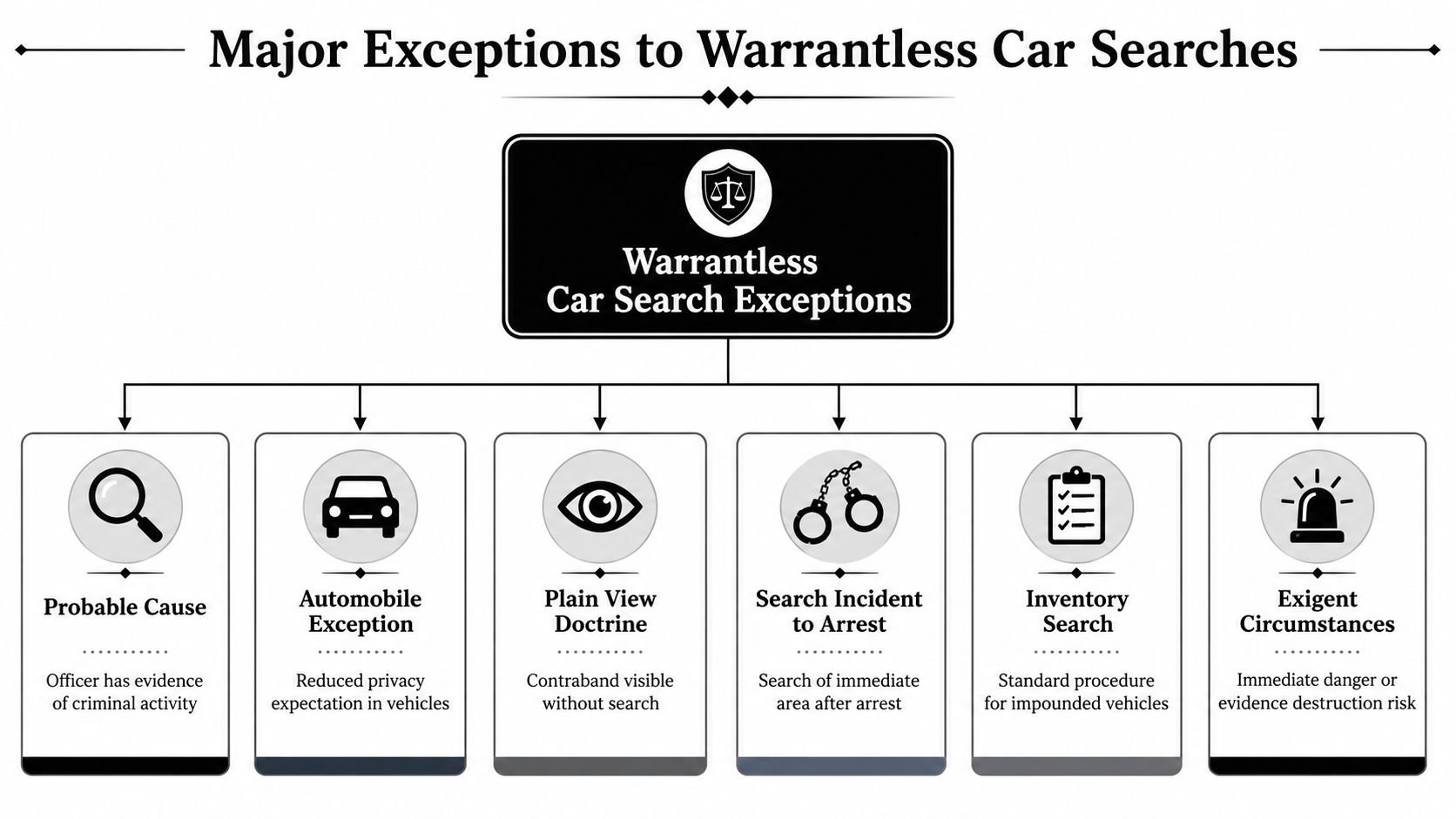
The biggest exception is the automobile exception. Under that rule, police may search a vehicle without consent or a warrant if they have probable cause and the vehicle is readily mobile, with no separate exigency requirement once those conditions exist, as explained in the Federal Law Enforcement Training Centers vehicle search guidance.
Probable cause is not just a hunch. It requires facts that would cause a reasonably cautious person to believe an offense is being committed. In practice, officers often point to things like visible contraband, the odor of marijuana or alcohol, or witness information.
A stop in Alpharetta might start as a lane violation and become something else if an officer says he saw drug packaging on the console. A stop near Milton or Johns Creek may shift quickly if the officer claims to smell marijuana from the car. Once probable cause exists, the scope of the search can expand into areas where the suspected evidence could reasonably be hidden.
For a broader look at how courts analyze these issues, this discussion of whether a warrantless police search is lawful is a useful companion.
Plain view in everyday traffic stop situations
The plain view doctrine is usually straightforward. If illegal items are clearly visible through the window or in an open part of the vehicle, officers don't need your consent to rely on what they can already see.
That's different from an officer digging through bags or opening compartments without a lawful basis. The line matters. A firearm sitting openly where possession is illegal under the circumstances is one thing. A closed container in the back seat is another.
What an officer can lawfully see from outside the car and what an officer can lawfully open are not always the same question.
In Fulton County and Forsyth County cases, this distinction often becomes a fact fight. Body camera footage, dash footage, lighting conditions, and where the officer was standing all matter.
Search incident to arrest
Another exception appears after an arrest. A search incident to arrest has limits tied to officer safety and evidence preservation. In real terms, if a lawful custodial arrest happens during the stop, officers may claim authority to search areas connected to that arrest.
Drivers often assume the original stop and the later search are one continuous event. They aren't. A defense challenge may focus on whether the arrest itself was lawful, whether the driver was secured, and whether the area searched was actually within the permitted scope.
Inventory searches after towing or impound
An inventory search usually comes up after a vehicle is impounded. Officers do not need probable cause for a proper inventory search, but they do need to be following a lawful impound and standard departmental procedure.
This is one of the most misused justifications in practice. If the tow itself wasn't proper, or if officers treated the inventory as an evidence hunt rather than a routine cataloging process, the search can become vulnerable to challenge. That issue comes up in North Georgia more often than people think, especially after arrests on suspended license, DUI, or warrant-related stops.
Consent and the overlooked problem of coercion
Consent sounds simple. It rarely is. The law requires consent to be freely and voluntarily given. If an officer pressures, intimidates, or implies consequences in a way that overbears a driver's choice, the “yes” may not be valid.
One overlooked point is that courts sometimes focus less on the word spoken and more on the circumstances around it. According to the verified analysis provided, 38% of disputed vehicle search cases involved courts finding consent was not voluntary due to implicit pressure, and a 2024 analysis found voluntariness was the primary factor in 29% of cases where searches were ultimately deemed unlawful, as discussed in this analysis of coerced consent and voluntariness.
That issue matters on roads throughout Alpharetta, Sandy Springs, Suwanee, and Canton because many drivers agree only after hearing some version of “If you've got nothing to hide, this won't take long.” That doesn't automatically make the consent invalid, but it creates a question worth examining closely.
A quick way to identify what basis the officer may be claiming
| Claimed basis | What it usually looks like |
|---|---|
| Probable cause | Officer cites odor, visible contraband, or specific facts suggesting evidence in the car |
| Plain view | Item is visible without opening containers or compartments |
| Search incident to arrest | Search follows a lawful arrest connected to safety or evidence concerns |
| Inventory search | Vehicle is being impounded and officers say they are documenting contents |
| Consent | Officer asks for permission and driver agrees, verbally or by conduct |
If you can identify which category the officer is relying on, you're already in a better position to protect the case later.
What to Do If Police in Forsyth County Ask to Search Your Car
When an officer in Forsyth County asks to search your car, your job is not to debate search-and-seizure law on the roadside. Your job is to protect yourself, avoid escalation, and preserve the record.
What to say and what not to say
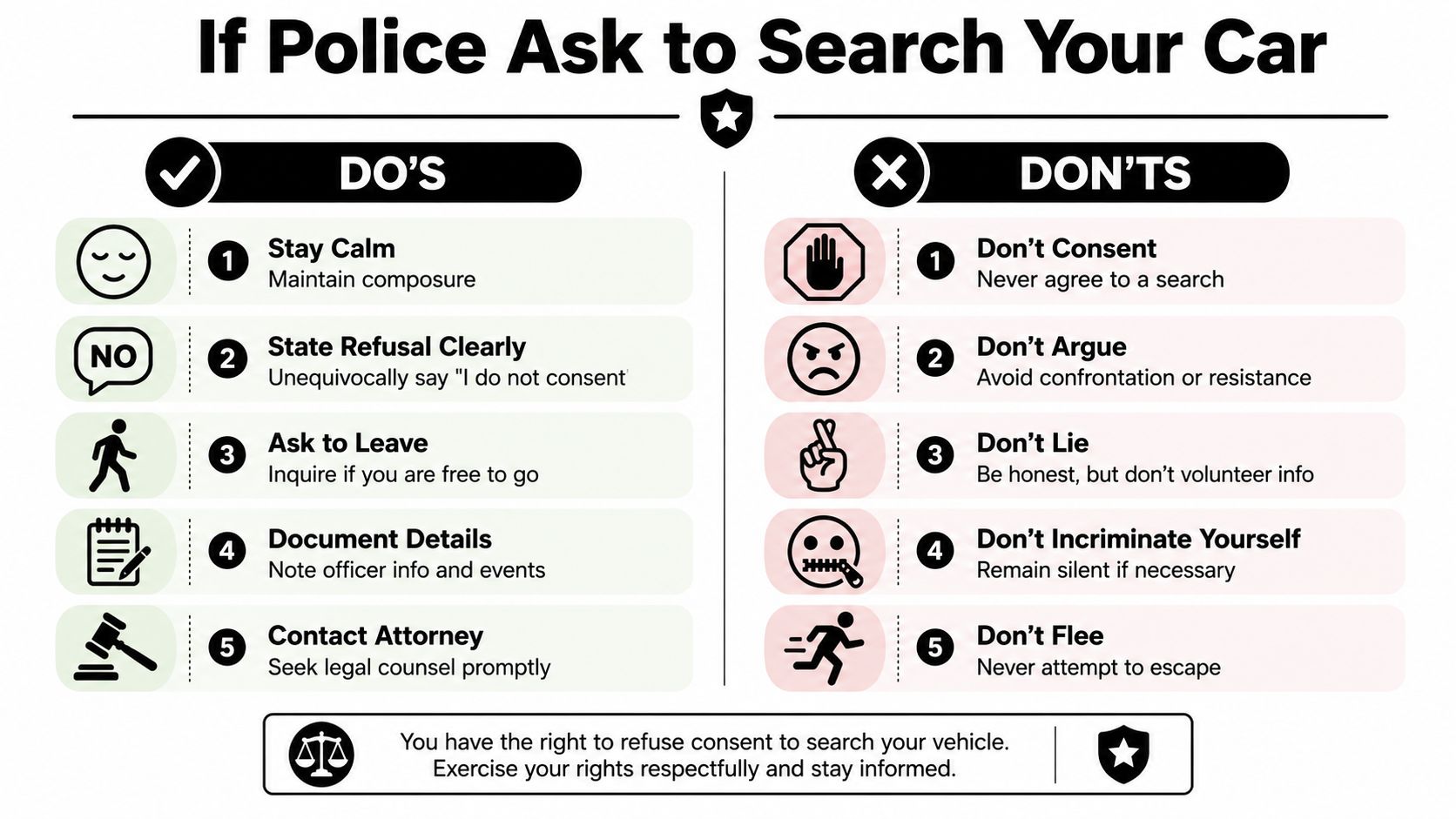
The clearest statement is still the best one. Drivers retain the constitutional right to refuse consent by stating “I do not consent to any searches,” and that refusal cannot be used as evidence of guilt, although officers may still search if they have another recognized legal basis, as explained in this guide on refusing consent to a car search.
Use plain language. Don't volunteer explanations. Don't try to sound clever.
A useful script looks like this:
- Provide documents when required: License, registration, and insurance are different from consent to search.
- State your refusal clearly: “Officer, I do not consent to any searches.”
- Ask a simple status question: “Am I free to leave?”
- If the officer searches anyway, don't resist: Save the argument for court.
The practical difference between silence and resistance
Silence can protect you. Resistance can create new problems. Even if you believe the search is unlawful, roadside confrontation rarely helps.
If the officer proceeds after your refusal, let it happen physically and challenge it legally later.
That distinction is critical in Cumming, Roswell, or anywhere else in North Georgia. Judges care about whether the stop escalated because of the officer's conduct or the driver's conduct. Staying composed protects both your safety and your legal position.
What to notice during the stop
If a search happens, details matter later. Try to remember:
- The officer's words: Did he ask or order? Did he imply consequences for refusing?
- The sequence: Was consent requested before or after talk of a dog, towing, or arrest?
- The setting: Were multiple officers crowding the car? Were lights and commands overwhelming?
- Your response: Did you say no clearly? Did you ever revoke prior consent?
Those facts become important if the case moves into suppression litigation in Forsyth County Superior Court or nearby courts.
For readers comparing warrant rules in other states, this overview of legal help with Florida warrants is a useful contrast on how warrant requirements can differ by jurisdiction. Georgia cases still rise or fall on Georgia law and federal constitutional standards.
One issue drivers confuse with search consent
Many Georgia drivers mix up search consent with implied consent in DUI cases. They are not the same. Agreeing or refusing to take a state-administered chemical test raises a different set of consequences than agreeing to let an officer search your vehicle. If that issue is part of your stop, this explanation of Georgia's implied consent law and chemical test refusal helps sort out the difference.
The roadside goal is simple. Be polite. Be firm. Be brief.
Challenging an Illegal Vehicle Search in North Fulton Courts
An unlawful search doesn't just feel unfair. It creates a legal issue that can change the entire case. If officers searched without meeting the required legal threshold, the defense can ask the court to exclude what they found.

The remedy is suppression
Failure to meet the technical requirements for a warrantless search makes the search unconstitutional and may trigger evidence suppression under Mapp v. Ohio, as outlined in this discussion of unlawful vehicle searches and suppression.
That usually happens through a motion to suppress. In practical terms, the defense asks the judge to rule that police obtained evidence in violation of the Fourth Amendment, so the prosecution cannot use it.
What that looks like in local courts
In Fulton County Superior Court, Forsyth County Superior Court, and other North Fulton courts, suppression issues often turn on specifics:
- Body camera timing: When did the officer decide to search?
- Officer testimony: Does the explanation stay consistent?
- Stop duration: Was the original traffic mission completed before the search expanded?
- Scope of search: Did the officer go beyond the area justified by the claimed exception?
A motion to suppress is not a technicality in the dismissive sense people use outside court. It is often the most direct way to test whether the officer's story fits the law.
Strong suppression arguments often come from small details. A single inconsistency in timing, wording, or scope can matter.
Why this can affect charges sharply
If the main evidence came from the car, suppression can weaken the prosecution's case fast. That may lead to reduced charges, a stronger negotiating position, or dismissal, depending on what remains.
This is especially important in drug, weapon, and DUI-related cases filed in Alpharetta and the surrounding North Atlanta area. Search issues often overlap with possession allegations, admissions made during the stop, and later inventory claims after impound. For a closer look at how these challenges work in local criminal litigation, this resource on defending against illegal search and seizure in Alpharetta provides additional context.
Why Choose Miles Hansford to Defend Your Rights in Alpharetta
If your case started with a vehicle search in Alpharetta, Cumming, Forsyth County, or Fulton County, local court knowledge matters. Search cases aren't won by broad constitutional slogans. They're won by close review of body camera footage, officer reports, timing, roadway context, arrest grounds, and the exact exception the State claims applies.
The attorneys at Miles Hansford serve clients across the North Atlanta area and bring courtroom experience in the jurisdictions where these cases are fought. That includes the local practices and expectations that shape criminal cases in Fulton County and Forsyth County. The firm's team includes former prosecutors, which gives clients insight into how the other side evaluates roadside evidence, officer credibility, and suppression risk.
Georgia law also has state-specific rules that can affect search analysis. For example, after a lawful custodial arrest in Georgia, officers may search the arrestee's entire vehicle, including areas within immediate reach such as the glove box or under seats, under Georgia Code § 17-5-1. Knowing when that statute applies, and when officers are stretching beyond it, is part of protecting the defense.
Clients also benefit from responsiveness. In criminal cases, people often need answers quickly after an arrest, impound, or court notice. Law firms looking to improve rapid client communication often study systems like an effective answering service for law firms, because speed and clarity matter when someone's rights and record are on the line.
If police searched your car and charges followed, early review matters. The sooner counsel examines the stop, the better the chance of preserving arguments and identifying weaknesses in the State's position.
Frequently Asked Questions About Vehicle Searches in Georgia
Q: Can police search my car in Alpharetta if I simply say no?
A: Sometimes, yes. Your refusal blocks a consent-based search, but it doesn't stop a search supported by another recognized exception, such as probable cause or a lawful arrest-related basis. In Alpharetta cases, the key question is what legal justification the officer claims after your refusal.
Q: Can an officer use my nervousness as probable cause in Georgia?
A: Nervousness by itself is not enough. Georgia-focused guidance on vehicle searches emphasizes that probable cause requires concrete facts, not just anxious behavior, prior arrests, or being stopped in a so-called high-crime area. That issue often comes up in Forsyth County and North Fulton suppression hearings.
Q: If I already said yes, can I change my mind?
A: Yes. Georgia guidance recognizes that a driver can revoke consent by clearly telling the officer that consent is withdrawn. In a real stop, that should be stated plainly and respectfully. If the officer continues anyway, the case may turn on whether another legal basis existed.
Q: Can police search closed containers in my vehicle?
A: They may be able to if the claimed legal basis supports that scope. Under the automobile exception, the search can extend to areas where the suspected contraband or evidence could reasonably be concealed. Whether a specific container was lawfully opened is often heavily litigated in court.
Q: What happens if the search was illegal?
A: The defense can seek suppression of the evidence. In Fulton County Superior Court or Forsyth County Superior Court, that usually means filing a motion to suppress and challenging the officer's legal basis, timing, and scope. If key evidence is excluded, the prosecution's case may weaken substantially.
Q: Does a lawful arrest always mean the whole car can be searched?
A: Not automatically in every circumstance, but a lawful custodial arrest can create significant search authority under Georgia law. The facts still matter, including where the arrest occurred, whether the arrest was valid, and what part of the vehicle officers searched.
Q: Should I argue with the officer if I know the search is wrong?
A: No. The better move is to refuse consent clearly, avoid physical resistance, and let your lawyer challenge the search later. Judges in North Georgia courts care about the actual sequence of events, and roadside arguments rarely improve the record.
If you were stopped in Alpharetta, Cumming, Johns Creek, Milton, Roswell, Sandy Springs, Suwanee, Dawsonville, or elsewhere in North Georgia, don't guess about whether the search was legal. Miles Hansford Law Firm helps clients challenge unlawful vehicle searches, assess suppression issues, and defend criminal charges in Fulton County, Forsyth County, and surrounding courts. Schedule a consultation, speak with an attorney, and get a clear assessment of what happened before you make any decision about your case.