


Yes, in nearly all cases, you can revoke a Power of Attorney (POA) in Georgia. Think of it like giving a trusted friend the keys to your house. As the homeowner, you always have the right to ask for your keys back, so long as you are making that decision with a clear mind.
Your Right to Reclaim Control
A Power of Attorney is a serious legal document. It gives someone else—your “agent”—the power to make decisions for you. While it's a critical tool for life planning, situations can change. A trusted relationship might break down, your chosen agent may no longer be the right person for the job, or you might simply feel you don't need the help anymore.
The ability to revoke that power is your fundamental safeguard. This isn't just a legal detail; it's the core principle that protects your independence and ensures you are never permanently stuck with a decision you made in the past. For anyone in North Georgia, from Cumming to Alpharetta, understanding this right is the first step to taking back full control over your personal and financial affairs.
Why Your Authority as Principal is Absolute
The entire concept of a POA rests on your power to cancel it. Without that ability, you would be signing away your rights indefinitely, leaving you vulnerable. The right to revoke ensures your agent works for you, not the other way around.
When you decide to revoke a POA, acting quickly and correctly is crucial. It stops a former agent from making unauthorized transactions, signing contracts in your name, or accessing your private information. Georgia law strongly supports a principal's right to end this arrangement, but how you do it matters immensely. A formal, state-specific notice is required to ensure your decision is legally binding. Informal attempts are often ignored or legally challenged.
A Power of Attorney is a tool of convenience and trust, not a permanent surrender of your rights. Revocation is your built-in mechanism to correct course when that trust is broken or the convenience is no longer needed.
Before diving into revocation, it’s helpful to understand the basics of what a power of attorney is and how you can use it. In Georgia, exercising your right to revoke requires clear, written documentation and proper notification to everyone involved. This ensures your decision is legally binding and respected by all parties.
The table below breaks down the key factors to consider when you decide it's time to revoke a POA.
Key Factors in Revoking a Power of Attorney
| Element | Description | Why It Matters |
|---|---|---|
| Your Mental Capacity | You must be of "sound mind" to revoke a POA. | This confirms you are making the decision voluntarily and understand its consequences, preventing challenges to the revocation. |
| Written Revocation | The revocation must be a formal, written document. A verbal statement is not enough. | A written record provides undeniable legal proof of your decision and the date it became effective. |
| State-Specific Rules | Georgia has specific laws governing how a revocation must be executed (e.g., signed, witnessed, notarized). | Following Georgia law ensures the revocation is legally valid and cannot be disputed by the agent or third parties. |
| Proper Notification | You must officially notify your former agent and any third parties (like banks or doctors) who have a copy of the old POA. | This prevents the former agent from continuing to act on your behalf and protects third parties from liability. |
The Step-by-Step Revocation Process in Georgia
Once you've decided to revoke a Power of Attorney, it's crucial to understand that in Georgia, simply saying "you're fired" or having a casual conversation will not work legally. To effectively and officially terminate an agent's authority, you must follow a specific, formal process.
Taking these deliberate, documented steps is the only way to protect your interests and ensure your decision is legally binding. This isn't just a suggestion; it's a requirement to avoid confusion for residents in Forsyth County, Fulton County, and across North Georgia.
The Notice of Revocation: Your Official Declaration
The foundation of this process is a legal document called a Notice of Revocation. Think of it as the official, written act of taking back the keys to your financial or medical life that you once handed over. This document is your clear, unambiguous declaration that the Power of Attorney is no longer in effect.
This diagram gives you a clear view of the flow—from giving someone control to taking it back.
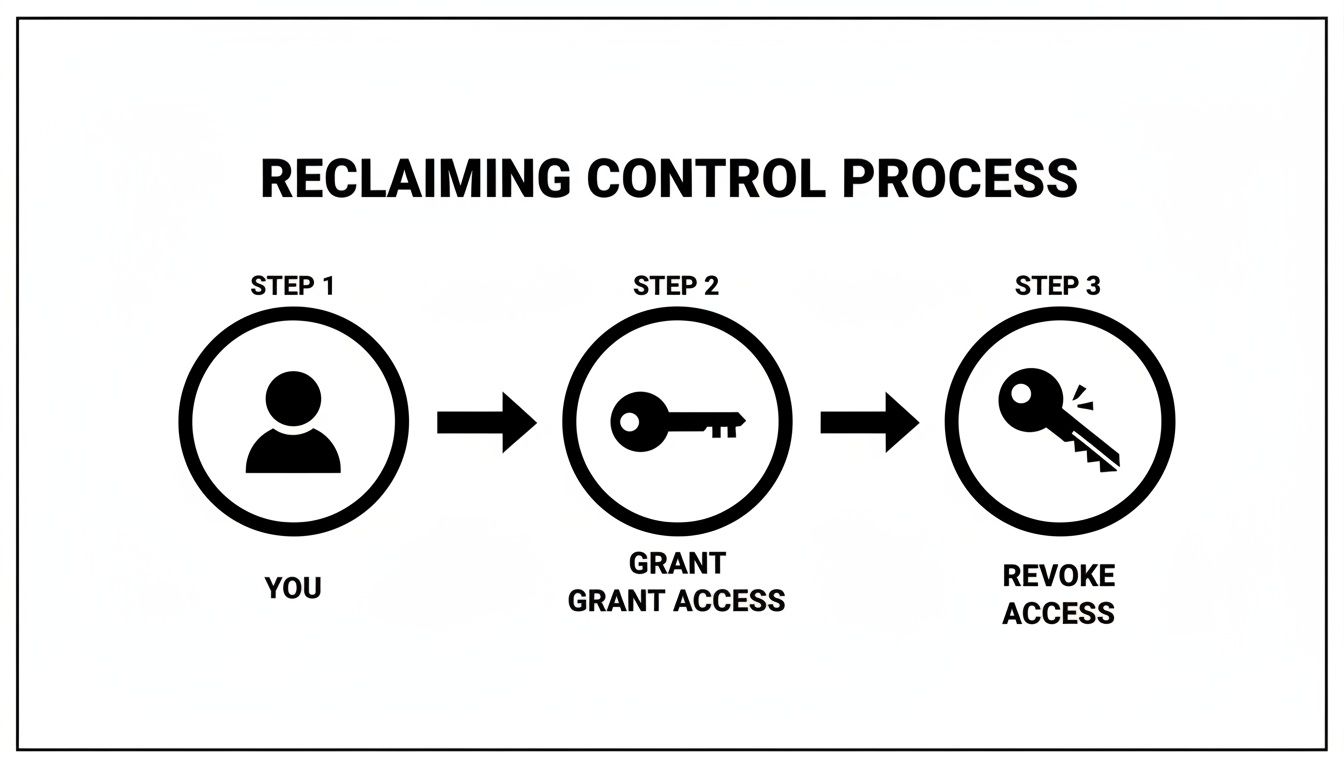
As you can see, both granting and revoking a POA are active, intentional steps you must take to manage who has authority over your affairs.
Drafting the Notice of Revocation
Your revocation document does not need to be filled with complicated legal jargon, but it absolutely must contain specific information to be valid. Precision is everything. A document that is vague or missing key details could easily be challenged or ignored, leaving you exposed.
To draft an effective Notice of Revocation in Georgia, make sure you include these essential pieces:
- Your Full Legal Name: Clearly state who you are as the principal.
- Your Former Agent’s Full Legal Name: Name the person whose authority you are cutting off.
- The Date of the Original POA: Be specific about the exact date the Power of Attorney was signed. This is vital to avoid confusion if you've signed more than one over the years.
- A Clear Statement of Revocation: Use direct and unmistakable language, such as, "I hereby revoke any and all authority granted to [Agent's Name] in the Power of Attorney dated [Original Date]."
This kind of clear statement leaves no room for debate. It is a firm signal that the old arrangement is over.
Executing the Document Correctly
Just writing the document is not enough. For a revocation to hold up in Georgia, it must be executed with the same formality as the original Power of Attorney. This is a critical step that underlines just how serious this action is.
Under Georgia law, a revocation must be signed and notarized to be valid. This formality creates an official, verifiable record of your decision, confirming both your identity and your intent on a specific date.
If you skip the notarization, the revocation could be legally worthless. An agent, or a third party like a bank in Roswell or a financial advisor in Johns Creek, could refuse to honor it, arguing it does not meet the legal standard.
Recording the Revocation for Public Notice
Here is a step that people often miss, especially when real estate is involved. If the original Power of Attorney was recorded with the county clerk—which is common if the agent had power to buy or sell property—then you must record the Notice of Revocation in that same county clerk's office. This applies to property records in places like Forsyth and Fulton counties.
Why is this so important? Recording the revocation serves as public notice. It effectively erases the agent’s power from the public record, stopping a former agent from trying to use the old, invalid POA to sell your house or land. Without this public filing, third parties like title companies or potential buyers would have no way of knowing the agent’s authority has been canceled.
This is a vital safeguard for your most valuable assets. For anyone needing guidance on this and other related matters, exploring comprehensive estate planning and probate law services can provide the clarity needed to ensure every legal base is covered.
Notifying Your Agent and Other Key Parties
You've drafted and signed a formal Notice of Revocation. That is a huge step, but do not stop there. A revocation document sitting in your desk drawer has no legal weight. For the revocation to be effective, you have to make sure the right people know about it.
Simply signing the paper is not enough to protect yourself. If you do not complete this crucial communication step, you could run into serious trouble. A former agent who does not know you've revoked their power could keep making transactions, thinking they are acting in good faith. An untrustworthy agent could also take advantage of the situation, using the now-invalid POA to empty a bank account or sign a contract you know nothing about. This puts your finances and personal affairs in a very vulnerable position.

Who Needs to Be Notified
You need a clear plan for getting the word out. The goal is to create a solid, undeniable record that everyone who needs to know has been told about the change. This leaves zero room for error, confusion, or misuse of the old document.
Your notification checklist should include:
- Your Former Agent: This is non-negotiable and the most important person to inform. They must be formally served with the Notice of Revocation.
- Financial Institutions: Let every bank, credit union, and investment firm you work with know. This includes your mortgage company and any financial advisors in places like Alpharetta or Roswell.
- Healthcare Providers: Tell your doctors, specialists, hospitals, and any care facilities. This is especially critical if you're revoking a healthcare POA.
- Government Agencies: If your agent was interacting with the Social Security Administration, the IRS, or the VA on your behalf, these agencies need to be put on notice.
- Business Partners: If the POA was connected to a business, make sure all your partners, fellow officers, and key contacts are aware of the change.
The Best Method for Delivering the Notice
How you send the notice is just as important as who you send it to. A quick phone call or a casual email will not hold up from a legal standpoint. You need proof that the notification was sent and, even better, that it was received.
The standard for notifying your former agent is to use Certified Mail with a Return Receipt Requested. This service from the post office gives you a mailing receipt and, crucially, a signed card back proving the date and signature of who received it.
This paperwork becomes your evidence if any disputes come up later. For third parties like banks, sending a formal letter along with a copy of the notarized revocation is standard procedure. You can also hand-deliver the notice to your local bank branch in Cumming or Johns Creek and ask a manager to sign an acknowledgment that they received it. Thinking through these delivery options is a vital part of the process, much like the original considerations needed while naming a power of attorney.
Special Considerations for Real Estate in Georgia
If your original Power of Attorney gave your agent the power to manage, buy, or sell real estate, there's one more essential step you must take. This is especially true for property owners in places like Fulton County and Forsyth County.
If the original POA was recorded with the Clerk of Superior Court for real estate transactions, you must record your Notice of Revocation in that very same county clerk’s office. Doing this creates a public record that officially cancels the agent's authority over your property. It’s what stops a former agent from trying to sell your property in Canton or Dawsonville behind your back, because any title search would immediately show that their power has been revoked.
When Revoking a Power of Attorney Gets Complicated
While revoking a Power of Attorney is often a simple matter of signing a new document, some situations can create challenges. These cases often require a more careful and strategic approach, especially for families and business owners here in Forsyth and Fulton Counties. Knowing how to handle these complexities is crucial for protecting your interests.
One of the biggest points of confusion we see is over the word “durable.” Many people mistakenly believe that a durable Power of Attorney is set in stone and can never be revoked.
That’s simply not true. The term “durable” just means the agent’s authority continues even if you, the principal, become incapacitated. It does not make the document permanent. As long as you are mentally competent, you have every right to revoke a durable POA just like any other type.
The Rare Case of an Irrevocable Power of Attorney
A truly irrevocable POA is something you will almost never encounter in personal estate planning. These are typically reserved for specific business or financial contracts where the agent has a personal, contractual stake in the matter.
Imagine a business owner in Alpharetta who needs a loan to expand. To secure the loan, she gives the lender a POA specifically to sell certain business assets if she defaults. That power is considered “coupled with an interest” because the lender’s ability to sell those assets is their collateral. The business owner cannot just turn around and revoke that power, because it is a key part of their binding loan agreement.
These are highly specific commercial instruments, not the kind of POA used for managing personal finances or healthcare decisions.
What to Do with an Uncooperative Former Agent
So, you’ve followed all the right steps, but your former agent is refusing to acknowledge the revocation. This is where things can get heated. An uncooperative agent might ignore your notice, refuse to hand over documents, or even try to keep acting on your behalf.
This is exactly why your formal notification is so important. That certified mail receipt showing they received your Notice of Revocation becomes your best piece of evidence. It proves, without a doubt, that they were made aware their authority was terminated.
If they continue to act, they could be committing fraud or other serious civil wrongs. In a situation like this, getting legal guidance is essential to enforce your revocation and stop any further harm.
When Your Mental Capacity Is Questioned
Another difficult scenario is when your very ability to revoke the POA is challenged. A former agent or even a family member might claim you are no longer of sound mind and therefore cannot legally sign a revocation document. This can quickly escalate into a legal dispute that has to be settled in court.
If you think there is any chance your capacity might be questioned, it is smart to be proactive. You could get a written opinion from your doctor confirming your mental state at the time you sign the revocation.
Having an attorney involved also adds a significant layer of credibility. A lawyer can attest that you understood what you were doing and what the consequences were. For residents in Roswell or Marietta facing this kind of challenge, professional legal counsel is a necessary step to protect your right to take back control.
Why Timely Revocation Is Crucial for Asset Protection
Knowing you can revoke a Power of Attorney is one thing, but understanding why you need to act fast is another matter entirely. Delay is not just a passive choice; it's a decision that leaves your hard-earned assets vulnerable with every passing day that old document is still valid.

A Power of Attorney gives someone else tremendous authority over your affairs. When that person is trustworthy, it's an incredibly helpful tool. But if that trust evaporates, the very same document can be turned against you with shocking speed.
Hesitating for even a few days before you formally revoke a POA can lead to disaster. An agent you no longer trust could legally empty your bank accounts, sell your property, or make ruinous choices for your family business in Alpharetta before you have the chance to intervene.
Red Flags That Signal a Need for Immediate Action
Protecting yourself starts with recognizing the warning signs that an agent is not acting in your best interest. Hesitation can be incredibly costly. If any of these behaviors look familiar, it’s probably time to seriously consider revoking the Power of Attorney right away.
Some common red flags include:
- Secrecy about finances: The agent gets vague or defensive when you ask to see statements or records.
- Decisions that contradict your wishes: They start doing things you’ve specifically told them not to do.
- Sudden changes in their lifestyle: The agent is suddenly spending a lot of money with no reasonable explanation for where it came from.
- Isolating you from family or friends: They might try to limit your contact with people who could question what they're doing.
These are not small problems; they are giant banners indicating your financial health is in jeopardy. Data on financial abuse shows that revoking a POA quickly is one of the most critical defenses you have. Financial exploitation, often through the misuse of a POA, is a growing concern for seniors. This is why a prompt, legally sound revocation is so critical. You can learn more from this report about the importance of POA revocation.
Revoking a Power of Attorney is not just a legal procedure; it is a vital act of asset protection. It is how you reclaim control and secure your future when trust has been violated.
At the end of the day, a swift revocation is about your peace of mind. For people in Forsyth and Fulton counties, taking decisive action ensures that your life’s work—from your retirement savings to your family home in Cumming or Roswell—is safe and sound under your control. It turns a legal process into a real, tangible shield for what matters most.
When to Seek Legal Guidance for Revoking a POA
While you can often revoke a Power of Attorney on your own, some situations are just too complex or messy to handle without professional legal support. Trying to navigate these scenarios alone can unfortunately lead to disputes or an incomplete revocation, leaving you and your assets vulnerable. Knowing when to call in an attorney is a critical part of protecting yourself.
Even a seemingly straightforward revocation can feel overwhelming. Having an experienced attorney from Forsyth County or Fulton County review your documents can provide invaluable peace of mind that every last detail is handled correctly.
Scenarios That Warrant Legal Counsel
Certain situations are clear signs that a DIY approach is not enough. If you find yourself in any of the following circumstances, getting legal guidance is a necessary step to safeguard your rights and make sure your wishes are legally enforced.
You should seriously consider consulting an attorney if:
- You Suspect Financial Abuse: If you have any reason to believe your agent has mismanaged your money, sold property without your permission, or helped themselves to your assets, you need immediate legal help. An attorney can help you properly revoke the POA and look into civil litigation to recover what was taken.
- The Agent is Uncooperative or Hostile: When a former agent simply refuses to acknowledge the revocation or becomes confrontational, an attorney can step in and manage all communications. This creates a professional buffer and ensures the agent cannot intimidate you or ignore your decision.
- Your Mental Competency is Challenged: Sometimes a family member or the agent might claim you are not of sound mind to revoke the POA, which can seriously complicate things. A lawyer can help you gather the necessary evidence, like a doctor's statement, to prove your capacity and defend your right to make your own decisions.
- The POA is Tied to a Business or Real Estate: For complex assets, like a family business in Alpharetta or property in Cumming, an attorney is essential. They will ensure all related contracts, deeds, and public records are updated correctly, preventing any lingering legal authority that could harm your business or financial interests.
How a Civil Litigation Attorney Can Help
In these kinds of difficult cases, a lawyer does much more than just draft a document; they build a protective legal strategy around you. An attorney will make sure your Notice of Revocation is legally airtight and properly delivered to every necessary party, creating an undeniable paper trail.
They can also issue a formal demand for a full accounting of all transactions the former agent made on your behalf. If financial misconduct comes to light, your attorney can then represent you in civil court to pursue a remedy. For residents in Roswell, Johns Creek, and across North Georgia, having a trusted local advocate in your corner ensures every legal avenue is used to secure your assets and enforce your decisions.
Frequently Asked Questions About Revoking a POA
When you're thinking about taking back a Power of Attorney, a lot of questions can come up. Here are plain-spoken answers to some of the most common ones we hear from clients in Georgia.
Do I have to give a reason for revoking a POA?
No, you do not have to give a reason for revoking a Power of Attorney. As the principal who granted the authority, you have the absolute right to revoke it at any time, for any reason or no reason at all, as long as you are mentally competent. Your decision does not require justification.
What if my former agent won't give back the original POA document?
That is a common concern, but the physical paper is less important than the legal notice you provide. Once you have properly delivered a signed and notarized Notice of Revocation to your former agent and all relevant third parties, the old document becomes legally invalid. This is why sending notice via certified mail is so important, as it provides proof of delivery.
Can I revoke a POA if my mental capacity is being questioned?
This is a complex situation where you should seek legal advice. To revoke a POA, you must be of sound mind and understand the decision you are making. If your capacity is successfully challenged in court, you may not be able to revoke the POA yourself, and a family member might need to seek a conservatorship to have the agent removed.
After I revoke a POA, do I need to create a new one?
Revoking a Power of Attorney only cancels the authority of your previous agent; it does not automatically appoint a new one. If you still want someone to be able to act on your behalf, you must create a new, separate POA document naming a different person as your agent. Many people prepare the new POA at the same time they revoke the old one to avoid any gap in coverage.
Navigating the complexities of revoking a Power of Attorney, especially when things get contentious, is much easier with experienced legal guidance. The attorneys at Miles Hansford, P.C. can make sure your rights are protected and that your revocation is handled correctly and effectively from the start. For clear advice and confident representation in Fulton County, Forsyth County, and across North Georgia, contact us to discuss your situation.