


Meta Title: Co Parenting Plan in Cumming, GA | Georgia Guide
Meta Description: Co parenting plan help in Cumming, GA. Learn Georgia parenting plan rules, Forsyth and Fulton court process, and how to protect your rights.
Suggested URL Slug: /co-parenting-plan-cumming-ga
A separation usually doesn't begin with legal language. It begins with practical fear. Where will the children sleep on school nights? Who handles pickup when one parent works late in Alpharetta? What happens on birthdays, summer break, or when one of you wants to travel out of state?
If you're dealing with that stress in Cumming, GA, you're not alone, and you don't have to guess your way through it. A strong co parenting plan gives your child predictability and gives you a clear set of rules to follow when emotions are running high. In Georgia, parenting plans are required in custody matters involving minor children, and the quality of that plan can shape what happens at temporary hearings, mediation, and final orders in Forsyth County Superior Court or Fulton County Superior Court.
Nationally, co-parenting affects millions of families. As of 2018, about 12.9 million custodial parents were caring for 21.9 million children under 21, with over a quarter of all children having a parent living outside their household, according to child custody statistics summarized here. That matters because it means your situation is common, even if it feels isolating right now.
If your child is struggling with the change, a practical emotional resource like Children Psych's divorce coping guide can help you think about what your son or daughter may need while the legal process moves forward.
Schedule a consultation if you need immediate guidance. Temporary orders matter, and early decisions often affect everything that follows.
Crafting Your Georgia Co-Parenting Plan An Introduction
A parenting plan isn't just paperwork attached to a divorce. In Georgia, it's one of the main documents the court uses to understand how your child's life will function across two homes. That means your plan needs to work in real life, not just look acceptable on a form.
Parents in Cumming, Johns Creek, Milton, and Suwanee often come in thinking custody is mainly about which parent gets more time. In practice, the harder problems are usually operational. School handoffs. Notice for trips. Makeup time. Medical decisions. Last-minute cancellations. Those details create peace or conflict.
What parents need to know early
Georgia is a no-fault divorce state, and there is a 30-day minimum waiting period after filing before a divorce can be finalized. If your case involves children, the court will expect a parenting plan that addresses custody and parenting time in a way that serves the child's best interests under Georgia law.
A workable plan usually does four things well:
- Creates routine: Children know where they will be on regular weekdays, weekends, holidays, and school breaks.
- Reduces arguments: Parents don't have to renegotiate basic issues every week.
- Protects enforceability: Judges in Forsyth County and Fulton County need specifics they can approve and enforce.
- Supports decision-making: The plan should say who decides what, and how disagreements get handled.
A parenting plan should answer the questions that usually trigger conflict before the conflict starts.
Why local drafting matters in North Georgia
A family in Cumming with children in Forsyth County schools has different scheduling pressures than parents splitting time between Alpharetta and Roswell or between Dawsonville and Canton. Commute time, school district boundaries, exchange locations, and work schedules all matter.
That's why generic online custody language often fails. Georgia family courts want clarity, and local judges see the difference between a thoughtful plan and one copied from a template without strategy.
Why a Formal Co-Parenting Plan is Essential in Forsyth County

A formal parenting plan protects you from two common problems. First, one parent starts making unilateral decisions. Second, both parents assume they “will work it out,” until they don't.
Once a parenting plan is approved and incorporated into a court order, it becomes enforceable. That matters in Forsyth County Superior Court and Fulton County Superior Court because the court needs something concrete to enforce if disputes develop later. A vague understanding may feel easier in the short term, but it usually creates more room for conflict.
Shared parenting is now a mainstream reality
Shared parenting is no longer unusual. The likelihood of shared physical custody after divorce more than doubled from 13% before 1985 to 34% in the early 2010s, according to this demographic study on shared custody trends. That shift is one reason Georgia courts expect detailed time-sharing arrangements rather than loose, undefined visitation language.
You can learn more about how those rules fit into broader Georgia child custody laws, including how courts evaluate the child's best interests.
What a formal plan actually does
A strong plan serves as the operating manual for your child's life between homes. It can:
- Prevent power struggles: Neither parent has to guess who controls school enrollment, medical decisions, or travel approvals.
- Give the court a roadmap: Judges can see that you're focused on the child, not on scoring points against the other parent.
- Support temporary hearings: Early court rulings often rely on whichever parent presents the more realistic and child-centered structure.
- Help in mediation: Clear terms make negotiation easier because everyone is discussing actual clauses, not broad wishes.
Practical rule: If a sentence in your parenting plan can be read two different ways, expect two different interpretations later.
What doesn't work in Forsyth County
Parents often want to use terms like “reasonable visitation,” “liberal parenting time,” or “as agreed by the parties.” Those phrases sound cooperative, but they break down fast in contested cases.
Courts in North Georgia generally prefer specifics. If one parent later refuses a holiday exchange, changes pickup times, or blocks a vacation, the question becomes simple. What does the written order say? If the answer is unclear, enforcement gets harder and stress gets worse.
Core Components of a Georgia-Mandated Parenting Plan
Georgia practice treats a parenting plan as a detailed operating document, not a casual agreement. Vague language like “as agreed” is a common failure point, and the strongest plans specify day-by-day schedules, holiday allocations, transportation duties, and decision-making authority. If parents submit competing plans, the court chooses the one it believes serves the child's best interests, as outlined in this Georgia parenting plan guidance.
For parents drafting or reviewing terms, a Georgia parenting plan template can help organize the structure. It should never replace legal review in a contested case, but it can help you spot missing provisions.
Physical custody and parenting time
This is the day-to-day calendar. It should say where the child sleeps on school nights, what happens on weekends, how exchanges occur, and how summer and school breaks are handled.
Good plans answer practical questions such as:
- Weekday routine: Which parent handles Monday through Thursday overnights?
- Weekend structure: Are weekends alternating, fixed, or tied to school pickup?
- Holiday override rules: Does Thanksgiving override a regular weekend rotation?
- School closure planning: What happens on teacher workdays and weather closures?
Legal custody and major decisions
Legal custody is separate from physical custody. It concerns major decisions for education, healthcare, extracurricular activities, and often religious upbringing.
Some parents share decision-making broadly. Others divide final authority in specific categories when cooperation is poor. The right approach depends on your history, communication pattern, and the level of trust that still exists.
If one parent has always handled medical care and the other has handled school logistics, the plan should reflect reality unless there's a reason to change it.
Child support and expense structure
Child support is usually addressed alongside the parenting plan, but parents should also clarify how they'll handle unreimbursed medical expenses, activity costs, school fees, and deadlines for reimbursement requests.
A smart plan doesn't just say expenses are “shared.” It explains the process. Who pays first. How receipts are exchanged. When reimbursement is due. Which expenses need advance agreement.
Transportation and exchange terms
Transportation is where many otherwise solid plans fail. A useful clause should cover:
- Pickup and drop-off location
- Which parent drives on which exchange
- What happens if a parent is late
- Whether exchanges happen at school, curbside, or another neutral site
Protect your parental rights before you sign anything. A review by a family law attorney can catch issues that aren't obvious until the first dispute happens.
Designing a Realistic Parenting Schedule for Life in North Georgia
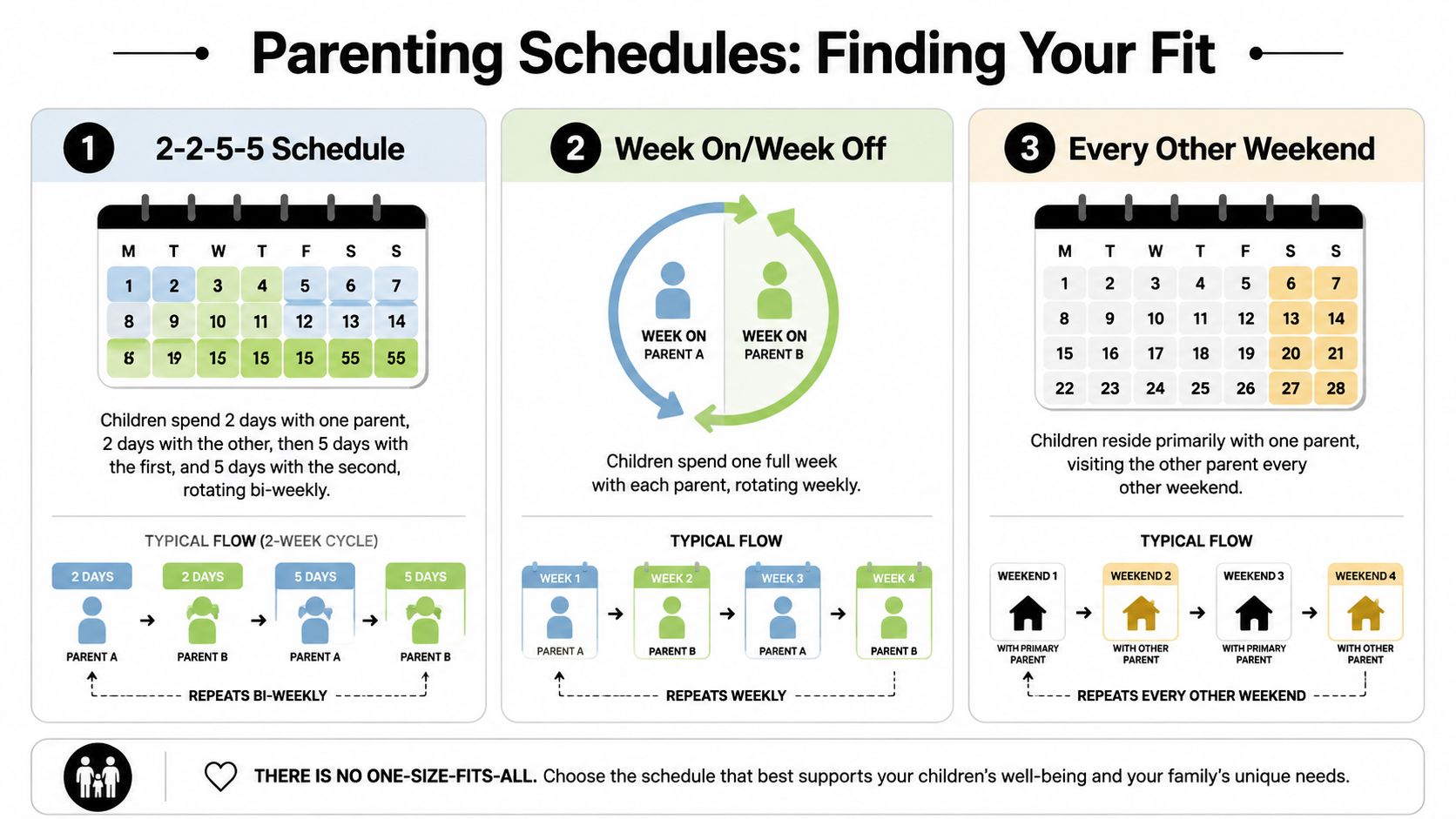
The best parenting schedule isn't the one that sounds the most equal on paper. It's the one your child can successfully live with, and the one both parents can follow consistently.
In North Georgia, distance matters. So do school districts, work hours, and traffic. A plan that might work for parents living near each other in Alpharetta and Milton may become unworkable if one parent lives in Dawsonville and the child attends school in Johns Creek.
Comparing common schedule options
| Schedule | Often works well when | Common strain points |
|---|---|---|
| 2-2-5-5 | Parents live close, communicate reasonably well, and want frequent contact | More exchanges, more room for conflict over timing |
| Week on week off | Older children handle transitions well and parents live far enough apart that fewer exchanges help | Long gaps can be hard for younger children |
| Every other weekend | One parent has primary physical custody and school-week stability is the priority | The non-primary parent may feel disconnected from routines |
How these schedules play out locally
A 2-2-5-5 schedule can work well for families in Alpharetta, Roswell, or Milton where both homes are close to the child's school and activities. Children see both parents often, and weekday responsibilities stay shared. The trade-off is volume. More handoffs mean more chances for lateness, friction, or confusion.
A week-on, week-off arrangement is sometimes better when parents live farther apart, such as Cumming and Johns Creek or Suwanee and Roswell. It reduces transitions and can simplify school planning. It also requires each home to function fully for school mornings, homework, clothing, and activities.
An every-other-weekend schedule may still be appropriate where one parent has primary physical custody because of school logistics, a parent's work schedule, or the child's need for one main school-week home. It offers predictability, but it often needs extra provisions for holiday time, school breaks, and regular phone or video contact.
Choose the schedule your child can rely on, not the schedule that sounds easiest to defend in an argument.
Holidays, birthdays, and summer need their own rules
Holiday conflict is predictable. That's why holiday terms should override the regular calendar and stand on their own.
Include clear language for:
- Major holidays: Specify start and end times, not just the day.
- School breaks: Spring break, fall break, and winter break need separate treatment.
- Summer vacation: Address notice deadlines, travel weeks, and camp conflicts.
- Birthdays and special days: Child birthdays, parent birthdays, Mother's Day, Father's Day.
For many families, school-based exchanges reduce conflict because the parents don't have to meet face-to-face. That can be especially useful in high-tension cases in Forsyth County and North Fulton courts.
Strategic Clauses to Include in Your Cumming, GA Plan

The difference between a basic parenting plan and a durable one is usually found in the clauses most parents don't think about until after a fight. These are the terms that keep a disagreement from becoming a new court case in Cumming or Alpharetta.
Do not agree to custody terms without legal representation.
Communication and dispute clauses
Many parents need more than “communicate respectfully.” They need rules.
Consider whether your plan should require:
- A co-parenting app: This creates one place for messages, calendars, and expense records.
- Response windows: For non-emergency issues, define how quickly each parent must respond.
- Emergency notice rules: Spell out how urgent medical or school issues are reported.
- Mediation before court: Many disputes can be narrowed if parents must attempt mediation first.
This is one place where practical support matters. Options can include a neutral mediator, a parenting coordinator when appropriate, or legal counsel familiar with local custody litigation, including services offered through Miles Hansford Law Firm for family law and mediation matters in North Georgia.
Travel, right of first refusal, and online boundaries
A few targeted clauses can prevent recurring friction.
- Right of first refusal: If one parent can't care for the child during their scheduled time, must they offer that time to the other parent first?
- Travel permissions: Define notice for in-state, out-of-state, and international travel.
- Passport access: Clarify who keeps the passport and how travel consent is handled.
- Social media rules: Decide whether parents may post the child publicly and whether new partners may do so.
One family may need a broad right of first refusal. Another may do better without it because every extra notice requirement creates another point of dispute. Good drafting depends on the parents involved, not on generic internet advice.
Parallel parenting for high-conflict cases
For high-conflict families in Georgia, traditional co-parenting advice can fail. A more realistic strategy may be parallel parenting, which uses highly structured rules to reduce direct contact and minimize disputes, as discussed in this parenting plan checklist resource.
Parallel parenting is often the better fit when one or both parents can't communicate effectively without arguments, accusations, or manipulation. In those cases, fewer judgment calls and fewer direct exchanges can protect the child from adult conflict while preserving each parent's relationship with the child.
Some families don't need better communication. They need less direct communication and better written rules.
That distinction matters in contested divorces, temporary hearings, and post-divorce modification cases in Forsyth County and Fulton County.
Filing and Enforcing Your Plan in Alpharetta & Cumming Courts
Once the plan is drafted, the court process matters just as much as the language. In Forsyth County Superior Court and Fulton County Superior Court, a parenting plan usually gets filed as part of the custody or divorce case. If the parties agree, the court may review it with the final paperwork. If they don't, the plan becomes a contested issue.
What happens in local courts
In an uncontested matter, the process is usually cleaner. The parties submit the agreed parenting plan, along with the other required filings, and the judge reviews whether the agreement is acceptable under Georgia law.
In a contested case, judges often expect the parties to mediate before final trial. Temporary hearings may happen earlier if parents need immediate rulings on parenting time, possession schedules, support, or use of the marital residence. If you're preparing for one of those early court dates, this guide on how to prepare for a custody hearing can help you think through documents, conduct, and presentation.
Enforcement and contempt
A parenting plan only works if both parents follow it. When one parent repeatedly violates the order, the other may need to seek enforcement through a contempt action.
Common enforcement problems include:
- Denied parenting time
- Repeated late exchanges
- Failure to return the child on time
- Unapproved travel or school changes
Parents in Cumming, Alpharetta, Canton, Dawsonville, and nearby communities often assume the court will fix a violation quickly. Sometimes it will. Sometimes the problem is that the order wasn't specific enough to enforce cleanly. That's why strong drafting on the front end matters.
In custody cases, temporary orders often shape the final result. Treat the first hearing like it matters, because it does.
Why Entrust Your Co-Parenting Plan to Miles Hansford
A parenting plan has to do two jobs at once. It has to satisfy Georgia law, and it has to function in your real life after the court date is over.
That's where experienced local counsel makes a difference. Parents dealing with divorce, legitimation, modification, contempt, or custody litigation in Cumming and Alpharetta usually need more than a template. They need judgment. They need to know what a judge in Forsyth County is likely to view as child-centered, what a Fulton County mediation session is likely to focus on, and where vague language is likely to become expensive later.
Miles Hansford handles family law matters in the North Georgia courts where these cases are decided. That local experience matters in cases involving temporary hearings, mediation strategy, Georgia equitable division issues tied to the divorce, and custody terms that need to hold up under pressure.
Your family's future is too important to leave to chance. Speak with a compassionate and strategic family law attorney to create a co parenting plan that provides structure, protection, and peace of mind.
Frequently Asked Questions about Co-Parenting Plans in Georgia
Q: How much does a co-parenting plan cost in Cumming, GA?
A: Costs vary based on the complexity of the case. An uncontested matter in Forsyth County is usually more straightforward than a contested custody dispute requiring negotiation, mediation, or hearings. A consultation is the best way to get clear pricing based on your facts, your goals, and how much conflict is involved.
Q: Do we have to go to court in Alpharetta to get our parenting plan approved?
A: Not always for a formal hearing, but a judge still must approve the plan. In Fulton County, uncontested filings may be handled on the paperwork if everything is complete and properly submitted. If there is a dispute, a hearing or further court involvement may be necessary.
Q: Can I create a co-parenting plan without a lawyer near me?
A: You can, but it's risky. Georgia parenting plans need enough detail to be approved and enforced. Parents in Cumming, Alpharetta, Johns Creek, and Milton often discover too late that a vague clause about holidays, travel, or decision-making creates more conflict than it solves.
Q: What is the difference between legal and physical custody in Georgia?
A: Physical custody addresses where the child lives and the parenting-time schedule. Legal custody addresses major decisions such as education and healthcare. Georgia courts often separate those issues, so a parent may share legal custody even if the child spends more regular time in one home.
Q: How do we modify a parenting plan in Forsyth County?
A: You generally must file a modification action and show a material change in circumstances affecting the child's welfare. That request is made through the Forsyth County Superior Court. Whether the facts support a modification depends on the child's needs and the changes since the current order.
Q: Does Georgia require mediation in custody cases?
A: Many custody disputes in Forsyth County and Fulton County are sent to mediation before final trial. Judges often want parents to try to resolve scheduling and decision-making issues before using trial time. Even when mediation doesn't settle everything, it can narrow the issues and improve the final plan.
If you need help building a workable parenting schedule, reviewing a proposed custody order, or preparing for mediation or a temporary hearing, schedule a consultation with Miles Hansford Law Firm. Speak with a family law attorney serving Cumming, Alpharetta, Forsyth County, and Fulton County, and take steps now to protect your parental rights.
Internal link suggestions:
- Georgia Child Custody Laws
- Parenting Plan Template Georgia
- How to Prepare for Custody Hearing
- Divorce Attorney in Cumming, GA
- Child Custody Lawyer in Alpharetta, GA
- Modification of Custody Orders in Georgia
Schema recommendations:
- Attorney
- LegalService
- FAQPage