


Meta Title: Competent to Stand Trial in Cumming GA
Meta Description: Competent to stand trial guidance for Cumming, GA families. Learn Georgia standards, Forsyth and Fulton court process, delays, and next steps.
Suggested URL Slug: /competent-to-stand-trial-cumming-ga
A call comes in from the jail. Your son, spouse, sibling, or business partner was arrested in Cumming, Johns Creek, or Alpharetta, and now something feels off. They don't seem to understand why they're there. They may be paranoid, detached, confused, or saying things that make no sense in the context of a criminal case.
Families often assume the next step is bond, court, and trial. Sometimes it isn't. Sometimes the first real issue is whether the person is competent to stand trial at all.
That question is not a trick, a loophole, or an excuse. It's a legal safeguard built to prevent a criminal case from moving forward when a defendant cannot understand the process or help with the defense. In North Georgia, that issue can arise in cases filed in Forsyth County Superior Court, Fulton County Superior Court, and courts serving communities like Milton, Roswell, Sandy Springs, Suwanee, Dawsonville, and Canton.
For families trying to make sense of frightening behavior after an arrest, the legal system can feel cold and technical. It helps to understand that competency law exists to slow things down when fairness requires it. In some situations involving younger defendants, related questions about age, maturity, and criminal exposure also matter, as discussed in this overview of whether a juvenile can be tried as an adult in Georgia.
If you're searching for answers “near me” in Cumming or Alpharetta, the most important first move is getting a lawyer who can identify whether this is a standard criminal case or a competency case that needs immediate intervention.
A Guide to Competency for Families in Cumming and Alpharetta
A family in Cumming may get through the first shock of an arrest only to face a second one at first appearance or shortly after. Their loved one can't track basic facts, insists the judge is part of a conspiracy, or can't hold a coherent conversation with counsel. In Alpharetta, the same thing can happen after a DUI, fraud allegation, probation violation, or assault charge.
That moment creates a different kind of legal problem. The issue is no longer just what happened. The issue becomes whether the person can fairly participate in the case now.
What families usually notice first
Family members often spot the problem before the court does. They describe behavior like this:
- Disorganized thinking: The person jumps from topic to topic and can't answer simple case-related questions.
- Delusional beliefs: They insist on facts that plainly aren't true and base decisions on those beliefs.
- Extreme confusion: They don't understand the role of the judge, prosecutor, or defense lawyer.
- Breakdown in communication: They can't help explain events, identify witnesses, or make decisions about the case.
A competency concern usually starts with a practical observation. The defendant cannot participate in the defense in any meaningful way.
In Georgia, raising that issue can protect due process and sometimes protect the person from making harmful decisions in court before their mental condition is addressed. That's why families in Forsyth County and Fulton County shouldn't dismiss bizarre behavior as stress alone. Stress can make things worse, but competency law exists for cases where the impairment is more serious.
Why the first legal response matters in Cumming and Alpharetta
Judges in local courts need specifics, not general worry. A lawyer who can document what the client is doing, saying, and failing to understand gives the court something concrete to act on. Waiting too long can lead to bad statements, missed opportunities, and hearings that should never have gone forward in the first place.
Why Competency to Stand Trial Is a Fundamental Right in Georgia
A criminal trial only has meaning if the defendant can understand it and participate in it. If that ability is missing, the process stops being a fair test of the charges and starts becoming something else entirely.
In Georgia, this is a due process issue. Courts aren't supposed to force a person through plea negotiations, hearings, or trial when the person cannot grasp the proceeding or assist counsel in a rational way. That protection matters in every courthouse, from Cumming to Alpharetta to Roswell.

This is about fairness, not diagnosis alone
A mental health diagnosis by itself doesn't decide the issue. A person can live with serious symptoms and still be legally competent. Another person may look calmer on the surface but still be unable to understand courtroom reality or communicate rationally with counsel.
That said, some patterns show up often enough that lawyers and judges should take them seriously. A large review discussed by the American Psychological Association found that defendants with a diagnosed psychotic disorder were approximately eight times more likely to be found incompetent, and unemployed defendants were twice as likely to be found incompetent (APA analysis of over 26,000 cases).
What that means in real cases
In practice, competency concerns often arise when a defendant:
- Cannot separate reality from delusion: They think the case is controlled by hidden forces rather than actual legal actors.
- Cannot process advice: Counsel explains options repeatedly, but the client can't weigh them in a rational way.
- Fixates on irrelevant beliefs: The client focuses on imagined threats instead of charges, evidence, or possible defenses.
- Lacks case-specific comprehension: They may know the word “judge” but not understand what that judge is doing in their own case.
The law doesn't ask whether a person is mentally ill in the abstract. It asks whether that condition prevents meaningful participation in the defense.
For families in North Fulton courts or Forsyth County proceedings, that distinction matters. It keeps the conversation grounded in function. Courts care about what the defendant can do now, in relation to this case, in this courtroom, with this lawyer.
Why families should resist the “just push through it” instinct
Families sometimes hope the person will stabilize on their own if they can just get to the next hearing. That's understandable, but it can be dangerous. A defendant who isn't competent may reject reasonable advice, say harmful things in open court, or make decisions that affect bond, plea posture, and case strategy.
Competency law exists to stop that from happening.
The Legal Standard for Competency in Cumming GA Courts
The core rule in Georgia comes from the federal standard set by Dusky v. United States and reflected in O.C.G.A. § 17-7-130. In plain terms, the court wants to know whether the defendant can understand what is happening and work with counsel in a rational way.
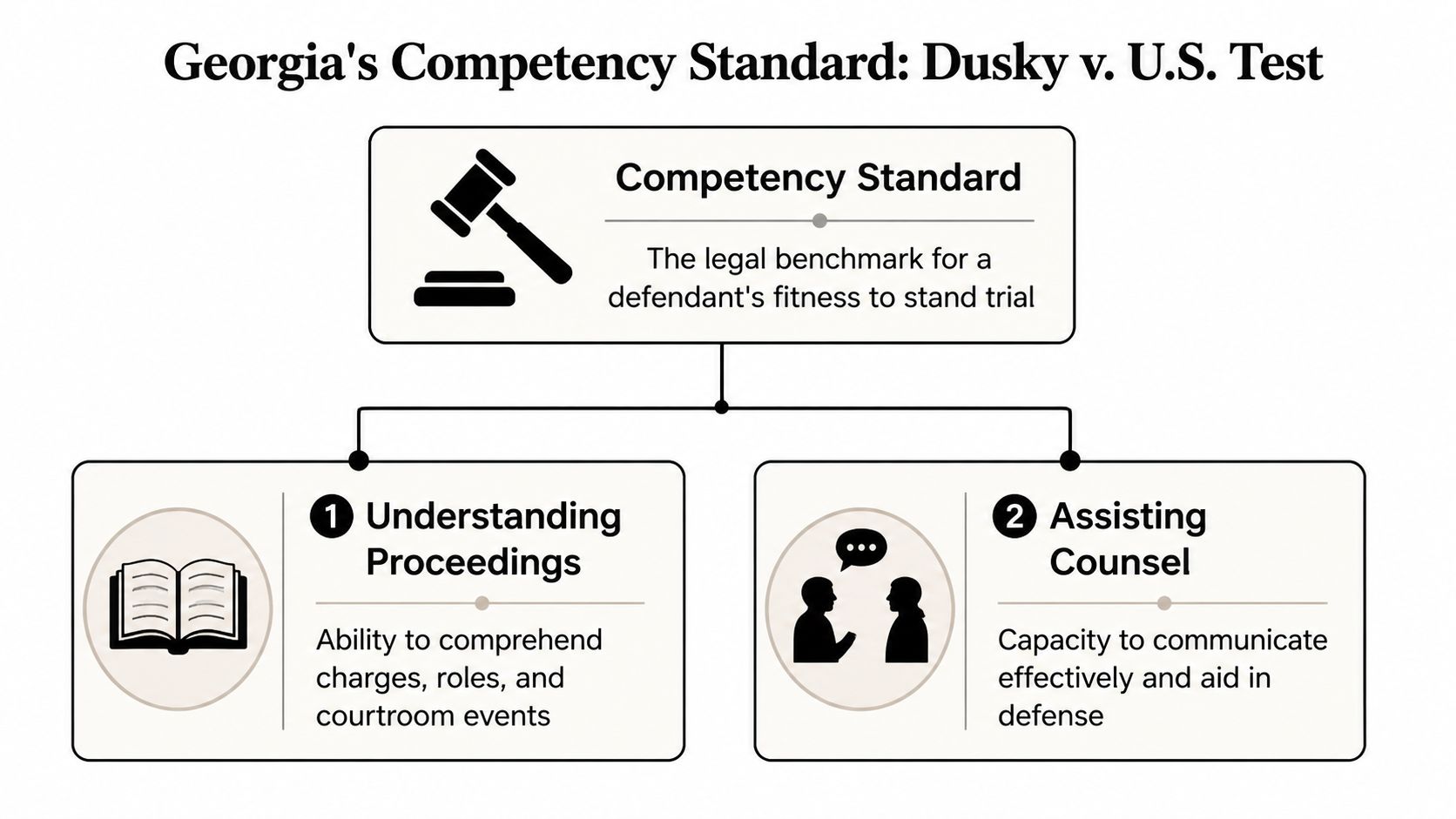
Under Georgia law, a defendant must have a sufficient present ability to consult with their attorney and a rational, factual understanding of the proceedings. When a court has a bona fide doubt about this, it must order an evaluation by DBHDD, which has a strict 30-day reporting deadline, as summarized here in this discussion of Georgia competency evaluations under O.C.G.A. § 17-7-130.
The two practical parts of the test
The legal wording sounds formal, but most families understand it once it's translated into everyday terms.
| Part of the standard | What it means in practice |
|---|---|
| Understanding the proceedings | The defendant knows the nature of the charges, the courtroom roles, and what can happen in the case. |
| Assisting counsel | The defendant can communicate with the lawyer, consider advice, and make rational decisions about the defense. |
A person doesn't need to be polished, educated, or emotionally calm. The law doesn't require perfect composure. It requires enough present ability to function in the case.
What a bona fide doubt looks like in Forsyth County Superior Court
Judges don't order evaluations just because someone is anxious, angry, or difficult. There has to be a real basis for concern. In court, that often means observed behavior, reports from counsel, or statements by the defendant that show a disconnect from reality or a severe inability to understand the process.
Examples that can create a bona fide doubt include:
- Case-specific delusions: The defendant believes the prosecutor is a family member in disguise or that the case is controlled by voices or secret messages.
- Inability to communicate: Counsel cannot get coherent answers needed to investigate or advise.
- Severe misunderstanding of courtroom roles: The defendant doesn't understand who the judge or lawyer is despite repeated explanation.
- Apparent inability to grasp consequences: They cannot process what a plea, trial, or sentencing exposure means.
Present ability is the key
Competency is about the defendant's condition now. It isn't the same as an insanity defense, which concerns the person's mental state at the time of the alleged offense. That's one reason families often get confused. They may say, “He knew what he was doing when this happened,” or “She didn't.” Those are different legal questions.
Practical rule: A person can have a defense about what happened at the time of the offense, and a separate competency issue about whether the case can proceed now.
Why local procedure matters in Cumming GA courts
In and around Cumming, local practice matters almost as much as the legal standard itself. The motion has to be framed with enough factual detail to be taken seriously. Judges want more than broad statements about mental illness. They want observable facts tied to the defendant's ability to understand the proceedings and assist in the defense.
That is where experienced criminal counsel changes the path of a case. A thin motion invites skepticism. A specific record gives the court a reason to act.
The Competency Evaluation Process in North Georgia
Once the issue is formally raised and the court finds enough reason to look deeper, the case moves into a different lane. Families often expect a quick answer. What ensues is a structured process involving evaluators, reports, and a later court ruling.

What happens after the judge orders the evaluation
In Forsyth County Superior Court, Fulton County Superior Court, or nearby North Fulton courts, the sequence usually looks like this:
- The court enters an order. The judge identifies the competency concern and refers the matter for evaluation.
- A forensic examiner gets involved. In Georgia, the evaluation is handled through the state system.
- The defendant is interviewed and assessed. The evaluator looks at present functioning, not just medical labels.
- A written report goes back to the court. That report addresses competency and may address restorability.
- The court resolves the issue. If needed, the matter proceeds to a hearing on competency.
For families trying to understand what a forensic evaluation is supposed to accomplish, materials on related capacity questions can also be useful. This overview of Ontario mental capacity evaluations is from a different legal system, but it helps illustrate the broader difference between clinical symptoms and legal decision-making capacity.
What the evaluator is looking for
The evaluator is not deciding guilt or innocence. The examiner is asking whether the defendant can presently understand the case and work with counsel.
That usually involves attention to things like:
- Factual knowledge: Does the defendant know what the charges are and who the courtroom actors are?
- Rational appreciation: Can the defendant apply that information to their own case, or do delusions distort everything?
- Communication with counsel: Can they answer questions, describe events, and consider legal advice?
- Restorability: If they are not competent, is treatment likely to bring them back to competency?
If expert testimony later becomes important, families often benefit from understanding how specialists support contested criminal issues, including in this discussion of how expert witnesses help criminal cases.
The three usual outcomes
The most practical question families ask is simple. “What are the possible results?”
A large sample of competency cases found that approximately 54% of defendants were found competent after the initial evaluation, 42% were found not competent but restorable, and 4% were found non-restorable (Connecticut competency report).
Those figures don't control what will happen in a case in Cumming, Alpharetta, or elsewhere in North Georgia, but they do show that the system often sorts people into three practical categories:
| Outcome | What it usually means |
|---|---|
| Competent | The criminal case resumes. |
| Not competent but restorable | Treatment is pursued so the defendant may later return to court. |
| Not competent and not restorable | The criminal case may take a very different path, depending on the charge and the person's condition. |
Families should expect the report to influence negotiations, custody status, and the pace of the case, even before the final competency ruling is entered.
Defense Strategies Involving Competency in Alpharetta GA
A competency motion isn't just a legal label. Used properly, it's a strategic decision with benefits, risks, and timing issues that matter in real cases in Alpharetta, Cumming, Roswell, and North Georgia generally.
The first strategic question is whether the concern is genuine and supportable. Good lawyers don't file these motions casually. Weak claims damage credibility with the court and can harden the prosecution's position.
What works
The strongest competency presentations are built on facts that existed before the arrest, facts observed after the arrest, and a clear link between those facts and the defendant's present inability to function in the case.
What usually helps:
- Documented history: Prior treatment, hospitalization history, medication issues, or long-standing symptoms often make the issue more concrete.
- Specific observations: Counsel should be able to describe how communication breaks down, not just say the client is “not well.”
- Consistent family input: Relatives can often identify baseline functioning and recent deterioration.
- Focused expert support: A competent expert can explain functional impairment in a way judges can use.
What doesn't work
Courts are skeptical of vague claims. “My client is depressed,” “he's acting strange,” or “she's very upset” usually won't carry much weight by themselves. Many defendants are distressed. Competency requires something more serious and more specific.
Bad strategy also includes treating competency as a generic delay tactic. That can backfire badly.
Raising competency without a factual foundation can hurt the defense twice. It can fail with the judge, and it can make future legitimate concerns harder to prove.
The malingering problem in Fulton County cases
Prosecutors and evaluators are trained to consider whether a defendant is exaggerating or feigning symptoms. That's not a side issue. It can become the central fight.
Forensic literature cited in this area notes that malingering must be considered in up to 30% of evaluations, and a prosecution claim of feigned incompetence can weaken an otherwise valid competency issue if the defense record is thin (forensic discussion of malingering in competency evaluations).
That means the defense has to think several moves ahead. If a client cannot understand proceedings or assist counsel, the record should show why. If symptoms fluctuate, that needs context. If the client presents poorly in one setting and better in another, counsel needs an explanation before the prosecution supplies its own.
The real trade-off
A competency challenge can protect the client, pause harmful proceedings, and create room for stabilization. It can also lead to extended supervision, treatment orders, and a longer path before the criminal case is resolved. Families deserve honesty about that trade-off.
In high-stakes matters, the question isn't whether delay is good or bad in the abstract. The question is whether moving forward now would be unfair and legally unsound.
After the Ruling What to Expect in Forsyth and Fulton County
For many families, the hardest part starts after the judge agrees that the defendant is not currently competent. People assume the case will be dismissed or quickly fixed. Most of the time, neither happens.
Instead, the criminal case pauses while the system tries to restore the defendant to competency. In Georgia, that can mean a long and frustrating wait.

The timeline families need to prepare for
For mentally ill defendants in Georgia, the competency evaluation and restoration process can lead to pretrial detention averages exceeding 150 days, often because state psychiatric placements are limited (Georgia competency restoration delays).
That has real consequences for families in Suwanee, Dawsonville, Milton, Canton, and the broader North Atlanta area:
- Employment disruption: The defendant may lose work or business responsibilities while the case is paused.
- Family instability: Children, spouses, and parents often absorb the uncertainty.
- Treatment pressure: Medication decisions and placement issues can become urgent and emotional.
- Case fatigue: Witnesses disappear, memories fade, and everyone involved grows frustrated.
What “restoration” actually means
Restoration usually involves treatment aimed at bringing the defendant back to a point where they can understand the case and assist counsel. The court reviews progress periodically, and if competency is regained, the criminal case starts moving again.
The key point is simple. A finding of incompetence usually stops the case temporarily. It doesn't erase the charges.
Families should plan for a process, not a single hearing. Competency litigation often unfolds over months, not days.
Related family concerns often appear at the same time
When an adult defendant cannot manage legal or personal affairs, families sometimes start asking separate questions about authority over finances, medical decisions, or care planning. Those issues are different from criminal competency, but they often surface at the same time. For some households, it helps to understand related civil tools such as guardianships and conservatorships.
In Forsyth County and Fulton County, practical court navigation matters just as much after the ruling as before it. Families need updates, realistic timelines, and a clear understanding of what the next review date means.
Why Choose Miles Hansford for a Complex Case in North Georgia
Competency cases sit at the intersection of criminal law, mental health, court procedure, and family crisis. They require more than legal vocabulary. They require judgment.
In North Georgia, local knowledge matters. The pace of a case, the quality of the record, the handling of evaluator reports, and the response to a prosecution challenge all depend on counsel who knows how these issues are approached in Forsyth County Superior Court, Fulton County Superior Court, and the surrounding North Fulton court system.
These cases also demand a calm style. Families are often dealing with fear, embarrassment, and confusion at the same time. A lawyer has to protect the client without escalating the chaos. That means identifying when competency is the issue, preserving evidence of impairment, coordinating with experts when needed, and preparing for the possibility that the prosecution will argue the client is exaggerating or avoiding trial.
For clients searching for a criminal defense attorney “near me” in Cumming, Alpharetta, Johns Creek, Roswell, Sandy Springs, or Milton, one practical advantage matters more than slogans. You want counsel who can explain the legal standard clearly, recognize the strategic trade-offs, and move the case in the right direction from the first hearing forward.
That combination of local courtroom familiarity and strategic restraint is especially important in competency matters, where rushed decisions can create long-lasting damage.
Frequently Asked Questions About Competency to Stand Trial
Q: What does competent to stand trial mean in Cumming, GA?
A: In Georgia, it means the defendant has a present ability to consult with counsel and a rational and factual understanding of the proceedings. In a case pending in Forsyth County Superior Court or another local court, the focus is on the person's functioning now, not just whether they have a diagnosis.
Q: Can a judge in Alpharetta order a competency evaluation without the defense asking?
A: Yes. If the court has a bona fide doubt about competency, Georgia law requires inquiry into the issue. In Fulton County matters and North Fulton courts, that concern may arise from courtroom behavior, statements by the defendant, or reports from counsel about communication problems.
Q: Does being mentally ill automatically mean someone is not competent to stand trial?
A: No. Mental illness alone doesn't decide competency in Georgia. The question is whether the condition prevents the person from understanding the proceedings or assisting counsel. Some defendants with serious conditions remain legally competent, while others cannot proceed fairly until treatment occurs.
Q: How long can a competency case delay a criminal case in Forsyth or Fulton County?
A: It can delay the case significantly. In Georgia, competency evaluation and restoration issues can lead to pretrial detention averages exceeding 150 days when treatment placement is limited. In practical terms, families in Cumming and Alpharetta should prepare for a process that may move much slower than a standard criminal case.
Q: What happens if someone is found not competent but restorable?
A: The criminal case is usually paused while the defendant receives treatment aimed at restoring competency. If the person improves enough to understand the case and help counsel, the matter returns to court. The charges usually remain pending during that process in Forsyth County or Fulton County.
Q: Can the prosecutor argue that the defendant is faking symptoms?
A: Yes. In some cases, the State may claim the defendant is malingering, meaning feigning or exaggerating incompetence. That's why defense counsel needs documented history, specific observations, and credible expert support rather than broad statements from worried family members alone.
Q: Is competency the same as an insanity defense in Georgia?
A: No. Competency concerns whether the defendant can proceed with the case now. An insanity defense concerns the defendant's mental state at the time of the alleged offense. In local criminal practice, those are separate questions, even though families often hear them discussed together.
Q: Should families wait to see if things improve before talking to a lawyer near me?
A: No. Delay can make the record worse and allow harmful hearings or statements to happen before the issue is addressed. If a loved one in Cumming, Alpharetta, Johns Creek, or elsewhere in North Georgia appears unable to understand the case, speak with a criminal defense attorney promptly.
If your family is facing a criminal case involving mental health concerns in Cumming, Alpharetta, Forsyth County, or Fulton County, Miles Hansford Law Firm can help you assess whether competency is a critical issue and what steps should happen next. Schedule a consultation to speak with an attorney who understands North Georgia courts, the practical timeline of these cases, and how to protect your loved one through a confusing process. Call today.
Internal link suggestions:
- Georgia criminal defense overview
- DUI defense in Alpharetta
- White collar and fraud defense
- Juvenile defense in Georgia
- Guardianships and conservatorships
- Expert witnesses in criminal cases
Schema recommendations:
- Attorney
- LegalService
- FAQPage