


A lot of North Georgia business owners reach the same point without much warning. The company is doing well in Cumming, GA or Alpharetta, GA. Revenue is up. New employees are coming on. A new software platform is collecting customer information. A larger client wants stricter contract terms. Then the legal questions stop feeling occasional and start feeling constant.
That shift is usually the moment when basic business counsel is no longer enough. A growing company in Forsyth County or Fulton County often needs a system for handling legal obligations, not just a lawyer to answer isolated questions. That's where a Corporate Compliance Attorney becomes useful. The role isn't just to react after a government inquiry, employment dispute, or internal misconduct issue. The role is to build rules, reporting lines, training, and oversight before those issues harden into expensive problems.
For companies in Cumming, Alpharetta, Johns Creek, Milton, Suwanee, Dawsonville, Roswell, Sandy Springs, and Canton, that kind of planning matters because growth creates complexity fast. A business that once operated on trust and common sense suddenly needs documented policies, consistent training, careful recordkeeping, and a plan for what happens when something goes wrong.
Navigating Growth and Risk in North Georgia
A familiar scenario looks like this. A business owner in Cumming, GA starts with a lean team, direct supervision, and fast decisions. Then the company adds managers, signs larger contracts, opens another location, or starts serving clients across county lines into Alpharetta, Roswell, or Sandy Springs. The business is stronger than it was a year ago, but the owner also starts hearing questions about wage practices, customer data, vendor screening, licensing, internal complaints, and record retention.

That pressure is not imagined. Compliance has moved into core business planning. 77% of global C-suite leaders said compliance contributes significantly or moderately to company objectives, and 58% of organizations conducted 4 or more audits in 2025, according to LawPay's legal industry statistics summary. For a local business owner, that means compliance is no longer back-office housekeeping. It affects hiring, contracting, reputation, and whether the company is ready for scrutiny.
Growth creates exposure at the edges
Most compliance failures don't begin with dramatic misconduct. They start with ordinary business growth:
- Hiring gets ahead of process and supervisors improvise discipline, overtime rules, or onboarding steps.
- Customer information spreads across systems with no clear retention or deletion plan.
- Vendors are onboarded quickly without enough diligence on contracts, insurance, or confidentiality.
- Managers escalate problems informally instead of using a documented reporting path.
A business can operate that way for years without visible trouble. Then one employee complaint, one audit request, or one customer dispute exposes all the weak spots at once.
A compliance program works best when it feels boring before you need it. Once regulators, counterparties, or litigants are involved, every undocumented shortcut becomes harder to defend.
What owners in Forsyth County and Fulton County usually need
Business owners in Forsyth County and Fulton County rarely need abstract legal theory. They need practical structure. They need someone to ask: What rules apply to this company now? What evidence shows the company follows those rules? Who is responsible for escalation? What happens when an exception appears?
A corporate compliance attorney helps answer those questions in a way that fits how the business operates. For a contractor in Dawsonville, that may look different than it does for a professional services firm in Alpharetta or a family-owned operation serving Suwanee and Canton. The principle is the same. Sustainable growth needs legal architecture.
What a Corporate Compliance Attorney Actually Does
A corporate compliance attorney helps a company set rules, assign responsibility, document decisions, and correct problems before they turn into claims, audits, or expensive disputes. In North Georgia, that work often starts when a business in Cumming or Alpharetta has outgrown informal decision-making but has not yet built a legal process that matches its size.
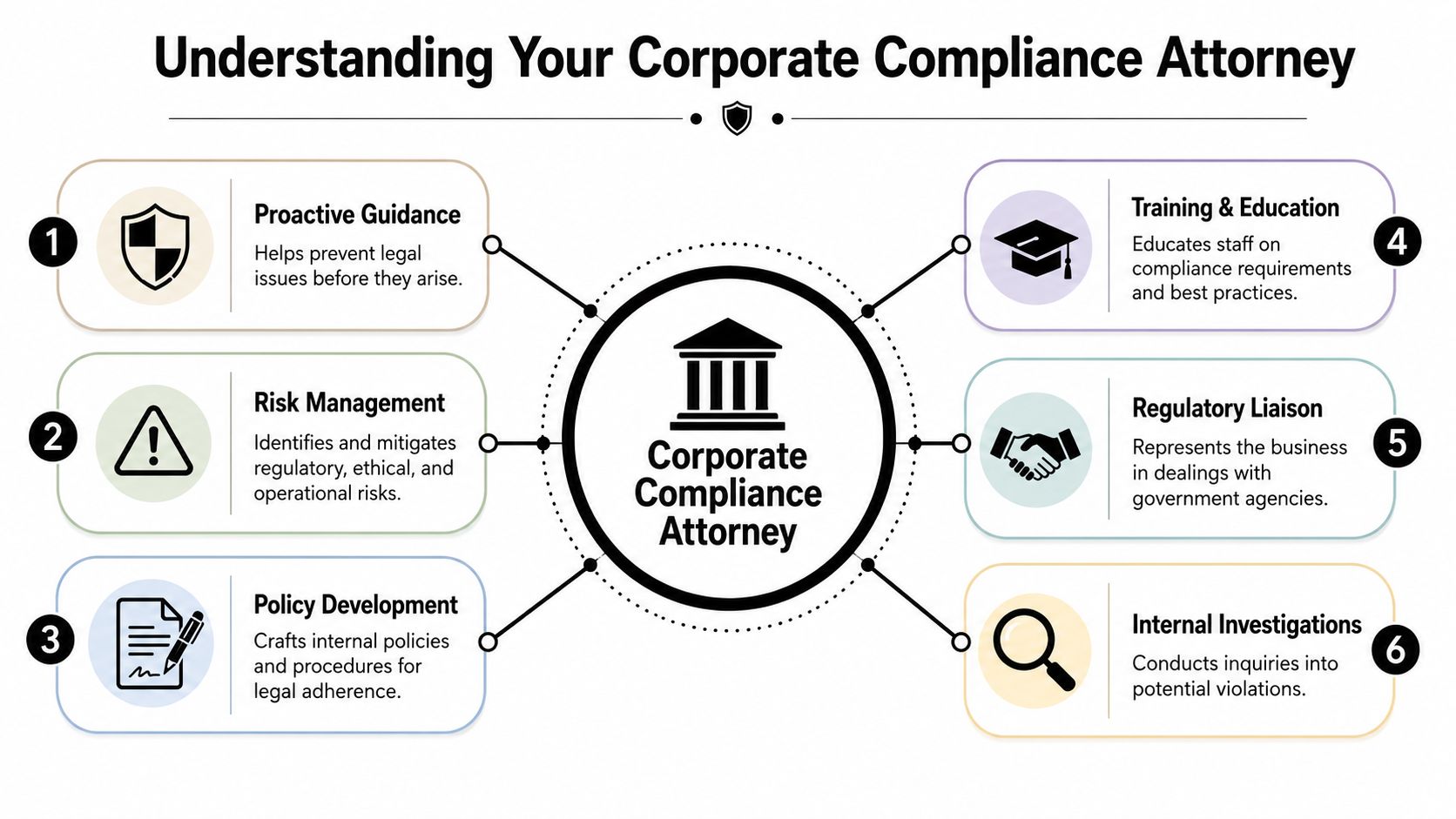
The job is preventive. A compliance attorney translates legal obligations into policies, reporting lines, training steps, review procedures, and records the business can produce later if a regulator, bank, insurer, investor, or opposing party asks questions. For a local manufacturer, that may center on vendor controls and workplace reporting. For a professional services firm in Alpharetta, it may focus more on confidentiality, governance approvals, and record retention.
The work is preventive, not ceremonial
Good compliance work is operational. It should help an owner answer practical questions that come up in real businesses across Forsyth County and North Fulton County:
- Which laws and obligations apply now based on your headcount, industry, contracts, and data handling?
- Which policies need to be written for your business instead of copied from a generic template?
- Who is responsible for each compliance task inside the company?
- How are managers and employees trained so the policy is followed consistently?
- What records show the company responded appropriately when an issue was reported?
For HR-heavy businesses, legal risk often grows out of routine administrative gaps. A useful supplemental resource on compliance advice for HR managers can help owners think through leave administration, policy tracking, and employee process issues that often create legal exposure.
What this looks like inside a real business
In a small or midsize company, compliance usually touches several core business functions at once. The attorney may review who can bind the company to a contract, how complaints move from a supervisor to leadership, what training is documented, and whether old policies still fit the company's current operations in Georgia.
That often includes work such as:
- Entity governance documents that define authority, voting, approvals, and decision-making
- Employment policies covering reporting, investigations, confidentiality, discipline, and manager expectations
- Contract review procedures for vendors, customers, and strategic partners
- Internal investigation protocols for misconduct, retaliation concerns, or financial irregularities
- Audit and remediation steps that test whether policies are being followed in practice
For some owners, the first issue is basic corporate housekeeping. Reviewing governance language against a corporate bylaws example can be a useful starting point, but the actual work is tailoring those documents to how the company in Cumming, Alpharetta, or the surrounding North Georgia market is run today.
Practical rule: If a supervisor cannot apply the policy during a busy workday, the policy is not ready to protect the company.
Key Compliance Areas for Businesses in Cumming and Alpharetta
A Forsyth County company can look healthy on paper and still carry quiet compliance exposure. The owner is focused on hiring, customer demand, and cash flow. Meanwhile, one manager is handling complaints informally, another is saving employee records in a shared drive, and a longtime vendor has broader system access than anyone remembers approving. That is the kind of drift that creates trouble for North Georgia businesses.
For companies in Cumming, Alpharetta, and the surrounding area, the most useful approach is to sort compliance by where problems usually start. In practice, that often means people, data, licenses, and third-party relationships.
Employment practices in Cumming and Alpharetta
Employment issues often become the first real compliance pressure point for a growing business. A small team can run on trust and daily communication for a while. Once the company adds supervisors, departments, or a second location, consistency matters more than good intentions.
The risk is usually not a single dramatic mistake. It is uneven handling of ordinary issues such as onboarding documents, timekeeping expectations, complaint intake, confidentiality, leave questions, discipline, and separations. In Georgia, owners also need to remember that a practical policy is more protective than a polished one that no manager follows during a busy week.
Local employers in Cumming and Alpharetta often face a specific trade-off. They want flexibility so managers can respond to people problems quickly, but too much discretion produces inconsistent treatment and poor documentation. A sound compliance program sets clear rules on what must be documented, who makes the call, and when legal review is appropriate.
Data handling and record disposal across North Georgia operations
Many North Georgia companies underestimate their data risk because they do not see themselves as tech companies. That is a mistake. Manufacturers, home service businesses, medical-adjacent practices, professional firms, and growing online sellers all collect records that can create legal and operational problems if they are kept too loosely or too long.
A basic review should answer four questions:
| Compliance question | Why it matters |
|---|---|
| What information do we collect? | A company cannot control data it has never identified |
| Who can access it? | Broad internal access increases misuse and error risk |
| How long do we keep it? | Keeping outdated records expands exposure |
| How do we dispose of it? | Poor disposal practices can turn old files into a current liability |
Disposal deserves more attention than it usually gets. I often see businesses with closed employee files, retired hard drives, copied customer records, and old laptops sitting in storage long after any business reason for retention has ended. For companies reviewing those procedures, guidance on secure data destruction in Georgia can help operations teams build a cleaner process for paper records, devices, and archived equipment.
Licensing, regulated activity, and local operating realities
Some businesses in Forsyth County and North Fulton need more than annual filings and a basic set of internal policies. Industry rules can affect advertising, customer disclosures, credentialing, approvals, recordkeeping, and how services are delivered. That is especially true in Alpharetta, Milton, Johns Creek, and Roswell, where many companies work in finance-adjacent services, healthcare-adjacent operations, technology, and specialized professional services.
The legal issue is often less obvious than owners expect. A company may be excellent at serving clients and still have weak controls around who is allowed to make representations, who can approve exceptions, or what must be documented before work starts. Those gaps tend to surface during disputes, audits, financing events, or buyer diligence.
Third-party oversight and contract risk
Outside vendors create some of the most preventable compliance problems I see. The company may handle its own operations carefully but give a payroll processor, marketing firm, IT provider, staffing company, or software vendor access without clear limits or internal oversight.
Common trouble spots include:
- Contract terms that are too loose on confidentiality, security duties, indemnity, and notice requirements
- No intake process for reviewing a new vendor before access is granted
- No internal owner responsible for monitoring the relationship after the contract is signed
- No escalation path when a vendor incident affects employee information, customer data, or financial records
These are ordinary operating issues. They become legal issues when no one is clearly responsible. For a practical look at how these breakdowns show up inside growing companies, review common business compliance violations that can hurt your company.
When Your Business Needs a Compliance Attorney
The right time to call a compliance attorney usually isn't after a formal crisis. It's when the business reaches a point where informal controls are no longer enough. Small and midsize companies in Cumming, GA, Alpharetta, GA, Milton, Johns Creek, and Canton often wait too long because they assume compliance counsel is only for large corporations. That assumption can be expensive.
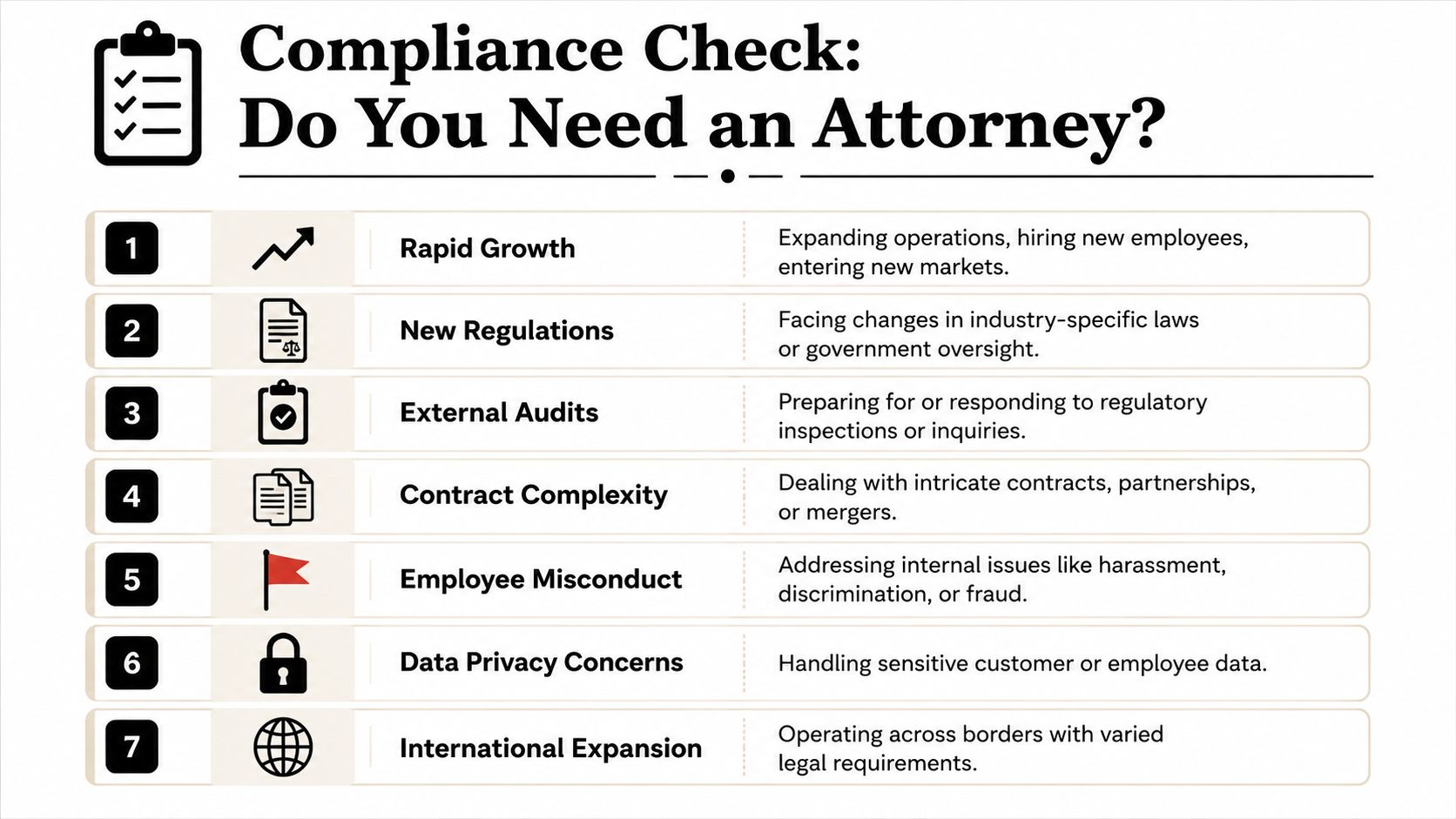
The trigger is usually a business event, not a headcount. If you're adding layers of management, entering a more regulated market, collecting more sensitive information, or preparing for a transaction, the legal risk profile has changed even if the company still feels small.
Milestones that should prompt a call
A business should seriously consider compliance counsel when any of these happen:
- The first real management layer appears. Once supervisors are making decisions on hiring, discipline, complaints, or approvals, consistency becomes a legal issue.
- The company starts collecting more data online. Websites, customer portals, intake forms, and internal software change the evidence and privacy picture.
- Expansion crosses practical boundaries. New markets, new business lines, or more complicated vendor relationships create control problems.
- An agency inquiry, internal complaint, or audit request arrives. At that point, the company needs a disciplined response, not guesswork.
- A deal is on the table. Mergers, acquisitions, investment rounds, and major contracts all expose weak compliance foundations.
Paper programs aren't enough
Federal enforcement expectations have moved toward substance over appearance. The U.S. Department of Justice's 2024 guidance emphasizes that prosecutors evaluate whether compliance programs are resourced and tested, not just written down, as discussed in Gertsburg Licata's summary of regulatory compliance and enforcement expectations. For a local company, that means a handbook by itself won't carry much weight if no one follows it, no one is trained on it, and no one checks whether it works.
If your answer to "How do we know this policy is being followed?" is silence, the problem isn't drafting. It's program design.
That is why many North Georgia businesses get the most value from compliance counsel during transition points. Not because they are already in trouble, but because they are becoming large enough, visible enough, or complex enough that they need proof of disciplined operations.
Services That Build Your Company's Legal Shield
In a growing North Georgia company, compliance work usually breaks down in ordinary places. A supervisor handles a complaint informally. A sales lead signs a vendor form without legal review. An employee saves customer information in the wrong system because no one gave clear instructions. Those are the moments that create exposure in Cumming and Alpharetta businesses, not just the policy binder sitting on a shelf.
A corporate compliance attorney builds a working system around those pressure points. The job is to turn legal requirements into approvals, reporting paths, training steps, review procedures, and records the company can produce later if a regulator, lender, buyer, or plaintiff asks how the business controls risk.
Policies that match your business operations
Many small and midsize businesses start with borrowed templates. That is understandable. It is also where problems begin, because a copied policy rarely matches who makes decisions, how exceptions are approved, or where key records are stored.
Useful policies usually cover:
- Employee conduct and reporting rules that set expectations and identify where concerns go
- Manager instructions so supervisors respond consistently to leave issues, complaints, discipline, and accommodations
- Vendor and contract procedures for review, signature authority, and document retention
- Data handling rules tied to access, storage, retention, and disposal
For a North Georgia business, the point is not volume. The point is fit. A 40-person manufacturer in Forsyth County does not need the same controls as a fast-growing Alpharetta software company, and both should avoid policy sets written for a national enterprise with separate compliance staff.
Training, reviews, and investigations
Training is where policy becomes daily conduct. It should reflect the decisions your team is likely to face, not abstract legal theory. Managers need to know what to escalate. HR needs a repeatable intake process. Finance staff need clear approval rules. Employees handling customer or employee data need practical instructions they can follow under time pressure.
Periodic reviews test whether those controls work. Counsel may review files, trace approval steps, sample contracts, examine complaint handling, or compare written policy against what teams do in practice. That review often finds the same issue in different forms. The rule exists, but no one owns it.
Investigations also need structure from the start. Someone must preserve records, define who interviews witnesses, protect confidentiality as much as possible, and document corrective action. Sloppy internal reviews create new problems, especially if the original issue later turns into a claim.
Operational advice: The strongest compliance programs rely on repeatable routines. The same intake method, the same approval path, the same retention practice, every time.
Companies working through technology risk should also align compliance planning with operational security. Our guidance on business planning for digital security and resilience addresses how legal controls and day-to-day safeguards should support each other, particularly for local businesses handling employee records, customer data, and vendor access across multiple systems.
Hiring the Right Compliance Attorney in the Alpharetta Area
Choosing a compliance lawyer in Alpharetta, GA isn't just about finding someone who knows legal vocabulary. The better question is whether the attorney can convert legal requirements into business process. That requires more than textbook knowledge.
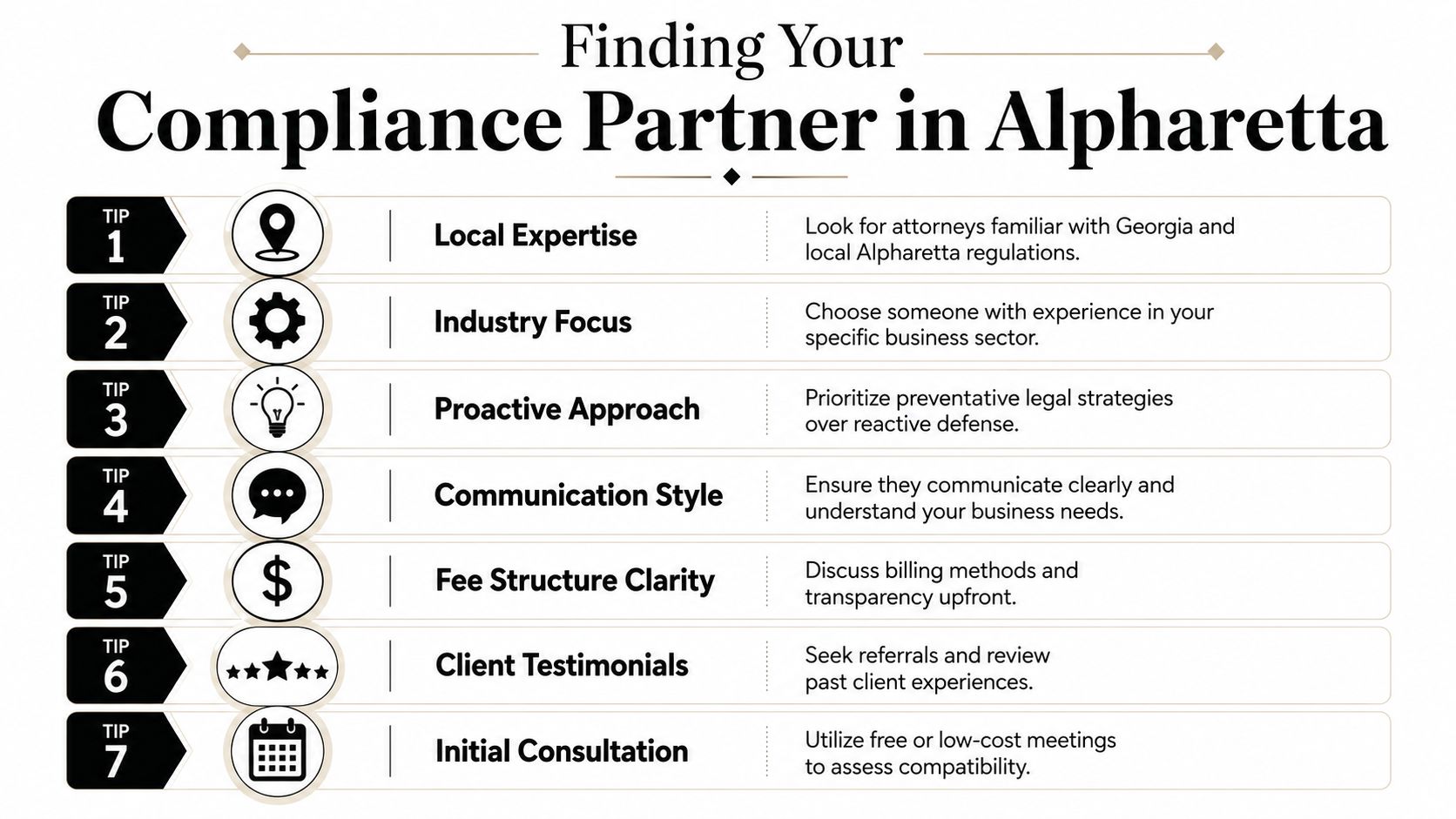
An effective compliance attorney needs a multidisciplinary profile, combining command of contract and administrative law with enough business and HR fluency to turn legal requirements into implementable controls, according to National Jurist's discussion of the compliance attorney role. That point matters for companies in Alpharetta, Roswell, Sandy Springs, and Cumming because the practical work often happens in handoffs between legal review, operations, finance, and people management.
Questions worth asking before you hire
A good interview with prospective counsel should reveal how they think, not just what they claim to know. Ask questions like these:
- How do you tailor policies to a small or midsize business?
- What does your review process look like beyond drafting documents?
- How do you handle manager training and follow-up?
- What kinds of audits or spot checks do you recommend?
- How do you respond when an internal complaint or agency inquiry arrives?
- What Georgia-specific issues do you watch for in local business operations?
What practical fit looks like
The right fit usually includes three things.
First, the attorney should be able to explain risk in plain English. If every answer sounds like a law school outline, implementation will suffer.
Second, the attorney should understand business reality in Fulton County and Forsyth County. Companies in Alpharetta, Johns Creek, Milton, Suwanee, and Dawsonville don't need theory detached from staffing limits, budget limits, and local operating pace.
Third, fee structure should be discussed early. Some businesses need project-based work such as handbook revision, training, or investigation support. Others need ongoing fractional counsel. The point is clarity. If scope is vague, billing disputes usually follow.
Why Choose Miles Hansford for Your Business's Future
Businesses in Cumming, GA, Alpharetta, GA, and across North Georgia often want one legal team that understands both day-to-day business planning and what happens when a dispute, investigation, or operational problem follows. That's especially true for owners balancing company growth with family, property, succession planning, and personal risk.
Miles Hansford serves clients across Forsyth County, Fulton County, and the greater North Atlanta area as a full-service law firm handling business and corporate law, civil litigation and dispute resolution, estate planning and probate, criminal defense, family law, and mediation. That range matters because compliance issues rarely stay in one lane. A governance issue can become a contract dispute. An employment problem can turn into litigation. A business transition can raise estate planning concerns for the owner.
For a North Georgia business, local counsel should understand more than statutes. Counsel should understand how companies in Alpharetta, Cumming, Johns Creek, Milton, Roswell, and surrounding communities operate, hire, contract, and grow. That kind of practical familiarity helps business owners make decisions earlier, with better information and fewer avoidable surprises.
Frequently Asked Questions for Georgia Business Owners
Do small businesses in Cumming really need a Corporate Compliance Attorney
Sometimes yes. The better question isn't company size. It's whether the business has enough employees, customer data, contracts, vendors, or regulated activity that informal practices are no longer safe. In Cumming and Forsyth County, that often happens sooner than owners expect.
What's the difference between a compliance officer and a Corporate Compliance Attorney
A compliance officer usually manages internal processes and day-to-day oversight. A Corporate Compliance Attorney brings legal analysis, privilege considerations, policy design, investigation structure, and defensibility planning. Many growing businesses need both functions, even if one is outsourced.
How often should a business review its policies
Policies should be reviewed whenever the business changes in a meaningful way. Hiring growth, new software, new data practices, new vendors, new service lines, and expansion into new markets all justify review. A schedule helps, but event-driven review is usually more useful than waiting.
What happens if a Georgia agency asks questions or requests records
The business should respond carefully, consistently, and with preserved documentation. That usually means identifying the scope of the request, controlling internal communications, collecting relevant records, and avoiding ad hoc explanations from multiple employees. Early legal coordination matters.
Can template policies work for a business in Alpharetta
Templates can help start a conversation, but they rarely finish the job. Most businesses in Alpharetta need policies tied to actual reporting lines, manager responsibilities, contract practices, and data handling habits. Generic language often leaves the most important operational gaps untouched.
Is compliance only about avoiding penalties
No. Good compliance also supports cleaner management, better delegation, stronger contracting, and more credible internal investigations. For many owners in Fulton County and Forsyth County, the main benefit is being able to grow without guessing whether the company is exposed in ways no one has documented.
If your business in Cumming, Alpharetta, Forsyth County, or Fulton County is growing faster than your internal controls, it's time to get clear about risk before a complaint, audit, or dispute forces the issue. Miles Hansford Law Firm provides business and corporate law counsel for North Georgia companies that need practical legal structure, not generic advice. Schedule a consultation to discuss your policies, reporting systems, contracts, training, and next steps.
Meta Title: Corporate Compliance Attorney in Cumming and Alpharetta
Meta Description: Corporate compliance attorney guidance for Cumming and Alpharetta businesses. Protect growth in Forsyth County and Fulton County. Schedule a consultation.
Suggested URL Slug: /corporate-compliance-attorney-cumming-alpharetta-ga/
Internal Link Suggestions:
- Corporate bylaws example
- Don't let these compliance violations hurt your business
- Business planning for digital security and resilience
Schema Recommendations:
- Attorney
- LegalService
- FAQPage