


If you're in the middle of a divorce in Cumming, GA or Alpharetta, GA, unfairness often shows up before anyone says it out loud. A spouse delays document production, drains an account, manipulates a business valuation, or agrees to one thing in mediation and does another the next week. In high-stakes family cases, that behavior creates fear fast because you can feel the ground shifting under your finances and your parenting time.
Georgia law gives you more protection than many people realize. Even when an agreement doesn't spell out every possible act of cooperation, the law expects people to carry out their obligations in good faith. In a divorce involving property division, support, custody logistics, or a settlement agreement, that principle can matter in very practical ways in Forsyth County Superior Court and Fulton County Superior Court.
Understanding the Implied Covenant of Good Faith and Fair Dealing
You sign a settlement agreement believing the hard part is over. Then the other side starts following the document in a way that defeats its purpose. The refinance never gets finished. Business records arrive late and incomplete. A transfer that should take days turns into months. In a divorce, that is often the moment clients first hear the phrase implied covenant of good faith and fair dealing.
The concept is technical, but the problem it addresses is familiar. Contract law does not look only at whether a person can point to a sentence and claim compliance. It also examines whether that person carried out the agreement faithfully and in a way that preserves the benefit both sides were supposed to receive. As the Restatement rule discussed in this legal analysis explains, every contract carries a duty of good faith and fair dealing in performance and enforcement.
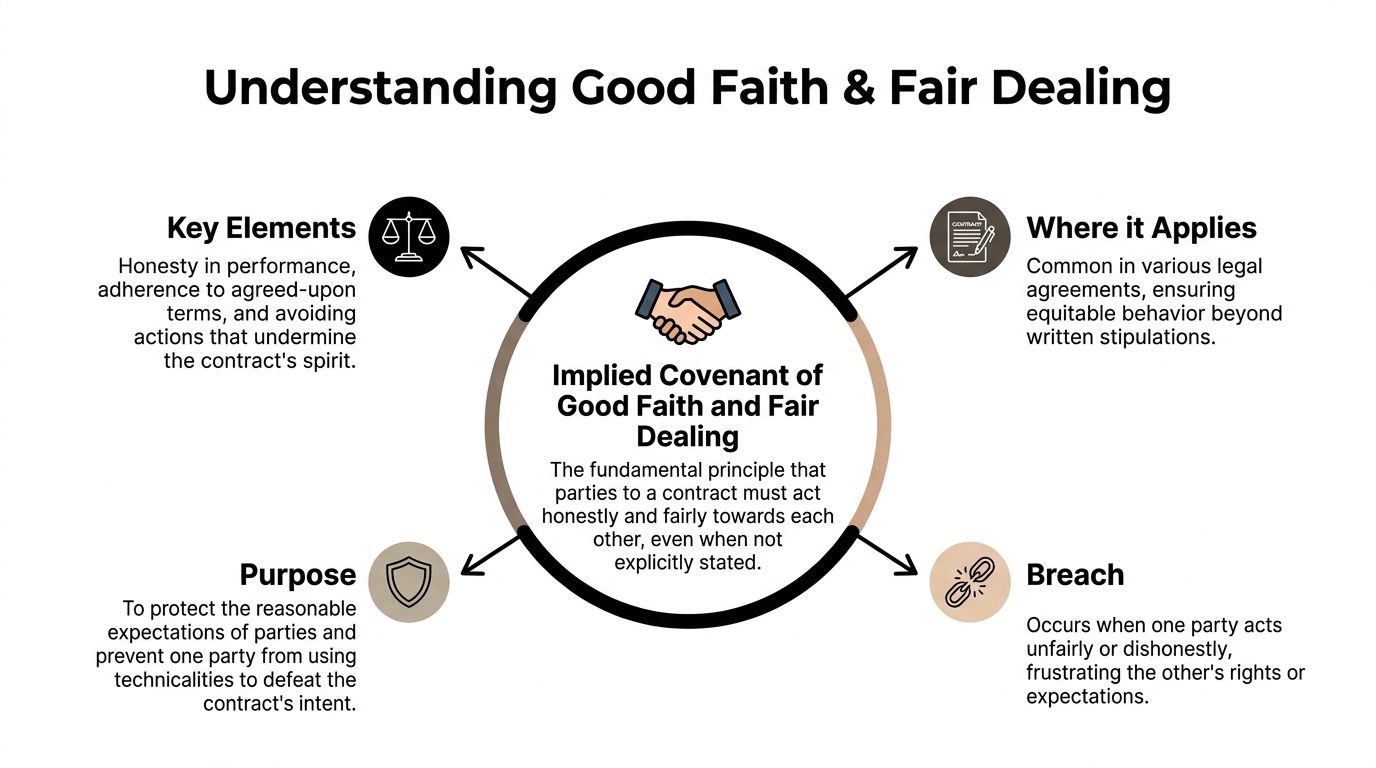
What this means in plain English
A party can violate the spirit of an agreement without violating it in the most obvious way.
That distinction matters in Georgia divorce cases because settlement terms often require cooperation after the papers are signed. One spouse may have control over payroll records for a closely held company in Alpharetta. Another may be the only person who can provide lender documents tied to a marital home in Cumming. If that spouse uses delay, selective disclosure, or technical excuses to undercut the result the agreement was supposed to deliver, the court may evaluate that conduct through the lens of good faith.
Judges in family law cases usually focus on function. They want to know whether a party performed in good faith, reasonably, and in a way that allowed the agreement to work as intended. Clever obstruction rarely plays as well in court as people expect.
Implied does not mean unlimited
An express term is written on the page. An implied covenant is a duty the law reads into the agreement because contracts are supposed to be performed in good faith, not manipulated for advantage.
That does not give either side a free pass to rewrite a bad bargain after the fact. It also does not turn every disappointment into a legal claim. The covenant usually matters where one party has discretion in how to perform, control over information, or the practical ability to block the other side from receiving what the agreement promised. In divorce litigation, that shows up often in property transfers, valuation support, debt payoff steps, and post-settlement business conduct.
Clients often understand the idea faster after reading about how implied contracts can create enforceable obligations under Georgia law. The same basic lesson applies here. A spouse cannot hide behind a narrow reading of the document while undermining the deal in practice.
Why this doctrine matters in North Georgia divorces
In Forsyth and Fulton County cases, good faith disputes are rarely abstract. They usually involve money, timing, and control. A spouse may technically agree to a business valuation, then start running personal expenses through the company or delaying receivables before the expert finishes the report. A settlement may require the division of retirement assets, but one side sits on plan paperwork until market conditions change. Those facts matter because they show intent and effect, not just delay.
People under strain often look for general advice on navigating divorce challenges. In court, though, broad advice gives way to specifics. The question becomes whether the conduct frustrated the benefit of the agreement and whether the record is strong enough to prove it.
That is the practical heart of the implied covenant of good faith and fair dealing. It is a tool for holding parties to honest performance, especially where one spouse has room to manipulate timing, access, or financial information without openly defying the written words.
Why Good Faith Matters in Your Cumming GA Divorce
You agree on paper to value the family business, refinance the house, and exchange records. Then the numbers start changing. Receivables slow down, personal expenses show up in the business, lender requests go unanswered, and the case begins to feel less like a divorce and more like a pressure campaign.
That pattern shows up often in Cumming divorces involving small businesses, deferred compensation, rental property, or complicated parenting schedules. In those cases, bad faith is not just aggravating behavior. It can change the outcome of property division, support, and settlement advantage.
In Georgia family law, good faith matters because many divorce obligations require cooperation to mean anything. A settlement term may look clear on paper, but one spouse can still undercut it by delaying signatures, withholding records, interfering with a sale, or manipulating business income before a valuation is complete. In practice, judges in Forsyth and Fulton County pay close attention to conduct that defeats the benefit of an agreement while maintaining the appearance of compliance.
Business owners and spouses of business owners see this problem more than anyone else. A company can be trimmed up for litigation in ways that are hard to spot unless someone asks the right questions early. Customers get shifted. Distributions change form. Expenses that should be personal run through the business. By the time a neutral expert starts the valuation, the paper trail may already be distorted.
The same problem appears with real estate. A spouse promises to refinance the marital home in Cumming or Alpharetta, but then misses document deadlines, ignores lender follow-up, or lets the lock expire. That delay can force the other spouse into a lower buyout, a rushed sale, or months of continued joint liability.
Debt issues matter too. If someone keeps drawing on joint credit lines after separation for reasons unrelated to the household, the final balance sheet can look very different from the one that should have been presented to the court.
Quiet obstruction still counts.
Good faith also affects children and support. A parent who withholds school information, refuses to confirm exchanges, or turns routine scheduling into a bargaining tool may be trying to gain an advantage in settlement through chaos at home. Judges see that for what it is. It also tends to damage credibility, which matters in any contested hearing involving custody, parenting time, alimony, or temporary support.
Many people look for outside help while they are navigating divorce challenges. That support can be useful. In court, though, the focus stays on proof, timing, and the specific way the other party's conduct interfered with an actual obligation.
The practical response is simple, even if it is not easy. Preserve emails, texts, bank records, business statements, lender communications, and shared calendar history. Do it early. If property may be dissipated or accounts may be moved, review steps for protecting assets in a Georgia divorce before the damage is harder to trace.
Clients are often tempted to give one more extension and hope things settle down. Sometimes that is the right call. More often, in a high-conflict divorce, delay rewards the spouse who is already using time as a weapon.
Proving a Breach of Good Faith in Alpharetta Family Law
You may know something is off. The business suddenly looks less profitable on paper. A spouse who once answered every question now delays, gives partial records, or claims documents no longer exist. In Alpharetta divorce cases, that instinct matters, but judges in Fulton County want the proof tied to a specific duty they can enforce.
Georgia law does not treat the implied covenant of good faith and fair dealing as a free-floating claim. It attaches to actual obligations in an agreement or order. As the Georgia analysis of Alan's of Atlanta, Inc. v. Minolta Corp. explains, the duty modifies express terms rather than creating a separate promise out of thin air. In family law, that point becomes very practical. If a spouse agreed to produce business records, cooperate with a sale, maintain insurance, or follow a temporary parenting schedule, the court can examine whether that duty was carried out fairly.

Identify the obligation before you argue motive
In my experience, good-faith arguments get traction when they start with the exact term that was undermined.
That may be a settlement provision requiring document exchange, a standing obligation to preserve marital assets, a temporary order governing parenting time, or a buyout term tied to a business valuation in Cumming or Alpharetta. The question is whether the spouse used delay, selective disclosure, manipulation of information, or technical compliance to defeat the purpose of that obligation.
Judges hear "unfair" every day. They respond better to specifics. "He tanked the value of the company before mediation by withholding vendor contracts and delaying accounts receivable reports" gives the court something concrete to evaluate. In a divorce involving a closely held business, that kind of conduct can affect equitable division, support, and settlement posture all at once.
What proof usually carries weight
In North Fulton family law cases, the strongest evidence is often ordinary paper, digital records, and testimony that lines up. Useful proof can include:
- Bank and credit card records showing unusual spending, transfers, debt increases, or cash withdrawals
- Business valuation materials such as ledgers, profit and loss statements, payroll records, merchant processing reports, and QuickBooks data
- Texts, emails, and parenting app messages showing delay, refusal, shifting explanations, or intentional confusion
- Third-party records from lenders, accountants, brokers, vendors, schools, or employers
- Deposition testimony that fixes a party's story before trial and exposes contradictions later
Depositions matter in these cases because bad faith is often proved through inconsistency, not confession. Careful deposition preparation for a Georgia family law case can prevent careless answers and help preserve credibility when the financial story starts to shift.
Parenting issues can create a similar record. A spouse may comply with the bare words of a parenting plan while using communication gaps, school events, or exchange logistics to make co-parenting harder than it should be. Families dealing with those dynamics often benefit from outside support such as trauma-informed co-parenting strategies, but in court the question stays the same: what duty existed, and what conduct interfered with it?
How these claims are usually built
The proof usually develops in stages, especially in a high-conflict divorce involving a business or disputed income:
- Pin down the duty. Pull the settlement language, standing order, temporary order, email agreement, or discovery response that created the obligation.
- Gather the missing and conflicting records. Compare what was promised, what was produced, and what outside records show.
- Use formal discovery to close gaps. Subpoenas, requests for production, interrogatories, and depositions often expose whether the problem is sloppiness or intent.
- Bring in an expert if the numbers matter. A forensic accountant or business valuator can explain why missing records, delayed reporting, or manipulated expenses changed the picture.
- Present the pattern clearly. Courts are more persuaded by a timeline of conduct tied to a duty than by a broad claim that one spouse acted badly.
A strong good-faith claim is usually methodical.
In many Alpharetta and Cumming divorce cases, the turning point is a pattern that shows one spouse used control over information, money, or parenting logistics to frustrate the deal the parties made or the order the court entered. That is how a suspicion becomes a breach the court can address.
Strategic Responses to Bad Faith in Your Divorce
Once bad faith appears, the case becomes a strategy problem. Waiting and hoping a difficult spouse becomes reasonable rarely works in Forsyth County or Fulton County. Early legal action is often what protects the status quo before assets move, debts rise, or the parenting dynamic hardens.
Georgia law gives structure to that response. Under O.C.G.A. § 11-1-304 and the related reasonableness framework discussed here, performance must be carried out in good faith, and contract terms are interpreted as reasonable. In disputes involving discretion, courts can examine whether conduct was driven by improper motives such as self-dealing.
The proactive path
A proactive approach is usually best when the warning signs appear early. That may mean asking the court for temporary relief before the case gets harder to control.
Common examples include:
- Temporary orders on finances that limit unusual spending, preserve accounts, or maintain bill payment patterns
- Restrictions on transfers or sales when a spouse may try to move or encumber property
- Temporary custody and parenting provisions so one parent can't use chaos to create a new normal
- Early business record requests when a family-owned company is central to equitable division
Temporary hearings often shape the rest of the divorce. Judges don't like preventable financial games, and they especially dislike avoidable instability affecting children.
The reactive path
Sometimes the misconduct becomes clear only after discovery, mediation, or missed deadlines. Then the strategy shifts.
A spouse's bad faith can be used in settlement negotiations by increasing pressure for transparency, stronger enforcement language, tighter deadlines, and clearer remedies. If resolution fails, the same conduct may become part of a courtroom presentation on equitable division, credibility, and attorney's fees.
A reactive strategy is also important in parenting disputes. A parent dealing with manipulative communication or pressure tactics may need practical emotional support alongside legal action. Some families find value in reading about trauma-informed co-parenting strategies while the legal issues are being addressed through counsel.
What helps and what hurts
Here is the trade-off in plain terms.
| Approach | What it can do | What it won't do |
|---|---|---|
| Early temporary relief | Protect accounts, routines, and leverage | Fix damage that's already been done |
| Aggressive discovery | Expose hidden records and contradictions | Replace a weak factual theory |
| Mediation with evidence | Turn proof into settlement pressure | Force honesty without consequences |
| Trial presentation | Ask the judge for enforceable remedies | Make up for poor documentation |
The mistake many people make is treating bad faith as a moral argument. Courts treat it as a proof problem and a remedy problem. The strongest position is calm, documented, and timely.
What to Expect in Forsyth and Fulton County Courts
The law is statewide, but court experience is local. A spouse filing in Forsyth County Superior Court may face a different pace and courtroom rhythm than someone handling a case in Fulton County Superior Court or the broader North Fulton courts serving Alpharetta, Milton, Roswell, and Sandy Springs.
That local reality matters in a covenant of good faith dispute because timing, judge expectations, and the quality of presentation often affect whether bad-faith conduct is addressed early or postponed until later.

Temporary hearings matter more than most people expect
In both Forsyth and Fulton County divorce cases, a temporary hearing may be the first real chance to show a judge that one spouse is manipulating finances, access, or settlement performance. If the issue is urgent, waiting for final trial can be too late.
A temporary hearing may address possession of the marital residence, temporary support, parenting time, bill payment, use of accounts, and limits on financial conduct while the case is pending. If one spouse has been hiding records, disrupting parenting exchanges, or undermining property preservation, that hearing can set the tone for the entire case.
Judges often make early credibility assessments at temporary hearings. Those impressions can influence the rest of the litigation.
Mediation is part of the local process
Mediation is a practical part of family law in both counties. Many divorce and custody matters will move toward mediation before final resolution, especially contested cases involving property division or parenting disputes.
Good faith matters there too. A spouse who mediates while concealing accounts, withholding valuation records, or using children as pressure points weakens the process. In some cases, that behavior makes settlement impossible. In others, it leads to stricter written terms, more verification requirements, and less flexibility in the final agreement.
Local issues that shape these cases
People searching for a divorce lawyer near me in Cumming, Alpharetta, Johns Creek, Suwanee, Dawsonville, Canton, Roswell, or Milton usually aren't just asking for legal information. They're asking whether someone understands how these courts function in practice.
Several local realities tend to matter:
- Forsyth County divorce filings often require disciplined preparation because judges expect concise, supported requests rather than broad accusations.
- Fulton County custody hearings can involve dense calendars and more procedural complexity, which makes clean evidence presentation especially important.
- Georgia parenting plans are required in custody cases, and a bad-faith parent often reveals themselves in the details of communication, exchanges, school coordination, and holiday scheduling.
- Equitable division in Georgia is not automatic equal division. Conduct affecting assets or debts can influence how fairness is argued.
- Georgia no-fault divorce law allows a case to proceed without proving traditional fault grounds, but conduct during the case still matters in temporary relief, settlement posture, and credibility.
A spouse in Cumming may be dealing with a family business. A spouse in Alpharetta may be dealing with deferred compensation or a complicated bonus structure. A parent in Johns Creek may be worried about school-zone logistics and parenting plan terms. The court system sees all of those issues differently depending on how clearly they're framed and how quickly they're addressed.
Why Choose Miles Hansford to Uphold Good Faith in Your Divorce
A bad-faith divorce case can turn fast. One spouse delays document production, changes how business income is reported, stops cooperating with refinancing, or agrees to terms in mediation and then undermines performance afterward. In North Georgia family court, that conduct is not just frustrating. It can affect advantage, timing, expense, and the final result.
Miles Hansford represents clients in Cumming, Alpharetta, Forsyth County, and Fulton County in divorce, custody, property division, mediation, and contested family litigation. The firm handles the kind of cases where good faith becomes a real issue, including closely held businesses, disputed valuations, missing financial records, parenting conflicts, and enforcement problems after settlement.
That matters because these cases require judgment, not just paperwork. A lawyer has to know when to press for records, when to push for a temporary hearing, when a business valuation needs closer scrutiny, and when a settlement term needs tighter language before it creates a future enforcement fight. In a divorce involving a company, commission income, deferred compensation, or shared real estate, small drafting choices can decide whether an agreement works in practice.
Clients also need a legal strategy that fits the court and the stakes. In Forsyth County, that often means disciplined presentation and clear proof. In Fulton County, it often means staying ahead of scheduling pressure and building a record a judge can review quickly. The right approach protects credibility while keeping the case focused on what the court can fix.
If your spouse is using delay, concealment, or selective cooperation to gain an advantage, early action usually matters. Clear advice at the start can help protect assets, preserve records, and keep a solvable problem from becoming a much more expensive one.
FAQs About Fair Dealing in a Georgia Divorce
Q: What is the covenant of good faith in a Georgia divorce?
A: It refers to the legal expectation that parties carry out agreements fairly, not in a way that destroys the other person's benefit of the deal. In Georgia divorce cases, this often matters in settlement agreements, property transfers, refinancing obligations, and other performance issues tied to written terms.
Q: Can my spouse hide assets during a divorce in Cumming, GA?
A: Your spouse may try, but Georgia divorce procedure allows discovery tools to investigate missing information. In Forsyth County Superior Court, bank records, subpoenas, depositions, and forensic review may help uncover concealed accounts, diverted income, or unusual transfers before equitable division is finalized.
Q: Does bad faith affect equitable division in Georgia?
A: It can. Georgia follows equitable division, which means the court looks at what is fair rather than automatically splitting everything equally. If a spouse wastes assets, manipulates debt, or interferes with valuation or sale of property, that conduct may affect how fairness is argued.
Q: What if my spouse won't cooperate with selling or refinancing the marital home in Alpharetta?
A: That problem can often be raised through temporary motions, enforcement requests, or settlement litigation. In Fulton County Superior Court and North Fulton family cases, courts may address missed deadlines, noncooperation with lenders or realtors, and conduct that frustrates the agreed transfer of the home.
Q: How long will my divorce take in Cumming or Alpharetta?
A: Georgia has a 30-day minimum waiting period after filing before a divorce can be finalized. An uncontested case may resolve relatively quickly, but contested divorce matters involving custody, business valuation, or hidden assets in Forsyth County or Fulton County usually take longer and depend on court scheduling and complexity.
Q: Can bad faith affect child custody in Georgia?
A: Yes, especially when the conduct affects the children's stability or a parent's ability to follow the parenting plan. Georgia courts decide custody based on the best interests of the child, and judges pay attention to communication problems, interference with parenting time, and refusal to cooperate on major child-related decisions.
Q: Are parenting plans required in Georgia custody cases?
A: Yes. Georgia courts require a parenting plan in custody matters. In practical terms, that means parents in Cumming, Alpharetta, Johns Creek, and nearby communities need a clear plan for schedules, holidays, transportation, decision-making, and communication. A vague plan often creates more conflict later.
Q: Will my divorce case have mediation in Forsyth County or Fulton County?
A: Many contested family law cases will involve mediation before final trial. Mediation can be productive, but it works best when both sides exchange accurate information and negotiate in good faith. If one spouse withholds records or uses mediation as a delay tactic, the case may need stronger court intervention.
If you're dealing with dishonesty, delay, hidden money, or pressure around custody or settlement terms, speak with Miles Hansford Law Firm. The firm helps clients in Cumming, Alpharetta, Forsyth County, Fulton County, and nearby North Georgia communities protect assets, protect parental rights, and move forward with a clear legal strategy. Schedule a consultation to speak with a family law attorney who understands the local courts and the stakes in your case.
Meta Title: Covenant of Good Faith in Cumming Divorce, GA
Meta Description: Covenant of good faith in Cumming, GA divorce cases. Learn how Forsyth and Fulton County courts handle unfair settlement and custody conduct.
Suggested URL Slug: /cumming-ga-covenant-of-good-faith-divorce
Internal Link Suggestions:
Schema Recommendations:
- Attorney
- LegalService
- FAQPage