


A hiring manager in Alpharetta sends the offer letter on Friday afternoon. The salary looks right. The role is a step forward. Then you reach the back of the packet and find a covenant not to compete.
That moment creates the same question for both sides. If you're the employee, you want to know whether signing it could box you out of Johns Creek, Milton, Cumming, or the broader North Atlanta market later. If you're the business owner, you want to know whether the clause will protect client relationships and confidential information if someone leaves.
A rushed answer usually creates the biggest problem. These agreements can shape hiring decisions, exits, buyouts, injunction requests, and emergency hearings in Forsyth County Superior Court or Fulton County Superior Court. Before signing, enforcing, or ignoring one, it helps to get a clear read on what Georgia law will and will not support.
A Guide to Covenants Not to Compete in Alpharetta GA
In Alpharetta, a non-compete issue often starts with a normal business event. A software employee changes jobs. A sales leader leaves with relationships across Roswell, Sandy Springs, and Suwanee. A practice owner hires someone with access to pricing, referral sources, or customer lists. Then the contract becomes the center of the dispute.

In real practice, the first mistake is usually overconfidence. Employers sometimes assume any signed restriction is enforceable. Employees sometimes assume every non-compete is dead on arrival. In Georgia, neither assumption is safe.
Why this matters in Alpharetta GA
Alpharetta businesses compete in tight talent markets, especially in technology, professional services, healthcare, and owner-operated companies. The same is true in nearby Cumming, Milton, Johns Creek, and Canton. A restriction that looks minor in a contract can affect who you can call, where you can work, and whether a former employer asks a court for immediate relief.
A well-drafted agreement can protect a legitimate business interest. A poorly drafted one can trigger expensive litigation and still fail.
Practical rule: If the agreement matters enough to affect where you work next year or who you can hire this quarter, it matters enough to review before anyone signs it.
The next step before you sign or enforce
Start with the actual language. The title of the document doesn't decide the issue. Georgia courts look at the text, the role, the business interest being protected, and the reasonableness of the limits.
For employers in Alpharetta and Cumming, that means resisting generic templates. For employees in Forsyth County and Fulton County, it means reading past broad labels like "competitive activity" or "restricted territory" and asking what the clause really blocks.
If you're dealing with a non-compete right now, schedule a consultation before signing or before sending a threat letter. Early review often changes the dynamic.
What Exactly Is a Covenant Not to Compete
A covenant not to compete is a contract term that limits what work someone can do after leaving a job. It usually tries to stop the former employee from working for a competitor, starting a competing business, or doing similar work in a defined market for a defined period.
The easiest way to read one is to break it into three moving parts. Think of it as a fence with three dimensions. How long does it last, where does it apply, and what conduct does it prohibit?
The three parts that matter
- Time limit: How long the restriction lasts after employment ends.
- Geographic area: The territory covered by the restriction.
- Scope of activity: The kind of work the person can't do.
A software developer in Alpharetta might see a clause aimed at work for competing technology firms. A sales executive covering Johns Creek, Milton, and Suwanee might face a restriction tied to customer-facing work in that territory. A local services manager in Cumming might have a clause that is far too broad if it bars work in any role for any competing business.
Why so many people run into these agreements
These clauses aren't rare. According to 2022 data analyzed by the Federal Reserve Bank of Minneapolis, 11.4% of all adult workers currently have active non-compete agreements. The rate is 13.3% in the South Atlantic region, which shows how often workers in Georgia and neighboring markets encounter them.
That doesn't mean every restriction is enforceable. It means many professionals, managers, and business owners in North Georgia will deal with one at some point.
What a non-compete is not
Not every restrictive covenant is a non-compete. Some contracts only bar the use of confidential information. Others focus on soliciting clients or recruiting co-workers. Those limits can be narrower, more practical, and easier to defend.
A broad ban on "working for a competitor in any capacity" often raises more trouble than protection.
For business owners, the key question isn't whether a contract sounds tough. It's whether the language fits the employee's real role and the interest the company needs to protect. For employees, the key question is whether the clause reaches beyond that interest and interferes with ordinary work.
How Georgia Law Treats Covenants Not to Compete
Georgia changed course with the Restrictive Covenants Act, codified at O.C.G.A. § 13-8-53. Before that shift, Georgia courts were far more likely to strike down employer-employee non-competes. Today, the analysis is more practical and more employer-friendly, but it still turns on careful drafting.
That distinction matters in Alpharetta, Cumming, and the wider North Atlanta business community. A signed agreement now has a better chance of partial enforcement than it would have under the older legal framework. But a court still won't rescue sloppy language just because the employer had a real concern.
The Georgia standard
Under Georgia law, a covenant not to compete must protect a legitimate business interest and be reasonable in time, geographic area, and scope of prohibited activities. Georgia courts can also use the blue pencil approach. That means a court may narrow or modify overbroad language rather than voiding the whole agreement.
The modern rule gives employers more room than they had before. It also creates uncertainty. A business may spend time and money enforcing a clause only to learn that the court trims it down. An employee may assume the agreement is useless and then discover that a judge is willing to enforce part of it.
What blue penciling really means in practice
Blue penciling isn't a free rewrite. It is a limited power. Courts may trim or modify some overbreadth, but they won't build a new agreement for the parties.
That point showed up clearly in Georgia guidance discussing All States AG Parts, LLC v. Herzig. As explained in this Georgia non-compete analysis, courts can modify overbroad non-competes under O.C.G.A. § 13-8-53, but they won't completely rewrite a deficient agreement. The same discussion notes that pre-2011 law invalidated most agreements, which is why the current drafting standard matters so much.
What works: a clause tied to the employee's actual job duties and actual business relationships.
What fails: a contract that tries to stop someone from doing any work for any competitor in any role.
Where North Atlanta disputes usually turn
In Fulton County Superior Court or Forsyth County Superior Court, the fight often narrows quickly to a few practical questions:
- What business interest is the employer trying to protect? Customer relationships, confidential information, and trade secrets are common examples.
- Did the employee have real access to that interest? A broad restriction on someone without meaningful exposure is harder to defend.
- Does the wording fit the role? Judges pay close attention to whether the agreement matches the person's position and responsibilities.
- Can the clause be narrowed without rewriting it from scratch? That line often decides whether the restriction survives.
The real trade-off under Georgia law
Georgia's current approach helps employers who draft carefully. It also creates risk for employers who overreach because they may invite litigation over language that could have been written more precisely at the start.
For employees, Georgia law means a challenge has to be strategic. The right argument isn't always "non-competes are unenforceable." The better argument is often that this specific covenant is too broad, unsupported, or disconnected from any legitimate business need.
Passing the Reasonableness Test in Alpharetta and Forsyth County
"Reasonable" sounds vague until you put it in context. In Georgia, judges usually look at three things together. Duration, territory, and scope of activity. If one part is too broad, the whole restriction becomes harder to defend.
In Alpharetta and Forsyth County, the local business reality matters. A restriction that may fit a regional sales executive can be excessive for a local operations employee. A covenant written for a statewide role may make no sense for someone whose work never extended beyond a small client base.
Duration in Alpharetta GA
Georgia law generally treats post-employment restrictions of 2 years or less as presumptively reasonable under the Georgia guidance summarized in the earlier legal discussion. That doesn't mean every two-year clause wins. It means the duration itself usually isn't the first problem.
A short restriction tied to a meaningful transition period is easier to defend. A longer one starts inviting closer scrutiny, especially if the employee's access to sensitive information was limited.
Geographic limits in Forsyth County
The territory should connect to where the business operates or where the employee worked. If a company serves clients in Alpharetta, Cumming, Johns Creek, and Milton, a carefully defined territory tied to those operations is easier to explain than a blanket statewide or undefined market ban.
For local employers, geographic overreach is common. A generic radius or multi-state territory may look protective on paper and look careless in court.
Scope of activities in Fulton County
Many agreements break down due to insufficient focus. The restriction should target the work that creates the actual competitive risk. If the clause bars someone from working for a competitor in any capacity, it may reach jobs that have nothing to do with the employer's legitimate interest.
A better clause limits the person from performing the same kind of competitive work they performed before. Courts are more receptive when the restriction follows the role instead of trying to block employment altogether.
| Factor | Presumptively Reasonable (Georgia Law) | Key Considerations for North Georgia |
|---|---|---|
| Duration | 2 years or less is generally treated as reasonable under Georgia guidance | Tie the period to customer transition, confidential information, or real competitive risk |
| Geographic area | Must be reasonable in relation to actual operations | Match the territory to markets like Alpharetta, Cumming, Johns Creek, Milton, or actual sales regions |
| Scope of activities | Must track the employee's real duties | Avoid "any capacity" language. Limit the restriction to the work that creates the concern |
A practical contract review should ask whether the restriction matches the employee's job on day one and on the day they leave. Job descriptions, compensation plans, and access to customer information often matter as much as the covenant itself.
For a focused review of related employment terms, see these top issues to review in a job contract.
Drafting an Enforceable Non-Compete for Your Alpharetta Business
A strong non-compete isn't the broadest one. It's the one a court can understand and defend. In Alpharetta, many disputes start because an employer used a form built for a different industry, a different role, or a different state.
The better approach is narrower and more deliberate. If the business concern is customer relationships, draft to customer relationships. If the concern is confidential technical information, draft to the role that gives access to that information. The more specific the fit, the stronger the contract usually becomes.
What works for Alpharetta employers
Employers in Alpharetta, Roswell, Milton, and Cumming usually get better results when they draft from the employee outward instead of from a company template downward.
Consider these drafting choices:
- Role-specific restrictions: Limit the covenant to the work the employee performed.
- Defined business interests: State what is being protected, such as trade secrets, confidential information, or customer relationships.
- Real territory: Use the markets where the employee operated or where the company has business presence.
- Consistent documents: Make sure the offer letter, job description, incentive plan, and restrictive covenant don't conflict.
What usually creates problems
The most common weakness is boilerplate. A generic clause may sound complete, but it often ignores the person's actual duties. That mismatch gives the other side room to argue that the employer was trying to suppress ordinary competition instead of protecting a legitimate interest.
Another problem is stacking restrictions without discipline. A company may add a non-compete, broad non-solicit, broad confidentiality clause, and expansive definitions for "competition" and "customer" in one document. If the package looks like a restraint on earning a living rather than protection of a real asset, the contract becomes harder to enforce.
Employers usually gain more by protecting the right target than by trying to restrict every possible future move.
Why this matters beyond employment disputes
For owner-managed companies, the quality of internal contracts can affect much more than a departure. A weak restrictive covenant can influence business disputes, partnership breakups, and the way business assets are viewed in other legal settings, including high-asset domestic cases where company value and goodwill become important.
If you're evaluating whether a contract is built to hold up, this overview of what a business contract needs to be enforceable is a useful companion.
Business owners in Alpharetta, Canton, Dawsonville, and across North Georgia should review restrictive covenants before a key employee leaves, not after. That is usually the least expensive point to fix the problem.
Your Rights and Defenses in Fulton County Courts
If you're an employee facing a non-compete dispute in Fulton County, don't assume your only options are surrender or litigation through trial. Many cases are decided early, sometimes around a demand letter, a negotiated standstill, or a hearing on immediate relief.

The first practical question is whether the former employer is trying to protect something Georgia law recognizes, or merely trying to make a departure painful. The second is whether the wording of the agreement truly matches that interest.
Common defenses that matter in Fulton County
Several defenses show up repeatedly in North Atlanta non-compete cases:
- Overbroad activity restrictions: The covenant bars work beyond the employee's actual role.
- Unreasonable territory: The restriction covers places where the employee did not work or where the employer has no meaningful connection.
- No legitimate business interest: The employer is trying to restrain competition for its own sake.
- Poor drafting: The contract language is too vague, too sweeping, or internally inconsistent.
- Mismatch between title and reality: The employee's actual duties don't justify the level of restriction claimed.
Local reporting summarized in a Cornell Wex overview of covenants not to compete notes that Georgia non-compete litigation has been rising in North Atlanta, particularly among tech and professional services businesses, and that narrow, industry-specific agreements are more enforceable in Fulton and Forsyth county courts than generic boilerplate restrictions.
What to expect in Fulton County Superior Court
When these disputes move quickly, the court may focus on temporary relief. That means the judge isn't deciding every final issue at once. The court is often trying to decide whether to preserve the status quo while the case proceeds.
At that stage, details matter:
- The signed agreement
- The employee's real job duties
- Customer contact history
- Access to confidential information
- Communications with the new employer or clients
A temporary hearing can move fast. The side that arrives with organized documents, clear affidavits, and a realistic position usually has an advantage.
If your former employer is threatening your new job, the response should be tailored to the exact language of the covenant and the exact facts of your role.
Employee strategy in Forsyth and Fulton counties
For employees in Alpharetta, Johns Creek, Sandy Springs, or Cumming, the best defense is often a focused one. Courts respond better to specific problems with a covenant than to broad complaints about fairness in the abstract.
That may mean challenging one phrase, one territory definition, or one category of prohibited activity. In many cases, the dispute narrows once both sides confront what the agreement says and what the employee did.
Strategic Alternatives to Covenants Not to Compete
Some businesses don't need a non-compete at all. They need a cleaner tool. If the true concern is confidential information, client lists, or employee poaching, a narrower agreement may protect the business more effectively and create less risk in court.
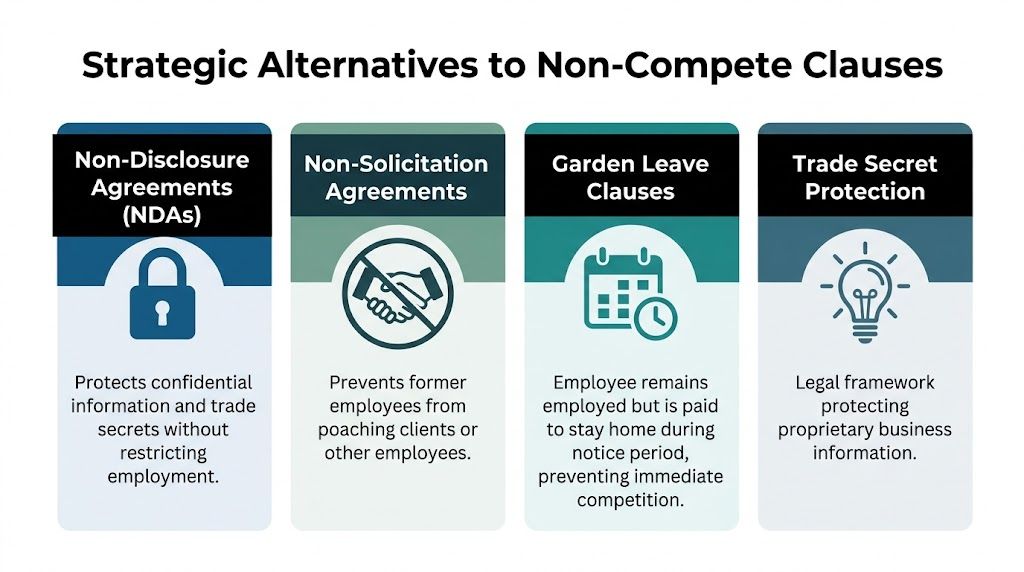
Recent legal pressure has pushed more Georgia employers to revisit that decision. As discussed in this analysis of non-competes becoming obsolete, businesses are increasingly exploring alternatives after the FTC's 2024 non-compete rule proposal and the related legal challenges. That same discussion notes that non-solicitation and non-disclosure agreements remain highly viable and are often favored by courts when the goal is to protect client data or patient lists without broadly restricting employment.
Four alternatives worth considering
- Non-disclosure agreements: Best when the concern is confidential information, trade secrets, pricing, processes, or internal strategy.
- Customer non-solicitation clauses: Useful when the business wants to stop a departing employee from taking active steps to move clients.
- Employee non-solicitation clauses: Often appropriate where the concern is team raiding rather than outside competition.
- Garden leave arrangements: In the right setting, these can create a paid buffer period that protects transition interests without imposing the same kind of post-employment restraint.
Choosing the right tool
A non-compete tries to stop competition itself. That can be appropriate in some roles, but it is also the most aggressive option. By contrast, an NDA or non-solicit can target the risk more precisely.
That precision matters in healthcare, technology, financial services, and professional firms around Alpharetta, Roswell, and North Fulton. If the actual concern is misuse of information or client relationships, a narrower covenant may do the job better.
For businesses trying to resolve these disputes without immediate courtroom escalation, alternative dispute resolution for business disputes is often worth considering early.
Why Choose Miles Hansford for Business Counsel in North Georgia
Non-compete disputes are local in a very practical sense. The contract may be governed by Georgia law, but pressure comes from local business relationships, local judges, and the speed at which disputes move in North Atlanta.
Counsel with experience in Forsyth County Superior Court, Fulton County Superior Court, and the surrounding court system can evaluate more than the wording of a covenant. They can assess whether the dispute is likely to settle, whether emergency relief is realistic, and whether a narrower business solution would protect the client more effectively than a scorched-earth fight.
That perspective matters for business owners, executives, physicians, professionals, and closely held companies in Alpharetta, Cumming, Johns Creek, Milton, Roswell, Sandy Springs, Suwanee, Dawsonville, and Canton. It also matters when employment issues overlap with larger concerns, such as business valuation, ownership disputes, or the protection of business interests during a high-asset divorce.
The right legal approach is usually strategic rather than reactive. Sometimes that means drafting a covenant properly before a hire. Sometimes it means challenging an overbroad restriction before it damages a career move. Sometimes it means using mediation to preserve relationships and reduce cost. The value is in choosing the approach that fits the facts.
Frequently Asked Questions About Georgia Non-Competes
| Question | Answer |
|---|---|
| Q: Are covenants not to compete enforceable in Alpharetta, GA? | A: Yes, some are. Georgia allows enforcement of certain non-competes if they protect a legitimate business interest and are reasonable in time, territory, and scope. In Alpharetta and the broader Fulton County market, enforceability usually turns on drafting quality and the employee's actual role. |
| Q: Can a Forsyth County judge change an overbroad non-compete? | A: Sometimes. Under Georgia's Restrictive Covenants Act, courts may blue pencil certain overbroad terms. But a judge won't rewrite a broken agreement from scratch. In Forsyth County Superior Court, that distinction can decide whether the covenant is narrowed or fails. |
| Q: How long can a non-compete last in Georgia? | A: Georgia guidance generally treats post-employment restrictions of 2 years or less as presumptively reasonable. That doesn't guarantee enforcement. Courts in Fulton County and Forsyth County still look at the role, the business interest involved, and the rest of the contract language. |
| Q: What if my non-compete says I can't work for a competitor in any capacity? | A: That language raises a serious concern under Georgia law. A restriction that blocks work in any role may be broader than necessary, especially if it prevents work unrelated to your former duties. Those clauses often deserve immediate review before you accept a new job. |
| Q: Are non-solicitation agreements easier to enforce than non-competes in Georgia? | A: Often, yes. A well-drafted non-solicitation or confidentiality agreement can be a more targeted way to protect client relationships or confidential data. Many North Georgia businesses use those tools because they address the real risk without imposing a broad employment ban. |
| Q: Should I sign a non-compete in Cumming or Alpharetta without legal review? | A: Usually not. If the role matters to your career path, the contract deserves review before you sign. A short consultation can identify whether the restriction is narrow and business-focused or broad enough to create problems later in Cumming, Alpharetta, or the wider North Georgia market. |
If you're dealing with a covenant not to compete in Alpharetta, Cumming, Forsyth County, or Fulton County, Miles Hansford Law Firm can help you assess the risk, protect your position, and move forward with a clear strategy. Whether you're an employer drafting protections or a professional facing a restrictive covenant, schedule a consultation to get Georgia-specific guidance before the issue becomes more expensive.
Meta Title: Covenants Not to Compete in Alpharetta GA
Meta Description: Learn how covenants not to compete work in Alpharetta, GA and Forsyth or Fulton County. Review Georgia enforceability rules and options.
Suggested URL Slug: /alpharetta-ga-covenants-not-to-compete
Internal Link Suggestions:
- What are the top 4 things you need to review in a job contract
- What does a business contract need to be enforceable
- Alternative dispute resolution for business disputes
Schema Recommendations:
- Attorney
- LegalService
- FAQPage