


Meta Title: DBA in Georgia for Cumming and Alpharetta
Meta Description: Learn how to file a DBA in Georgia for Cumming and Alpharetta businesses, including Forsyth County and Fulton County filing steps and local hurdles.
Suggested URL Slug: /dba-in-georgia-cumming-alpharetta
Schema Recommendations: Attorney, LegalService, FAQPage
Internal Link Suggestions:
If you're in Cumming, GA or Alpharetta, GA and you're getting ready to launch a side business, consulting practice, online shop, or second brand, the trade name issue usually shows up later than it should. You print cards, set up a website, maybe open social accounts, and only then realize the name you're using isn't your legal name or your company's registered name.
That's where a DBA in Georgia, called a trade name, becomes important. For small business owners in Forsyth County, Fulton County, and across North Georgia, the process is manageable, but it isn't as simple as many national guides make it sound. The filing happens locally, not through one clean statewide portal, and the practical differences between Cumming, Alpharetta, Johns Creek, Milton, Roswell, and Sandy Springs can matter.
What Is a DBA and Why Does Your Georgia Business Need One
You start a side business in Cumming, buy the domain, order signs, and set up a bank meeting under “North Georgia Home Solutions.” Then the banker or a vendor asks why that name does not match your legal name or your LLC records. That is usually the moment a Georgia business owner learns what a DBA really does.
In Georgia, a DBA is usually called a trade name. It lets a person or existing business operate publicly under a name different from the owner's legal name or the entity name already on file.
A sole proprietor in Forsyth County might use a trade name to avoid marketing under a personal name. An LLC in Alpharetta might use one to roll out a second brand without forming another company. Those are common, practical uses.

What a DBA does and what it doesn't do
A trade name allows the public-facing name to match your branding, website, invoices, advertising, and in many cases your banking and vendor paperwork. It helps avoid the confusion that starts when customers know one name and your legal documents show another.
A trade name does not form a new company. It does not give liability protection. It does not replace an LLC or corporation if liability protection, ownership structure, or tax treatment is the issue. Business owners sorting out that choice should review how to choose the right business structure for a Georgia company before filing a trade name.
Practical rule: A DBA is a naming tool. It is not a liability shield.
Why this trips up Georgia business owners
Georgia handles trade names locally. That simple fact causes more confusion than the legal definition itself.
New owners often assume the Secretary of State handles the filing because that is how many other business filings work. Trade names are different. The filing is generally handled through the Clerk of Superior Court in the county tied to the business's principal place of business. For North Georgia owners, that local setup creates real differences in forms, clerk procedures, publication steps, and timing.
The county-level structure often frustrates new business owners. A business based in Forsyth County can run into a different process than a business with its principal office in Fulton County, even when both are using the same kind of assumed name. Generic national guides usually skip that point, but it matters on the ground in Cumming and Alpharetta.
For businesses in Cumming, Alpharetta, Milton, Johns Creek, Roswell, and nearby communities, the safest test is straightforward. If the public sees a business name that does not match the owner's personal legal name or the company's legal entity name, stop and confirm whether a county trade name filing is required before you keep marketing under it.
Who Must File a Trade Name in Forsyth and Fulton County
A common North Georgia mistake starts like this. An owner forms an LLC, launches a website, orders signs, and assumes the state filing covered the business name. Then the bank, a vendor, or opposing counsel asks why the public name does not match the legal owner. That is usually the moment the trade name issue surfaces.
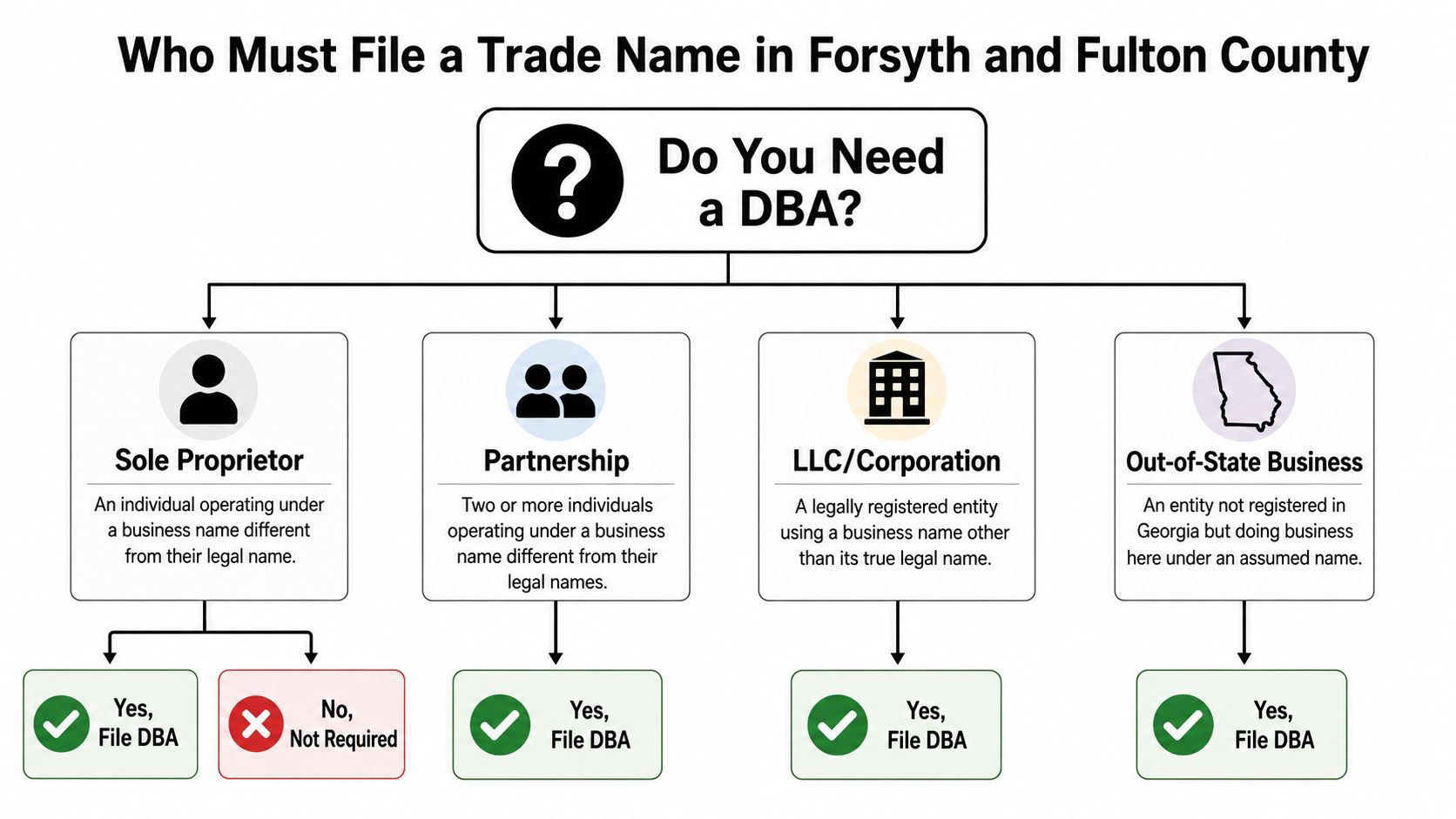
In Forsyth and Fulton, the key question is simple. Are you doing business under a name the public sees that does not match the owner's legal name or the entity name on file? If yes, a county trade name filing is often required. Georgia handles that at the local level through the Clerk of Superior Court in the county of the principal place of business, not through the Secretary of State. As described in Crowdspring's Georgia trade name overview, the rule generally reaches sole proprietors, individuals, and partnerships using a different public-facing name, and it also reaches LLCs, corporations, and nonprofits that market under an assumed name.
Sole proprietors and general partnerships in Cumming and Alpharetta
For sole proprietors, the rule is usually straightforward. If a painter in Cumming advertises only as "John Miller," a trade name filing is often unnecessary. If that same painter uses "North Forsyth Home Painting," the filing issue is now on the table.
General partnerships run into this problem often because the owners assume their handshake deal is enough. It is not enough if the business is presented to customers under a label that does not match the partners' legal names. In practice, that catches a lot of small service businesses, creative shops, contractors, and home-based operations around Cumming, Milton, and Johns Creek.
A quick working test helps:
- Personal legal name only: Usually no trade name filing.
- Brand name used with the public: Filing is usually required.
- Partnership name that does not match the partners' names: Filing is usually required.
LLCs and corporations using alternate brands
Many owners in Alpharetta assume the LLC or corporate filing solved every naming issue they will have. It did not. The entity formation covers the legal company name. It does not automatically cover each brand, program, or storefront name used in the market.
If "Peachtree Digital Solutions LLC" sells services under "North Fulton Web Lab," that alternate brand may need a trade name filing in the county tied to the principal place of business. That is one reason I tell clients to settle the entity structure first, then map the operating names they plan to use. If you are still sorting that out, review the steps to business formation in Georgia before you spend money on branding.
This is also where county differences start to matter in real life. A Forsyth County business and a Fulton County business may face the same legal question but a different clerk experience, different form handling, and different practical delays. Generic national articles usually miss that point, but owners in Cumming and Alpharetta feel it fast.
If the name on your website, invoice, proposal, storefront, or payment link does not match the legal owner name, check the trade name requirement before you keep using it.
Why filing matters
The legal risk is only part of the problem. Georgia law can treat failure to register an assumed name as a misdemeanor under O.C.G.A. § 10-1-493. The practical problems usually show up first. Banks question account setup. Contracts look sloppy. Payment processors and vendors ask for backup. Disputes become harder to clean up because the paper trail does not match the business name the public knows.
For business owners in Forsyth and Fulton, this is not just a paperwork detail. It is part of keeping the business name, the legal owner, and the county record aligned before that mismatch causes trouble.
Your Step-by-Step Guide to Registering a DBA in Georgia
A Cumming contractor opens a bank account under the LLC name, then starts sending invoices under a cleaner brand name. An Alpharetta consultant does the same thing from an office on the Fulton side of the city. Both assume a quick online filing will clean it up later. Then the county clerk asks for a different form, a notarized signature, and legal newspaper publication. That is the part generic DBA guides usually miss.
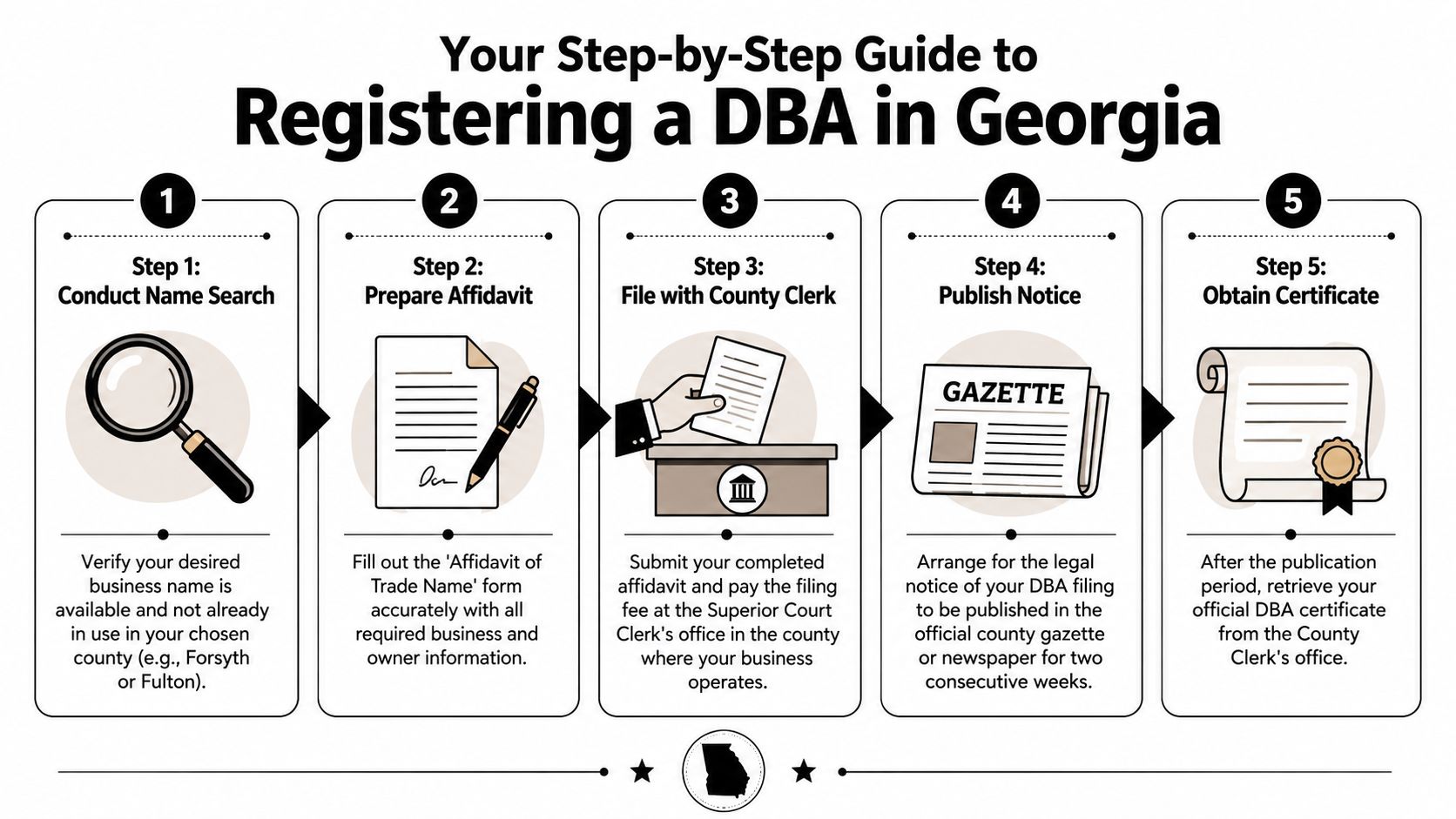
A Georgia trade name filing is handled at the county level. The right approach is to treat it as a local clerk process with county-specific rules, not a simple state portal filing.
If you are still choosing between an LLC, corporation, or sole proprietorship, review these steps to business formation in Georgia before filing a trade name. The DBA should sit on top of a business structure that is already settled.
Step 1 Check the name where you will actually file
Start with the county tied to the business's principal place of business.
For many Cumming businesses, that means Forsyth County. For many Alpharetta businesses, it means Fulton County, but not all of them. Alpharetta crosses county lines, and owners sometimes assume the city address answers the county question. It does not. If you file in the wrong county, the clerk will not fix that problem for you.
The name search is practical, not cosmetic. It helps you catch conflicts early, avoid wasting money on signs and web updates, and reduce the risk of filing paperwork for a name already in local use.
Step 2 Get the correct county form
Georgia does not use one standard statewide trade name form for county filings. You need the version accepted by the Clerk of Superior Court in the proper county.
In practice, Fulton and Forsyth often feel different. One clerk's office may have clearer online instructions. Another may expect you to follow up by phone or confirm filing details before you show up or mail anything in. Owners get delayed here all the time because they downloaded a form from the wrong county or relied on a national article that treated every Georgia county the same.
Expect the form to ask for the legal owner name, business address, trade name, and the nature of the business. Make sure those details match your entity records and the name you are already using with customers.
Step 3 Sign it correctly and get it notarized
The signature step causes more trouble than it should.
Trade name filings generally need to be notarized, and the owner information needs to match the actual legal owner. If the business is an LLC, use the LLC's legal name and authorized signer. If there are multiple owners, confirm who must sign before the document goes in. A mismatch between the entity name, signer name, and business address is the kind of small error that slows a filing down.
Bring a clean final copy to the notary. Do not mark up the form afterward unless the clerk tells you to.
Confirm the exact legal owner name before signing. Correcting a trade name filing after submission is usually slower and more expensive than catching the mistake up front.
Step 4 File with the Clerk of Superior Court in the proper county
File the completed form with the Clerk of Superior Court for the county where the business chiefly operates. For North Fulton and Forsyth owners, that county question matters more than many online guides admit.
Do not assume the clerk's office handles intake the same way from county to county. Ask how they want payment, whether they accept mailed filings, whether a self-addressed return envelope is needed, and what they expect for businesses with more than one owner. That short phone call can save a wasted trip or a rejected filing packet.
Step 5 Complete the required newspaper publication
After filing, the trade name notice must be published in the county's legal organ. In Georgia, that publication runs once a week for two consecutive weeks.
Owners often stumble here because they think filing with the clerk finishes the job. It does not. In some counties, the publication piece feels routine. In others, the timing and handoff take more attention. Keep proof of publication and any confirmation the county expects for its file.
For business owners in Cumming, Alpharetta, Johns Creek, and nearby parts of North Georgia, the lesson is simple. The DBA process is manageable, but it is only smooth when the county, the owner name, the filing form, and the publication step all line up the first time.
Georgia DBA Costs Timelines and County-Specific Differences
A Cumming owner can file a trade name and be done with the clerk side fairly quickly, then learn the newspaper step takes extra calls and follow-up. An Alpharetta owner may run into a different problem first. Figuring out whether Fulton is the right filing county, and then dealing with a clerk process that does not match what a statewide guide suggested. That is the part of a Georgia DBA filing that frustrates people.
Georgia does not run trade names through one statewide system. The rules come from state law, but the process is handled county by county. In practice, that means the cost, paperwork flow, payment method, and publication logistics can feel different in Forsyth than they do in Fulton.
What the costs usually look like
The full cost usually includes two buckets. The clerk filing fee and the legal newspaper publication fee. Counties do not package those costs in the same way, so owners often compare numbers that are not measuring the same thing.
According to LegalZoom's discussion of Georgia DBA filing differences, Fulton County lists a fee of $172, while other counties may fall lower or end up higher once publication is added. In real terms, many North Georgia owners should expect the total DBA cost to land around the low-to-mid hundreds, with the final number turning on the county's filing setup and the legal organ's charge.
| Cost Item | Typical Range (Forsyth County) | Typical Range (Fulton County) |
|---|---|---|
| Filing and publication combined | Often in the low-to-mid hundreds | Fulton County may present a higher published fee structure before publication logistics are fully added in |
| Clerk filing fee | County-specific | County-specific |
| Legal newspaper publication | County-specific | County-specific |
Do not rely on a statewide article that gives one flat number.
What actually affects your timeline
The legal deadline matters, but the practical delay usually comes from county handling. A rejected form, a payment issue, or confusion over publication can cost more time than the filing itself.
As noted earlier, Georgia requires prompt filing once the business starts using the trade name, and the newspaper notice must run for two consecutive weeks. That does not mean the whole process wraps up on the same schedule in every county. Some owners get held up waiting on the clerk's office to confirm intake. Others lose time coordinating with the legal newspaper or correcting a small mismatch in the owner or business name.
Where Forsyth and Fulton tend to differ
The law is the same. The friction points are not.
Forsyth filings often feel more manageable for local owners because the county process is easier to confirm with a direct call, and the volume is usually more predictable. Fulton can be less forgiving because more owners are filing there, county routing questions come up more often, and small procedural mistakes can waste a trip.
The differences usually show up in a few places:
- County determination: Alpharetta owners are the classic example. Depending on where the business chiefly operates, the correct filing county is not always obvious at first glance.
- Form and intake expectations: One clerk may be clearer about signatures, copies, and payment than another.
- Publication coordination: Some counties make the handoff to the legal organ feel routine. In others, the owner has to stay on top of it.
- Return processing: Even after acceptance, getting proof back in the form you need for banking or records can take different amounts of time.
That county-level inconsistency is why many owners end up asking broader licensing questions at the same time. If your trade name filing is only one piece of opening the business, review Georgia business license requirements for local companies alongside the DBA process.
Compliance Renewals and the Risks of Not Registering
A common North Georgia problem looks like this. A Cumming owner opens a bank account under the LLC name, starts advertising under a different brand, then gets asked for trade name paperwork the first time a customer writes a check to the public-facing name. By that point, the filing is no longer a startup task. It is a delay in getting paid.
Georgia does not require routine DBA renewals in the way some states do. But that does not mean you can file once and ignore the record forever. If the business changes its legal entity, starts using a different trade name, or stops using one name and later returns to market under a different setup, the filing should match reality.
The risk of skipping registration is not just technical. Georgia law can treat failure to register a required trade name as a misdemeanor under OCGA § 10-1-493. In practice, I find the daily business problems usually hit first.
Those problems show up fast:
- Banking friction: Banks often want the trade name filing before they will treat the DBA as part of the business record.
- Payment delays: Checks made payable to the brand name can create deposit issues if the paperwork does not support that name.
- Contract mismatch: If the name on the proposal, invoice, and agreement does not line up, the other side has room to question who they hired.
- Vendor and licensing confusion: A county or city office may see one name on local paperwork and another name in use, which leads to follow-up questions you could have avoided.
Fulton and Forsyth owners can feel these problems differently. In Forsyth, it is often easier to confirm what the clerk expects and fix a mistake before it spreads. In Fulton, a filing problem can linger longer because the volume is higher and owners are more likely to be dealing with multiple offices, banks, and counterparties that all want matching records. The statute is the same. The inconvenience is not.
The practical rule is simple. No annual renewal requirement does not mean no maintenance. Review the filing any time the business name, ownership structure, or operating setup changes.
That matters for businesses that start informally and then grow. A sole proprietor in Alpharetta who later forms an LLC, or a Cumming contractor who adds a second brand for a new service line, should not assume the original trade name filing still covers the new arrangement.
The filing fee is small. Cleaning up a name problem after contracts are signed, payments are issued, and customers know you by the wrong name is not.
When to Consult a Business Attorney in Cumming or Alpharetta
Some trade name filings are simple. Many only look simple until the owner hits a county-specific snag.
A business attorney becomes most useful when the name question overlaps with bigger issues. That happens when you're choosing between a sole proprietorship and an LLC, buying an existing business, adding a second brand under an existing company, dealing with multiple owners, or trying to determine where the business chiefly operates for filing purposes.
Situations where legal help saves time
In Cumming and Alpharetta, these are the moments when owners usually benefit from counsel:
- Name conflict concerns: You found a similar business name in county records and aren't sure whether to move forward.
- Multi-owner filings: Partnerships and shared ownership structures create more signature and authority issues.
- Entity mismatch: The public brand, state registration, contracts, and banking documents don't line up cleanly.
- Expansion decisions: You want to know whether a new service line needs its own trade name or its own entity.
Why local knowledge matters
The law is statewide. The friction is local.
A lawyer who regularly works with businesses in Forsyth County, Fulton County, and North Georgia knows that the underlying problem often isn't the statute. It's the clerk process, the form variation, the publication follow-through, and the business consequences of getting it half-right.
For owners in Cumming, Alpharetta, Milton, Roswell, Sandy Springs, and nearby communities, the value isn't just filing paper. It's starting with a structure and naming approach that won't create preventable problems later.
If you're starting a business or operating under a new brand in North Georgia, get the name issue resolved before it turns into a banking, contract, or compliance problem. Miles Hansford Law Firm helps business owners in Cumming, Alpharetta, Forsyth County, Fulton County, and the surrounding area make smart formation and trade name decisions. Schedule a consultation, speak with an attorney, and protect your venture from the start. Call today.
FAQ
Q: Do I file a DBA in Georgia with the Secretary of State?
A: No. In Georgia, a DBA, called a trade name, is filed at the county level with the Clerk of the Superior Court in the county where the business chiefly operates or has its principal place of business. For business owners in Cumming, that often means Forsyth County. For many Alpharetta businesses, Fulton County may be involved.
Q: Do I need a trade name if I already formed an LLC in Alpharetta, GA?
A: Maybe. If your LLC is doing business under a name different from its legal registered entity name, a county trade name filing may still be required. That's a common issue for Alpharetta businesses launching a new brand, division, or service line under a different public-facing name.
Q: How much does a DBA in Georgia usually cost?
A: Costs vary by county because Georgia doesn't use one standardized statewide system. Verified guidance shows Fulton County lists a fee of $172, while other counties may fall lower or higher depending on filing and publication requirements. Many owners should expect county-specific filing costs plus a separate legal newspaper charge.
Q: Does Forsyth County use the same DBA process as Fulton County?
A: Not always. The legal rule is statewide, but the forms, filing routines, and publication logistics can differ by county. That means a Cumming business filing in Forsyth County may face a different practical process than an Alpharetta business filing in Fulton County, even though both are following Georgia trade name law.
Q: Do Georgia DBAs expire or need renewal?
A: Generally, no. Georgia trade names do not typically require periodic renewal. But if the business changes legal structure, changes the trade name, or stops using the name and later operates differently, a new filing may be necessary to keep the public record accurate.
Q: What happens if I use a business name without registering it in Georgia?
A: Georgia law treats operating under an unregistered required trade name as a misdemeanor under OCGA § 10-1-493. Beyond that, the business can run into practical trouble with banking, payments, advertising, and contracts. Those are the problems owners in Cumming, Alpharetta, and across North Georgia usually feel first.
Q: How quickly do I need to file after starting business under a trade name?
A: Verified guidance states Georgia imposes a 30-day deadline from the date you begin operating under the trade name. Because publication is also required in the county's legal newspaper for 2 consecutive weeks, it's best to handle the filing early rather than waiting until a bank or customer requests documentation.