


Deciding how to protect your family's future can feel overwhelming. For many in Cumming, GA, the first question is whether a will or a trust is the right choice. The decision you make has significant consequences for your loved ones, your assets, and whether your estate will face a public, lengthy court process. Understanding the difference is the first step toward peace of mind.
At Miles Hansford, we help families in Cumming, Alpharetta, and across Forsyth County navigate these critical choices with calm, strategic guidance. The most important distinction is this: a will only takes effect after you pass away and must go through probate court. In contrast, a trust is effective the moment you create and fund it, allowing your estate to bypass the probate process entirely. This guide will clarify which path is right for your North Georgia family.
Feeling unsure about what happens next? Schedule a consultation with our experienced attorneys today to protect your assets and your family’s future.
Why This Matters in Cumming and Alpharetta

Understanding your options is the first step toward protecting your family’s future. In Georgia, both a Last Will and Testament and a Revocable Living Trust are tools for directing how your property is distributed, but they operate very differently. The right choice for your family in Cumming, Alpharetta, or surrounding areas like Johns Creek and Milton depends on your unique goals, your assets, and your desire for privacy.
A will is a foundational legal document that communicates your final wishes. It’s where you:
- Name an executor to carry out your instructions.
- Identify your beneficiaries—the people who will inherit your assets.
- Appoint a legal guardian for minor children.
A will, however, must be validated by the probate court in your county of residence, which would be the Forsyth County Superior Court or Fulton County Superior Court for most in our area. This process makes your estate a matter of public record.
A trust is a private legal arrangement where you transfer assets to be managed by a trustee for your beneficiaries. Many people in North Georgia prefer trusts because they streamline how assets are passed down and, most importantly, avoid the public and often time-consuming probate process. There are many good resources that explain how to avoid probate court in more detail.
For families in Cumming and neighboring communities like Suwanee and Dawsonville, a clear understanding of these differences is key to making a protective, strategic decision.
Will vs. Trust: Key Differences for Cumming, GA Residents
This table offers a quick comparison of wills and trusts under Georgia law, helping you understand the fundamental distinctions for your Cumming or Alpharetta estate plan.
| Feature | Last Will and Testament | Revocable Living Trust |
|---|---|---|
| Effective Date | Only upon your death | Immediately upon signing and funding |
| Probate | Required (Public Record in Forsyth/Fulton Courts) | Avoids probate (Private) |
| Incapacity Plan | Not included; requires a separate power of attorney | Can manage assets if you become incapacitated |
| Privacy | Becomes public record in local courts | Kept private from the public |
| Asset Control | Executor distributes assets after probate | Trustee manages and distributes assets per your rules |
| Initial Cost | Generally lower upfront cost | Higher upfront cost but can save on probate fees |
This side-by-side view highlights the trade-offs. A will is often simpler and less expensive to create, but a trust offers far more control, privacy, and the ability to manage your affairs if you become incapacitated. Your specific needs will determine which instrument is the right fit. Don't leave your family’s security to chance. Speak with a family law attorney at Miles Hansford to build the right plan.
The Legal Process Breakdown: How Wills and Trusts Function Differently Under Georgia Law
For families in Cumming, Alpharetta, and across North Georgia, making an informed choice about your estate starts with understanding how wills and trusts actually work. While both are tools for distributing your assets, their legal mechanics and the paths they follow are worlds apart.
The biggest difference comes down to when each document takes effect and how your estate is ultimately handled.
The Role of Probate in Wills for Forsyth County Residents
A will is a document that lies dormant until your passing. Only after you die does it become active. Your designated executor is then required to file the will with the probate court in your county of residence—like the Forsyth County Superior Court or Fulton County Superior Court—to kick off the formal probate process.
Probate is the court-supervised procedure that accomplishes several key tasks:
- It validates your will, making it legally binding.
- It gives your executor the official power to manage the estate.
- It ensures all your debts and taxes are paid.
- It confirms the final transfer of your assets to your beneficiaries.
The catch? This entire court-led process is a public record. Any interested party can look up the court filings in Cumming or Alpharetta and see the details of your assets, their values, and who is set to inherit them. For many people, especially in communities like Milton and Johns Creek, that complete lack of privacy is a significant downside.
The Private Nature of Trusts in Georgia
A revocable living trust, on the other hand, operates completely differently. It’s a private legal entity that you create and put assets into while you're still alive. As the creator (grantor), you typically name yourself as the trustee, so you keep total control over everything in the trust.
A will is a one-way ticket to public probate court. A trust operates as a private vehicle for your estate, completely avoiding court supervision and keeping your family’s financial affairs confidential.
This privacy is often the number one reason North Georgia families opt for a trust-based plan. But there’s another critical advantage: a trust provides for a seamless transition if you ever become incapacitated. Because the trust already owns the assets and you've named a successor trustee, that person can step in immediately to manage your affairs. There's no need for court intervention, bypassing a potentially costly and contentious guardianship or conservatorship proceeding. A will simply can't do that. You can get a deeper look by exploring our comprehensive guide to trusts.
These functional differences mean that wills and trusts have distinct advantages for different situations. Privacy is a major dividing line: a will guarantees that your financial details will become public through probate, while a trust keeps everything shielded from public view. At the same time, a will is the only way to legally name a guardian for your minor children, making it an indispensable document for parents. Find out more by reading how to decide which is right for you on NCOA.org.
What to Expect in Forsyth or Fulton County Courts: The Probate Process

When clients in Cumming and Alpharetta ask about the difference between a will and a trust, our conversation almost always turns to one critical process: probate. It’s the single biggest factor that separates these two estate planning tools.
Simply put, probate is the formal, court-supervised process for validating a will, paying off a person’s final debts, and legally transferring their assets to heirs. If a will is the main document in your estate plan, it must pass through the local court system, like the Forsyth County Superior Court or Fulton County Superior Court, to be executed.
While probate serves a necessary function, it’s a process most families would prefer to skip. This is precisely why so many people choose a trust instead.
The Major Downsides of Probate in Georgia
For a family that is already grieving, navigating the probate process can feel like a significant burden. There are three primary drawbacks that convince many people in North Georgia to set up a trust-based plan.
- Significant Time Delays: Probate isn't fast. Here in Georgia, the process can drag on for months, and in some cases, for more than a year. During that time, your assets are essentially frozen. They can't be distributed to your loved ones, which can cause real financial strain when they need support the most.
- Mounting Costs: Court involvement comes with a price. Executor compensation, attorney fees, and various court filing costs add up quickly. These expenses are paid directly from your estate's assets, which ultimately reduces the inheritance you worked so hard to leave behind.
- Complete Loss of Privacy: Because probate is a public court proceeding, your will becomes public record. This means that a complete inventory of your assets—what you owned and who inherited it—is available for anyone to see at the courthouse in Cumming or Alpharetta.
Probate makes your private family matters public. A trust allows your estate to be settled privately and efficiently, shielding your loved ones from court involvement and public scrutiny.
This lack of privacy is a major concern for many of our clients, especially business owners and individuals in communities like Roswell, Suwanee, and Sandy Springs who would rather keep their financial affairs confidential. If you're looking for a deeper dive into this court process, you can learn more about what probate is and why it occurs in our related article.
Probate vs. Trust: A Real-World Scenario in North Georgia
Let’s look at two common scenarios to see how this plays out. Imagine a longtime resident of Cumming passes away with only a will. Their executor has to hire a lawyer, file the will with the Forsyth County Superior Court, and begin the public probate process. The family waits for months as the court approves each step, all while legal bills pile up and the estate's details are entered into the public record.
Now, consider an Alpharetta resident who had a living trust. When they pass away, their chosen successor trustee can step in immediately. Without any court filings or long delays, the trustee begins settling any final debts and distributing the assets privately, just as the trust instructs. This process is often completed in a matter of weeks, not months or years. It’s faster, less expensive, and completely confidential, giving the family true peace of mind.
Strategy: Comparing Cost, Control, and Complexity for North Georgia Families
When families in Cumming, Alpharetta, and across North Georgia sit down to plan their estates, the decision often comes down to a will versus a trust. It’s a choice that involves weighing three things: how much control you want to have, what it will really cost, and how much work is involved.
These aren't just legal details; they have a direct impact on how your legacy is passed on and how your loved ones are cared for.
The Level of Control You Keep in Cumming
One of the main reasons so many families opt for a trust is control. A will is fairly straightforward—it’s a set of instructions for who gets your property after you pass away. But it gives you almost no say in how or when your heirs actually receive that inheritance.
A trust, on the other hand, lets you manage your assets with precision, even long after you’re gone. This is especially important for parents and grandparents in communities like Cumming and Dawsonville who want to make sure their hard-earned wealth is used responsibly.
With a trust, you can:
- Stagger distributions. Instead of a young adult getting a large inheritance at once, you can schedule payments for when they reach certain ages, like 25, 30, and 35.
- Set conditions for receiving assets. You can link distributions to important life milestones, such as graduating from college or holding down a job.
- Designate assets for a specific purpose. A trust can ensure funds are set aside for a grandchild’s education or that a beloved family cabin stays in the family for generations.
- Establish a Special Needs Trust. This is a critical tool for providing for a loved one with disabilities without risking their eligibility for government benefits.
A will simply can't achieve these kinds of detailed goals. It transfers assets in one broad stroke, while a trust allows for careful, long-term management. Protect your assets with a strategic plan. Call today to speak with an attorney.
The True Cost of Wills vs. Trusts in Forsyth and Fulton County
Many people think a will is the cheaper choice, and when it comes to the initial legal fees, that’s usually correct. But that lower upfront cost is often misleading. A will guarantees that your estate will have to go through probate in the Forsyth County or Fulton County courts.
The expenses of probate can add up quickly. Court filing fees, executor compensation, and attorney's fees are all paid directly from your estate’s assets. In the end, what seemed like a "cheaper" will can actually cost your family much more in both money and time than a trust ever would have.
A will costs less to draft, but it can end up costing your estate far more to settle. A trust requires a bigger investment upfront but is designed to save your family a significant amount of money by avoiding probate entirely.
It helps to think of it as an investment. The work of setting up and funding a trust today is a strategic move. It preserves more of your wealth for your heirs tomorrow. For anyone with significant assets in Alpharetta or Milton, the savings from avoiding probate almost always outweigh the initial cost of creating the trust.
The Upfront Work of Funding a Trust
The biggest hurdle with a trust is the initial setup. A trust is an empty container until you "fund" it. This means you must formally transfer ownership of your major assets—like your house, bank accounts, and investment portfolios—into the name of the trust.
This process can feel like a lot of paperwork. However, doing that work now is exactly what allows your estate to bypass the probate process later. You are essentially organizing everything ahead of time, which saves your family from the stress of court proceedings, public records, and frustrating delays.
Because the trust already owns the assets, your successor trustee can step in immediately to manage and distribute everything privately and efficiently. It’s more work at the beginning, but a properly funded trust creates a far simpler and faster process for your loved ones when they need it most.
When to Use a Will, a Trust, or Both in Cumming, GA
Deciding on the right estate planning tools isn't about legal theory; it's about finding a solution that fits your real-world circumstances. For families here in Cumming, GA, and nearby cities like Canton and Roswell, the choice between a will, a trust, or both comes down to your specific goals for your family and your assets.
This chart helps visualize the key factors—control, cost, and complexity—that guide the decision between a will and a trust.
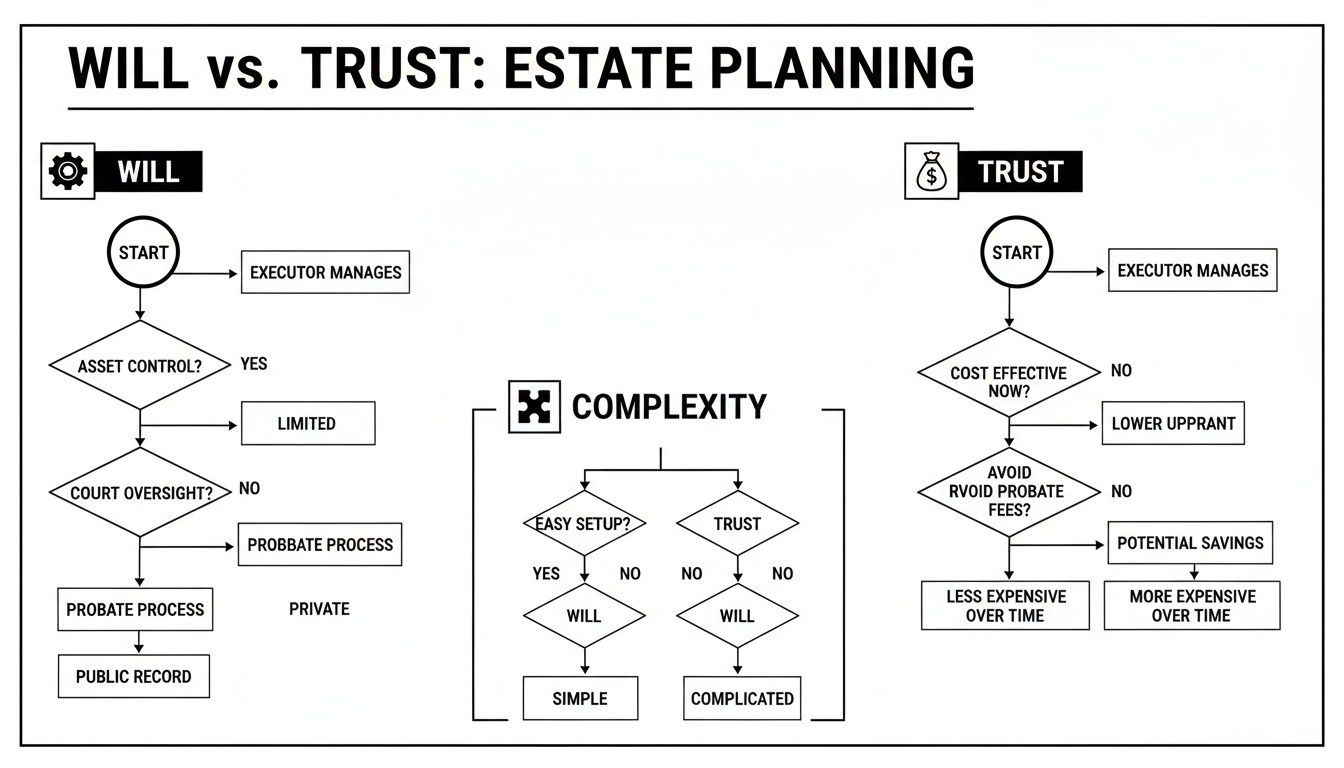
As you can see, the choice is often a balance between upfront simplicity and long-term privacy and control.
Scenarios Favoring a Will in Alpharetta
In many situations, a will-based plan is a practical and effective choice. It's simple, direct, and accomplishes critical objectives without the added complexity of a trust.
You might lean toward using a will as your primary tool if:
- You are a young individual with limited assets. When you don't own real estate and have a straightforward financial picture, a will is a cost-effective way to make sure your property goes to the people you choose.
- Your main goal is to name a guardian for your children. This is one of a will's most important functions. In fact, a will is the only legal document in Georgia that can name a guardian for your children, which makes it absolutely essential for every parent.
- Your assets are modest, and you aren’t concerned about probate. If your estate is small enough that it might qualify for a simplified probate process in Forsyth or Fulton County, the time and public nature of the process may be an acceptable trade-off for you.
For many young families in Alpharetta, a will provides that foundational layer of protection, especially for appointing guardians—something a trust simply cannot do.
When a Trust is the Better Choice in Cumming
As your life and finances grow more complex, a revocable living trust often becomes the better option. It offers a level of privacy and control that a will cannot provide.
A trust-based plan is something we strongly recommend for residents in Cumming if:
- You own real estate in Georgia. Putting your home into a trust is the surest way to pass it to your heirs without it getting tied up in the public probate process in Forsyth County.
- You have a high net worth. For families in high-asset communities like Milton and Johns Creek, a trust is a key tool for protecting privacy, managing wealth for future generations, and potentially minimizing estate taxes.
- You want to maintain privacy. A will becomes a public court record. A trust, on the other hand, is a private contract that keeps your financial affairs and wishes confidential.
- You have a blended family or complex wishes. A trust allows you to set out very detailed instructions for asset distribution. This is ideal for ensuring children from a previous marriage are provided for or that a new spouse is cared for exactly as you intend.
- You want to plan for potential incapacity. A trust lets your chosen successor trustee step in and manage your finances if you become unable to, avoiding a costly and public court-appointed guardianship.
The Power of Using a Will and a Trust Together
For most of our clients here in North Georgia, the strongest estate plan isn't an "either/or" choice. In reality, the most comprehensive approach involves using both a will and a trust.
This combination creates a powerful strategy. The revocable living trust is the main vehicle for holding and distributing your primary assets, which keeps them private and out of probate court.
Alongside the trust, we create what’s called a "pour-over will." This special type of will does two very important things:
- It serves as a safety net, "pouring over" any assets you may have forgotten to put into the trust into that trust upon your death.
- It officially names legal guardians for your minor children—which, again, is a job a trust can't do on its own.
By combining these documents, you truly get the best of both worlds: the probate avoidance and privacy of a trust, plus the essential guardianship nominations of a will. As you can see, understanding why to have both a trust and a will is often the key to building a plan that fully protects your family.
Why Choose Miles Hansford for Your Cumming & Alpharetta Estate Plan
Choosing the right legal partner to protect your legacy is as important as choosing the right legal tools. The attorneys at Miles Hansford are not just experts in Georgia law; we are your neighbors. We live and work in the Cumming and Alpharetta communities, and we are deeply familiar with the procedures of the Forsyth and Fulton County courts. Our team is dedicated to providing calm, empathetic, and strategic representation for every client. We translate complex legal concepts into clear, actionable plans that protect what matters most to you.
Many people in Cumming and Alpharetta understandably put this conversation off, but failing to plan your estate is effectively a decision to let the state of Georgia decide your legacy. When you do nothing, it can have significant and often heartbreaking consequences for the loved ones you leave behind.
If a Georgia resident passes away without a will or a trust, they are considered to have died “intestate.” This legal term simply means that the state’s rigid formula—not your personal wishes—will dictate who inherits your property.
This process often creates outcomes that are the exact opposite of what someone would have wanted. Heirs can also face a host of unexpected practical challenges, from managing inherited property to dealing with recent estate cleanout trends.
The 2026 Trust & Will Estate Planning Report revealed a startling gap: while 83% of Americans believe estate planning is important, a staggering 55% have no documents at all. For families here in Alpharetta and North Georgia, that statistic highlights an urgent need to move from good intentions to decisive action. You can read more about these estate planning findings.
Doing nothing is not a neutral choice. It is an active decision to hand control of your assets and your family’s future over to the Georgia court system.
Creating a will or a trust is the only way to ensure your wishes are honored, your loved ones are protected, and your legacy is preserved on your terms. It is, at its core, a fundamental act of protection for your family.
FAQ: Answering Your Questions About Wills and Trusts in Cumming, GA
At Miles Hansford, we understand that estate planning brings up many questions. We've helped countless families in Cumming, Alpharetta, and throughout Forsyth and Fulton counties find clarity. Here are direct answers to some of the most common questions we hear.
Q: Can I name a guardian for my kids in a trust in Georgia?
A: No. In Georgia, a Last Will and Testament is the only legal document where you can nominate a guardian for your minor children. A trust cannot fulfill this critical function. This is why we ensure every parent we work with has a valid will, even if their primary estate plan is a trust.
Q: What is a "pour-over will" and why do I need one in Cumming?
A: A pour-over will acts as a safety net for your living trust. Its job is to "catch" any assets you forgot to transfer into your trust. Upon your death, the will directs those assets into your trust so they are managed according to your wishes, avoiding unintended probate issues in Forsyth County.
Q: Is a will or trust better for a homeowner in Alpharetta, GA?
A: For most homeowners in Alpharetta, Milton, or Johns Creek, a revocable living trust is the strategic choice. By placing your home in a trust, the property passes directly to your heirs, completely bypassing the public, time-consuming, and often expensive probate process in the Fulton County Superior Court.
Q: Do I still need a will if I have a trust in Georgia?
A: Yes, absolutely. A will is essential for naming guardians for minor children. Additionally, a pour-over will ensures that all your assets are consolidated into your trust. The will is a vital companion document that completes your estate plan and makes your trust work as intended under Georgia law.
Q: How does a trust avoid probate in Forsyth County courts?
A: A trust avoids probate because it changes asset ownership. When you "fund" a trust, assets like your home or accounts are no longer owned by you personally; they are owned by the trust. Since you do not technically own those assets at your death, there is nothing for the Forsyth County probate court to administer.
Q: Aren't wills and trusts just for wealthy people in North Georgia?
A: This is a common myth. While trusts are powerful for high-asset estates, they offer huge benefits for almost anyone in North Georgia. If you own a home, want to keep your family’s affairs private, or want to make a difficult time as simple as possible for your loved ones, a trust can be invaluable.
Q: Can I make changes to my will or trust after I sign it?
A: Yes. A standard will can be amended with a "codicil" or replaced with a new will. A revocable living trust is, by its nature, flexible. You can amend it or even revoke it entirely during your lifetime, giving you the ability to adapt your plan as your family's needs change in Cumming or Alpharetta.
Interestingly, where you live can influence planning trends. Regional data shows that while 35% of suburban residents have a will, trust ownership varies geographically. Understanding these patterns highlights why localized guidance is essential for your family's plan. You can discover more insights about these estate planning trends on TrustandWill.com.
The best way to protect your family’s future is with a clear, legally sound estate plan. The attorneys at Miles Hansford have decades of experience helping North Georgia families navigate these important decisions. Schedule a consultation today to ensure your legacy is secure. https://mileshansford.com