


Meta Title: Disadvantages of a Corporation in Cumming, GA
Meta Description: Learn the disadvantages of a corporation in Cumming, GA, including tax, compliance, and divorce-related risks in Forsyth and Fulton County.
Suggested URL Slug: /disadvantages-of-a-corporation-cumming-ga/
A lot of business owners in Cumming, GA reach the same point. The company is growing, revenue is steadier, and someone says it’s time to incorporate. On paper, that can sound like the obvious next move. In practice, the disadvantages of a corporation can affect your taxes, your control, your paperwork burden, and, in the wrong personal circumstances, your family and property rights too.
That matters in North Georgia because business decisions rarely stay isolated. A corporation formed for a shop in Cumming, a medical practice near Alpharetta, or a service company working across Johns Creek, Milton, Suwanee, and Dawsonville can become a major issue in litigation, succession planning, and divorce. The legal form you choose today can shape what happens later in Forsyth County Superior Court or Fulton County Superior Court.
A careful entity decision isn’t about chasing a label. It’s about understanding what works, what doesn’t, and what risks you’re willing to carry long term.
Thinking of Incorporating Your Cumming, GA Business? First, Understand the Risks
If you own a growing business in Cumming or Alpharetta, incorporating may look like a sign that you’ve made it. Clients often associate the word “corporation” with stability, professionalism, and stronger legal protection. Those benefits can exist. But they come with trade-offs that many owners underestimate.

For a North Georgia entrepreneur, the disadvantages of a corporation usually show up in four places:
- Tax treatment: A traditional C-corporation can create a second layer of tax when profits are distributed.
- Ongoing compliance: Corporate minutes, annual meetings, bylaws, board structure, and filings all require attention.
- Reduced flexibility: You won’t have the same freedom that many owners enjoy in an LLC or simpler structure.
- Personal spillover: In divorce, shareholder disputes, or business litigation, the corporate structure can add complexity instead of reducing it.
A lot of owners searching for “business lawyer near me” or “corporate attorney Cumming GA” aren’t trying to build a public company. They want liability protection and a sensible tax structure without burying themselves in avoidable administrative work.
Practical rule: The right entity isn’t the one that sounds most impressive. It’s the one you can operate correctly year after year.
That’s especially true if your business is also part of your household wealth. In Georgia, personal and business decisions can overlap fast, particularly when property division, valuation, or ownership transfers become issues in family court.
The Financial Burden: Double Taxation and High Costs
The first hard reality is cost. Not just startup cost. Ongoing cost.
For many small and midsize businesses in Cumming, Roswell, or Sandy Springs, a corporation becomes more expensive than expected because the tax structure and compliance structure both pull money out of the business.
Double taxation is a real reduction in owner takeaway
A C-corporation pays tax at the entity level, and shareholders may pay tax again when profits are distributed as dividends. The clearest example comes from Rippling’s discussion of corporate taxation: a corporation earning $100,000 in profit might pay $21,000 in corporate tax at the 21% federal rate, leaving about $79,000, and shareholders then pay personal income tax if that amount is distributed as dividends.
That structure can work for companies planning to retain earnings and reinvest aggressively. It often works poorly for owner-operated businesses where the owner expects to live on distributions.
Here’s the practical effect:
| Issue | What it means for an owner |
|---|---|
| Corporate tax first | The company pays tax before the owner sees the profit |
| Dividend tax later | The owner may pay tax again on distributed earnings |
| Cash flow pressure | Less flexibility for owners using the business as primary income |
For a local business owner in Forsyth County, that matters more than the abstract term “double taxation.” It affects what lands in your pocket.
The setup bill is only the beginning
The formation process itself also carries a real price. Corporations generally require more legal and accounting work than sole proprietorships, partnerships, or many LLCs.
If you’re evaluating the full budget, it helps to review the true cost of accounting alongside legal formation expenses. Many owners focus on the filing itself and overlook what they’ll spend keeping the structure compliant.
A broader business-formation budget should also include legal planning around governance, ownership, and future disputes. That’s why many owners benefit from looking at a more complete breakdown of business formation costs and risks.
Cost shows up in places owners often miss
The recurring burden usually includes:
- Specialized accounting: Corporate books, compensation treatment, and tax handling are more technical than many owners expect.
- Legal maintenance: Bylaws, resolutions, ownership transfers, and governance disputes often require attorney review.
- Administrative time: Every hour spent fixing records is an hour not spent selling, hiring, or serving clients.
A corporation can be profitable and still be inefficient for the owner.
That’s the problem. The structure may be legally valid while still being the wrong financial fit.
Navigating Corporate Formalities in Forsyth County
A Forsyth County owner forms a corporation, lands a strong year, and assumes the hard part is over. Then a shareholder dispute, divorce, or buyout request forces everyone to examine the records. That is usually when the gaps show up.
A corporation requires ongoing legal maintenance. Georgia expects the business to act like a separate entity on paper, not just in the owner’s head. For closely held companies in Cumming and the surrounding area, that paperwork often gets postponed until there is already a problem.

What Georgia owners must maintain
Corporate formalities are stricter than many owners expect, especially if they are used to running a family business informally. The corporation should have directors and officers with defined roles, annual meetings should be held and documented, major decisions should be approved in writing, and the bylaws should match how the company is really being run.
Those requirements usually include:
- Board governance: Directors and officers should be properly appointed, with authority that matches the company’s actual operations.
- Annual meetings: Shareholders and directors should meet as required, even in a closely held corporation.
- Minutes and resolutions: Elections, compensation decisions, stock issuances, loans, and major contracts should be documented when they happen.
- Internal rules: Bylaws should exist, fit the business, and be updated after ownership or management changes.
Many owners underestimate the detail involved until they review a corporate bylaws example and see how much governance a corporation is supposed to document.
Why these formalities matter in Forsyth County
These records do more than satisfy a filing requirement. They become evidence.
If a dispute reaches Forsyth County Superior Court, the company’s files may be used to answer practical questions that decide the case. Who had authority to sign the contract? Was an owner properly removed? Did the company approve compensation, distributions, or a stock transfer? If the records are thin or contradictory, the owner loses control of the narrative.
That problem gets sharper in a divorce. In North Georgia, I often see business owners focus on revenue and operations while ignoring the paper trail behind ownership, officer authority, and retained earnings. During divorce litigation, those missing records can turn an already difficult valuation fight into a credibility fight about whether the corporation was handled consistently, whether a spouse has a marital claim, or whether a transfer to a relative was legitimate.
Where closely held corporations break down
The weak points are predictable.
Bylaws are signed once and never updated. Annual meetings do not happen, or no one writes down what was approved. Stock transfers are handled casually inside the family. Compensation, loans, and personal expenses are discussed by text message instead of formal resolutions.
For a North Georgia family business, that informality can affect more than the company. It can shape property division in divorce, fuel claims between siblings or former spouses, and increase the cost of cleaning up the record later.
Good corporate records protect more than the entity. They protect the owner’s position when authority, ownership, or family intent is challenged.
For many small corporations, the disadvantage is not just paperwork. It is the long-term exposure created when the business grows, the family changes, and the records do not keep up.
The Myth of Absolute Protection: Hidden Liability Risks
Many owners believe incorporation creates a complete wall between personal assets and business problems. That belief is too broad.
A corporation can help separate the company from the owner. But if the owner treats the corporation like a personal checking account, ignores governance rules, or fails to document decisions, a plaintiff or creditor may argue that the business was never operated as a separate entity.
How veil-piercing arguments develop
Take a hypothetical business owner in Johns Creek or Milton. The company is incorporated. But there are no reliable minutes, no clean distinction between corporate and personal expenses, and contracts are signed inconsistently. If a dispute lands in North Fulton courts, the other side may look past the filing certificate and focus on conduct.
That’s where owners run into the phrase piercing the corporate veil.
The argument is simple. If you want the law to respect the corporation as separate, you have to respect it first.
Protection is conditional, not automatic
Corporate status doesn’t excuse:
- Poor separation of funds
- Missing governance records
- Undocumented ownership decisions
- Informal side deals with insiders
It also doesn’t eliminate personal stress in a lawsuit. Even where personal liability is not ultimately imposed, owners still deal with discovery, document requests, deposition risk, and business interruption.
Another issue owners overlook is privacy. A corporation often requires more disclosure and more visible internal structure than many privately held businesses expect. For owners who value discretion, especially those with family wealth concerns or pending domestic problems, that can be a drawback.
The filing itself is not the shield. The shield is the combination of filing, maintenance, and disciplined operation.
That’s why the disadvantages of a corporation aren’t limited to taxes and paperwork. They include the false confidence a bad corporate setup can create.
The S-Corp Fix: A Solution with Its Own Disadvantages
A lot of Georgia business owners hear the same advice: form a corporation, then elect S-corp status and avoid the C-corp tax problem. Sometimes that works. Sometimes it creates a new set of problems.
An S-corporation avoids entity-level taxation in the same way a C-corp does not. But owners often treat the S-corp election like a shortcut instead of a compliance system. That’s where the trouble starts.
The IRS pays close attention to S-corps
According to Klasing Associates’ summary of entity selection issues, S-corp audit rates are double those of partnerships, and 25% of audits reclassify shareholder compensation. A common trigger is an owner paying an “unreasonably low” salary in order to reduce payroll tax exposure.
That matters because many service businesses in Alpharetta, Cumming, and surrounding areas depend heavily on owner labor. If the business exists largely because of the owner’s work, compensation has to make sense.
The restrictions are tighter than many owners expect
S-corps also come with structural limits that can complicate growth and succession. The same source explains that S-corporations are limited to 100 shareholders and those shareholders must be U.S. citizens or residents.
For some owners, that’s not an issue today. It becomes an issue later when they want to:
- bring in investors,
- transfer ownership within a blended family,
- handle estate planning,
- or resolve a divorce without disturbing the tax election.
What works and what doesn’t
What works:
- Paying owner-employees compensation that reflects actual work performed
- Keeping payroll and distributions clearly separated
- Documenting why compensation decisions were made
- Reviewing shareholder eligibility before ownership changes
What doesn’t work:
- Treating distributions like a substitute for wages
- Making family ownership transfers casually
- Assuming the election solves every tax problem
- Waiting until an audit notice or domestic dispute to fix records
For some businesses, the S-corp election is sensible. For others, it’s a structure that looks efficient until scrutiny begins.
That’s the practical point. The S-corp isn’t a magic answer. It’s a narrower lane with its own guardrails.
When Business Meets Divorce: Corporate Complexities in Alpharetta
The most overlooked disadvantages of a corporation often appear when the owner’s personal life changes. In Alpharetta, Milton, Roswell, and other high-income parts of North Fulton, the business is often one of the largest marital assets. The way that business is structured can shape almost every part of a divorce.

Consider a common scenario. A spouse owns a successful closely held corporation in Alpharetta. The parties file under Georgia no-fault divorce law, and once the case is pending, temporary financial arrangements may need to be addressed early. Georgia also has a 30-day minimum waiting period before a divorce can be finalized, but contested cases involving business interests often last much longer because valuation and ownership questions take time.
A corporation can become a central property division fight
Georgia uses equitable division, not automatic equal division. That means the court looks at what is fair under the circumstances. If corporate stock was acquired or increased in value during the marriage, it may become part of the marital estate analysis.
That can trigger disputes over:
- whether the stock itself is marital or separate,
- how the business should be valued,
- whether retained earnings should be treated as available wealth,
- and whether one spouse should receive offsetting assets instead of a direct ownership interest.
In a contested divorce in Fulton County Superior Court, those questions can become expensive fast.
Valuation is rarely just bookkeeping
A business owner may believe the company is worth what the tax return says. A spouse may argue the business is worth far more because of goodwill, contracts, recurring revenue, or owner compensation practices. That is one reason professionals often examine compensation, distributions, and financial records closely. If you want background on how financial experts approach these issues, this overview of the role of forensic accountants in divorce cases is a useful starting point.
The corporate structure can make valuation harder because the records may show salary, distributions, retained earnings, shareholder loans, and expense treatment differently than an LLC or sole proprietorship would.
In a divorce, a corporation is not just a business form. It becomes evidence of value, control, and access to money.
Governance documents can help or hurt
Shareholder agreements, buy-sell terms, transfer restrictions, and bylaws may influence what happens if one spouse claims an interest or if a decree requires some form of division. If the documents are weak or outdated, the case gets harder.
That’s especially important where there are children and business demands at the same time. Georgia courts focus on the best interests of the child in custody matters, and parents must submit parenting plans in custody cases. In real terms, that means a business owner can be managing all of the following at once:
| Divorce issue | Why the corporation matters |
|---|---|
| Equitable division | Stock ownership and business value may be disputed |
| Temporary hearings | Business income may affect support positions early |
| Mediation | Settlement options depend on transfer restrictions and valuation |
| Parenting schedule | Business obligations may affect time-sharing proposals |
In Forsyth County and Fulton County, temporary hearings can establish an early advantage. Mediation is often required before trial. If business records are disorganized, that weakness shows up before final resolution.
Georgia LLC vs. Corporation: A Practical Comparison
For many North Georgia owners, the key question isn’t whether a corporation has disadvantages. It does. The primary question is whether those disadvantages are justified compared with an LLC.
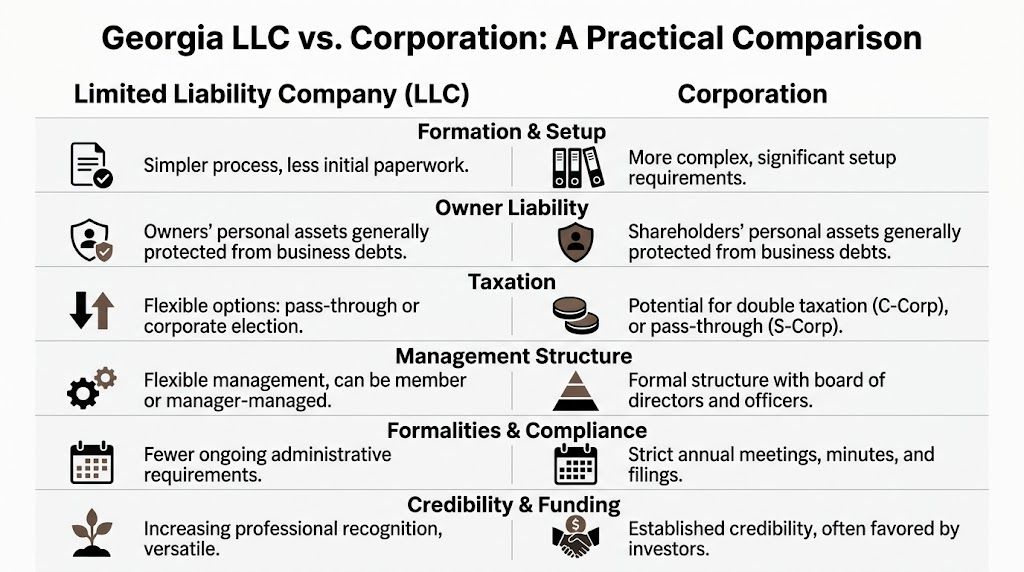
A Georgia LLC often gives owners liability protection with fewer formalities and more flexible management. A corporation may still be the better fit for certain investment or governance goals, but many owner-operated businesses in Cumming, Dawsonville, Canton, and Suwanee prefer the LLC model because it is easier to run correctly.
Side-by-side practical view
| Decision factor | Georgia LLC | Corporation |
|---|---|---|
| Tax treatment | Often more flexible | C-corp can create double taxation, S-corp has restrictions |
| Management | Member-managed or manager-managed | Formal board and officer structure |
| Compliance burden | Usually lighter | More rigid record-keeping and meeting expectations |
| Ownership changes | Often easier to customize by agreement | More formal stock and governance rules |
| Investor appeal | Can work well depending on deal structure | Often preferred where formal share structure matters |
Why many small business owners start with an LLC
An LLC usually makes sense where the owner wants:
- Operational flexibility: Fewer formal procedures and easier internal decision-making.
- Customized control: The operating agreement can be adapted to the actual business relationship.
- Cleaner administration: Less risk of falling out of compliance because the structure is simpler to maintain.
A corporation may make more sense where the business expects outside investors, formal stock issuance, or a governance model built around a board.
That said, many businesses choose a corporation for image rather than necessity. That’s usually a mistake.
If you’re weighing the two structures in a more direct way, this comparison of LLC vs corporation for small business is worth reviewing before you commit.
The divorce and litigation angle matters too
Entity choice also affects what happens if things go wrong. In a shareholder dispute, buyout conflict, or divorce, a heavily formalized corporate structure can either protect you or create more issues depending on whether it was maintained properly.
That’s why the right answer often depends less on theory and more on your actual life:
- Is this a family-run business?
- Are ownership changes likely?
- Could divorce, probate, or succession planning become part of the picture?
- Will you keep up with the corporate formalities?
If the answer to that last question is uncertain, a corporation may be the wrong vehicle from the start.
Why Choose Miles Hansford for Your Business's Future in North Georgia
A business owner in North Georgia can make a perfectly reasonable incorporation decision at formation and still regret it later, once the company is under pressure. I see that happen in two settings more than any others. Litigation exposes whether the records, governance, and ownership structure were handled correctly. Divorce exposes how income, control, and business value look once they are examined line by line.
That is why entity planning should be tied to real life, not just filing strategy. In Cumming, Alpharetta, Forsyth County, and Fulton County, many owners are building a company while also building a marriage, a family, and long-term financial stability. If the structure is poorly chosen or poorly maintained, the problem is rarely confined to the business. It can affect settlement advantage, support arguments, valuation disputes, and the owner’s day-to-day control of the company.
Miles Hansford Law Firm handles corporate matters, business disputes, mediation, and family law issues in the same local court environment where these problems usually surface. That matters because the legal question is often connected to several others at once.
The right legal advice should answer practical questions such as:
- How will this entity hold up if a partner relationship deteriorates?
- What records will matter if a spouse challenges business income or value?
- How exposed is the owner if corporate formalities were treated casually?
- What can be fixed now, before a dispute puts every decision under scrutiny?
For many owners, the best time to review the structure is before anyone files suit, serves discovery, or starts arguing over valuation. Early corrections are usually cheaper, cleaner, and more effective than trying to explain bad records in the middle of a business case or a divorce.
If you already incorporated and have concerns, those concerns deserve a serious review now.
Frequently Asked Questions About Corporate Structures in Georgia
A corporation can look tidy on paper and become messy fast once a marriage, shareholder dispute, or support case puts the books under a microscope. These are the questions Georgia business owners ask when they want to know how the corporate choice will hold up in real life, not just at filing.
Q: Is a corporation always better than an LLC for a business in Cumming, GA?
A: No. The better choice depends on how the business earns money, who owns it, whether outside investors are realistic, and how much formality the owners will maintain. For many closely held North Georgia businesses, an LLC gives liability protection with less administrative work. A corporation can make sense, but it often brings more recordkeeping, stricter procedures, and more room for trouble if those procedures are ignored.
Q: My spouse and I own a corporation together in Cumming. How does that affect a divorce?
A: It raises several problems at once. The court may need to sort out ownership, control, access to accounts, compensation, and the value of each spouse’s interest. If one spouse handles payroll and the other claims the business is worth more than shown on paper, the dispute can expand quickly. In practice, jointly owned corporations often create fights over who can act for the company while the divorce is pending and whether one spouse is using the business to influence settlement pressure.
Q: Will my corporation’s income matter in an Alpharetta divorce or support case if I leave money in the business?
A: Yes, it can. Owners sometimes assume retained earnings or company-paid expenses stay inside the corporation and outside the family case. That assumption is dangerous. If the business is closely held and the owner has control over compensation or distributions, those financial decisions may become part of the argument over income, cash flow, and ability to pay support.
Q: Can a corporation keep my spouse from claiming part of the business in a Georgia divorce?
A: Incorporation alone does not do that. The court looks at the facts behind the ownership interest, including when the business was formed, how it grew during the marriage, whether marital effort increased its value, and how the parties used business income. A corporate shell does not erase a marital claim. It often creates more documents to review.
Q: Can an S-corp solve the tax problems that make corporations unattractive?
A: Sometimes it helps, but it is not a cure-all. S-corp status may reduce one tax problem while creating others tied to payroll, distributions, ownership limits, and record discipline. It can also complicate family transfers, buyouts, and settlement terms during a divorce if the structure was never planned with those events in mind.
Q: What happens if I never kept minutes, held meetings, or separated business and personal spending?
A: Poor records weaken your position. They can hurt credibility in a business dispute and create valuation problems in divorce. They also give the other side room to argue that the company was operated like a personal account instead of a separate legal entity. That is the kind of fact pattern that makes litigation more expensive and settlement harder.
Q: How long does a divorce take when a corporation is involved?
A: Usually longer than a divorce without a business. A closely held corporation adds requests for tax returns, bank records, payroll data, shareholder documents, and valuation materials. If the spouses disagree about income, ownership, or control, temporary hearings and forensic review often follow. Delay becomes expensive, especially when the business still has to operate during the case.
Q: Does incorporating protect me from personal exposure if the business gets sued?
A: It can help, but the protection is not absolute. Owners still create risk when they personally guarantee debt, mix funds, sign carelessly, commit wrongful acts, or fail to respect corporate formalities. That same sloppiness often appears again in divorce discovery. If the records are weak in one case, they are usually weak everywhere.
Q: Should I review my structure now, even if no one has filed for divorce or sued the business yet?
A: Yes. The best time to fix governance, compensation practices, ownership documents, and recordkeeping is before a dispute starts. Once a spouse, partner, creditor, or opposing lawyer starts asking for documents, every shortcut becomes harder to defend. Miles Hansford Law Firm regularly sees how entity decisions made early affect business control, settlement options, and personal financial exposure later.