


Meta Title: Disorderly Conduct Charge in Alpharetta, GA
Meta Description: Facing a disorderly conduct charge in Alpharetta, GA? Learn penalties, local court process, defense strategy, and what to expect in Fulton County.
Suggested URL Slug: /alpharetta-disorderly-conduct-charge-defense
Schema Recommendations:
- Attorney
- LegalService
- FAQPage
Internal Link Suggestions:
- Can you expunge a misdemeanor in Alpharetta
- How Miranda rights protect against self-criminalization
- How to choose a criminal defense lawyer
If you're dealing with a disorderly conduct charge in Alpharetta, GA, you're probably asking the same question commonly asked in the first hour after release or after getting a citation. How did something this small turn into a criminal case?
It happens fast in Alpharetta, Cumming, Johns Creek, Milton, and the rest of North Atlanta. A loud argument outside a restaurant, a confrontation during a custody exchange, a neighborhood complaint in a subdivision, or a tense scene after drinks can turn into handcuffs, a citation, or a court date. People are often stunned because they never thought of themselves as the kind of person who gets charged with a crime.
A disorderly conduct charge is serious, but it is not the end of the story. A charge is an accusation. It is not a conviction. What you do in the next few days matters more than what you said in the heat of the moment.
Practical rule: Stop explaining. Stop apologizing to police. Stop texting your version of events to half your contacts. Start protecting yourself.
For professionals in Alpharetta and Cumming, the risk goes beyond court. A misdemeanor record can create problems with employment, licensing, security clearance, divorce litigation, custody disputes, and even the way an opposing party frames you in family court. In North Fulton and Forsyth County, that context matters.
If you're searching for a lawyer "near me," you need local judgment, not generic internet advice. You need to understand how these charges work in Fulton County, Forsyth County, and nearby municipal courts, and you need a plan that fits your life, your record, and your long-term goals.
An Unexpected Charge An Unclear Future
A lot of disorderly conduct cases in Alpharetta start with a normal day going sideways.
You argue with a spouse in a parking lot near downtown Alpharetta. A neighbor in a Cumming subdivision calls police over noise. A custody handoff in North Fulton gets tense. Someone says you were aggressive. An officer arrives after emotions have already peaked, listens to two competing stories, and writes the charge that gives the state the most room to maneuver.
That is why people feel blindsided. They expected a warning, maybe a lecture, maybe everyone goes home. Instead, they leave with a citation, a bond condition, or an upcoming court date.
Why the first reaction often makes things worse
Individuals often damage their case in the first few hours because they think cooperation means talking. It doesn't.
The officer already decided there may be a charge. The prosecutor isn't looking for a balanced conversation. They're looking for usable statements. If you start offering context, the state may later cut your explanation into admissions.
A calmer approach works better:
- Stay silent about the facts: Give identifying information if required, but don't narrate the incident.
- Preserve evidence immediately: Save texts, call logs, Ring footage, security video requests, and names of witnesses.
- Treat the charge as a real threat: Even if it feels petty, a misdemeanor can still hurt your record and your family court position.
- Talk to counsel before court: That is especially important in Alpharetta, Cumming, Roswell, Sandy Springs, and surrounding courts where local practice matters.
A rushed guilty plea often costs more than the original charge.
Why this hits hard in North Atlanta
In affluent suburbs like Alpharetta, Milton, Johns Creek, and Suwanee, reputation carries real weight. People serve on HOA boards, work in regulated professions, hold management roles, or are already dealing with a divorce or custody conflict in Fulton County Superior Court or Forsyth County Superior Court. One misdemeanor allegation can become an influential factor.
Georgia family law adds another layer. Georgia is a no-fault divorce state, and there is a 30-day minimum waiting period after filing. But if you're also fighting over custody, parenting time, or temporary relief, a pending criminal allegation can show up quickly in a temporary hearing. Georgia courts decide custody based on the child's best interests, and they expect workable parenting plans. If the other side can paint you as unstable or volatile, they'll try.
That is why you should treat this charge as both a criminal matter and, in some homes, a family law risk.
What a Disorderly Conduct Charge Means in Georgia
You get into a loud argument outside your subdivision clubhouse in Alpharetta. A neighbor calls police. Nobody is hurt, but by the end of the night you are holding a citation or walking out of jail on a disorderly conduct charge. For many people in North Atlanta, the primary shock is not the accusation itself. It is how fast a minor-looking misdemeanor starts touching work, family, and reputation.
Georgia uses disorderly conduct as a broad misdemeanor charge. Prosecutors and officers often rely on it in arguments, neighborhood disputes, public confrontations, and cases where they believe someone crossed a line but the facts do not support a cleaner charge. That broad reach is exactly why you should read the accusation carefully instead of assuming it is just about being loud or rude.
What the charge actually covers
The law generally targets conduct that disturbs public order. In real cases, that usually means allegations of violent or tumultuous behavior, threatening conduct, or words the state claims were likely to provoke an immediate breach of the peace.
Those details matter.
An officer may describe you as aggressive. A complaining witness may say they felt intimidated. Video may show raised voices, pointed fingers, and a crowd forming, but no attempt to hit anyone. A strong defense often starts by forcing the court to look at what happened, second by second, instead of relying on a loaded summary in a police report.
A bad moment is not automatically a crime
Georgia does not criminalize every argument. People are allowed to be upset. People are allowed to say things others dislike. The state still has to prove conduct that fits the statute, and that is where many cases become defensible.
In Alpharetta, Milton, Cumming, and nearby communities, these charges often grow out of situations that look minor at first glance. HOA disputes. Parking lot confrontations. Parenting exchanges. Business disagreements that spill into public. For professionals, executives, physicians, real estate agents, and business owners, the concern is rarely limited to the courtroom. A pending charge can trigger employer scrutiny, licensing questions, and image concerns that overlap with brand or review management issues long before the case is resolved.
State law and local ordinance cases are not the same
One of the first things I look at is where the charge came from and who wrote it. In and around Alpharetta and Cumming, a disorderly conduct allegation may proceed under state law, a city ordinance, or a mix of both. That difference affects court location, plea options, and the long-term impact on your record.
Here is the practical distinction:
| Allegation Type | Georgia State Charge | Local Ordinance Version |
|---|---|---|
| Public fighting or tumultuous behavior | Prosecuted as a misdemeanor under state law | Sometimes handled in municipal court if charged under city code |
| Provoking conduct or fighting words allegations | Can carry broader record consequences | May create more flexible local resolution options in some courts |
| Neighborhood or public nuisance behavior | Facts may or may not fit the statute | Local code may be the charging path instead |
| Conduct tied to domestic spillover in public | Often treated more seriously because of context | Less common as a pure ordinance matter |
That distinction is not academic. A negotiated resolution to a city ordinance can look very different from a plea to a state misdemeanor. If you are worried about background checks, professional licensing, or whether this can ever be cleared, you also need to understand whether a misdemeanor can be expunged in Alpharetta.
Why this charge causes outsized problems in North Atlanta
Two people can both face a disorderly conduct charge and have completely different risk profiles.
If you live in a high-visibility neighborhood, serve on an HOA board, hold a professional license, or are in the middle of a high-asset divorce or custody fight, this charge gives the other side material to use against you. Opposing counsel in family court will frame the incident as proof of instability. A licensing board may ask for an explanation. A spouse, co-parent, employer, or business partner may care less about the legal definition than the fact that police were called at all.
That is why the label alone tells you very little. The facts, the court, the charging authority, and your personal exposure outside the criminal case are what define the full meaning of a disorderly conduct charge in Georgia.
Penalties and the Hidden Consequences in Alpharetta
You may be standing in your kitchen in Windward or Vickery, staring at a citation that says disorderly conduct, telling yourself it was a misunderstanding and it will blow over. That is the wrong approach. In Alpharetta and the surrounding North Atlanta suburbs, this charge can do damage long before any judge decides punishment.
Under O.C.G.A. § 16-11-39, disorderly conduct is a misdemeanor punishable by up to 12 months in jail and fines up to $1,000, as reflected in Georgia's statutory text and related case discussion.
For many first-time offenders, the court outcome is less dramatic than the statute allows. You may be looking at probation, counseling, community service, anger management, or conditions tied to staying out of trouble. But the courtroom penalty is only part of the problem, and often not the part that hurts the most.

The real risk usually sits outside the criminal case
In Alpharetta, Milton, Johns Creek, Roswell, and Cumming, clients with stable careers, strong finances, and established family routines often have more to lose from a disorderly conduct charge than from many people facing more serious records.
A pending charge can show up on background checks. It can trigger questions from an employer, a licensing board, a business partner, or a spouse's lawyer. If you work in real estate, health care, education, finance, contracting, or any role that depends on trust and public judgment, you need to treat this as a reputation problem and a legal problem at the same time.
Family court is where this charge often turns expensive. In a high-asset divorce or contested custody case, the other side will try to frame the incident as proof that you are volatile, reckless, or disruptive around the children. That argument may be weak on the facts, but it can still affect temporary hearings, settlement posture, parenting schedules, and who controls the story early.
Why this hits affluent suburbs differently
North Atlanta suburbs create their own pressure points.
One police response in a gated community or golf neighborhood can lead to HOA complaints, neighbor statements, private security reports, and screenshots passed around long before your first court date. If you sit on an HOA board, coach youth sports, hold a leadership role at school, or own a visible local business, the practical fallout can arrive fast.
Common collateral consequences include:
- Professional license exposure: Boards may ask for an explanation, supporting documents, or notice of the case.
- Employment risk: A pending misdemeanor can affect promotions, renewals, hiring decisions, and internal investigations.
- HOA friction: Community associations and neighbors may turn one incident into an ongoing dispute over noise, conduct, or access to shared spaces.
- Divorce and custody pressure: Opposing counsel may use the allegation to gain an advantage concerning parenting time, possession of the home, or settlement terms.
- Business reputation problems: If your name is tied to a local company, public conflict can become a marketing issue. Some business owners use review management to limit online fallout after a public incident.
If your first instinct is to call this minor, correct that now.
A quick plea can create a long problem
Analysts at Prison Policy Initiative reported in a 2025 Jail Data Initiative analysis of 2023 jail admissions that misdemeanors make up a large share of jail admissions nationwide. Disorderly conduct sits inside that broader reality. So-called minor charges still lead to booking, supervision, missed work, court costs, and records that linger.
That is why a fast plea is often a bad bargain. It may close the court file, but it can leave you with a record that becomes an issue in licensing, hiring, family court, or future background screening.
What you should do in an Alpharetta case
Set the goal correctly. Protect your record, your family position, and your professional standing.
Ask these questions early:
- Is the evidence consistent with disorderly conduct, or was this an overcharged argument or neighborhood dispute?
- Is there body camera footage, surveillance video, Ring footage, or witness bias that changes the picture?
- Can the case be reduced, diverted, or dismissed without creating a damaging record?
- Would a local resolution put you in a better position than a straight plea to the state charge?
- If the case does not end cleanly, what are your options later for clearing a misdemeanor record in Alpharetta?
That is the practical analysis that matters. A careless plea can cost far more than a careful defense.
The Legal Process After a Disorderly Conduct Arrest in Cumming
You get home after a neighborhood argument, a school event confrontation, or a dispute outside a restaurant in Cumming, and then the gravity of the situation sinks in. You are not just dealing with a ticket. You are dealing with a court process that can spill into your job, your HOA, your parenting schedule, and any divorce or custody fight already brewing.
What happens next depends on where the case was made and who charged it. A City of Cumming case may stay in municipal court. A Forsyth County case may follow a different track. An arrest in Alpharetta can bring a different set of local procedures and expectations. The court system is not hard to handle if you act early, but it does punish delay and loose talk.
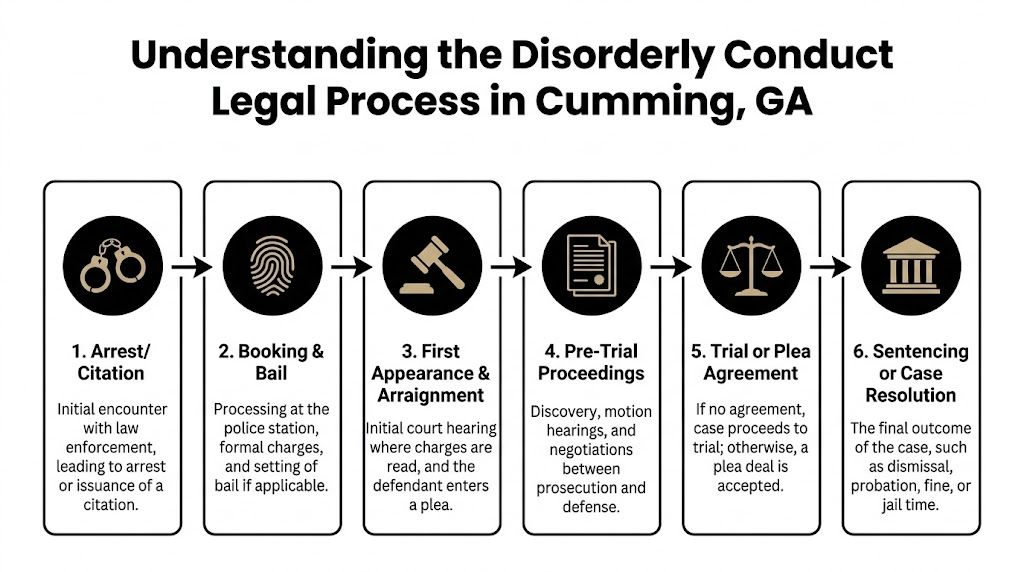
The first two stages
Arrest or citation
Some clients are taken to jail. Others are handed a citation and a court date. That decision usually turns on the officer's view of the scene, whether anyone claimed to feel threatened, and whether the officer believed the conflict might continue.
Do not assume a citation means the case is minor. In North Atlanta suburbs, even a case that looks small on paper can create outsized problems for executives, licensed professionals, and parents in contested family cases.
Booking and bond
If you were booked, the next issue is release and bond conditions. Read every condition. Follow every condition. If the accusation involved a spouse, partner, neighbor, or family member, the bond terms may limit contact, travel, or where you can stay.
That matters fast in high income households. One bond condition can disrupt access to the home, create an advantage in a custody dispute, or trigger ugly HOA complaints if police already came to the property.
Your first court date
In many Cumming and Forsyth County cases, the first appearance is arraignment. The judge advises you of the charge, and you enter a plea or preserve your rights through counsel.
Treat that date as a legal event, not a chance to tell your side of the story. Clients hurt themselves here all the time. They try to sound reasonable, fill in gaps for the prosecutor, or explain facts that were not obvious from the report. Keep quiet. Let your lawyer do the talking. If you need a refresher on why silence matters, read this explanation of how Miranda rights protect against self-criminalization.
One careless statement can become the centerpiece of a misdemeanor case.
What happens between arraignment and resolution
This part of the case decides the outcome. In a well-handled disorderly conduct case, the work happens before any trial date.
A defense lawyer should be doing several things at once:
- Getting the full file from the prosecutor and law enforcement
- Reviewing video from body cameras, dash cameras, business surveillance, home systems, and phones
- Comparing witness statements for exaggeration, inconsistency, or personal motive
- Examining the charging decision to see whether the facts fit Georgia's disorderly conduct statute
- Filing motions if police obtained statements improperly or if the evidence is legally weak
- Pushing for a result that protects your record, not just a quick plea that closes the case file
In Cumming area cases, good evidence often sits outside the police file. Ring footage, subdivision cameras, restaurant video, text threads, and messages from the complaining witness can change the posture of the case.
Why local court knowledge matters
A disorderly conduct case in Cumming is not handled exactly like one in Alpharetta. Court calendars differ. Prosecutors differ. Diversion options, negotiation style, and scheduling practices differ. A lawyer who regularly appears in these courts knows the practical pressure points and knows when a prosecutor is open to a cleaner resolution.
That local knowledge matters even more when the criminal case is only one problem in a larger life picture. I have seen a single misdemeanor allegation show up in professional licensing disclosures, get quoted in a temporary custody hearing, and become a talking point in a high asset divorce. In affluent communities, reputation is part of the case whether the court says so or not.
What to do now
If you have a pending disorderly conduct case in Cumming or nearby, take these steps immediately:
- Save every paper and screenshot tied to the arrest, citation, bond, and court date.
- Write out a private timeline for your lawyer while the details are still fresh.
- Identify every witness and every camera before footage is deleted.
- Follow bond conditions exactly even if they feel unfair or unnecessary.
- Stay off text, email, and social media about the incident.
- Do not discuss the facts with the complaining witness or with friends who may later become witnesses.
Act like the case will affect more than a fine. In Alpharetta, Cumming, and the surrounding suburbs, it often does.
Building a Strong Defense for Your Case in North Georgia
You may have had one bad night at a restaurant, a school event, a neighborhood meeting, or outside your own home, and now the charge is sitting on the table like it defines you. It does not. A good defense starts by stripping the accusation down to proof, context, and motive.
That matters more in North Atlanta suburbs than generic articles admit. A disorderly conduct charge can become HOA gossip, a problem for a licensing board disclosure, or a talking point in a custody or divorce case where the other side wants to paint you as unstable. Defense strategy has to protect more than the criminal file.

Start with the weak points in the state's case
Disorderly conduct cases are often built on a short police summary, an annoyed witness, and a scene that was already over by the time the officer arrived. That is not the same as clean proof.
Georgia law does not make every loud argument, rude comment, or embarrassing public scene a crime. In many cases, a key defense is that the facts do not fit the charge. Sometimes the conduct was protected speech. Sometimes the officer got only one side of a family fight or neighbor dispute. Sometimes the report uses loaded words like "aggressive" or "threatening" without facts to support them.
I look for details first.
Defense themes that often work in Alpharetta, Cumming, and nearby courts
A strong disorderly conduct defense usually comes from a careful factual attack, not courtroom theatrics. Common angles include:
- No legally sufficient threat or qualifying conduct. Anger and volume are not enough by themselves.
- Missing context. A short clip, a partial statement, or a witness summary can leave out what triggered the exchange.
- Biased witnesses. Neighbor conflicts, strained marriages, ex-spouses, and business disputes regularly spill into these cases.
- Video and audio evidence. Phone footage, doorbell cameras, bar surveillance, and patrol car recordings can undercut the police version fast.
- Protected speech issues. Offensive language is still not automatically criminal.
- Practical resolution pressure. If the proof is thin, prosecutors are often more open to dismissal, a reduction, or another outcome that avoids broader fallout.
Collateral damage should shape the defense
If you are a physician, executive, financial professional, educator, or licensed contractor, your defense has to account for disclosure rules and reputation risk from day one. The same is true if you are in the middle of a high-asset divorce or a custody dispute. Opposing counsel will not treat this as a minor municipal annoyance if they can use it to question judgment, temperament, or parenting.
In HOA-heavy communities and tight social circles, a misdemeanor accusation can spread faster than the case moves. That is why I often focus on getting ahead of the narrative, preserving favorable evidence early, and pushing for a result that limits the record problem rather than just settling for the first plea offer.
Subjective charges deserve hard scrutiny
Disorderly conduct is one of the most subjective charges on the books. Officers make quick judgment calls. Witnesses describe the same event in completely different ways. Personal bias, social status, family history, and who called 911 first can all shape the report.
The ACLU's report on racial disparities in low-level offense arrests shows why discretionary charges deserve close examination. In an individual case, that means asking direct questions about why your conduct was singled out, what the officer observed, and whether the evidence matches the language in the citation.
Choose a lawyer who sees the whole problem
You need a lawyer who can try the case if necessary, but also one who understands what a clean outcome means for your job, your family case, and your name in the community. If you are comparing counsel, read this guide on how to choose a criminal defense lawyer.
Law firms also know that public perception matters, which is why firms pay attention to Criminal Defense Law Firm Marketing. For a client, though, image is not enough. You want disciplined strategy, local court judgment, and a defense built to protect your record and the rest of your life.
Why Choose Miles Hansford for Your Alpharetta Defense
If your case is in Alpharetta, Cumming, Forsyth County, Fulton County, or the North Fulton courts, you should hire counsel who already knows the local terrain.
That means knowing how municipal cases differ from state-level prosecutions. It means understanding how a disorderly conduct charge can spill into a divorce, temporary custody fight, or mediation. It means recognizing when a local ordinance outcome may be cleaner than a plea to the state offense. And it means being prepared for the practical concerns North Atlanta clients have, including professional risk, family reputation, and future record issues.
Local court knowledge is not optional
A lawyer handling these cases in North Georgia should be comfortable with the routines and expectations of the courts your case may touch, including Fulton County Superior Court, Forsyth County Superior Court, and local municipal courts. That matters because local practice often shapes results.
It matters in family law too. In Georgia, property division follows equitable division, not automatic equal division. Custody decisions turn on the child's best interests. Parenting plans are required. Mediation is often part of the process. Temporary hearings can shape the rest of the case. If a criminal allegation overlaps with those issues, your lawyer needs to think across both lanes.
Strategic and protective representation matters more than bluster
A good disorderly conduct defense doesn't come from sounding aggressive online. It comes from disciplined case analysis, local credibility, and the judgment to know when to push and when to negotiate.
For law firms trying to explain that difference to the public, this overview of Criminal Defense Law Firm Marketing is a useful reminder that presentation is not the same thing as legal skill. If you're hiring someone for an Alpharetta or Cumming case, look past slogans and ask how they defend fact-sensitive misdemeanor charges in local courts.
The right fit is a lawyer who sees the whole picture. Not just the citation. Your job. Your children. Your divorce. Your license. Your reputation in Milton, Johns Creek, Roswell, Suwanee, Sandy Springs, Canton, or Dawsonville. That is the level of strategy this kind of case requires.
Frequently Asked Questions About Disorderly Conduct Charges
Q How serious is a disorderly conduct charge in Alpharetta GA
A disorderly conduct charge is a misdemeanor in Georgia, and you should treat it seriously. Even when jail is unlikely, the case can affect employment, licensing, background checks, and family court strategy in Fulton County. If the incident connects to a divorce or custody dispute, act quickly before temporary hearings and mediation start shaping the record.
Q Will I have to appear in court in Cumming or Forsyth County
Usually, yes, at least until your lawyer determines whether appearance requirements can be handled in a particular court. That depends on the court, the charge posture, and local procedure. Do not assume you can skip a date in Cumming or Forsyth County because missing court can create a much bigger problem than the original charge.
Q Can a disorderly conduct charge affect my divorce or child custody case
Yes. In Georgia, custody decisions focus on the child's best interests, and courts require parenting plans in contested custody matters. A spouse can use the incident to argue for restrictions at a temporary hearing or to gain an advantage in settlement talks. That is especially important in pending cases in Fulton County Superior Court or Forsyth County Superior Court.
Q Is disorderly conduct just a fallback charge
Often, yes. In practice, it is frequently used when police or prosecutors believe something happened but the proof for a more serious allegation is not strong enough. That is one reason these cases deserve careful review. A broad charge creates room for defense, but only if someone challenges the facts and the legal theory.
Q Can I get the charge reduced to a local ordinance in Alpharetta
Sometimes. In the right case, a negotiated resolution to a local ordinance may be better than a plea to the state charge because the practical consequences can be different. Whether that option exists depends on the court, prosecutor, facts, and your record. This is a good question to ask early, not after you've already decided to plead.
Q What should I do if the police report leaves out important context
Preserve your own evidence immediately. Save text messages, screenshots, call records, video, GPS data, and witness names. Then stop discussing the case publicly. In disorderly conduct cases, the missing context is often the defense. That is particularly true in neighbor disputes, family conflict, and incidents during exchanges involving children.
Q Can biased or selective enforcement be part of the defense
Yes, in the right case. Disorderly conduct is a subjective charge, which means officer judgment plays a large role. National ACLU data shows Black individuals can be arrested at much higher rates for low-level offenses in some cities, and that supports careful scrutiny of how discretionary enforcement works. In a Fulton County case, that may be relevant when the facts suggest unequal treatment or thin justification.
Q Can I clear my record later if the case is dismissed
Possibly, but you should not assume cleanup is automatic. Eligibility depends on how the case ends, whether there is a conviction, and what Georgia law allows at that time. The better strategy is to aim for the best possible outcome from the start. Preventing a damaging disposition is usually easier than fixing one later.
If you're facing a disorderly conduct charge in Alpharetta, Cumming, Fulton County, or Forsyth County, get local legal advice before you make statements, appear in court, or accept a plea. Miles Hansford Law Firm helps clients protect their record, their family position, and their future with strategic guidance grounded in North Georgia courts. Schedule a consultation and speak with an attorney who understands how these cases affect real life, not just the court file.