


When you’re facing a divorce and have children, the questions about custody can feel overwhelming. It's a deeply emotional time filled with uncertainty about what happens next. The path forward seems unclear. At Miles Hansford, we help families in Cumming, GA, find clarity and protect what matters most: your children's future and your relationship with them. A calm, strategic plan is achievable, and we are here to help you build it.
If you are facing a divorce and have questions about child custody, do not wait. Schedule a confidential consultation with a Miles Hansford family law attorney today to protect your parental rights.
Why Divorce and Custody in Cumming, GA Requires a Protective Strategy

We see the fear and emotional toll on parents in Cumming, GA, every day. When your family's future is uncertain, the questions are endless. Where will the kids live? Who makes the big decisions? How do I make sure I remain a central part of their lives? These worries are common for the families we serve across Alpharetta, Johns Creek, and throughout North Georgia.
Our first job is to provide direct, honest reassurance. The goal is not just to finalize a divorce; it's to lay the groundwork for a secure new normal for you and your children. Having an experienced local attorney who practices in Forsyth County and Fulton County courts can cut through the noise and help you regain control.
Protecting your parental rights isn’t about winning a battle. It’s about building a stable foundation for your children's future. The temporary and final orders entered in a Forsyth County Superior Court or Fulton County Superior Court today will define your family’s life for many years.
For parents in communities like Milton, Dawsonville, and Suwanee, the first step is understanding the local process. Custody is one of the most difficult parts of family law, and you are not alone in this. While your family's situation is unique, Georgia law provides a structured path for these cases. This path involves:
- Understanding Georgia's “best interest of the child” standard.
- Learning the critical differences between legal and physical custody.
- Preparing for temporary hearings, which are often the most critical stage of a case in Forsyth or Fulton County.
- Creating a detailed Parenting Plan, which is required by all Georgia courts.
For families in the North Fulton area, from Roswell to Sandy Springs, navigating a divorce and custody case requires a careful and protective strategy. You do not have to do this on your own. A family law attorney can explain the next steps and help you build a case that safeguards your family’s future. If you feel lost and unsure what to do, now is the time to ask for guidance.
The Legal Process for Divorce and Custody in North Georgia
When you’re facing a divorce with children, the court process in places like Cumming or Alpharetta can feel overwhelming. Knowing the timeline from start to finish helps reduce that anxiety and highlights the critical moments where the right legal strategy can protect your parental rights. Here’s how a typical divorce and custody case unfolds in Forsyth and Fulton Counties.
1. Filing the Initial Divorce Petition
Everything officially starts when one spouse files a Complaint for Divorce in the correct Superior Court. If you or your spouse live in Cumming, Johns Creek, or parts of Suwanee, you’ll file with the Forsyth County Superior Court. For residents of Alpharetta, Milton, or Sandy Springs, the case will be heard in Fulton County Superior Court.
This initial filing is a formal document that states the marriage is “irretrievably broken” under Georgia’s no-fault divorce laws. It also lays out what the filing spouse requests for child custody, child support, alimony, and property division. After being served with the papers, the other spouse has 30 days to file a formal Answer. You can learn more about the specifics of the filing process in our guide on how to file for divorce in Georgia.
2. The Critical Role of Temporary Hearings in Cumming, GA

Soon after filing, either spouse can request a temporary hearing. This is one of the most important early stages of a custody case. At this hearing, a judge will issue temporary orders that dictate how things will run while the divorce is ongoing, covering:
- Temporary Child Custody: Which parent the children will primarily reside with.
- Parenting Time: The visitation schedule for the non-custodial parent.
- Temporary Child Support and Alimony: The amount of financial support to be paid.
- Use of the Marital Home: Who gets to live in the family house.
CRITICAL: These temporary orders are incredibly powerful. They establish a "status quo" for your children that judges are often reluctant to change later. A temporary schedule can easily become the framework for the final order. Do not agree to temporary custody terms without representation.
3. Discovery, Mediation, and Trial
Once temporary orders are in place, the case enters the discovery phase. This is the formal process where both sides gather evidence through written questions (Interrogatories), requests for documents, and sworn testimony (Depositions). This is how your attorney builds a strong case based on the "best interest of the child" factors.
Before a final trial, Georgia courts in Forsyth and Fulton County require couples to attend mediation. In this confidential meeting, a neutral mediator helps you and your spouse try to reach an agreement. For many families in Roswell and Dawsonville, mediation is successful and avoids the expense and stress of a trial. If you cannot agree, the final step is a trial where a judge makes the final decisions.
Strategic Considerations for Your Custody Case
Navigating a custody battle in Cumming or Alpharetta requires more than just knowing the law; it demands a strategic approach focused on protecting your relationship with your child. The decisions you make now will shape your family's future.
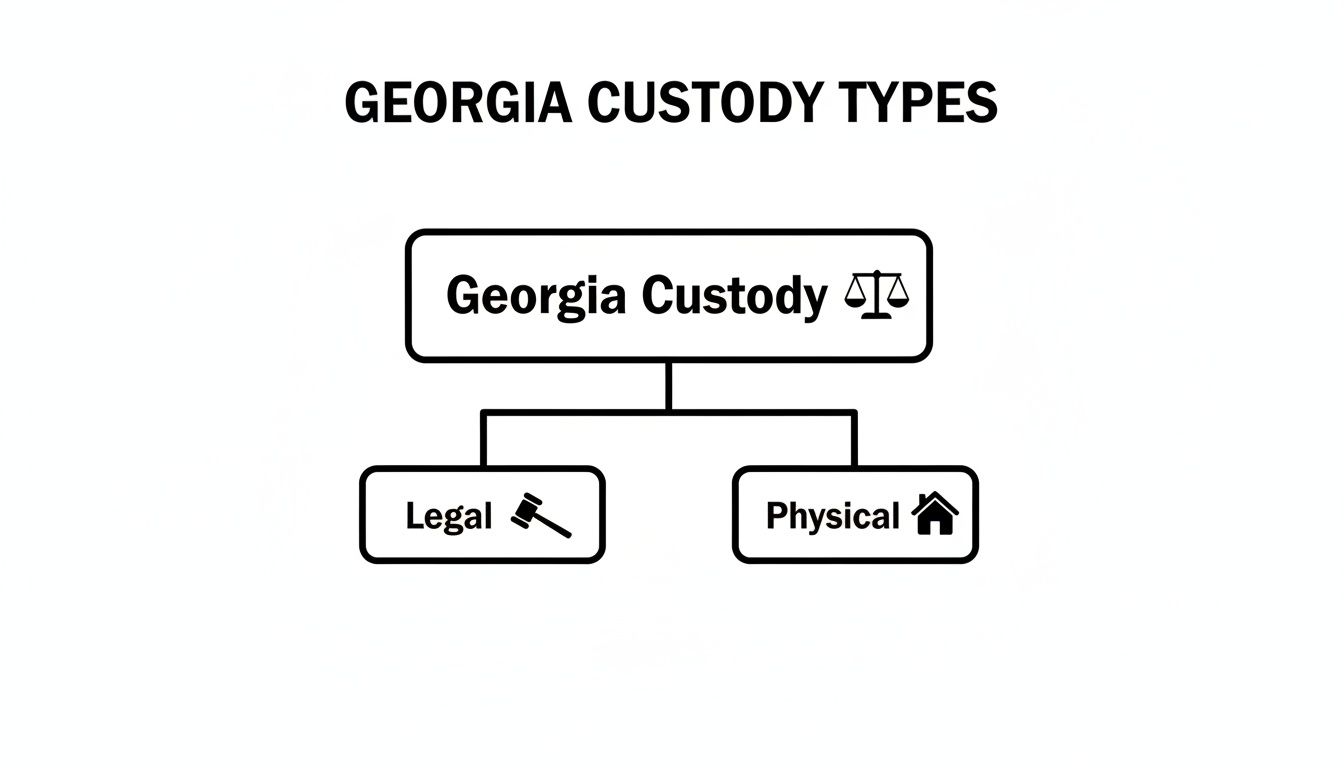
Understanding Georgia Custody Types
In any custody case, from mediation in Alpharetta to a trial in Cumming, every agreement is built on two concepts: legal custody and physical custody.
- Legal Custody is the right to make major decisions for your child regarding education, healthcare, religion, and extracurricular activities. In most Forsyth County and Fulton County cases, judges award joint legal custody, as Georgia policy favors both parents being actively involved.
- Physical Custody determines where the child lives. The parent with primary physical custody is the custodial parent, while the other parent has a set schedule of parenting time (visitation). The goal is always to create a predictable routine that ensures frequent and meaningful contact with both parents.
Crafting a Strong Georgia Parenting Plan in Alpharetta, GA

The Parenting Plan is the single most important document in your custody case. It is a detailed, legally required blueprint that a Forsyth or Fulton County judge will sign into a final, enforceable order. A vague plan is a recipe for future conflict.
Your plan must outline:
- A daily schedule (where the child lives each day).
- A holiday and vacation schedule.
- Transportation responsibilities.
- Decision-making authority for legal custody matters.
A strong plan also anticipates future problems by including provisions for communication protocols, the right of first refusal for childcare, relocation notices, and dispute resolution methods like mediation. We can help you draft a document that protects your rights and minimizes future conflict. To learn more, read our guide on how to prepare for custody mediation.
What to Expect in Forsyth and Fulton County Courts
When a divorce involves children, parents in Cumming and Alpharetta ask, "How will a judge actually decide our custody case?" In Georgia, every single custody ruling from a Forsyth County or Fulton County Superior Court judge comes down to one guiding principle: the best interests of the child.
This is a legal standard defined by Georgia law. A judge must weigh 17 factors to determine which arrangement will best support a child's happiness and well-being. For parents in Roswell, Johns Creek, or Milton, understanding these factors is critical.
Some of the most influential factors a judge will analyze include:
- Emotional Ties: The love and specific emotional bonds between each parent and the child.
- Capacity to Provide: Each parent's ability to give the child love, guidance, and education, on top of essentials like food, clothing, and medical care.
- A Stable Home Environment: The stability of the home each parent can offer. This is a huge factor for families in rapidly growing communities like Suwanee and Dawsonville.
- History of Family Violence or Abuse: Any evidence of abuse is taken with the utmost seriousness.
- Involvement in the Child's Life: A judge wants to see a parent's track record of involvement in their child's schooling, social life, and activities.
- Willingness to Co-Parent: A judge will look for the parent more likely to foster a positive relationship between the child and the other parent.
While Census data still shows that around 80% of custodial parents are mothers, the tide is turning. Georgia courts, like others across the country, are increasingly favoring joint custody arrangements that keep both parents actively involved, as shown by evolving custody trends and what they mean for families. A judge in the North Fulton court system is tasked with creating an order that serves the child’s long-term well-being.
Why Choose Miles Hansford for Your Cumming & Alpharetta Divorce
When it comes to your children, the stakes are incredibly high. You need a family law attorney who knows the local courts and understands what's on the line for families in Cumming, GA, and Alpharetta, GA.
Our firm is part of this community. We are in the Forsyth County Superior Court and Fulton County Superior Court daily. We have firsthand knowledge of local procedures and what strategies resonate with judges in communities from Johns Creek and Roswell to Milton and Dawsonville. We combine compassionate, straightforward advice with firm advocacy, making sure you feel both supported and defended.
We know you are a parent fighting for your child's future, not just another case file. We prepare you for critical steps like temporary hearings because we’ve seen how these initial rulings can influence the rest of the case. Whether you are a father seeking legitimation, a professional in a high-asset divorce, or a parent in Canton or Suwanee facing a custody dispute, our team has the local experience to help.
Decisions are being made right now that will affect your family's future. You don't have to go through this alone.
Your next step is to protect your rights. Call our office today to speak with a family law attorney who is ready to fight for you.
Frequently Asked Questions About Divorce and Custody in Cumming, GA
Q: How long does a divorce take in Cumming, GA?
A: In Georgia, there is a mandatory 30-day waiting period after filing for divorce. In Forsyth County, an uncontested divorce may resolve in 60-90 days. However, a contested divorce involving complex custody or property division issues can take significantly longer, often 6-12 months or more, depending on court schedules and the level of conflict.
Q: Can a mother refuse the father access to the children in Georgia?
A: No, if a court order is in place, one parent cannot legally prevent the other from exercising their court-ordered parenting time. Doing so can lead to a contempt action in Forsyth or Fulton County court. If no order exists, a judge will still look unfavorably on a parent who unilaterally withholds the children. The proper step is to seek a temporary custody order immediately.
Q: Do Georgia courts favor mothers over fathers in custody cases near me?
A: No. Georgia law is explicitly gender-neutral, and there is no legal preference for mothers in custody cases. A judge in Cumming, Alpharetta, or any North Georgia court will only use the “best interests of the child” standard, evaluating 17 factors to determine the best outcome. A father who is the primary caregiver has just as strong a case as a mother.
Q: At what age can a child choose which parent to live with in Georgia?
A: In Georgia, a child aged 14 or older has the right to elect which parent they wish to live with. A Forsyth or Fulton County judge will generally honor this election for physical custody unless the chosen parent is proven to be unfit. For children aged 11-13, their wishes will be considered by the court but are not controlling.
Q: What is a Guardian ad Litem and will one be appointed in my Cumming, GA case?
A: A Guardian ad Litem (GAL) is a neutral attorney appointed by the court in high-conflict custody cases to represent the child's best interests. The GAL investigates the situation by interviewing parents, children, and others, then makes a recommendation to the judge. They are most common in Forsyth and Fulton County cases involving serious allegations or extreme parental conflict.
Q: Is mediation required for a divorce in Forsyth or Fulton County?
A: Yes, both Forsyth and Fulton County Superior Courts require that parties attend mediation before they can schedule a final trial for a contested divorce. This process gives parents a chance to settle their custody and divorce issues with the help of a neutral third party, often saving time, money, and emotional stress compared to litigation.
When your children's future is at stake, you need an advocate who understands the local courts and is committed to protecting your parental rights. The attorneys at Miles Hansford are ready to provide the calm, strategic guidance you need to navigate your divorce and custody case. Schedule a consultation today by visiting https://mileshansford.com to start building your strategy.