


When you are facing a divorce in North Georgia, the path forward can feel anything but clear. Finding the right divorce lawyer in Alpharetta, GA, is your first and most important step toward regaining control. A good local attorney does more than file paperwork; they translate the complexities of Georgia's laws into a language you can understand, empowering you to make the best decisions.
Your First Steps in a North Georgia Divorce
The decision to end a marriage is deeply personal, but the legal process that follows can feel overwhelming. For residents in Fulton and Forsyth counties, understanding the fundamentals of Georgia divorce law is critical. This is not about starting a fight; it is about preparing yourself, reducing anxiety, and gaining the perspective needed to protect your future.
A seasoned local attorney is your guide through this process, cutting through dense legal jargon to ensure you feel confident, not confused. They help you navigate these crucial early stages, from understanding the state's residency rules to deciding on the grounds for your divorce.
Key Concepts to Understand Early
Before you step into an attorney's office, it helps to be familiar with a few core concepts. Knowing this basic terminology will make your initial consultations far more productive and less intimidating.
- Residency Requirement: To file for divorce in Georgia, you or your spouse must have lived in the state for at least six months before the case is filed. This is a non-negotiable first hurdle.
- Grounds for Divorce: Georgia is a "no-fault" state, meaning you can simply state that the marriage is "irretrievably broken." However, the state also recognizes 12 "fault" grounds, like adultery, which can sometimes impact outcomes related to alimony or how property is divided.
- Jurisdiction: Your divorce case must be filed in the Superior Court of the county where your spouse lives. If your spouse has moved out of Georgia, you can file in the county where you reside.
Understanding these initial requirements is the bedrock of a well-managed divorce case. It ensures that from day one, your actions are legally sound and strategically aligned with Georgia law.
Before we dive deeper, it is helpful to see these foundational concepts laid out simply.
Key Georgia Divorce Concepts at a Glance
This table breaks down the essential factors you will need to understand as you begin the divorce process here in Alpharett.
| Concept | What It Means in Georgia | Why It Matters |
|---|---|---|
| Residency | At least one spouse must live in GA for 6 months prior to filing. | This determines if you can file for divorce in a Georgia court. |
| Grounds | You can file "no-fault" or cite one of 12 fault-based reasons. | The grounds you choose can influence alimony and property division. |
| Jurisdiction | The case is filed in the Superior Court of your spouse's county. | Filing in the wrong court will get your case dismissed. |
Grasping these three points will make your first conversation with a lawyer much more efficient and focused.
Georgia consistently has one of the lower divorce rates in the country, with around 2.1 divorces per 1,000 residents. While that statistic points to a relatively stable marital landscape for families in Alpharetta and Cumming, the need for clear, compassionate legal guidance is still paramount when a separation does happen.
As you start gathering your information, you will quickly run into paperwork. Getting organized from the very beginning will make the entire process smoother. This overview of essential legal client intake documents can give you a head start on what your attorney will need.
For a much more detailed checklist, be sure to read our guide on what to do before filing for divorce.
Understanding the Georgia Divorce Process
Getting a divorce in Georgia is not just an emotional event; it is a structured legal journey. While no two cases are identical, the fundamental steps are the same whether you are in Alpharetta or anywhere else in Fulton or Forsyth County. Understanding this progression can take some of the mystery out of the process and help you prepare for what is coming.
The process officially begins when one spouse, who becomes the "Petitioner," files a Complaint for Divorce with the Superior Court. This is the legal document that formally asks the court to end the marriage and lays out what the Petitioner wants regarding property, alimony, and child custody.
Once that is filed, the next crucial step is making sure the other spouse, now the "Respondent," is formally notified. This is called service of process. It is a legal requirement to ensure the Respondent knows about the lawsuit and has a fair chance to respond.
Key Milestones in a Georgia Divorce Case
After the papers are filed and served, the case moves through a few distinct phases. How long this takes and how complicated it gets depends on whether you and your spouse are on the same page (uncontested) or at odds (contested).
- The Answer and Counterclaim: The Respondent generally has 30 days to file their formal response, called an Answer. They might also file a Counterclaim, which is their own list of requests for the court to consider.
- The Waiting Period: Even in the most straightforward, agreeable divorces, Georgia law requires a minimum 31-day waiting period after the Respondent has been served. Think of it as a mandatory cooling-off period before anything can be finalized.
- Temporary Hearings: Life does not stop just because a divorce is pending. If you need to sort out immediate issues like who pays the mortgage, temporary child support, or a temporary custody schedule, either spouse can ask a judge for a temporary hearing to get a ruling in place.
The first moves you make, researching your options, talking to a lawyer, and filing the complaint, set the stage for everything that follows.
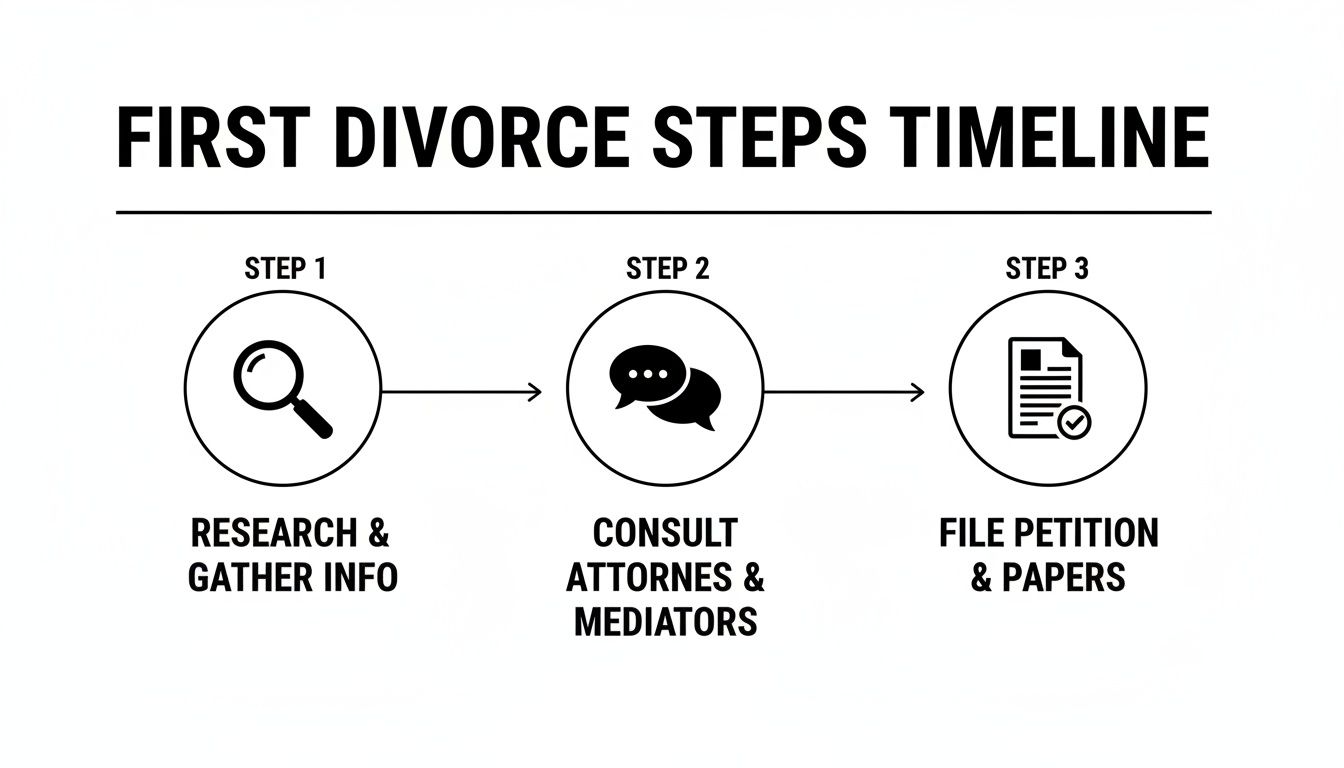
This simple timeline drives home the point: taking informed action with solid legal advice is the best way to start this process.
The Discovery and Financial Disclosure Phase
In a contested divorce, the discovery process is often the most intensive part. This is the formal, court-supervised exchange of information and evidence. The goal is to ensure everyone has a full and transparent picture of the entire marital estate, with no hidden assets or surprise debts.
We use a few key tools during discovery:
- Interrogatories: These are written questions that the other side must answer completely and under oath.
- Requests for Production of Documents: This is a formal demand for financial records such as bank statements, pay stubs, tax returns, property deeds, and loan applications.
- Depositions: This involves sitting down for out-of-court testimony under oath, where the attorneys can question the spouses and any relevant witnesses.
This phase is absolutely critical for piecing together a clear financial picture. You cannot negotiate a fair settlement or prepare for trial without it. Judges in courts serving Roswell and Johns Creek expect nothing less than thorough financial disclosures from everyone involved.
The discovery process is not about digging up dirt or placing blame; it is about gathering facts. Full financial transparency is the bedrock of any equitable and lasting divorce settlement in Georgia.
While the legal steps are clear, the personal and financial stakes are high. Statistics show the lifetime likelihood of divorce in Georgia is around 11.2%. The state’s six-month residency rule and the ability to finalize a divorce just 31 days after service can make for a relatively quick process. Uncontested cases might cost between $300 and $5,000. But when things get complicated with business assets or custody battles, those costs can climb significantly. You can find more data about Georgia's divorce statistics and trends online.
Reaching a Final Resolution
The end goal is to get a Final Judgment and Decree of Divorce. This is the official court order that ends the marriage and lays out the terms. You can get there one of two ways: by negotiating a settlement agreement or by having a judge decide after a trial.
An uncontested divorce is where both spouses agree on absolutely everything. They sign a settlement agreement, we submit it to the court, and a judge approves it. It is the fastest and most affordable way to get divorced.
If you cannot find common ground, the case is considered contested and heads toward trial. There, a judge will listen to evidence and arguments from both sides before making final, binding decisions on all the unresolved issues. A good divorce lawyer in Alpharetta, GA, can help you figure out the best path for your unique situation, whether that means being a skilled negotiator or a tough advocate in the courtroom.
Resolving Key Issues in Your Alpharetta Divorce
A divorce is about more than just legally ending a marriage. At its core, you are untangling a shared life to create two separate, stable futures. For most families here in Alpharetta, Roswell, and Johns Creek, that process boils down to three critical pillars: the children, the finances, and the property.
How these issues are handled will shape your life for years to come. An experienced local attorney’s job is to bring clarity and a sound strategy to these emotional conversations. We aim to move you from a place of uncertainty to one of resolution, making sure the final agreement is fair, sustainable, and fully compliant with Georgia law. This takes careful negotiation, a deep dive into the finances, and a real understanding of how judges in Fulton and Forsyth County approach these matters.

Creating a Stable Future for Your Children
When kids are involved, their well-being is everyone's top priority, especially the court's. In Georgia, we address this through custody arrangements laid out in a formal Parenting Plan. It is important to know the difference between the two types of custody.
- Legal Custody: This is about who gets to make the big decisions for your child, things like education, healthcare, religious upbringing, and major activities. Georgia courts have a strong preference for joint legal custody, which allows both parents to have a say.
- Physical Custody: This simply determines where the child primarily lives. One parent might be the primary physical custodian, with the other having a set visitation schedule. Or, schedules can be set up for a more balanced split, depending entirely on what is best for the child.
The cornerstone of any custody agreement is the Parenting Plan. This is a highly detailed document, required by Georgia law, that serves as a roadmap for co-parenting. It covers everything from daily schedules and holidays to vacation time and how you will communicate with each other. A well-crafted Parenting Plan is one of the best tools for preventing future conflict.
Addressing Finances: Alimony and Child Support
Money is often one of the biggest stressors in a divorce. The two main financial components we deal with are child support and alimony, and they are calculated very differently.
Child support in Georgia follows a specific formula laid out in state law. It is based on an "income shares model" that looks at both parents' gross monthly incomes. This combined income is used to calculate a basic child support obligation, which is then split between the parents according to their respective percentages of that total income.
While the formula gives us a starting number, a judge can adjust the final amount. Factors like health insurance costs, daycare expenses, or special educational needs can all impact the final figure.
Alimony, or spousal support, is much less black-and-white. There is no automatic right to alimony in Georgia. A judge in Cumming or Canton will consider many factors to decide if it is appropriate, including:
- The length of the marriage
- Each person’s earning capacity and financial standing
- The standard of living during the marriage
- Each spouse's contributions, including non-financial ones like being a homemaker
The goal of alimony is to support a spouse who has a real financial need and to help balance any significant financial gaps that the divorce creates.
Dividing Marital Property and Debt
Georgia is an equitable distribution state. This is a crucial point that people often misunderstand. It does not mean a 50/50 split. It means the court divides marital assets and debts in a way it considers fair.
The first step is always to sort out what is marital property versus what is separate property.
- Marital Property: This is generally everything, assets and debts, acquired by either of you from the wedding day until the divorce is final. It does not matter whose name is on the account or the title.
- Separate Property: This typically includes anything you owned before the marriage, as well as inheritances or gifts received by just one spouse during the marriage.
Once the marital pot is defined, the court looks at numerous factors to decide on a fair division. This can include each spouse's financial situation, their contributions to the family, and even conduct that might have caused the divorce. As you work to resolve these issues, understanding concepts like the legal meaning of a matrimonial home becomes incredibly important.
Navigating these complex personal and financial issues is what a skilled divorce lawyer in Alpharetta, GA, is for. We work to protect your rights and help you start your next chapter on solid ground.
Choosing Between Mediation and Litigation
Not every divorce has to end in a drawn-out, public courtroom battle. For many families right here in Alpharetta and throughout Fulton County, there are different ways to reach a final agreement. The two main paths are mediation and litigation, and your choice will have a huge impact on the cost, timeline, and emotional toll of your divorce.
Mediation is a collaborative process where you and your spouse sit down with a neutral third party, the mediator. Their job is not to make decisions for you. Instead, they guide the conversation, helping you find common ground on tough issues like dividing property or creating a parenting plan.
Litigation, on the other hand, is the traditional court process. You and your spouse, each with your own attorney, present your case to a judge, who then makes the final, binding decisions.
The Collaborative Path of Mediation
Mediation puts you and your spouse in the driver's seat. Instead of a judge telling you how your life will look, you work together to build a settlement agreement that you can both live with. This approach can be a game-changer for preserving a respectful co-parenting relationship, which is priceless when you have kids.
The biggest draws of mediation include:
- Confidentiality: What is said in mediation, stays in mediation. It is a private setting, and the discussions cannot be used against either of you in court if you cannot reach an agreement. This makes it easier to be open and honest.
- Cost-Effectiveness: By avoiding the heavy prep work and multiple hearings that come with court, mediation is almost always a less expensive route than a fully litigated divorce.
- Efficiency: A mediated divorce can often be wrapped up in a matter of weeks or a few months. A contested case that goes to trial can easily take a year or more.
Mediation empowers you to be the architect of your own post-divorce life. It shifts the focus from winning and losing to finding practical, sustainable solutions that work for your unique family.
This process works best when both of you are willing to negotiate in good faith. Even in complex cases, a skilled mediator can help untangle tricky financial issues and find creative solutions a court might not have the authority to order.
When Litigation Becomes Necessary
Sometimes, reaching an agreement on your own is not an option. Litigation becomes the only choice when there are serious power imbalances, a history of domestic violence, or if one spouse is hiding assets or refuses to negotiate reasonably. In those scenarios, the formal structure of the court system provides crucial protections.
The litigation process involves formal "discovery," where your attorney will gather financial records and other evidence. It might also include temporary hearings and multiple court appearances. While it is more adversarial, it is the right choice when you need a judge to enforce your rights and make a final call. A seasoned divorce lawyer in Alpharetta, GA, will build a strong case to advocate for your best interests before a judge in the Fulton or Forsyth County Superior Court.
Making an Informed Decision
Figuring out which path to take is one of the most important strategic choices you will make with your attorney. We can look at the specifics of your situation, the level of conflict, the complexity of your assets, your personal goals, and advise you on the best approach. In fact, many Georgia courts now require couples to at least try mediation before they will even schedule a final trial, because they know how effective it can be.
To help you visualize the differences, here is a straightforward comparison of the two processes.
Comparing Mediation and Litigation in Georgia Family Law
This table gives you a side-by-side look at the key differences between resolving your divorce through mediation versus going to court.
| Factor | Mediation | Litigation |
|---|---|---|
| Control | You and your spouse make the final decisions together. | A judge makes the final, binding decisions for you. |
| Cost | Generally less expensive, billed hourly for the mediator. | Significantly more expensive due to legal fees, court costs. |
| Timeline | Can be resolved in weeks or months, based on your schedule. | Can take over a year, dependent on the court's calendar. |
| Privacy | Private and confidential sessions. | Public court proceedings and records. |
| Tone | Collaborative and focused on mutual agreement. | Adversarial and focused on winning the case. |
Ultimately, whether we get there through skilled negotiation in mediation or steadfast advocacy in court, our goal is the same: to secure a fair and final resolution that protects your future.
To dig deeper into the pros and cons, you can learn more about divorce mediation vs litigation and see how each process works here in Georgia.
How to Select the Right Alpharetta Divorce Attorney
Choosing your legal partner is one of the most critical decisions you will make during your divorce. This is not just about hiring a lawyer with a good resume; it is about finding a guide who can provide calm, clear direction through an emotionally turbulent time.
The right attorney for you will have a deep, practical understanding of the Fulton and Forsyth County court systems. Their familiarity with local judges and opposing counsel can be a significant advantage, often leading to more realistic expectations and a smoother process.

What to Look for During Your Consultation
Think of the initial consultation as a two-way interview. You are not just there to be sold. You are there to see if this is the right professional to handle your case. Go in prepared with questions that help you get a real sense of their experience and approach.
Here are a few key areas to discuss:
- Experience with Similar Cases: Do not be shy. Ask them to describe their experience with cases that mirror your situation, whether it involves complex asset division or a high-conflict custody battle.
- Communication Style: How will the firm keep you in the loop? Who will be your main point of contact? A clear communication plan from the start is essential for reducing anxiety.
- Legal Strategy: Ask for their initial thoughts. A good attorney should be able to explain potential strategies and outcomes in plain English, not confusing legal jargon.
A productive consultation should leave you feeling informed and confident, not pressured or confused. The right attorney empowers you with knowledge, clarifies your options, and provides a steady hand to guide you forward.
While many firms serve the Alpharetta area, the best divorce lawyer in Alpharetta, GA for you is someone you connect with. Do you feel heard and respected? That is the foundation of a successful attorney-client relationship.
Understanding Fee Structures
It is completely normal to be concerned about the cost of a divorce. Most family law attorneys in Georgia work on an hourly basis and require an upfront payment called a retainer. This retainer is held in a trust account, and the firm’s time is billed against it as work is done.
Make sure you ask for a clear, detailed explanation of their billing practices. You need to understand the hourly rates for everyone who might work on your case, including the main attorney, paralegals, and other staff. Transparency about fees right from the beginning is a hallmark of a trustworthy firm.
While costs vary, uncontested cases in Alpharetta can range from $300 to $5,000, with contested divorces starting around $8,000. Interestingly, during the pandemic, the Metro Atlanta area actually saw a 12.5% decrease in divorce filings.
The Importance of a Good Fit
Ultimately, legal skills are only part of the equation. You need to feel comfortable with the person you choose. You will be sharing incredibly personal and financial details, so trust is paramount.
You are looking for an advocate who is responsive, empathetic, and dedicated to protecting your best interests. Take your time, do your research, and select a partner who gives you the confidence to navigate this process. For more detailed advice, check out our guide on how to choose a divorce lawyer that is right for your specific needs.
Frequently Asked Questions About Divorce in Alpharetta
When you are facing a divorce, questions can stack up fast, making an already tough time feel overwhelming. In our Alpharetta office, we hear the same practical, urgent concerns from people every day. We have put together some straightforward answers to the questions we hear most often to give you some clarity.
How Much Does a Divorce Cost in Georgia?
The cost of a divorce varies significantly. The most affordable path is an uncontested divorce, where you and your spouse agree on all issues. In these cases, the cost is typically a few thousand dollars because the process is mostly administrative.
If you have a contested divorce, where you disagree on key issues like custody, property, or alimony, the costs will be higher. These situations often require more intensive work, such as formal discovery, court hearings, and in-depth negotiations. The final cost reflects the time and complexity needed to reach a fair resolution.
How Long Will My Divorce Take?
An uncontested divorce can move along quickly. After the divorce papers are served, Georgia law has a mandatory 31-day waiting period. If all your agreements are in order, your divorce can be finalized shortly after that period ends.
Contested divorces do not have a set timeline. How long it takes depends on the complexity of your situation and the level of disagreement between you and your spouse. These cases can take several months or even stretch beyond a year, particularly if a full trial becomes necessary.
The biggest factor driving both the cost and timeline of your divorce is simple: how much you and your spouse can agree on. The more you can resolve together, the smoother and more efficient the whole process will be.
Can We Still Live in the Same House During the Divorce?
Yes, you can, and many couples in Alpharetta and Roswell choose to do this, often for financial reasons or to maintain stability for their children. It is a practical solution for some, but it can also create tension and is not the right fit for every family.
If the living situation becomes too strained, either of you can ask the court for a Temporary Order. This can grant one person exclusive use of the family home while the divorce is pending. A judge will look at what is best for the children and the overall circumstances before making a decision.
Do I Actually Have to Go to Court?
Not always. Many divorce cases are settled outside of the courtroom through direct negotiation or mediation. If your divorce is completely uncontested, you will probably never need to step foot in a courtroom; your attorney handles all the filings for you.
Even in a contested case, you might only need to attend hearings for temporary matters. The reality is that the overwhelming majority of these cases, over 95%, settle before ever reaching a final trial. The goal is always to find a fair settlement, with a trial being the absolute last resort.
What Is the First Thing I Should Do?
Your first move should be to gather your key financial documents and schedule a private consultation with a family law attorney experienced in the local courts. This first meeting is about understanding your situation, your options, and what the road ahead looks like.
To make the most of it, come prepared. Jot down your questions and be ready to talk openly about your family's situation. A good divorce lawyer in Alpharetta, GA, will give you a clear, no-nonsense overview and help you start building a strategy to move forward with confidence.
Getting through a divorce requires a steady hand and knowledgeable legal advice. The team at Miles Hansford Law Firm is here to answer your questions and give you the clear direction you need to protect your future. Contact us to schedule a confidential consultation and learn how we can help.