


When you're facing a divorce, it's easy to feel lost. The road ahead seems uncertain, and the sheer number of questions can be overwhelming. This guide is for individuals in Alpharetta, Roswell, and Johns Creek who need clear, straightforward information about the divorce process in Georgia. Our goal is simple: to replace that uncertainty with confidence by showing you how an experienced local attorney can help you navigate this transition.
Your Path Through Divorce in Alphareto_start_spana
Deciding to end a marriage is one of the most difficult experiences anyone can face. It brings up a storm of personal, financial, and practical questions that can feel impossible to answer on your own. For families here in Fulton and Forsyth Counties, the legal journey itself adds another layer of complexity.
Think of this guide as your roadmap. It’s designed to provide a calm, clear overview of the journey ahead. We’ll walk through the essential steps, from understanding your legal options to protecting your future, so you can see how the right legal partner makes all the difference in reaching a fair outcome.
Understanding the Local Legal Landscape
Divorce isn’t just a legal procedure; it’s a deeply personal experience that happens within a specific community. Choosing a divorce lawyer in Alpharetta means working with someone who knows the local court systems in Fulton and Forsyth Counties. That localized experience is invaluable, because every jurisdiction has its own procedures and tendencies.
An experienced local attorney does more than give legal advice. They offer steady guidance, built on years of walking through the same courtrooms and working within the same legal community you're about to enter. This firsthand knowledge helps set realistic expectations and craft a strategy that’s grounded in what actually works here.
Divorce is a personal journey, but it’s also a common one. As of 2022, the U.S. had a crude divorce rate of 2.4 per 1,000 people, which is a bit higher than the worldwide average. For our neighbors here in Georgia, these numbers highlight how important it is to have skilled legal representation to protect your assets and parental rights. If you’re interested, you can explore more about these global divorce rate trends to see the bigger picture.
What to Expect From This Guide
We've structured this guide to build your understanding one step at a time, covering the key aspects of a Georgia divorce. We'll provide clear, actionable information on the topics that matter most, including:
- The Divorce Process Step-by-Step: A simple breakdown of the legal journey, from filing the initial paperwork to receiving the final decree.
- Contested vs. Uncontested Divorce: Understanding the two main paths a divorce can take and what each one means for your timeline and budget.
- Core Issues to Resolve: Plain-language explanations of child custody, child support, alimony, and how property gets divided.
- Choosing the Right Attorney: Practical tips for finding a legal advocate who understands your goals and can guide you with confidence.
Our commitment is to bring clarity to this process and reduce the anxiety that comes with legal uncertainty. By the time you finish this guide, you’ll have a much better handle on the road ahead and feel more prepared to take the next step.
Understanding the Georgia Divorce Process Step by Step
The legal path for a Georgia divorce follows a structured sequence, but it's far from a one-size-fits-all journey. Think of it as a roadmap with several possible routes, all leading to the same destination: a final resolution. Understanding each step helps demystify what's ahead, empowering you to make clear-headed decisions for your future.
For anyone in Alpharetta, Roswell, or the surrounding communities in Fulton and Forsyth County, the process kicks off by meeting a key legal requirement.
Starting the Process: Filing the Complaint
The first official move is filing a document called a Complaint for Divorce. This paperwork gets submitted to the Superior Court in the right county.
To file in Georgia, at least one spouse must have been a resident of the state for a minimum of six months before filing. Generally, you'll file in the county where your spouse lives. Your attorney will handle the details to make sure all jurisdictional rules are met, starting your case on solid legal ground.
Once filed, the next crucial step is formally notifying your spouse. This is called "service of process," where your spouse officially receives a copy of the complaint and a summons to respond. It’s a formal but necessary step to ensure both parties know the legal process has begun.
The Discovery Phase: Gathering Information
After the initial paperwork is handled, the case moves into the "discovery" phase. This is the stage for gathering and exchanging all relevant information.
Discovery is all about creating a complete and transparent financial picture for both spouses. Each of you will provide documents covering income, assets, debts, and any property acquired during the marriage. This transparency is essential for negotiating a fair settlement based on facts, not assumptions.
This is a critical phase where having an experienced Alpharetta divorce lawyer is invaluable. They know what to ask for, how to get it, and how to protect your financial interests every step of the way.
The right attorney helps you navigate from the initial options to a final outcome with a clear strategy.
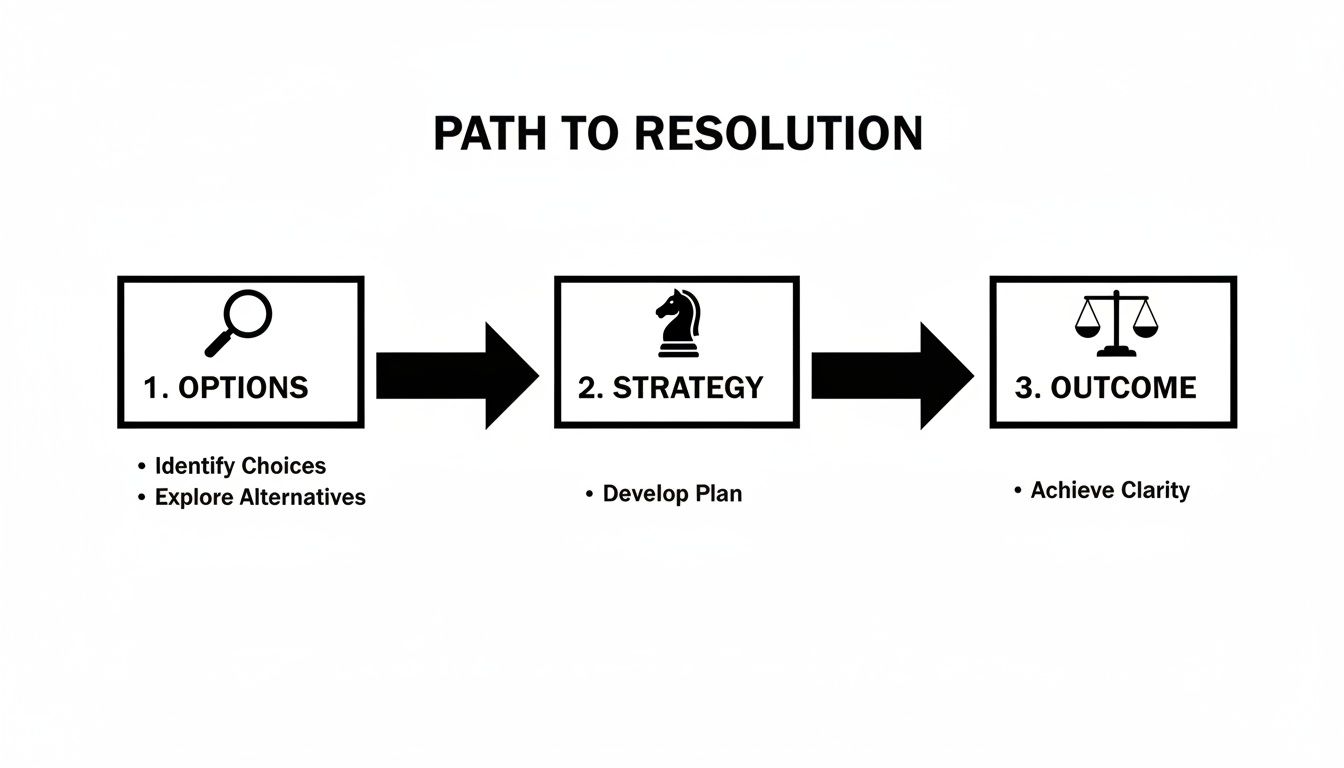
As this shows, a successful outcome isn't an accident. It's the result of carefully evaluating all your options and building a sound legal strategy from the start.
Reaching a Resolution: Negotiation, Mediation, or Trial
With all the cards on the table, the focus shifts to resolving the core issues of your divorce. The vast majority of cases in Georgia are settled out of court through negotiation or mediation.
- Negotiation: Your attorneys might negotiate directly to hammer out an agreement on everything from property division to custody.
- Mediation: A neutral third-party mediator helps you and your spouse find common ground and craft a settlement you can both live with.
- Trial: If you simply cannot reach an agreement, the case will proceed to trial. A judge will hear the evidence from both sides and make the final decisions for you.
Our goal is always to find the most direct and effective path to a fair resolution. While we are always prepared to advocate for our clients in court, we find that many disputes can be resolved more efficiently and with less stress through skilled negotiation.
Georgia is an "equitable distribution" state. This means marital property is divided fairly, which doesn't always mean a strict 50/50 split. A detailed parenting plan must also be created, outlining custody and visitation in a way that serves the best interests of the children. For a deeper dive, you can learn more about how to file for divorce in our detailed guide.
Ultimately, once every issue is resolved by agreement or by a judge’s order, the court issues a Final Judgment and Decree of Divorce. This is the legal document that officially ends the marriage and makes all the terms of your settlement legally binding.
Contested vs. Uncontested Divorce in Georgia
When a marriage ends in Georgia, the path you take isn’t always the same. The entire journey hinges on one big question: how much do you and your spouse agree on? This is what separates a divorce into two main categories, uncontested and contested, and it makes a world of difference in the time, money, and stress involved.
Figuring out which path you’re likely on is the first step toward managing your expectations. At its core, the difference is simple: are you working together, or are you at odds? An uncontested divorce is a cooperative effort to dissolve the marriage, while a contested divorce means there are disagreements that need a legal resolution.
The Uncontested Divorce: An Amicable Path Forward
An uncontested divorce is the most straightforward and affordable way to end a marriage in Georgia. This option is on the table only when both spouses agree on every single issue without exception.
This means you’re on the same page about all the big-ticket items, including:
- Division of Property and Debts: You’ve already decided how to split all marital assets, from the family home in East Cobb to retirement accounts and shared credit card balances.
- Child Custody and Parenting Time: If you have children, you’ve hammered out a detailed parenting plan that you both fully support.
- Child Support: You agree on the child support amount, making sure it aligns with Georgia's guidelines.
- Alimony (Spousal Support): You both see eye-to-eye on whether alimony is needed, how much should be paid, and for how long.
Because there’s nothing to fight over, an uncontested divorce can sometimes wrap up in as little as 31 days after the initial filing. It’s faster, less expensive, and lets you and your spouse keep control over the final decisions, rather than leaving them in a judge’s hands. An experienced Alpharetta divorce lawyer can help you draft a fair agreement that’s legally solid and properly filed with the court.
The Contested Divorce: Navigating Disagreements
A divorce becomes contested as soon as there’s a disagreement on even one key issue. It could be something as small as who keeps a sentimental piece of furniture or as significant as the parenting schedule. Any unresolved point pushes the case into this category. Contested divorces are quite common, particularly when there are significant assets, a family business, or complicated custody matters involved.
These situations demand a more formal legal process, which can include negotiation, mediation, and sometimes, taking the case to court. The word "contested" might sound aggressive, but it does not automatically mean you are headed for a courtroom battle. Many issues are settled through skilled negotiations between attorneys or with a neutral mediator guiding the conversation.
The goal in a contested divorce isn’t to stir up more conflict, but to resolve it methodically. A steady, experienced attorney works to find common ground and protect your interests, pushing for a fair settlement without running to the courthouse unless absolutely necessary.
Globally, divorce rates vary, with a worldwide average of 1.6 per 1,000 people in 2022. The U.S. rate was higher at 2.4, with one divorce for every 2.26 new marriages recently which is a rate of over 44%. In our own communities like Alpharetta, these numbers show a real need for skilled legal guidance. Find out more about the global statistics on divorce rates and how they compare.
Ultimately, if you and your spouse can’t find a way to agree, a judge in a Fulton or Forsyth County courtroom will make the final decisions for you. This is when having a seasoned divorce lawyer who is ready and able to represent you in court is absolutely critical for protecting your rights and securing a just outcome.
Resolving The Core Issues In Your Divorce
A divorce isn’t just the legal end of a marriage. It is a process for untangling two lives that have become deeply intertwined, creating a new, stable foundation for everyone to move forward. For any family here in Alpharetta, that means carefully working through a handful of critical issues. Each one demands a solid understanding of Georgia law to make sure the final agreement is fair, lasting, and legally sound.
When you get down to it, every divorce decree has to resolve four main pillars: child custody, child support, alimony, and how you divide up your property. A seasoned divorce lawyer in Alpharetta is your guide through each of these areas, making sure your rights are protected every step of the way.

To really understand what's at stake, it helps to see how these pieces fit together. They form the legal framework for your post-divorce life.
Core Issues in a Georgia Divorce
| Legal Issue | What It Covers | Primary Goal in Georgia Law |
|---|---|---|
| Child Custody | Decisions about a child's upbringing (legal custody) and where the child lives (physical custody). | To create a stable parenting plan that serves the "best interests of the child." |
| Child Support | The financial obligation of parents to cover the costs of raising their children. | To ensure children have adequate financial support from both parents, based on their combined income. |
| Alimony | Financial support paid from one spouse to the other after the divorce. | To prevent one spouse from suffering an unfair economic disadvantage and help them maintain a reasonable standard of living. |
| Property Division | The separation of all assets and debts acquired during the marriage. | To divide marital property "equitably" (fairly), which may not necessarily be a 50/50 split. |
Each of these components has its own set of rules and requires a unique strategy to navigate successfully. Let's dig a little deeper into what each one means for you.
Child Custody And Parenting Plans
When you have children, their well-being is the absolute top priority. Georgia courts make every decision based on the "best interests of the child" standard. This principle is the north star for everything related to legal custody (who makes the big decisions like schooling and healthcare) and physical custody (where the child primarily lives).
All of these decisions are finalized in a parenting plan. This is a legally binding document that gets incredibly specific, mapping out things like:
- The day-to-day and week-to-week parenting schedule.
- How holidays, birthdays, and school breaks will be handled.
- Who has the final say on major decisions about education, healthcare, and religion.
- Rules for communication and transportation between parents.
The whole point is to build a predictable, stable routine that minimizes future disagreements and allows the child to thrive with both parents in their life.
Calculating Child Support
Child support is the money one parent pays to the other to help with the costs of raising their children. This isn't just a number someone makes up; Georgia uses a specific formula called the "Income Shares Model" to determine the baseline amount.
The calculation starts with both parents' gross monthly incomes and the number of children they have together. It then factors in key expenses like who pays for health insurance and work-related childcare. While this formula gives the court a starting point, a judge can adjust the final amount up or down if the circumstances call for it. You can learn more about the details in our guide on the basics of child support calculations.
Alimony And Spousal Support
Alimony, sometimes called spousal support, is financial assistance for a spouse who might be at an economic disadvantage after the divorce. It's important to know that it is not awarded in every Georgia divorce. A judge looks at a whole range of factors to decide if it's necessary, such as:
- How long the marriage lasted.
- The income and earning potential of each spouse.
- The lifestyle the couple was accustomed to during the marriage.
- The contributions each spouse made, including non-financial ones like raising children or managing the household.
Alimony can be temporary to help someone get back on their feet or, in some cases, permanent. The goal is simply to ensure both people can move forward on stable financial ground.
Division of Marital Property
Georgia is an equitable distribution state. This is a crucial concept. It means that all property and debt acquired during the marriage must be divided fairly which is not always the same as a 50/50 split.
The court aims for what is equitable, or fair, given the specifics of your situation. Marital property is a broad category, covering everything from the family home in East Cobb to retirement accounts, business interests in Cumming, and investment portfolios.
Navigating this requires a complete and honest accounting of all marital assets and debts. The court then weighs different factors, like each spouse's financial standing and their contributions to the marriage, to reach a final, fair division. As you work through the financial untangling, it's also smart to start understanding how major life changes like divorce impact your taxes to avoid any unwelcome surprises down the road.
How to Choose the Right Alpharetta Divorce Lawyer
Your attorney is your most important partner through the divorce process. Choosing the right one is about so much more than just a law degree; it’s about finding an advocate who truly understands what you’re trying to achieve and can guide you with a steady, experienced hand. This choice will set the tone for your entire case and can influence the final outcome.
When you start looking, it’s critical to find a lawyer whose practice is built around family and civil law. This is not the time for a jack-of-all-trades. A dedicated focus means your attorney has the specific expertise needed for tricky issues like property division or child custody. A general practitioner, on the other hand, might not have the nuanced understanding of local court procedures in Fulton and Forsyth Counties, which is essential for a smooth process.

Experience in Local Courts Matters
Familiarity with the local legal landscape matters. An attorney who is in the superior courts of Fulton and Forsyth County day in and day out brings an invaluable perspective to your case. They know the tendencies of local judges and the common tactics opposing attorneys in the area use.
This "home field advantage" allows your lawyer to set realistic expectations and build a strategy based on what actually works here in the Alpharetta, Roswell, and Cumming court systems. It’s a subtle but powerful edge that helps you sidestep unnecessary delays and puts you in a much better position for a favorable result.
Communication and a Clear Strategy
During that first meeting, pay very close attention to how the attorney communicates. Do they explain complex legal ideas in plain English, making you feel like an active participant in your own case? A good divorce lawyer listens intently to your priorities first and then uses that information to build a clear, logical strategy.
Don't be afraid to ask about their approach. Do they prefer to start with negotiation and mediation? Are they ready and willing to litigate if the other side refuses to be reasonable? The right attorney for you will be skilled at both the negotiation table and in the courtroom, with the good judgment to know which path is best for your unique situation.
The connection you have with your attorney is crucial. You need to feel confident in their ability and comfortable with their communication style, as you will be trusting them with deeply personal and financial matters during a stressful time.
When looking at law firms, you might also consider those that use the most effective and essential tools for law boutique owners to keep things running efficiently. A well-managed firm is better equipped to handle your case, keep you in the loop, and make this difficult process as seamless as it can be.
Questions to Ask a Divorce Lawyer
The initial consultation is your chance to interview a potential attorney and see if they’re the right fit. Go into that meeting prepared with questions that help you get a feel for their experience, strategic thinking, and how they communicate with clients.
Here are a few key questions to get you started:
- What percentage of your practice is dedicated specifically to family law?
- How much experience do you have in the Fulton or Forsyth County courts?
- Based on what I’ve told you so far, what’s your initial take on my case?
- What’s your philosophy on settling cases versus going to trial?
- How will you and your team keep me updated on what’s happening with my case?
Your lawyer is your guide, your advocate, and your advisor. Choose someone who gives you a sense of confidence and clarity from that very first conversation. Taking the time to make a thoughtful choice now is one of the most important things you can do for yourself. For more help, check out our guide on preparing for your divorce consultation to get the most out of that first meeting.
Our Approach: Calm, Confident Legal Guidance
We know that dealing with a family law issue can feel completely overwhelming. From the moment you first speak with us, our entire approach is designed to lower that stress by giving you clear, strategic, and reassuring advice. We firmly believe that an informed client is an empowered one, which is why we take the time to explain complicated Georgia laws in plain, easy-to-understand English.
You will never be left wondering what is happening with your case. We do not just see ourselves as your lawyers; we are your dedicated advisors through this entire process.
A Strategy Built Around Your Goals
Every family is different, so a cookie-cutter legal strategy just will not cut it. Our attorneys bring decades of combined experience from the courtrooms of Fulton and Forsyth Counties to build a plan that truly fits your specific goals.
For some of our clients, that means finding a quiet, efficient path forward through skilled mediation that preserves relationships and keeps conflict to a minimum. For others, it requires us to be assertive advocates in court, fighting to protect their rights and their assets. We have the experience to know which approach is right for you and the skill to see it through.
Our philosophy is straightforward: provide the calm, confident guidance you need to navigate this transition. We prioritize direct communication and responsiveness, ensuring you always know where you stand and what to expect next.
As a trusted divorce lawyer in Alpharetta, our commitment is to help you move forward. We provide the clarity and confidence you need to make sound decisions for your future, making sure your voice is heard and your interests are protected. We’re here to help you get to the other side with your stability and dignity intact.
Some Common Questions About Divorce in Alpharetta
When you're facing a divorce, you've got a lot of questions. We get it. Here are some straightforward answers to the questions we hear most often from our clients here in North Georgia. We hope this clears up a few things and helps you feel a little more prepared for what's ahead.
How Much Does a Divorce in Alpharetta Cost?
The cost of a divorce comes down to one main factor: how much you and your spouse disagree. An uncontested divorce, where you both agree on all major issues, is always the most affordable path. It simply requires less time and legal work to complete.
If your divorce is contested, meaning there are issues you can't resolve on your own, it will be more expensive. The final cost hinges on the complexity of your finances and how willing both parties are to negotiate toward a middle ground without a prolonged fight.
How Long Does a Georgia Divorce Take?
An uncontested divorce can be completed in as little as 31 days after filing, depending on the county in Georgia. That's the fastest it can happen under state law.
A contested divorce, on the other hand, can take many months or sometimes longer. The timeline is extended by the number of disagreements, the court's schedule in Fulton or Forsyth County, and the time required to sort through finances and negotiate a settlement.
Do I Have to Go to Court to Get Divorced?
Not always. Many people finalize their divorce without ever setting foot in a courtroom. If your divorce is uncontested and you’ve both signed a settlement agreement that covers everything, a judge can often sign off on it without a hearing.
You will only end up in court if you cannot reach an agreement on your own. At that point, a judge will have to step in to hold hearings or a trial and make the final decisions on things like dividing property or child custody.
Does Georgia Have Legal Separation?
This is a common point of confusion. Georgia law does not have a formal status called "legal separation." What we do have is an action for Separate Maintenance.
This is a legal process for the court to sort out child support, alimony, and property use without actually ending the marriage. It’s an option for couples who need to live apart and get financial matters in order but aren’t ready or able to file for a full divorce.
Is Alimony Always Awarded in a Georgia Divorce?
No, alimony is not automatic in any divorce. A judge in Fulton or Forsyth County looks at many different factors to decide if spousal support is necessary.
A few of the big ones include:
- How long you were married
- What each spouse earns and is capable of earning
- The lifestyle you had during the marriage
- What each person contributed to the marriage, whether financially or as a homemaker
The goal of alimony is to make sure one spouse is not left at a major financial disadvantage because of the divorce.
What Should I Do to Prepare for a Divorce?
The single best thing you can do to start is to get your financial documents together. This includes tax returns, pay stubs, bank statements, retirement account information, and a list of any major assets or debts.
Being organized right from the beginning gives your attorney a clear financial picture. It’s a crucial step in protecting your interests and helps us build a solid strategy for you from day one.
After that, your next step should be to schedule a consultation with an experienced divorce lawyer in Alpharetta. This first meeting is your chance to understand your rights, talk about your goals, and get professional advice on how to move forward. Having a confidential conversation with an attorney can bring the clarity and confidence you need to take back control.
At Miles Hansford Law Firm, we provide the calm, steady guidance you need to get through this. If you are facing a divorce in Alpharetta, Roswell, Cumming, or anywhere in North Georgia, we are here to protect what matters most to you and help you start your next chapter. Contact us today to discuss your situation.