


When you are facing a divorce, understanding where to begin can feel overwhelming. For residents of Alpharetta, Roswell, and Cumming, the path forward starts with meeting Georgia's legal requirements and filing the necessary paperwork with the local Superior Court.
Your First Steps in an Alpharetta Divorce
The divorce process begins not with conflict, but with procedure. Properly handling the initial legal steps sets the foundation for everything that follows.
First, you must meet the state's residency rule. To file for divorce in Georgia, either you or your spouse must have lived in the state for at least six months before filing the petition. This is a strict legal requirement that gives our local courts the authority to preside over your case.
Filing the Divorce Petition
Once residency is established, the next step is to file a Petition for Divorce. This document is filed in the Superior Court of the county where your spouse resides. For most people in our community, this means filing with either the Fulton County Superior Court or the Forsyth County Superior Court.
The petition is your formal request to the court, outlining your desired outcomes on key issues such as:
- The division of property and assets
- Child custody and a proposed parenting plan
- Child support and any requests for alimony
After the petition is filed, your spouse must be formally "served" with the divorce papers. This is the legal notification that the process has started and gives them the opportunity to respond.
Contested vs. Uncontested Divorce
Your spouse's response determines the path your divorce will take. There are two primary routes.
An uncontested divorce is the most straightforward option. It occurs when both spouses agree on all major issues. Because there are no points of contention to resolve, the process is significantly faster and less expensive.
A contested divorce happens when you and your spouse cannot agree on one or more key matters. Whether the dispute is over property, finances, or parenting, it will require negotiation, mediation, or potentially a trial for a judge to make the final decision.
This visual provides a high-level overview of the divorce progression in Georgia, from residency to the final waiting period.
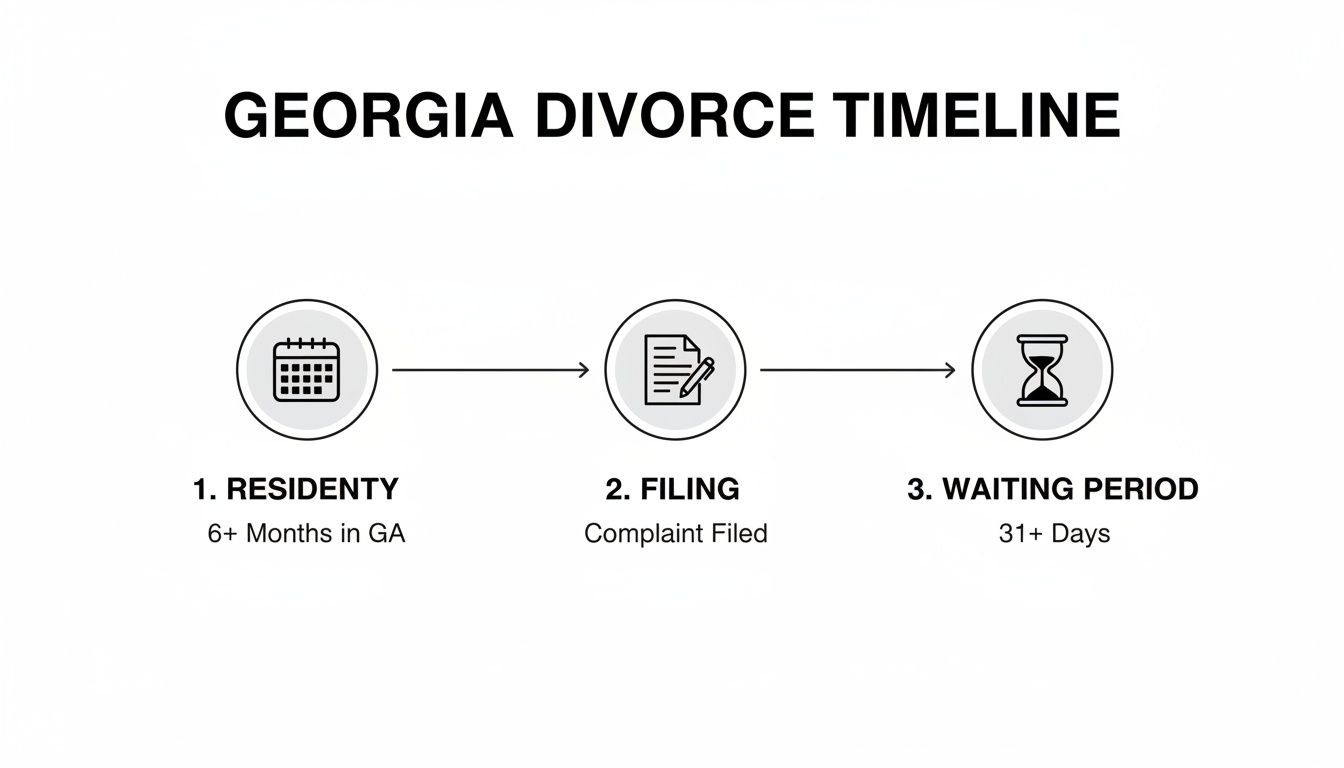
As shown, even the simplest divorce must follow specific legal stages.
Even with full agreement, Georgia law mandates a minimum 31-day waiting period before an uncontested divorce can be finalized. Contested cases, however, can last for many months or even longer, particularly when they involve complex assets common in the Alpharetta area.
You will also need to consider initial court costs. In Fulton County, which serves a large portion of Alpharetta, the court filing fee is currently $218.50. You can learn more about Georgia's divorce requirements and find other helpful Alpharetta legal resources from our firm.
Here is a general breakdown of what to expect as you move through the process in either Fulton or Forsyth County.
Key Stages of the Georgia Divorce Process
This table outlines the typical phases of a divorce case in Fulton and Forsyth County, from initial filing to final resolution.
| Stage | Description | Typical Duration (Contested) |
|---|---|---|
| Initial Filing | One spouse files a Petition for Divorce and serves the other spouse. | 1-2 weeks |
| Response & Discovery | The other spouse files an Answer. Both sides exchange financial information and documents. | 2-6 months |
| Mediation | A neutral third-party mediator helps the couple try to reach a settlement agreement. | 1-2 months |
| Temporary Hearings | If needed, a judge makes temporary decisions on custody, support, or who stays in the home. | 2-4 months |
| Trial Preparation | If no settlement is reached, lawyers prepare for a final trial. | 3-6 months |
| Final Resolution | The case is resolved either by a signed settlement agreement or a final trial verdict. | Varies Greatly |
These stages provide a general roadmap. Every family's situation is unique, and your journey may differ. An experienced attorney can guide you through each step with confidence.
How to Choose the Right Divorce Attorney

Selecting your divorce lawyer is one of the most critical decisions you will make in this process. A good attorney is more than a legal representative; they are your guide, strategist, and a steady presence during a turbulent time. Your choice will influence everything from the tone of negotiations to the final outcome.
When searching for a divorce lawyer in Alpharetta, it is important to focus on what truly matters for your specific situation. You need an attorney with a proven track record, a compatible communication style, and a strategic approach that aligns with your goals.
Focus on Local Courtroom Experience
Local knowledge is a powerful asset. An attorney who is a familiar presence in the Fulton and Forsyth County Superior Courts brings a significant advantage. They understand the procedures, preferences, and personnel of the local judiciary.
This experience means they know how the law is applied in our community. Familiarity with other local attorneys, mediators, and court staff can streamline the process and lead to more productive negotiations. A strong local reputation is invaluable.
Key Questions to Ask During a Consultation
Your initial meeting with a potential lawyer is an interview where you are the employer. This is your chance to assess if they are the right fit. Arriving prepared with thoughtful questions will help you make a confident decision.
Consider asking the following:
- Case Strategy: "Based on what I've shared, what is your initial assessment of my case? What do you see as the primary challenges and opportunities?"
- Experience: "How much of your practice is dedicated to family law? How frequently do you appear in court in Fulton or Forsyth County?"
- Communication: "If I retain your firm, who will be my primary point of contact? What is your standard response time for calls or emails?"
- Fee Structure: "Can you explain your billing process? I would like to understand your retainer, hourly rate, and any other potential costs."
- Mediation vs. Litigation: "What is your general philosophy on settling cases out of court versus proceeding to trial?"
Their answers will provide insight into their professional style and whether it aligns with your needs.
A successful attorney-client relationship is built on clear communication and mutual trust. Your lawyer should be someone who can explain complex legal issues in plain English, ensuring you feel empowered to make crucial decisions about your future.
Evaluate Communication and Compatibility
Beyond legal expertise, you need to feel comfortable with your attorney. You will be sharing sensitive details about your life and finances, so trust is essential. Pay attention to how they interact with you during the first meeting. Do they listen carefully, or do they dominate the conversation?
When choosing an attorney, feedback from past clients can be helpful. Understanding the importance of customer reviews can guide you toward a professional with a strong reputation. For more guidance, we have also created a resource on how to select a divorce lawyer that expands on these points. Finding an advocate who provides both sharp legal advice and calm reassurance can make a significant difference.
How Marital Property Is Divided in Georgia
Determining who gets what is one of the most contentious aspects of a divorce. After building a life together in a community like Alpharetta or Johns Creek, untangling finances, property, and debts can seem overwhelming.
Georgia law provides a clear framework for this process, and understanding how it works is the first step toward a fair resolution.
Equitable Distribution: Fair Isn't Always 50/50
Georgia is an equitable distribution state. This legal term is often misunderstood. It does not mean that all assets are split evenly, 50/50. Instead, "equitable" means fair.
A judge in Fulton or Forsyth County has the authority to divide your marital property in a way they deem fair based on the specific circumstances of your marriage.
So, What's Considered "Marital Property"?
The process begins by identifying what is subject to division. Generally, marital property includes nearly every asset and debt acquired by either spouse from the date of marriage until the divorce filing. It does not matter whose name is on the title or account.
Common examples of marital property we see include:
- The family home in Roswell or Marietta
- Retirement accounts like 401(k)s and pensions
- Bank accounts, stocks, and investments
- Vehicles, furniture, and other personal property
- A business started or grown during the marriage
Conversely, separate property includes anything one spouse owned before the marriage. It can also include inheritances or gifts given specifically to one spouse during the marriage. However, separate property can become marital property if it is mixed with joint funds, a process known as commingling.
How a Judge Decides What's "Fair"
There is no simple formula for dividing assets. A judge will weigh several factors to achieve a just outcome in a process that is a careful balancing act.
In Alpharetta, dividing high-value homes, investments, and businesses can become complex. This is often why contested divorces can take several months to resolve. For additional local legal resources, you can see a list of divorce lawyers in Alpharetta on Justia.
The court will consider factors such as:
- Each person’s income and future earning capacity
- Each spouse’s contributions to the marriage, including non-financial contributions like managing the household or raising children
- The future financial needs of each spouse
- Misconduct by either party that wasted marital assets
The purpose of equitable distribution is to ensure both parties can move forward with financial stability. It recognizes the joint effort and partnership that went into building a life together.
The final property division is detailed in a settlement agreement. To better understand the specific clauses within your divorce settlement, it is helpful to know how the components of a legal document function.
An experienced Alpharetta divorce lawyer will protect your rights and advocate for a division that accurately reflects your contributions to the marriage.
Navigating Child Custody and Support in North Georgia

For parents going through a divorce, concerns about the children are always the top priority. Questions about living arrangements, decision-making authority, and financial support can be a source of significant anxiety.
In North Georgia, courts in Fulton and Forsyth Counties handle these sensitive matters with one guiding principle: the best interests of the child. Understanding how they make these decisions is key to creating a stable future for your family.
The Two Types of Custody in Georgia
It is important to understand that "custody" is not a single concept under Georgia law. It is divided into two distinct parts, and knowing the difference is essential for creating a functional parenting plan.
-
Legal Custody: This refers to decision-making authority. It determines who decides on the child’s schooling, healthcare, religious upbringing, and other major life issues. Courts in Georgia strongly favor joint legal custody, where both parents have a say in these fundamental decisions.
-
Physical Custody: This refers to where the child resides. One parent may be the primary physical custodian while the other has a regular visitation schedule. Alternatively, parents may share joint physical custody, where the child divides time more evenly between both homes.
All details of your custody arrangement are outlined in a parenting plan. This document is a mandatory requirement for any Georgia divorce involving minor children and serves as the rulebook for co-parenting.
Creating a Stable and Effective Parenting Plan
A well-drafted parenting plan is more than just a schedule. It is a proactive tool designed to minimize future conflicts and provide the consistency children need. This detailed agreement must be submitted to and approved by a judge.
A strong plan will always cover:
- The day-to-day schedule for school days and weekends
- A clear outline for holidays, school breaks, and birthdays
- Transportation responsibilities for exchanges
- A process for resolving disagreements on legal custody matters
The best parenting plans are the result of cooperation, not conflict. When you can focus on your child's needs rather than your own disagreements, you set everyone up for a better outcome. A judge will always review the plan to ensure it prioritizes the child’s well-being.
How Child Support Is Handled in Georgia
Financial support is another critical component of post-divorce parenting. Georgia uses a formula called the “Income Shares Model” to calculate child support. The guiding principle is that children should receive the same proportion of parental income as they would have if the family remained intact.
The calculation begins with the combined gross income of both parents. A state-mandated table then determines a basic child support obligation. This total amount is divided between the parents based on their respective shares of the total income. You can find more information by reading about the basics of child support calculations in our detailed guide.
A judge can adjust this base amount to account for real-world expenses like health insurance premiums, work-related childcare costs, and the amount of parenting time each parent has.
An experienced Alpharetta divorce lawyer who understands the local courts can help ensure the final support calculation is fair, accurate, and serves your child’s best interests.
Deciding Between Mediation and Litigation
When facing a divorce in Alpharetta, one of the first strategic decisions is how to navigate the process. Some couples can resolve their issues collaboratively, while others require a formal courtroom setting where a judge makes the final decisions.
The two primary paths are mediation and litigation. Understanding the difference is crucial for choosing the right approach for your family.
The Collaborative Path: Mediation
Mediation is a structured, private negotiation that takes place outside of court. You, your spouse, and your respective attorneys meet with a neutral third-party mediator.
A mediator does not take sides or issue rulings. Their role is to facilitate a productive conversation, help both parties focus on the issues, and guide you toward a mutually acceptable agreement. The process is designed to empower you to make your own decisions.
Why Mediation is Often the First Choice
The primary benefit of mediation is control. You and your spouse retain decision-making authority. You determine the terms of your future instead of ceding that power to a judge who is unfamiliar with your family's circumstances.
This collaborative approach often results in more creative and personalized solutions than a court could order.
Other major benefits include:
- Privacy: Court proceedings are public. Mediation is 100% confidential. Your financial and personal matters remain private.
- Cost-Effectiveness: Resolving a case through mediation is almost always less expensive than a contested trial. The savings on legal fees can be substantial.
- Efficiency: Court dockets in Fulton and Forsyth County can be slow. Mediation allows you to finalize your divorce in a fraction of the time.
By working together, you can create an agreement tailored to your family's unique needs. To learn more about the process, you can read about what divorce mediation can do for you on our blog.
When Litigation is the Only Way Forward
While mediation is often ideal, it is not suitable for every situation. Litigation, the formal court process, becomes necessary when negotiations break down or one party is unwilling to be reasonable.
If you cannot agree on major issues like child custody, alimony, or the division of a complex asset like a family business, a judge will have to intervene and make the decision for you.
Litigation is not the enemy; it is a necessary legal framework that protects your rights when cooperation is not possible. It ensures a fair outcome based on Georgia law, which is especially critical in high-conflict situations.
A good Alpharetta divorce lawyer must be prepared for trial. Litigation is often unavoidable in cases involving a history of domestic violence, a significant power imbalance, or suspicion that one spouse is hiding assets. In such cases, the formal discovery process of litigation is the only way to uncover the facts and achieve a just result.
This table highlights the core differences between the two approaches.
Mediation vs. Litigation: A Comparison
Choosing between mediation and litigation is a pivotal decision. This table compares the key differences to help you understand what each path entails.
| Factor | Mediation | Litigation |
|---|---|---|
| Control | You and your spouse make the final decisions. | A judge makes the final decisions. |
| Privacy | Completely confidential and private. | Public record and open court proceedings. |
| Cost | Generally lower cost. | Typically much more expensive. |
| Timeline | Can be resolved relatively quickly. | Often takes many months or longer. |
| Tone | Collaborative and cooperative. | Adversarial and formal. |
The right path depends entirely on the unique facts of your situation. An experienced attorney is skilled in both arenas: a deft negotiator in the mediation room and a strong advocate in the courtroom. They can help you select the strategy that best protects your interests and allows you to move forward.
Why Choose Miles Hansford for Your Divorce?
Navigating a divorce requires a steady, experienced guide. When you are looking for a lawyer in Alpharetta, you need more than just legal knowledge. You need a team that understands the local courts, our community, and the specific challenges faced by families in North Georgia. At Miles Hansford, this is our focus.
Our firm is deeply rooted in the community. We have spent years representing clients in the Fulton County and Forsyth County court systems, building a reputation for professional and effective advocacy. This local experience is a significant advantage, as it means we understand the practical realities of how divorce cases proceed in courtrooms from Cumming to Johns Creek.
We Believe in Clear, Honest Guidance
Legal terminology can be confusing. We believe an informed client is an empowered client, so our first priority is to provide clear, straightforward advice. We will walk you through every step, set realistic expectations, and ensure you always understand the status of your case.
Your peace of mind is our priority. We work to achieve that by:
- Maintaining open lines of communication and being responsive to your needs.
- Explaining the real-world implications of every strategic choice.
- Providing a calm, steady presence to reduce the anxiety of the unknown.
A Strategy That Fits Your Family
Every divorce is different. Some cases require careful negotiation, while others demand a strong, assertive voice in the courtroom. As your divorce lawyer in Alpharetta, we are skilled in both mediation and litigation. This versatility allows us to tailor our approach to fit your family’s unique circumstances and goals.
We do not use a one-size-fits-all strategy. Our focus is on protecting your rights and achieving the best possible outcome, whether that involves negotiating a fair settlement in mediation or advocating for your interests before a judge.
We are here to guide you through one of life’s most challenging chapters with confidence and support. When you retain our firm, you are not just hiring a lawyer; you are gaining a dedicated team invested in helping you begin your next chapter.
Common Questions We Hear About Divorce in Georgia
The legal process can feel like a maze of unfamiliar rules and terminology. When facing the possibility of a divorce, it is natural to have many questions about what lies ahead. Getting clear answers is the first step toward reducing anxiety and making sound decisions for your future.
Here are some of the most common questions we hear from clients in Alpharetta, Roswell, and across North Georgia. The answers are direct and easy to understand, providing the clarity you need.
How Much Does a Divorce Cost in Alpharetta?
The cost of a divorce varies significantly. The most influential factor is whether your divorce is uncontested (you agree on all issues) or contested (you disagree on at least one issue).
An uncontested divorce with few assets and no children can be relatively straightforward and is often handled for a flat fee. However, a contested case involving disputes over a business, property, child custody, or alimony will require more time and resources. These cases can cost thousands of dollars in legal fees. The best way to understand potential costs is to discuss your specific situation with an attorney.
Do I Have to Go to Court to Get Divorced in Georgia?
Not necessarily. Many divorces are finalized without a trial. If you and your spouse can resolve all issues, either through direct negotiation or with a mediator, you will sign a settlement agreement. This document is filed with the court, and a judge finalizes the divorce.
However, if you cannot reach an agreement on every issue, your case will move toward litigation. This path may involve court appearances for temporary hearings and, ultimately, a final trial where a judge makes the decisions for you. A skilled divorce lawyer in Alpharetta can help you determine the most appropriate path.
Our goal is to find the most efficient and amicable resolution possible. While we are always prepared for a courtroom battle, resolving matters out of court almost always saves our clients time, money, and emotional stress while allowing them to retain control over the final outcome.
How Long Does a Divorce Take in Fulton County?
Similar to cost, the timeline for a divorce in Fulton County depends on the level of conflict. At a minimum, Georgia law requires a 31-day waiting period after filing before a judge can finalize even an uncontested divorce.
Contested cases take longer. A moderately contested divorce in Fulton or Forsyth County can take from six months to over a year to conclude. Complex cases involving significant assets or a high-conflict custody dispute can sometimes take even longer, depending on the court's schedule.
Can I Get Alimony in My Georgia Divorce?
Alimony, also known as spousal support, is not guaranteed in a Georgia divorce. It is awarded on a case-by-case basis after a judge considers several specific factors; there is no simple formula.
A court will evaluate one spouse's financial need against the other spouse's ability to pay. Other important factors include the length of the marriage, the standard of living during the marriage, each person's contributions (including non-financial ones like being a stay-at-home parent), and whether misconduct by either party led to the divorce. An experienced attorney can provide a realistic assessment of whether alimony is a likely factor in your case.
Navigating a divorce requires clear-headed thinking and steady guidance. The attorneys at Miles Hansford Law Firm have the local experience and legal skill to protect your interests and help you move forward with confidence. If you have more questions or are ready to discuss your situation, we are here to help. Contact us to schedule a consultation.