


When you're facing a divorce in Cumming, GA, the thought of a public, confrontational court battle in Forsyth County can be overwhelming. There is a calmer, more strategic path. The divorce mediation process offers a private, structured way for you and your spouse to negotiate the terms of your future. It puts you in control, rather than leaving life-altering decisions about your children, finances, and property in the hands of a judge. At Miles Hansford, we are here to provide the calm, strategic guidance you need to navigate this journey. Schedule a consultation to discuss how mediation can work for you.
What the Divorce Mediation Process Means for Your Cumming Case

Standing at the crossroads of divorce is emotional and confusing. Mediation provides a private and controlled alternative to heading straight into a courtroom fight.
Think of it less like couples counseling and more like a structured business meeting to untangle a shared life. A trained, neutral mediator guides the conversation, but they do not have the power to make any decisions for you. Your Miles Hansford attorney is there to protect you and ensure any agreement is fair under Georgia law.
This approach is especially practical for families in Cumming, Alpharetta, and nearby communities like Johns Creek and Suwanee. It allows you to build solutions that fit your family’s specific circumstances, which is crucial when creating the detailed parenting plans required by Georgia courts.
Why This Matters for Families in Cumming and Alpharetta
For many people going through a divorce in Forsyth or Fulton County, mediation has clear advantages over a courtroom fight:
- You Control the Outcome: You and your spouse, with guidance from your own attorneys, create the settlement. A judge in the Forsyth County Superior Court will not impose a one-size-fits-all order on your family.
- Complete Privacy: Court hearings and records are public. Mediation sessions are completely confidential. This keeps your family’s personal and financial details out of the public eye, a major benefit for many high-asset divorce cases in North Georgia.
- Reduced Conflict: The process is built on cooperation, not confrontation. This can preserve a healthy co-parenting relationship, which is vital for your children's well-being.
- Saves Time and Money: Mediation is almost always faster and more affordable than litigation. You avoid the long delays and mounting costs associated with the crowded court dockets in both Fulton and Forsyth counties.
By engaging in the divorce mediation process, you are taking a strategic step to resolve your divorce on your own terms. It’s about retaining control, protecting your privacy, and moving forward with a fair agreement that you helped create.
For families across North Georgia, from Dawsonville to Roswell, mediation aligns with the courts' preference for amicable resolutions. Our attorneys at Miles Hansford are experienced negotiators who can protect your interests throughout the process. To get a deeper look at the mechanics, you can learn more about how mediation works in our detailed guide.
The Legal Process Breakdown: Mediation in North Georgia Divorces
In North Georgia, divorce mediation isn't just an optional detour; it's a core part of the process. For most couples with a contested divorce in places like Cumming or Alpharetta, the question isn't if you'll go to mediation, but when.
Judges in both the Forsyth County and Fulton County Superior Courts will often order couples to attempt mediation in good faith before they will even consider setting a final trial date. This isn't a hurdle. It is a built-in opportunity for you and your spouse to find your own solutions, save money, and sidestep a public, drawn-out court battle.
The Court's Mandate for Resolution in Forsyth and Fulton County
The courts serving our North Georgia communities see the value in resolving family matters outside the courtroom. The dockets, particularly in North Fulton courts, are packed, and taking a case to trial can stretch on for many months, sometimes even years.
Mediation offers a more direct path forward. It’s how families all over the area—from Johns Creek and Milton to Suwanee and Dawsonville—tackle tough issues and build their own agreements. The court’s preference for mediation highlights a basic truth: you and your spouse know your family best. You are in a far better position to decide your future than a judge who only gets a brief glimpse into your lives.
Do not view mediation as just another hoop to jump through. It is your best opportunity to control the outcome of your divorce, protect your privacy, and set a more positive tone for your future, especially if you will be co-parenting.
Creating Compliant Agreements for Georgia Courts
Georgia law is particular about what goes into a final divorce decree. The mediation process is the most effective place to work through these required, detailed agreements.
- Georgia Parenting Plans: The court demands an incredibly thorough parenting plan. This document must cover custody, specific visitation schedules, decision-making authority, and holiday splits. Mediation gives you the time and collaborative setting needed to work through these deeply personal details for a Cumming parenting plan.
- Equitable Division of Property: Georgia divides marital property "equitably," which means fairly—not necessarily a 50/50 split. Mediation allows you and your spouse to privately and creatively figure out how to divide everything from the family home in Roswell to complex business interests in Canton, according to Georgia's equitable division laws.
Even in an uncontested divorce, mediation plays a key role. You can use Georgia’s mandatory 30-day waiting period after filing to mediate and finalize your entire settlement. This allows you to have everything ready to go, making the divorce final as soon as the waiting period is over.
The alternative—litigation—is almost always a more adversarial and unpredictable path. If you're weighing your options, getting a clear picture of the differences between divorce mediation vs. litigation within the Georgia legal system is a crucial first step.
The Divorce Mediation Process in Cumming: A Step-by-Step Guide
The fear of the unknown can make a divorce even harder. Knowing what to expect from the process, however, can make a world of difference. Think of divorce mediation not as a single event, but as a series of structured conversations designed to guide you and your spouse toward a fair, private resolution. Understanding this roadmap can help you feel more prepared and in control.
The visual guide below shows the typical path of a Georgia divorce, from the initial court filing through mediation and on to a final agreement. It highlights where mediation fits in as a crucial step toward finalizing your divorce without a protracted court battle.
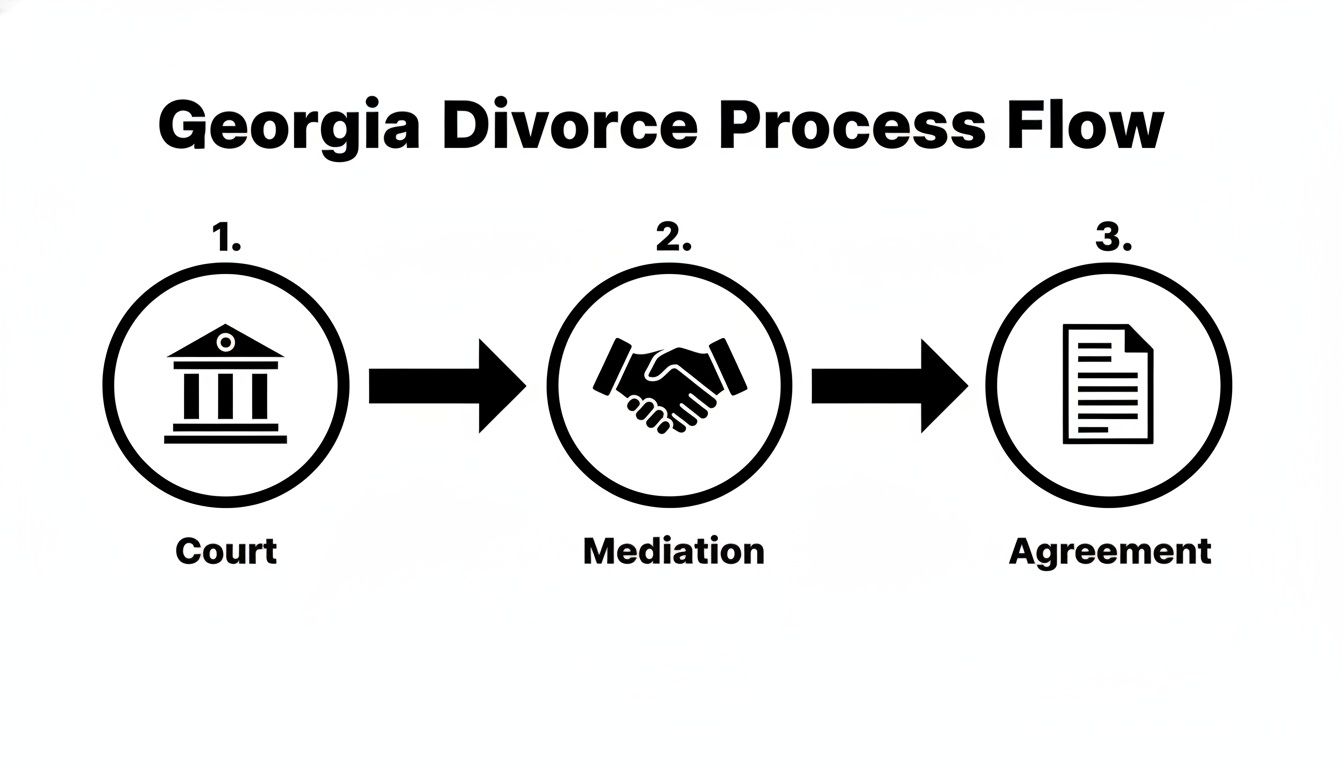
As you can see, the process flow shows how mediation acts as an off-ramp from the contentious path of court litigation. It channels disputes toward a collaborative agreement that you and your spouse create together.
Phase 1: The Initial Setup and Scheduling
The first step is choosing a neutral, third-party mediator. In Georgia, it's wise to select a professional registered with the Georgia Office of Dispute Resolution. This ensures they have the proper training and adhere to strict ethical standards.
You and your spouse must both agree on the mediator. Your attorneys can provide a list of respected professionals they have worked with successfully for clients in Cumming and Alpharetta.
Once you’ve settled on a mediator, your attorneys will coordinate a date and time. Sessions are often scheduled for a full day or half day and typically take place at the mediator’s office or another neutral site in Forsyth or Fulton County. With a date on the calendar, you and your legal counsel can begin preparing.
Phase 2: The Opening Session and Information Gathering
Your mediation day starts with an opening session. This is a joint meeting with you, your spouse, both of your attorneys, and the mediator. The mediator will begin by laying out the ground rules, emphasizing that the process is confidential and that their role is to be a neutral facilitator, not a judge.
After the introduction, the process shifts to information gathering. You and your attorney will present the essential facts of your case, working through key topics:
- Financial Disclosures: Both sides share documents like financial affidavits, tax returns, and bank statements to create a transparent picture of the marital estate.
- Property and Debts: You’ll identify all assets (homes, cars, retirement accounts) and liabilities (mortgages, credit card debt) to be divided under Georgia’s equitable division laws.
- Parenting Goals: Each parent will outline their desired outcomes for custody and visitation. This discussion forms the foundation for the required Georgia parenting plan.
Getting all the facts on the table is crucial for a productive negotiation.
The core of the divorce mediation process is not about winning arguments but about finding common ground. Your attorney's role is to ensure the solutions explored are fair, legally sound, and protect your long-term interests.
Phase 3: Negotiation and Private Caucuses
This phase is the heart of the mediation process. While the mediator may keep everyone together, it is more common to use private caucuses. A caucus is a private meeting between the mediator and one side (you and your attorney).
This technique creates a space where you can speak frankly with the mediator about your true priorities and bottom lines without your spouse present.
The mediator then acts as a shuttle, moving between the two private rooms. They carry offers, float ideas, and explore potential compromises, all while maintaining confidentiality. This back-and-forth allows for creative problem-solving on sensitive issues like alimony, child support, or dividing a family business in Johns Creek or Milton.
Phase 4: Drafting the Memorandum of Understanding
When you reach an agreement on some or all issues, the mediator drafts a Memorandum of Understanding (MOU).
This MOU details every term you and your spouse agreed upon. The MOU itself is not a legally binding court order. It is the detailed blueprint for your final settlement.
Your Miles Hansford attorney will take the MOU and draft a formal, enforceable Settlement Agreement. Once signed, it is filed with the Forsyth County or Fulton County Superior Court and incorporated into your divorce decree, making it a legally binding court order.
What to Expect in Forsyth or Fulton County Courts
Knowing the definition of divorce mediation is one thing; understanding how it plays out in Cumming and Alpharetta is what truly matters. While the basic ideas are the same, the logistics and judicial expectations can vary between Forsyth County and Fulton County.
Our experience in these local courts gives our clients practical insight that helps them prepare effectively. It makes a real difference whether your case is filed with the Forsyth County Superior Court or within the Fulton County Superior Court system that covers North Fulton areas like Roswell and Sandy Springs.
Local Court Procedures and Mediation Logistics
In Forsyth County, mediations for divorce cases are usually held in the private offices of mediators near Cumming. These meetings are typically set for a half-day (four hours) or a full day (eight hours). A half-day might suffice for straightforward property division, but if your case involves child custody or high-value assets, a full day is more realistic.
For cases filed in Fulton County, especially in the North Fulton courts, the options are similar. Fulton County also has a court-connected mediation program, which may mean working with a mediator from a court-approved list. Choosing between a private mediator and a court-appointed one is an important strategic decision, and we guide our clients to the best fit for their situation.
The Strategic Role of Temporary Hearings
The timing of your mediation is often tied to another key event: the temporary hearing. This is a court date where a judge makes initial decisions on custody, child support, and who lives in the house while the divorce is pending. These temporary orders shape the outcome of your case.
- Mediation Before a Temporary Hearing: It is often a smart move to mediate before seeing a judge. This allows you to create your own temporary agreement and avoid the risk of a judge issuing orders you don’t like.
- Mediation After a Temporary Hearing: If a hearing has already occurred, the judge's temporary order provides a dose of reality. It often pushes both sides to negotiate more seriously in mediation to prevent a similar result at trial.
In our work with Fulton County custody mediations, we’ve seen that the results of a temporary hearing heavily impact how negotiations play out. A judge's initial ruling provides a clear signal, and we use that information to position our clients for the best possible outcome.
Court-Appointed vs. Private Mediators in Local Cases
Judges in both Forsyth and Fulton counties want to see a genuine attempt to settle before a trial. While you can use a court-appointed mediator, hiring a private one often provides more flexibility.
With a private mediator, you have more control over scheduling and can choose a professional whose background matches your case. For our clients in Alpharetta, Milton, or Canton dealing with high-asset divorces or complex custody fights, finding a mediator with specific experience is priceless.
Research shows that structured mediation programs, like those supported by Georgia, have high success rates. You can read the full research on mediation's effectiveness to see just how impactful these programs are. Navigating the divorce mediation process in North Georgia isn't just about knowing the law. It’s about knowing the local legal landscape.
Our Strategy: How to Prepare for a Successful Cumming Mediation
Walking into mediation unprepared is a recipe for stress and a poor outcome. A successful mediation is not an accident; it is the direct result of strategic preparation. Taking proactive steps is the best way to ensure the conversation stays productive and protects what matters most to you.
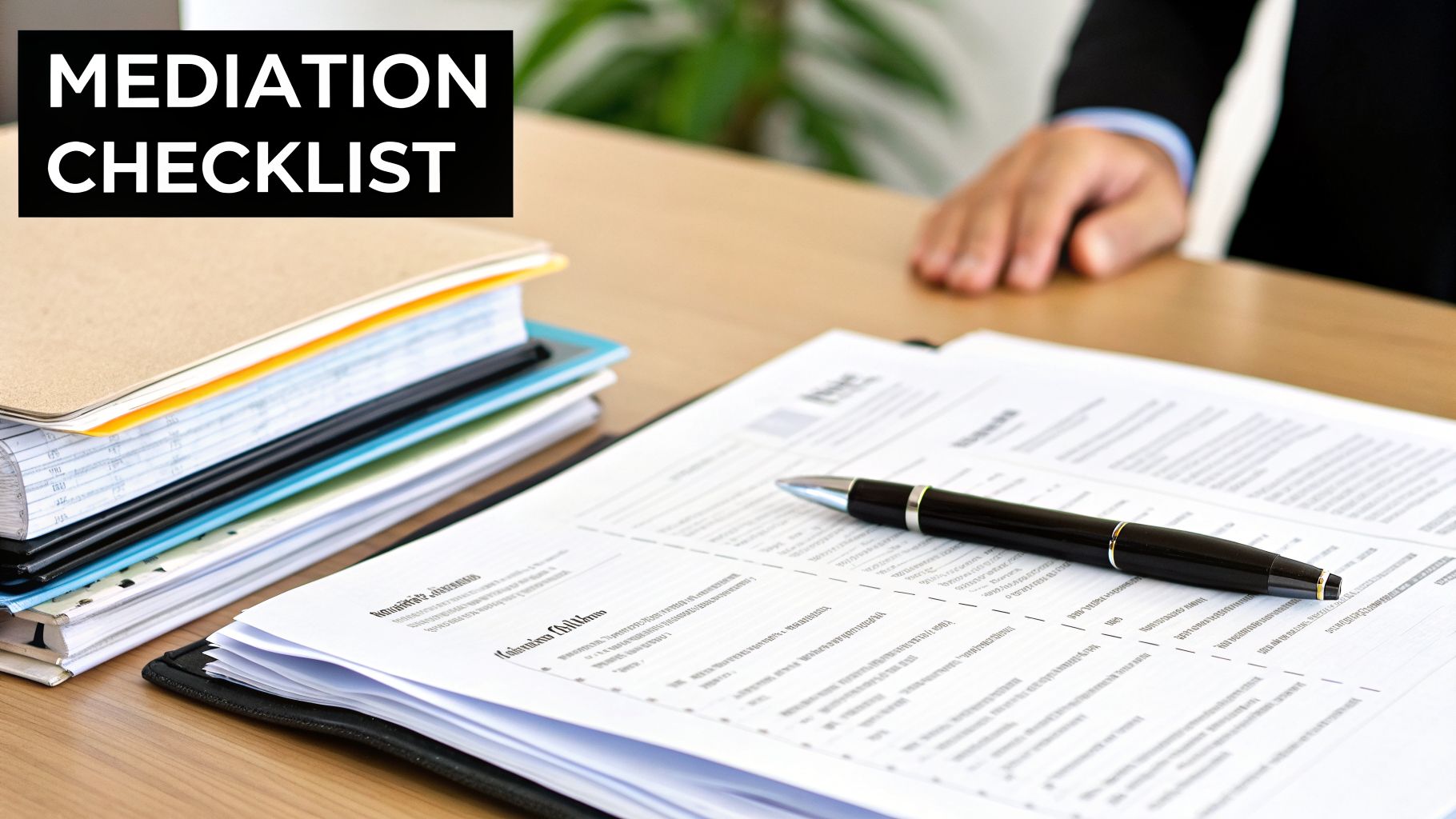
This preparation phase turns anxiety into action. When you gather the right documents and clarify your goals, you shift from a reactive, emotional headspace to a proactive, strategic one. To get the most out of your session, it's worth learning how to strategically prepare for mediation.
Gather Your Essential Documents for a Mediation in Cumming
A good negotiation is built on facts. You and your attorney need to organize all relevant paperwork to ensure the discussion is transparent and efficient.
Your document checklist should include:
- Financial Affidavits: A complete picture of your income, expenses, assets, and debts, as required by Georgia courts.
- Tax Returns: Typically the last three to five years of your joint tax returns.
- Proof of Income: Recent pay stubs, W-2s, or 1099s for both spouses.
- Property Valuations: Appraisals or market analyses for real estate, like your family home in Milton or a rental property in Dawsonville.
- Account Statements: Recent statements for bank accounts, retirement plans (401(k)s, IRAs), and investment portfolios.
- Debt Information: Statements for mortgages, car loans, and all credit card balances.
Having this information ready allows the conversation to focus on solutions, not searching for missing numbers. For a more detailed guide, see our resource on how to prepare for divorce mediation.
Define Your Goals and Priorities Before Your Alpharetta Mediation
Before you enter the room, you need to know what a "win" looks like for you. Sit down with your attorney to clarify your priorities. A helpful way to think about this is in terms of "needs" versus "wants."
Create a list of your non-negotiables—the outcomes you must have—and identify areas where you have wiggle room. For instance, keeping the family home in Johns Creek might be non-negotiable. But you might be flexible on how an investment account is divided to make that happen. This clarity prevents you from making emotional decisions in the heat of the moment.
The goal isn’t to "win" the mediation. It’s to secure a fair, lasting agreement that lets you and your family move forward. Your greatest asset is a calm, business-like mindset.
The Protective Role of Legal Counsel in Mediation
While mediation is less formal than a trial, having your own attorney is a necessity. The mediator is neutral. They cannot give you legal advice or tell you if an offer is fair under Georgia law.
Your Miles Hansford attorney, on the other hand, plays a crucial protective role:
- Analyzing Proposals: We run every offer through the lens of Georgia’s equitable division standards and child custody laws.
- Protecting Your Rights: We ensure you don't accidentally sign away important legal rights. Do not agree to custody terms without representation.
- Maintaining Focus: We act as a calm buffer during emotional conversations, helping you stay focused on your strategic goals.
Ultimately, people who use mediation report better outcomes. Research shows mediated agreements often lead to more joint custody arrangements, and participants feel the process was fairer to everyone involved—especially their children.
Why Choose Miles Hansford for Your Cumming Divorce Mediation
When facing divorce mediation, you need an attorney who knows more than the law. You need a lawyer with a practical, on-the-ground understanding of the local courts. The attorneys at Miles Hansford don't just take cases in Cumming and Alpharetta—we are a constant presence in the North Georgia legal community.
Our team appears daily in the Forsyth County and Fulton County courts that will handle your case. This local immersion gives our clients a distinct advantage. We know the judges, understand how local mediators think, and have seen which strategies are most effective for families in our area, from Johns Creek to Canton.
Our Dual Expertise In Georgia Mediation
What gives our clients an edge is our 360-degree perspective on the mediation process. Our attorneys are involved in two critical ways:
- As Your Advocate: We represent our clients in their mediation sessions. In this role, we are your strategic partner, ensuring any agreement is fair, complies with Georgia law, and protects your long-term financial stability and parental rights.
- As Registered Neutrals: Our attorneys are also frequently hired as registered mediators to help other parties resolve their disputes. This work provides us with an insider’s view of how negotiations progress and what creative solutions can break a stalemate.
This dual experience means we don’t just see the process from your side. We know how to build a strong case for you because we also know how to anticipate the other party’s arguments and strategies.
Mediation is a well-established path to achieving better divorce outcomes. A landmark 12-year study highlighted its effectiveness, finding that only 4 out of 35 mediated cases later returned to court for a contested hearing. In contrast, 26 out of 36 traditionally litigated cases ended up back in court. Discover more insights about mediation's positive impact from this comparative analysis.
Whether your situation involves an uncontested divorce or a high-asset case in Alpharetta with complex property to divide, our team has the necessary experience to guide you. We offer the calm, protective, and strategic counsel you need to turn a difficult process into a lasting resolution. The decisions made today will shape your future. Let the local authority in Cumming divorce mediation protect it. Contact Miles Hansford to schedule your consultation and speak with an attorney who understands how to secure your best interests.
Frequently Asked Questions About the Divorce Mediation Process in Georgia
Going through a divorce brings up many questions and a great deal of uncertainty. We’ve provided straightforward answers to questions we hear most often from our clients in Cumming and Alpharetta, based on the real-world practices of Forsyth and Fulton County courts.
Is mediation required for a divorce in Cumming, GA?
In most contested divorces in Forsyth and Fulton counties, judges will order couples to attempt mediation before they will schedule a final trial. They want you to have every chance to resolve issues like child custody and property division yourselves. Even in uncontested cases, mediation is an excellent way to finalize your settlement agreement efficiently and affordably.
How long does the divorce mediation process take in Forsyth County?
Mediation sessions are often completed in a single day, or perhaps over a few meetings for complex cases. A successful mediation will always shorten your overall divorce timeline compared to a litigated case, which can drag on for months—or longer—in the busy North Georgia court system. The key factor is both parties' willingness to negotiate.
What happens if we do not agree on everything in mediation?
Reaching a partial agreement is a significant success. For instance, you might settle all financial matters but still be at odds over the parenting plan. This is a win. You have narrowed the issues a judge must decide, saving you time, money, and stress by allowing your attorney to focus only on the few remaining contested points in court.
Is a mediated divorce agreement legally binding in Georgia?
Not immediately. At the end of mediation, the mediator drafts a Memorandum of Understanding (MOU), which is a blueprint for your final agreement but is not legally binding. Your attorney then drafts a formal Settlement Agreement based on the MOU. Once signed by both parties and incorporated into your Final Judgment and Decree of Divorce, it becomes a fully enforceable court order.
Do I need a lawyer for divorce mediation in Alpharetta?
Yes, it is critical to have your own attorney for the divorce mediation process in Alpharetta. The mediator is a neutral party and cannot give you legal advice. Your lawyer is there solely to protect you, ensuring the agreement is fair under Georgia’s equitable division and child custody laws and that you understand the long-term consequences of your decisions.
How much does divorce mediation cost near me in Cumming?
While the final cost depends on the mediator’s hourly rate and the length of your sessions, mediation is almost always significantly less expensive than going to trial. Most couples split the mediator's fee. By resolving disagreements outside the courtroom, you avoid the substantial and unpredictable legal fees and court costs associated with a protracted legal battle.
The agreements you reach during mediation will shape your future for years to come. You need to ensure your rights are protected by an attorney who understands the local courts in Cumming, Alpharetta, and across North Georgia. The team at Miles Hansford Law Firm has the strategic experience to guide you through this process. Call us today to schedule a consultation and take the first step toward a secure resolution.