


When you're facing a divorce in Georgia, you're looking at one fundamental choice that will steer the entire process: divorce mediation vs. litigation. Think of mediation as a collaborative path where you and your spouse sit down with a neutral guide to work out an agreement. Litigation, on the other hand, is the more traditional courtroom route where a judge makes the final calls. The path you take has huge implications for the cost, the timeline, and the amount of control you ultimately have over your family's future.
Two Distinct Paths for Your Georgia Divorce
As a marriage comes to an end, families across North Georgia—from Alpharetta to Cumming—have to figure out how to untangle complex issues like dividing property and creating a custody plan. The road you choose, whether it's mediation or litigation, will define not just the outcome but the entire experience. Getting a solid handle on what each one entails is the first, and most critical, step you can take.
Mediation is a private, cooperative process. It involves you and your spouse, often with your attorneys, working with a trained, neutral mediator to hash out a settlement. The mediator’s job is not to make decisions for you, but to guide the conversation and help you find workable solutions.
Litigation is the opposite. It’s a formal, public process that unfolds within the court system. Each of you will have your own attorney, and if you cannot come to an agreement on your own, a judge in a Forsyth or Fulton County courthouse will issue final, legally binding orders that you both must follow.

Key Differences at a Glance
To make this less abstract, let’s break down how these two approaches stack up on the issues that matter most to families going through a divorce.
| Factor | Divorce Mediation | Divorce Litigation |
|---|---|---|
| Control | You and your spouse keep control over every decision and the final agreement. | A judge holds all the power and makes the final, binding decisions for your family. |
| Process | Collaborative, informal negotiation sessions held behind closed doors. | Adversarial and formal court proceedings, including public hearings and trials. |
| Privacy | Confidential. All your conversations and financial details stay completely private. | Public record. Your personal and financial information becomes accessible to the public. |
| Timeline | Typically much faster. Many cases are resolved in just a few months. | Can drag on for a year or more, slowed down by backed-up court calendars. |
| Cost | Generally less expensive. You save a significant amount on legal and court fees. | Substantially more expensive due to mounting attorney fees, expert witnesses, and court costs. |
| Tone | Focused on cooperation and trying to maintain a civil co-parenting relationship. | Often becomes contentious and can do lasting damage to future communication. |
The most significant difference is who holds the power. In mediation, the power to decide rests with you. In litigation, you transfer that power to the court.
Picking the right approach means taking a hard, honest look at your family's specific situation, how well you and your spouse communicate, and what you hope to achieve. Both mediation and litigation can get you to the finish line, but the journey itself is profoundly different. Having an experienced family law attorney in your corner provides the calm, steady guidance you need to choose the process that will best protect your interests and help you move forward.
Understanding the Divorce Mediation Process

If the thought of a courtroom battle makes you anxious, divorce mediation offers a private and much more constructive alternative. It’s a confidential process where you and your spouse sit down with a neutral third party—the mediator—to negotiate the terms of your separation. Right away, this approach shifts the dynamic from an adversarial fight to a collaborative problem-solving session.
The core principle behind mediation is empowerment. Instead of handing over control to a judge who does not know you or your family, you and your spouse keep the decision-making power. This is absolutely critical when it comes to the big issues: dividing assets, creating child custody arrangements, and figuring out spousal support.
The Role of the Mediator
A lot of people think a mediator acts like a private judge, but that’s not the case at all. A mediator does not make decisions for you. Their real job is to facilitate productive communication, keep conflicts from escalating, and help both of you explore creative solutions you might not have considered.
These are trained professionals who know how to guide conversations that are often emotionally charged. Their goal is not to force a settlement on anyone; it's to help you build an agreement that you both can live with. Importantly, a mediator does not provide legal advice to either party. They are simply an impartial guide for the journey.
What Happens in a Mediation Session
Unlike a public hearing in a Forsyth or Fulton County courthouse, mediation sessions in Georgia happen in a private office. The whole process is flexible and built around your family’s specific situation.
- Opening Statements: Each of you gets a chance to state your goals and concerns without being interrupted.
- Information Gathering: The mediator will help you nail down the key issues that need to be resolved, like property division, who takes what debt, and of course, the parenting plan.
- Negotiation: This is where the real work happens. The mediator guides the discussion as you and your spouse talk through different options to find mutually agreeable terms. This might happen with everyone in the same room or with the mediator going back and forth between separate rooms (this is called a "caucus").
- Drafting the Agreement: Once you've reached a consensus on everything, the terms are written up into a formal settlement agreement.
The biggest advantage of mediation, in my experience, is its ability to preserve—and sometimes even improve—communication between spouses. This is invaluable for families in Roswell and Johns Creek who will need to co-parent effectively for years to come.
This non-adversarial approach does not just save you time and money; it sets a much more positive tone for your family’s future. By working together to find common ground, you lay the foundation for a healthier relationship after the divorce is final.
You can learn more about what divorce mediation can do for you in our detailed guide. Ultimately, mediation lets you craft a customized agreement that actually reflects your family's unique circumstances, steering clear of a one-size-fits-all court order.
Taking the Fight to Court: The Divorce Litigation Path
Sometimes, collaboration just is not in the cards. When you and your spouse cannot find common ground, divorce litigation provides the formal structure needed to get things done. Litigation is the court-managed process that takes over when you simply cannot agree on your own.
When you go this route, you're essentially handing the final decision-making power to a judge in a Fulton or Forsyth County Superior Court. That judge will issue a final, legally binding order that settles everything. It’s an inherently adversarial path. Each of you will have your own family law attorney, and their job is to fight for your specific interests. The whole process is dictated by strict legal rules, which ensures both sides get a fair chance to present their case, but it also means your personal and financial details become part of the public record.
The Stages of a Litigated Divorce in Georgia
Litigation is not a single event; it's a series of structured steps designed to move a case toward resolution, whether that's a last-minute settlement or a full-blown trial. It’s a formal and often long journey.
It all starts when one spouse, known as the Petitioner, files a Complaint for Divorce. This is the official document that kicks things off, laying out why the divorce is being filed and what the petitioner wants regarding property, kids, and financial support. The other spouse, the Respondent, is then formally served with these papers and has a limited time to file a legal response.
From there, the case moves into what’s called the discovery phase. This is where the real work begins, and it can take a lot of time. Both sides exchange information and gather the evidence they need to build their case. Discovery typically involves:
- Interrogatories: These are written questions that the other person must answer in writing, under oath.
- Requests for Production of Documents: This is a formal demand for financial records, bank statements, deeds, and any other relevant paperwork.
- Depositions: This is out-of-court testimony given under oath. It’s a chance for attorneys to question the spouses and any potential witnesses face-to-face.
The whole point of discovery is to create total financial transparency. It’s a powerful tool designed to prevent one spouse from hiding assets and to level the playing field, especially if one person was kept in the dark about the family’s finances.
All through this discovery period, attorneys might file various motions with the court to sort out immediate issues. Think things like who gets to stay in the house for now, or how temporary child support will be paid. These motions can trigger court hearings where a judge makes temporary decisions. If you get through all of this and still cannot settle, the case gets put on the calendar for trial. That’s when a judge will hear all the evidence and make the final, permanent decisions for your family. Understanding the structured, step-by-step nature of a contested divorce in Georgia is absolutely critical if you're considering heading down this road.
A Practical Comparison of Mediation and Litigation
Understanding the dictionary definitions of mediation and litigation is one thing, but seeing how they actually play out for families here in North Georgia is what really matters. The path you choose will have a direct and lasting impact on your finances, your schedule, your privacy, and your emotional health. This head-to-head comparison breaks down the most important factors to help you weigh your options.
Cost: The Financial Reality
One of the most immediate and significant differences you'll find is the cost. The cooperative, solution-focused nature of mediation is simply more efficient, which translates directly into lower legal bills for everyone involved.
Litigation, on the other hand, is a process with many expensive parts. Costs add up quickly through attorney hours spent on formal discovery, filing motions with the court, multiple court appearances, and extensive trial preparation. It's a much more complex and labor-intensive route, and the final invoice will reflect that.
The core difference in cost comes down to the process itself. Mediation is about finding solutions together in one room, while litigation involves a series of procedural steps, each requiring billable hours from your legal team.
Did you know that divorce mediation is dramatically less expensive than a traditional court battle, often saving couples tens of thousands of dollars? Research from Ohio State University's Moritz College of Law found that mediation typically costs between $2,000 and $5,000 total. In contrast, litigation can easily run upwards of $20,000 per person—meaning a potential cost of $40,000 or more for the couple combined. You can learn more about these financial findings from the research.
Timeline: How Long Will It Take?
Beyond the bottom line, the timeline is a critical concern for most people who are ready to move on with their lives. The speed of your divorce is almost entirely dependent on which path you take.
Mediation is nearly always the faster option. Because you are not tied to the court's calendar, you can schedule sessions as quickly as you, your spouse, and the mediator are available. Many mediated divorces in the Cumming and Dawsonville area are wrapped up within just a few months.
Litigation, however, operates on the court's schedule—not yours. The dockets in Fulton County and Forsyth County can be incredibly crowded, leading to long waits between hearings. The discovery phase alone can drag on for months, and if your case has to go all the way to a trial, it could easily be a year or more before you get a final resolution.
This flowchart shows the typical, and often lengthy, stages of a litigated divorce case.
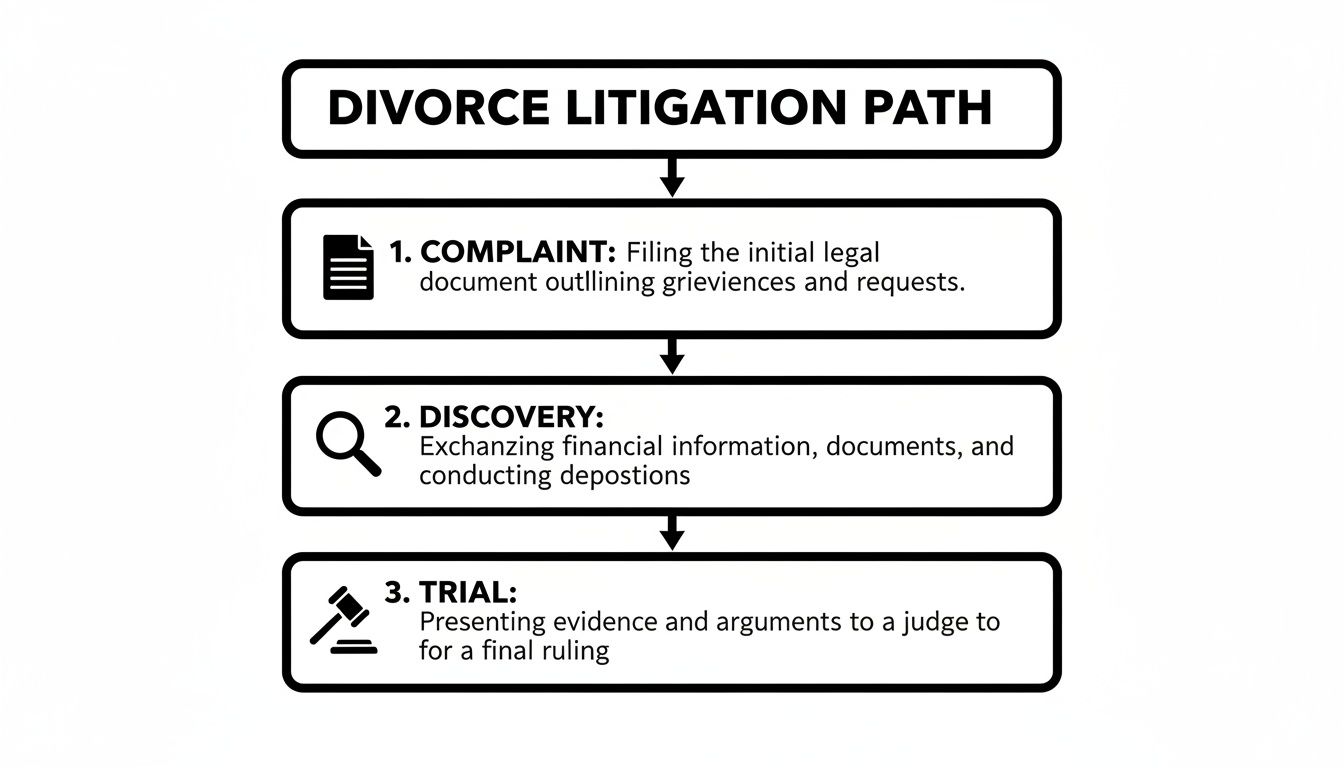
Each step, from filing the initial complaint to a potential trial, adds layers of time and complexity that are mostly avoided in mediation.
Control: Who Makes the Final Decisions?
This might be the most fundamental difference between the two approaches. It all comes down to who has the ultimate say over your family's future.
In mediation, you and your spouse keep complete control. The mediator is there to guide the conversation and offer options, but every single decision about your assets, your debts, and your children is made by the two of you. This empowers you to create a truly customized agreement that fits your family’s unique situation.
In litigation, you hand over control to a judge. If you cannot settle, a judge who knows very little about you or your family will make binding decisions based only on the limited evidence presented in court. While judges do their best to be fair, their orders may not reflect the nuanced, practical solutions you could have created together.
Privacy: Protecting Your Personal Information
Divorce is an intensely personal matter, but the level of privacy you get from each process is starkly different.
- Mediation is completely confidential. All discussions, financial documents, and negotiations happen behind closed doors. Nothing said in mediation can be used later in court, which creates a safe space for honest and open communication.
- Litigation is a public record. Court filings—including detailed financial statements and personal allegations—are accessible to the public. Hearings and trials are also typically open, meaning your private family matters can become public knowledge.
Emotional Impact: The Human Element
Finally, it's crucial to think about the emotional toll each path can take on you and your children. The tone of the process has a powerful and lasting effect on how your family functions after the divorce.
Mediation is designed from the ground up to be non-adversarial. Its main goal is to lower the temperature and encourage cooperation. This approach is especially valuable for parents who know they need to maintain a healthy co-parenting relationship for years to come. By working together, you set a more positive tone for your future.
Litigation is, by its very nature, adversarial. It frames the process as a fight, pitting you against your spouse. This often escalates conflict and creates lasting resentment. The stress of depositions, hearings, and cross-examinations can be emotionally draining and may do serious damage to family relationships—damage that is very hard to repair, especially for those in close-knit communities like Johns Creek or Roswell.
Mediation vs. Litigation At a Glance
To make the choice clearer, it helps to see the core differences side-by-side. Think of this as a quick reference guide to how each path works in practice.
| Factor | Divorce Mediation | Divorce Litigation |
|---|---|---|
| Average Cost | $2,000 – $5,000 (total) | $20,000+ (per person) |
| Typical Timeline | 2-4 months | 12-18+ months |
| Decision-Maker | You and your spouse | A judge |
| Privacy Level | Completely confidential | Public record |
| Process Tone | Collaborative, cooperative | Adversarial, confrontational |
| Control | You retain full control | You give up control to the court |
Ultimately, this table highlights the trade-offs you make when choosing a path. Mediation prioritizes efficiency, control, and cooperation, while litigation provides a formal structure for resolving disputes when cooperation is not possible.
When Is Mediation the Right Choice for Your Divorce?
Making the choice between divorce mediation and litigation is not just a legal one; it’s a personal decision about the path that best suits your family’s unique situation and what you hope to achieve. Mediation can be an incredibly effective tool in certain circumstances, offering a route that favors cooperation, privacy, and personal control over the high-stakes, public nature of a courtroom.
It's a common misconception that you and your spouse have to agree on everything to even consider mediation. In reality, mediation is a process built specifically to help you work through those disagreements in a structured, constructive way. The only real requirement is that both of you are willing to come to the table in good faith, ready to be transparent and negotiate honestly.
Scenarios Where Mediation Really Shines
Mediation is often the clear choice for couples who have a few shared priorities. If any of these situations sound familiar, the collaborative spirit of mediation may be the right fit for your divorce here in the North Georgia area.
- You Want to Keep a Healthy Co-Parenting Relationship: For parents in communities like Alpharetta and Roswell, the divorce is just one chapter in a long story of raising kids together. Mediation centers on respectful communication, helping you build a functional co-parenting partnership right from the start instead of damaging it in an adversarial court battle.
- You Need to Protect Your Financial Privacy: Taking your divorce to court makes your personal and financial life a matter of public record in Forsyth or Fulton County. Mediation, on the other hand, is completely confidential. This ensures that sensitive details about your assets, business dealings, and personal debts stay private.
- You Want to Control the Final Outcome: In mediation, you and your spouse are the ones making every single decision. This gives you the power to create a customized settlement agreement that actually works for your family's specific needs, rather than having a judge impose a generic solution.
The Right Mindset for a Successful Mediation
A successful mediation often comes down to the mindset of the people involved, not just the issues on the table. The process is designed for those who want to resolve their divorce more amicably and efficiently, sidestepping the immense emotional and financial toll of a drawn-out court fight.
The most critical ingredient for mediation is a mutual desire to find a workable solution. You do not have to be friends, but you do have to be willing to engage in a process aimed at resolution, not victory.
This collaborative focus is exactly why mediation has become so common. In fact, over 90% of family law cases, including divorces, are settled outside of a courtroom through mediation or similar approaches. That number points to a clear trend away from the risks and downsides of full-blown litigation. Learn more about the success of out-of-court settlements and see why so many families are choosing this path. It’s an approach that lets couples move on with their dignity—and their finances—more intact.
When Litigation Becomes a Necessary Step
While mediation is a fantastic tool for many couples, let's be realistic—it is not a silver bullet. There are times when the formal, structured process of litigation is not just an option; it's an absolute necessity to protect your safety, your finances, and your family's future.
Deciding to litigate is not a sign of failure. It's a strategic move to bring in the power of the court system when good-faith negotiation simply is not on the table. This often happens when there's a serious power imbalance between spouses or one person just refuses to be honest.
Situations Demanding Court Intervention
Some scenarios make mediation completely ineffective or, worse, dangerous. In these cases, you need the legal tools that only litigation can provide to get a fair and just outcome for your family here in Forsyth or Fulton County.
- Domestic Abuse or Coercion: If there’s any history of domestic violence, control, or intimidation, the collaborative setting of mediation is the wrong place to be. Litigation gives you access to protective orders and a formal court process designed to keep you and your children safe.
- Hidden Assets or Financial Deception: Suspect your spouse is hiding assets, not disclosing financial information, or lying about debts? Litigation is critical. We can use formal discovery tools like subpoenas and depositions to force the full financial transparency that mediation simply cannot compel.
- Refusal to Negotiate in Good Faith: Sometimes, a spouse is completely unwilling to negotiate. They might stonewall every proposal or just refuse to show up. When that happens, litigation might be the only way to move your divorce forward. A judge's final ruling becomes the only path to a resolution.
- Severe Power Imbalances: This could be about financial control, emotional manipulation, or even substance abuse issues that make a fair negotiation impossible. When you're dealing with exceptionally difficult dynamics, such as navigating relationships with a narcissistic partner, the strong advocacy of an attorney in court is essential to level the playing field.
Litigation is designed to protect your rights when collaboration breaks down. It provides a necessary framework for compelling cooperation and enforcing legal obligations when one party is unwilling to act fairly.
Making a Strategic Choice for Protection
It's true that mediation can wrap up a divorce in a few months, while litigation takes longer. Research shows that mediation successfully resolves 70-80% of cases in a fraction of the time, which is why it's so popular.
But when you're up against dishonesty or danger, the protections you get from litigation are indispensable. Opting for litigation in places like Cumming or Alpharetta is not about starting a fight; it's a proactive move to safeguard your interests. It ensures the final divorce decree is based on truth and fairness, enforced by the full authority of the Georgia courts.
Finding the Right Legal Guidance for Your Chosen Path
Whether you end up working things out through mediation or heading toward a more formal litigation process, one thing does not change: you need skilled legal guidance. The path you choose for your North Georgia divorce has a huge impact on the outcome, but it does not eliminate the basic need to have an experienced family law attorney protecting your rights.
There's a common myth that if you choose mediation, you do not need your own lawyer. That's just not true. The mediator is a neutral third party; by law, they cannot give legal advice to you or your spouse. Your attorney's job is to advise you privately, look over any proposed settlement terms, and make sure the final agreement is fair, legally solid, and actually protects your interests down the road.
How Your Lawyer's Role Changes
When a case goes to litigation, your attorney’s role shifts completely. They become your dedicated advocate. In the courtrooms of Forsyth and Fulton County, our job is to fight for you using formal legal procedures. This calls for a totally different set of skills—we're talking assertive courtroom presence, strategic presentation of evidence, and crafting persuasive legal arguments.
Thinking about legal help for your divorce also means considering how responsive a firm is. A good overview on setting up a dependable law firm phone answering service shows just how much effective communication can impact a case.
The best family law firm is one that excels in both arenas—skilled at the negotiating table and formidable in the courtroom. This versatility ensures you have the right support, no matter which direction your divorce takes.
At Miles Hansford, our attorneys have spent years handling both negotiated settlements and aggressive litigation. We offer the calm, professional guidance clients in Alpharetta, Roswell, and across North Georgia need to get through their divorce with confidence. We’re committed to shaping our strategy to your specific situation, making sure you feel supported and heard every step of the way.
Choosing the right legal partner is one of the most important decisions you'll make. For a little more help, take a look at our guide on how to choose a divorce lawyer that’s right for you. We hope you'll contact our office for a consultation to talk about your situation and figure out the best path forward for your family.
Georgia Divorce: Your Top Questions Answered
When you’re staring down the road to divorce, a lot of questions pop up. Here are some straightforward answers to the things we hear most often from families in Fulton County, Forsyth County, and across North Georgia as they try to decide between mediation and a courtroom battle.
Can We Mediate If We Can’t Agree on Anything?
Absolutely. In fact, that’s exactly what mediation is for. You don’t need to have anything sorted out ahead of time. Mediation creates a space for a neutral guide to help you have productive conversations, even when you’re miles apart on sensitive topics like finances or custody. The only thing required to make mediation work is a real commitment from both of you to negotiate honestly and try to find a solution you can both live with.
Do I Still Need a Lawyer If We Have a Mediator?
We highly recommend that you have your own attorney, even if you’re committed to mediation. A mediator has to stay neutral; they cannot give legal advice to either side. Their job is to guide the negotiation, not to protect your specific interests. Think of your own lawyer as your advocate. They’re the one who will advise you on Georgia law, look over any proposed settlement to make sure it’s fair to you, and ensure the final paperwork is solid, enforceable, and protects your future.
What Happens If Mediation Doesn’t Settle Everything?
If you hit a wall on a few issues during mediation, it’s not a total loss. Any agreements you did make are still valid. You can often finalize a partial settlement covering all the things you saw eye-to-eye on. For the topics left on the table, you can then move to the court system. It's important to know that everything discussed in mediation is confidential. Nothing you said can be brought up or used against you in court, so you can negotiate openly without worrying about it backfiring later.
Is an Agreement from Mediation Legally Binding in Georgia?
Yes. Once you and your spouse reach a deal and sign the mediated settlement agreement, it becomes a legal contract. That agreement is then filed with the court and becomes part of your official divorce decree. This makes the agreement as powerful and enforceable as any other court order. If one person does not hold up their end of the bargain, you have the full weight of the court system to enforce the terms.
Deciding between mediation and litigation is a tough call, and it’s one you shouldn’t make without experienced legal advice. The team at Miles Hansford Law Firm is here to offer the steady hand you need to pick the right path for your family and protect what matters most. Contact us to talk through your options and move forward with confidence.