


Meta Title: Divorcing While Pregnant in Cumming, GA
Meta Description: Divorcing while pregnant in Cumming, GA. Learn Georgia law, Forsyth and Fulton County court steps, temporary orders, and local strategy.
Suggested URL Slug: /divorcing-while-pregnant-cumming-ga/
If you are pregnant and your marriage is breaking down, you may be trying to solve ten problems at once. You may be worried about where you will live, how bills will get paid, whether your spouse can seek custody, and whether a judge in Cumming or Alpharetta will even let the divorce move forward before the baby is born.
The first point of relief is this. In Georgia, pregnancy does not stop you from filing for divorce. But divorcing while pregnant does change the strategy, especially in Forsyth County Superior Court and Fulton County Superior Court, where child-related issues often cannot be finalized until after birth. That means your case needs a plan early, not panic later.
If you searched for a “divorce lawyer near me” or a “family law attorney Cumming GA” because you need answers today, the right next step is to get local legal guidance before you sign anything, leave the home without a plan, or agree to parenting terms that may hurt you later.
Answering Your First Question When Divorcing While Pregnant in Cumming GA
A lot of clients arrive at this point feeling embarrassed by how scared they are. They are not confused about whether the marriage is healthy. They are confused about what happens next.
In Cumming, GA, I often see the same immediate concerns. A pregnant spouse wants to know whether filing will trigger a fight, whether insurance can be protected, whether support can start before birth, and whether the court will force everyone to wait for months without real help in place.
The short answer is that there is a path forward. It usually starts with filing, asking for temporary orders, and building the case around what the court can decide now versus what must wait until after the child is born. That distinction matters in Forsyth County and for families in nearby Dawsonville, Suwanee, Milton, Johns Creek, and Canton.
This is also where many people lose control of the case. They rely on generic online advice, assume the judge will “sort it out later,” and fail to request early relief for housing, expenses, medical needs, or contact boundaries. In pregnancy-related divorce cases, temporary decisions often shape the outcome more than people expect.
Key takeaway: If you are divorcing while pregnant, do not wait for the birth to get legal protection in place. The strongest move is usually early, organized action.
If you need steady guidance from a North Georgia family law attorney, schedule a consultation and get a practical plan for the next few weeks, not just the next few months.
Why Divorcing During Pregnancy is a Unique Challenge in Georgia
National divorce articles often flatten this issue into a generic statement. “You can file, but things may be delayed.” That is not enough for someone living in Cumming, Alpharetta, or the broader North Georgia area.

Georgia procedure changes the whole case
Georgia law allows filing for divorce during pregnancy, but courts in Fulton and Forsyth Counties often delay finalization of child-related issues until after birth to establish paternity and assess the child’s needs. That procedural reality can extend proceedings by 3 to 6 months, as noted by Custody X Change’s discussion of divorce while pregnant.
That timing issue affects more than the court calendar. It affects your housing choices, your medical expense planning, your settlement position, and your expectations about what a judge can order while you are still pregnant.
Generic advice can mislead Georgia families
A person reading broad national content may assume the court can enter custody, visitation, and support orders for the unborn child as part of a final decree. That is where trouble starts. Georgia judges are dealing with Georgia family law statutes, local court procedure, and paternity rules that are not interchangeable with another state’s process.
For clients in Alpharetta, that local difference matters because cases may be heard through Fulton County Superior Court depending on venue. For clients in Cumming, the path usually runs through Forsyth County Superior Court. The law is statewide, but scheduling, judicial preferences, mediation practice, and case flow are local.
One Georgia rule changes everything
The most important legal reality is the presumption of paternity for a child born during marriage. That rule affects who can seek custody, who may owe support, and why judges often separate the divorce itself from child-related decisions.
That is why divorcing while pregnant is not a standard divorce plus a medical issue. It is a family law matter with overlapping concerns about parentage, support, temporary stability, and long-term rights.
For people in Roswell, Sandy Springs, Johns Creek, and Milton searching for help “near me,” the right lawyer is not just someone who handles divorce. It is someone who works in these courts and understands how pregnancy changes timing, risk, and strategy.
The Legal Process for a Pregnancy Divorce in Cumming and Alpharetta
Georgia is a no-fault divorce state. Many people file on the ground that the marriage is irretrievably broken. Georgia also has a statutory minimum waiting period after filing before a divorce can be finalized. That is the baseline. Pregnancy adds a separate set of issues that often prevent a clean finish on the same timeline.
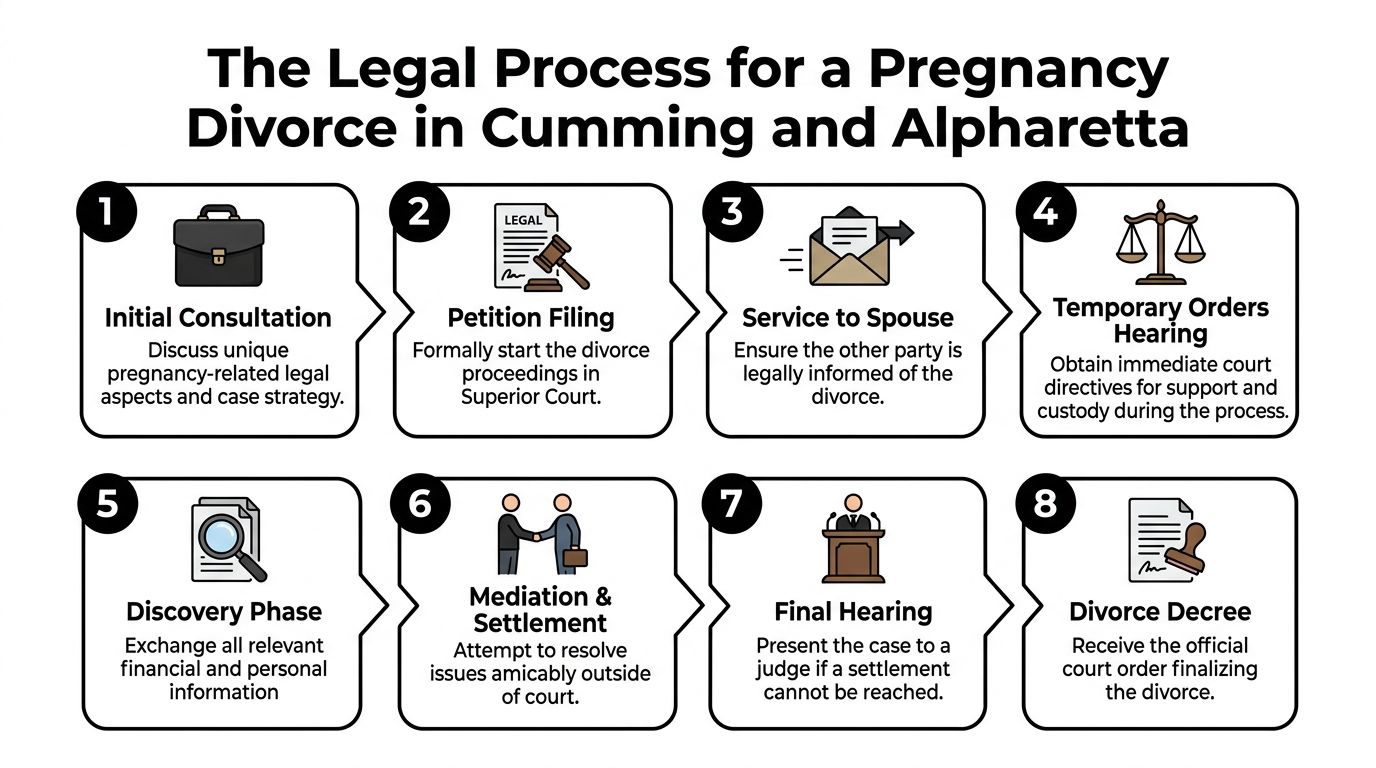
Step one starts in the proper superior court
You file in the appropriate county, commonly Forsyth County Superior Court for Cumming residents or Fulton County Superior Court for many Alpharetta residents. If you are unsure how venue, service, and filing work, this overview on how to file for divorce is a useful starting point.
The initial filing should do more than start the case. It should frame the issues correctly. In a pregnancy divorce, that often means identifying immediate needs such as temporary support, exclusive use of the home, and boundaries for contact.
Step two is service and early case control
After filing, the other spouse must be formally served. Once the case is active, attention usually shifts quickly to temporary arrangements.
This is important because you may need court help long before the child is born. A waiting period on final judgment does not mean you must live in limbo without structure.
Step three is understanding paternity before making mistakes
Under O.C.G.A. § 19-7-20, a child born during a marriage is legally presumed to be the husband’s. Georgia courts typically delay finalizing a divorce decree until after birth to properly address paternity, custody, and support because they lack jurisdiction to issue such orders for an unborn child, as explained in this Georgia divorce-while-pregnant legal answer.
That is why people run into trouble when they try to force all issues into one fast decree. If paternity is uncertain, or if the child may not be the husband’s, trying to “solve” the issue informally can create larger problems later.
Practical tip: Do not rely on verbal assurances about paternity, support, or future custody. If the child is expected during the divorce, your legal paperwork needs to preserve options rather than lock in avoidable errors.
Step four is temporary relief
Georgia courts can enter temporary orders while the divorce is pending. That may include use of the home, payment of certain expenses, temporary alimony, and conduct rules between the parties. In some cases, these hearings become the most important event before birth because they determine how stable your day-to-day life will be during the remainder of the pregnancy.
Step five is discovery, mediation, and narrowing disputes
Most contested cases involve an exchange of financial information. In Georgia, equitable division governs property division. That means the court divides marital property fairly, not necessarily equally. If one spouse controls the accounts, business records, or insurance information, discovery is often essential.
Courts in Forsyth County and Fulton County also commonly require mediation before trial. Mediation can be productive during pregnancy if both parties are realistic about what can be resolved now and what must wait until after birth.
Step six is final resolution, sometimes in two phases
Some cases resolve after the child is born. Others require the divorce issues to be separated, with some matters handled sooner and child-specific terms addressed later. The right structure depends on the facts, the county, and whether paternity is disputed.
The key point is that divorcing while pregnant in Cumming or Alpharetta is not stalled because the baby has not arrived. It is managed in stages.
Key Strategies to Protect Yourself and Your Child
A pregnancy-related divorce calls for discipline. People often focus on the final decree because it feels permanent. In practice, the safer approach is to protect the period between filing and birth.
Resolve paternity issues carefully
If everyone assumes the husband is the biological father and no one later challenges that assumption, the legal path is usually more straightforward. But not every case fits that pattern.
If the husband may not be the biological father, or if another man expects to seek rights, do not improvise. Georgia’s presumption rules create legal consequences first and emotional consequences second. That order surprises many people.
For mothers, this means being careful about what is said in texts, emails, medical paperwork, and negotiations. For husbands, it means not admitting or waiving away rights and obligations without legal advice. For biological fathers, it can mean later action related to legitimation and paternity after the child is born.
What works is a controlled approach. Preserve documents. Avoid side agreements. Make sure the court filings do not create future contradictions.
What does not work is trying to “keep things manageable” by saying everyone will work it out after delivery. Those understandings often collapse once support, custody, or a new relationship enters the picture.
Secure financial stability early
Pregnancy can shrink a person’s ability to work at the exact moment divorce increases household pressure. One verified source states that divorcing while pregnant in Georgia can amplify financial strain, citing a 27% drop in divorced mothers’ standard of living, along with Georgia superior court filing fees of $200 to $400 and contested attorney fees of $5,000 to $15,000, according to this discussion of getting divorced while expecting a baby.
Even without focusing on the numbers, the practical lesson is clear. Financial problems get worse when people wait too long to ask the court for help.
Temporary orders matter more than many realize
In Georgia, temporary relief can address immediate support and possession issues while the case is pending. That may include:
- Household support: Help with mortgage, rent, utilities, groceries, and ongoing living expenses.
- Medical expense planning: A court order can help structure responsibility for insurance and uncovered pregnancy-related costs.
- Use of the marital residence: In the right case, one spouse may seek exclusive use of the home.
- Temporary alimony: If one spouse has been financially dependent, support may be essential during the pregnancy.
A temporary hearing is not just a stopgap. It often sets the tone for settlement because it shows both sides how a judge views the facts.
Build your financial file before conflict escalates
Start gathering the records your attorney will need:
- Income proof: Pay stubs, tax returns, bonus information, and business distributions.
- Account history: Bank statements, retirement records, credit cards, and loan balances.
- Insurance details: Health coverage, premiums, and policy information.
- Pregnancy-related costs: Appointment records, pharmacy costs, and expected delivery expenses.
People in Alpharetta, Johns Creek, and Milton often have more complex compensation structures, including commissions, equity, or business income. Those cases require early financial analysis, not rough estimates.
Key takeaway: The spouse who organizes financial information first negotiates from a stronger position.
Protect your safety if the conflict is escalating
Not every divorce while pregnant involves abuse. But when it does, delay is dangerous.
A 2024 JAMA Network Open study analyzing pregnancy-associated homicide data from 2018 to 2021 across 49 states and Washington, D.C. found that states prohibiting the finalization of divorce during pregnancy had significantly higher rates of intimate partner homicide among pregnant women, with an incidence rate ratio of 2.11. The study also noted that homicide remains the leading cause of death for pregnant women in the United States and is often linked to intimate partner violence, according to this summary of the study’s findings.
The Georgia takeaway is not that every difficult spouse is violent. It is that threats, stalking, coercive control, forced financial dependence, and physical intimidation must be taken seriously during pregnancy.
Warning signs that call for immediate legal action
- Escalating control: Monitoring your movements, medical visits, or phone.
- Money restriction: Cutting off access to cards, accounts, or transportation.
- Threats tied to the baby: Statements about taking the child, keeping you from the hospital, or punishing you for filing.
- Physical intimidation: Blocking exits, damaging property, or grabbing during arguments.
In those cases, do not treat the divorce as an ordinary scheduling problem. Consider whether a protective order, emergency filing, or immediate safety planning is needed. If parenting and safety concerns are urgent, review the legal options around an emergency custody order.
Do not make these common mistakes
Some mistakes appear in nearly every high-stress pregnancy divorce:
| Mistake | Why it causes trouble | Better approach |
|---|---|---|
| Leaving the house without a plan | It can create financial and possession issues | Get advice first on housing, safety, and temporary relief |
| Signing a quick agreement | It may ignore paternity or post-birth issues | Use a Georgia-specific agreement customized to timing |
| Hiding the pregnancy from the court | It can undermine the case and create later challenges | Disclose material facts and plan around them |
| Waiting until after birth to act | You may lose your negotiating position and stability | File strategically and seek temporary orders early |
Focus on the next decision, not the whole year
Overwhelmed clients often try to solve everything at once. The better approach is narrower.
Think in stages:
- Stabilize the next month
- Protect housing and income
- Preserve paternity and custody options
- Prepare for post-birth orders
- Negotiate from a position of structure, not fear
That is what practical strategy looks like in a Georgia pregnancy divorce.
What to Expect in Forsyth County and Fulton County Family Courts
People are often less afraid of court once they understand what happens there. Local procedure still matters, but the rhythm of these cases is more predictable than clients expect.

Temporary hearings in local courts
At a temporary hearing in Forsyth County Superior Court or Fulton County Superior Court, the judge is usually focused on immediate stability. The court wants to know who is paying which bills, where each spouse is living, whether conflict is affecting safety, and what interim structure is needed while the case is pending.
For pregnant clients, that often means the court is looking at support, housing, health insurance, and practical conduct between the parties rather than trying to decide final parenting terms for a child who has not yet been born.
Judges also care about credibility. The spouse who arrives organized, measured, and realistic stands in a better position than the spouse who turns the hearing into a running marital argument.
Mediation is part of the process
Georgia family courts commonly require mediation in contested divorce and custody matters. In Forsyth County divorce filings and many Fulton County custody hearings, mediation is not just a formality. It is where a large number of cases narrow down to the issues that need judicial attention.
For clients in Cumming, Alpharetta, Roswell, and Sandy Springs, mediation works best when the pregnancy is treated as a timing issue with legal consequences, not a pressure tactic. Good preparation means knowing which issues can be settled now, which terms should be reserved until after birth, and which proposals are too risky to accept.
If your case involves both marital and parenting concerns, this overview of divorce and custody in Georgia helps explain how the two tracks often overlap.
Practical tip: Mediation is most useful when temporary orders already provide basic stability. People negotiate better when they are not deciding under financial panic.
Parenting plans after birth
Georgia courts require a Parenting Plan in custody cases. After the baby is born, the court applies the best interest of the child standard. That includes the practical realities of infant care, parental availability, communication ability, and any evidence of abuse or instability.
In cases involving a newborn, parenting plans must be realistic. Judges in North Fulton courts and Forsyth County tend to scrutinize plans that sound copied from an older-child schedule. A newborn case needs details about transitions, feeding, medical decision-making, communication, and how the parents will handle frequent schedule changes.
Local experience is important here. A parenting proposal that feels “fair” on paper is not always one a Georgia judge will find workable.
Why Choose Miles Hansford for Your North Georgia Family Law Case
Divorcing while pregnant is not a routine filing. It is a case that touches paternity, temporary support, parenting rights, housing, and safety all at once. The lawyer handling it needs to understand not only Georgia law, but how these issues unfold in real courtrooms across Cumming, Alpharetta, Forsyth County, and Fulton County.
That is why local experience matters. A North Georgia family law attorney who works in these courts every day understands the pressure points. Temporary hearings matter. Mediation matters. Proper drafting matters. Timing matters even more.
The right representation should feel both protective and practical. You need clear advice about Georgia no-fault divorce laws, the statutory minimum waiting period, equitable division, child custody standards, and the Parenting Plan requirements Georgia courts expect after birth. You also need someone who can tell you what not to do before your next text message, financial transfer, or move out of the residence.
Clients searching for a “family law attorney Cumming GA,” a “divorce lawyer near me,” or an attorney for a pregnancy-related divorce near Johns Creek, Milton, Suwanee, Roswell, or Canton are looking for the same thing. They want calm judgment under pressure.
That is the standard to look for. Not drama. Not promises. Not a one-size-fits-all template. You need a legal strategy built around your county, your facts, your timeline, and your child.
Frequently Asked Questions About Divorcing While Pregnant in Georgia
Q: Can I file for divorce while pregnant in Cumming, GA?
A: Yes. Georgia allows you to file for divorce during pregnancy. In Forsyth County Superior Court, the filing can move forward, but child-related issues are often not finalized until after birth because paternity, custody, and support must be addressed at the proper time under Georgia law.
Q: How long does a divorce take in Cumming or Alpharetta if I am pregnant?
A: Georgia has a statutory minimum waiting period after filing, but pregnancy often extends the practical timeline. In Forsyth County or Fulton County, a case may take longer when the court reserves child-related matters until after birth or when temporary hearings and mediation are needed.
Q: Will the judge finalize my divorce before the baby is born in Georgia?
A: Sometimes parts of the case can move forward, but many Georgia courts will not finalize child-related issues before birth. That is because the court cannot issue custody and support orders for an unborn child, and paternity may still need to be legally resolved after delivery.
Q: Does my husband automatically count as the father under Georgia law?
A: Usually, yes. Under O.C.G.A. § 19-7-20, a child born during the marriage is presumed to be the husband’s child. That presumption is one reason divorcing while pregnant requires careful legal planning, especially if paternity may later be disputed.
Q: Can I get temporary support in Forsyth County while I am still pregnant?
A: Yes. In Georgia, temporary orders can address support and other immediate issues while the divorce is pending. In Forsyth County divorce filings, temporary hearings are often the best tool for securing financial help, use of the home, and structure during the pregnancy.
Q: What happens in Fulton County if there is a paternity dispute?
A: The case usually requires extra care and additional procedural steps after birth. In Fulton County Superior Court, paternity issues can affect who has standing to seek custody, who may owe support, and when final child-related orders can be entered.
Q: Do Georgia courts require mediation in pregnancy divorce cases?
A: Often, yes. Mediation is commonly required in contested family law cases in Forsyth County and Fulton County. It can be useful if both parties understand which issues can be settled immediately and which must wait until the child is born.
Q: Do I need a Parenting Plan if the child has not been born yet?
A: Georgia courts require Parenting Plans in custody cases, but the final version usually becomes relevant after birth. If you are expecting, your attorney should still prepare early for post-birth custody issues so you are ready once the court can address them directly.
If you are divorcing while pregnant in Cumming, Alpharetta, Forsyth County, or Fulton County, Miles Hansford Law Firm can help you take control of the next step. Speak with a family law attorney who understands local court procedure, temporary hearings, mediation, and how to protect your parental rights, financial stability, and long-term position under Georgia law. Schedule a consultation to get a clear strategy for your case. Call today.
Internal link suggestions
- /family-law/
- /divorce-and-custody/
- /how-to-file-for-divorce/
- /emergency-custody-order/
- /legitimation/
- /mediation/
Schema recommendations
- Attorney
- LegalService
- FAQPage