


The question, "do grandparents have rights?" is one we hear with heartbreaking frequency from families across Cumming, GA, and throughout North Georgia. When a parent suddenly prevents you from seeing a grandchild you love and have helped nurture, the sense of helplessness can be overwhelming. While Georgia law doesn't give grandparents an automatic right to see their grandchildren, it does offer a specific legal path to ask a court for visitation in certain situations.
Being cut off from a grandchild is a profound loss, but you are not without options. The attorneys at Miles Hansford are here to provide the calm, strategic guidance you need to protect your family bond. If you are a grandparent in Cumming or Alpharetta facing this painful situation, schedule a consultation to understand your legal standing.
Why This Matters in Cumming, GA: Understanding Grandparents' Rights
For many grandparents in Cumming and Alpharetta, the sudden loss of contact with a grandchild is more than just a family disagreement—it's a crisis. You may have been a primary source of stability, childcare, and love. It’s critical to understand that Georgia law, specifically O.C.G.A. § 19-7-3, acknowledges this painful reality and provides a framework for seeking court-ordered visitation.

However, the legal standard is intentionally high. You cannot simply file a petition in Forsyth County Superior Court because you disagree with the parents' choices or want more time. To succeed, you must prove two critical things:
- Potential Harm: You must show with evidence that the child will suffer actual physical or emotional harm if your visitation is denied. This is more than proving the child will simply be sad; it requires evidence of a real, negative impact.
- Best Interest of the Child: The court's primary focus is always what is best for the child. Your case must clearly demonstrate that maintaining your relationship serves the child’s health, welfare, and happiness.
This high bar exists to protect the fundamental rights of fit parents to raise their children as they see fit. A judge in Dawsonville or Johns Creek will not overrule a parent's decision without a very compelling reason.
The court's goal is to protect the child. This means your case must be built not around your own desire to see your grandchild, but around the provable harm the child would suffer without you in their life.
Georgia Grandparent Rights in Cumming, GA At-a-Glance
The legal landscape can be confusing. Here is a quick summary of the key principles under Georgia's grandparent visitation statute that our clients in Cumming & Alpharetta need to know.
| Legal Principle | What It Means for Grandparents in Cumming & Alpharetta |
|---|---|
| No Automatic Rights | Parents have a constitutional right to raise their children. Grandparents do not have an automatic legal right to visitation. |
| Must Prove Harm | You must show with evidence that denying visitation will cause actual physical or emotional harm to the child. |
| Best Interest of the Child | The court's primary consideration is whether visitation is in the child's best interest, not the grandparent's. |
| Specific Legal Action | You must file a formal petition with the Forsyth or Fulton County court under O.C.G.A. § 19-7-3 to seek visitation rights. |
This table highlights the significant legal hurdles involved. Successfully meeting this standard requires a strategic approach and strong evidence. This is not a journey you should attempt on your own. The process involves precise legal filings, strict rules of evidence, and knowing how local North Fulton judges in cities like Milton, Roswell, and Suwanee interpret these sensitive cases. For more information, you can also check out our guide on Georgia visitation rights.
An experienced family law attorney can review your unique circumstances and help build a case that gives you the strongest possible chance to protect your relationship with your grandchild.
The Legal Process: Overcoming the Parental Rights Hurdle
To understand the challenges grandparents face in court, we must look at one powerful U.S. Supreme Court decision: Troxel v. Granville. This single case changed everything for grandparents' rights across the country, creating a high legal wall that protects a fit parent's right to decide who their children see.
At its core, the case established that the decisions of a fit parent are given special weight under the Constitution. A court can't just step in and overrule a parent simply because a judge thinks a different choice would be "better."
The Foundation of Parental Rights
Before the Troxel decision in 2000, some states allowed judges to grant visitation to just about anyone if they felt it was in the child’s best interest, even when a parent disagreed. The Supreme Court found that one such law was "breathtakingly broad" and unconstitutional. It didn't give proper deference to a fit parent's choices for their own child.
Because of this ruling, states everywhere, including Georgia, had to rewrite their laws to meet this higher standard. You can see how this case impacted laws nationwide by reviewing Justia's 50-state survey.
This is why your case cannot be based only on your love for your grandchild. A judge in Forsyth County or Fulton County is constitutionally required to presume that a fit parent is acting in their child's best interests.
Your legal challenge is to present enough compelling evidence to overcome this powerful presumption. You have to show that the parent's decision isn't just unfortunate, but that it is actively causing harm to the child.
How This Affects Your Case in Cumming, GA
If you live in Cumming, Alpharetta, or nearby areas like Johns Creek and Milton, the Troxel case directly shapes your legal strategy. It means you carry the heavy burden of proving that keeping you away from your grandchild will cause them actual, demonstrable harm.
This is the main obstacle you must clear. You cannot win a case by arguing:
- "I love my grandchild and miss them."
- "I've always been part of their life."
- "I can provide things the parents can't."
While these feelings are completely valid, they do not meet the high legal standard set by the court. Your case must be built on evidence that proves the child’s physical or emotional well-being is genuinely at risk. This is the reality in every courtroom in North Georgia, from Dawsonville to Roswell. The burden of proof is significant, and successfully meeting it requires a strategic, evidence-based approach from day one.
A Strategic Approach to Filing for Grandparent Visitation in Cumming or Alpharetta
Knowing you have potential legal rights is one thing; understanding how to pursue them is another entirely. For grandparents in the Cumming and Alpharetta areas, seeking visitation isn't as simple as asking a judge for time. It's a formal legal process with very strict rules.
The first, and most critical, question is figuring out when and how you’re allowed to file a case. Your specific legal path depends entirely on the parents' current situation.
Determining the Right Legal Action in Georgia
Georgia law offers two different ways for grandparents to ask a court for visitation rights. Choosing the wrong one can get your case dismissed before it even starts, costing you time and money.
Intervening in an Existing Case: This is the most common path. If your grandchild’s parents are already involved in a family law case—like a divorce, custody modification, or legitimation action—you cannot file a brand new lawsuit. Instead, you must formally intervene in their active case.
Filing an Original Action: You can only file a completely new, standalone petition for visitation in very specific situations. The most frequent reason is when the child's parents are living separately and have decided to cut off your relationship with your grandchild.
It is absolutely crucial to get this right. Any paperwork must be filed correctly with the Forsyth County Superior Court for matters in Cumming or the Fulton County Superior Court for those in Alpharetta.
This chart helps visualize the tough legal standard you're up against. Courts start by giving immense respect to the decisions of fit parents.
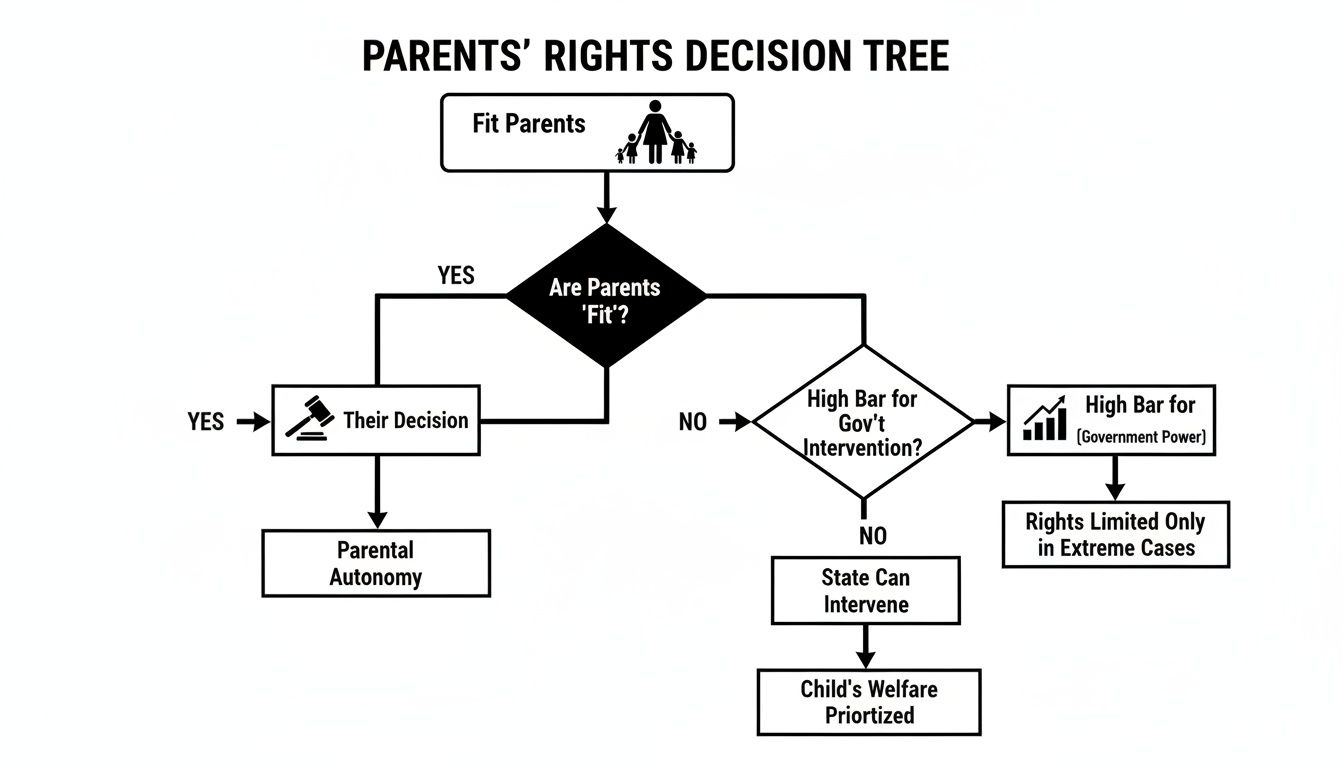
As you can see, the law presumes parents act in their child's best interest. The burden is on you, the grandparent, to provide a powerful reason why a judge needs to step in.
Key Steps in the Filing Process for Cumming and Alpharetta
Once your attorney has identified the proper way to proceed, the process involves several non-negotiable steps. Precision is key. Here’s what that typically looks like:
- Drafting and Filing the Petition: Your lawyer will draft a formal petition (or a motion to intervene) that outlines the legal reasons and factual background for your request. This gets filed with the Clerk of Superior Court in the correct county.
- Service of Process: After filing, the child's parents must be officially notified of the lawsuit. This is called service of process, and if it isn’t done exactly by the book, it can cause major delays or even get your case thrown out.
- Discovery and Evidence Gathering: This is where you build your case. Your legal team will gather the proof needed to show that your grandchild will suffer harm without having you in their life. This might include emails, photos, text messages, or witness testimony from people in your community, from Roswell to Suwanee.
- Temporary Hearings: In many situations, the court will hold a temporary hearing to set a short-term visitation schedule while the full case moves forward. The outcome of a temporary hearing in Forsyth or Fulton County can shape the outcome of your case.
This is not a do-it-yourself project. The procedural rules in North Fulton courts are complex and unforgiving. A simple error in filing or serving papers can sink your case before you have a chance to make your argument.
What to Expect in Forsyth and Fulton County Courts

When you petition for grandparent visitation in Georgia, your love for your grandchild is the starting point, not the whole story. A successful case in a Forsyth County or Fulton County court must be built on a strong foundation of compelling, admissible evidence that meets the state’s high legal standard.
Simply wanting to be in your grandchild’s life, unfortunately, isn’t enough. Your primary job is to prove to a judge that cutting off your relationship will cause real and demonstrable harm to the child’s well-being.
Defining Harm for the Court in Cumming and Alpharetta
In a Georgia courtroom, "harm" is a specific legal concept. It goes far beyond a child simply being sad or missing you. While those feelings are completely valid, the court needs more. You must show that the child had such a consistent and meaningful relationship with you that they would suffer genuine emotional, psychological, or even physical harm if that bond were suddenly broken.
This is the central challenge of your case. Your attorney will help you build a clear narrative, backed by proof, showing the crucial role you played in the child's life. A judge in Cumming, Alpharetta, or Sandy Springs needs a solid legal reason to step in, and proving harm is what provides it.
A grandparent’s case must shift the focus from their own pain to the child’s potential suffering. The court needs to see clear evidence that the parent’s decision to deny visitation is actively detrimental to the child’s best interests.
Gathering Persuasive Evidence for North Fulton Courts
The evidence you bring to court must paint a detailed picture for the judge. In North Fulton courts, from Roswell to Johns Creek, judges are persuaded by concrete facts, not just emotional appeals. Here are some examples of the types of evidence that can build a strong case:
- Communication Records: A history of text messages, emails, and social media conversations showing a consistent, loving, and active relationship with your grandchild.
- Photographs and Videos: Visual proof that you were there for holidays, birthdays, school events, and ordinary day-to-day life in places like Canton or Dawsonville. These images are powerful tools for showing the depth of your bond.
- Financial Support Documentation: Any receipts, bank statements, or records showing you helped pay for the child's needs, like school supplies, clothing, medical co-pays, or extracurriculars.
- Witness Testimony: Statements from neutral third parties who can speak to your important role in the child’s life. Think of a teacher, a neighbor in Milton, a coach, or a family friend who saw your relationship firsthand.
You can learn more about how to get ready for these crucial legal moments by reading our guide on how to prepare for a custody hearing. Ultimately, your goal is to show a judge in Forsyth County or Fulton County that you were an essential part of the child’s stability and support system.
When to Seek Custody Instead of Visitation in Georgia
There are heartbreaking situations where a grandchild’s well-being requires more than just scheduled visits. Sometimes, the circumstances demand a fundamental change in who is legally responsible for their care. This is the crucial difference between asking a court for visitation and petitioning for full legal and physical custody.
Seeking custody is a far more significant legal undertaking. It involves asking a judge in the Forsyth County or Fulton County Superior Court to take the profound step of removing a child from their parent's care and placing them with you. In Georgia, this is a decision the courts do not make lightly.
The Serious Grounds for Seeking Custody in Cumming, GA
A judge will only consider awarding custody to a grandparent if there is clear and convincing evidence that both parents are unfit or have forfeited their parental rights. This represents a very high legal bar to clear.
This legal action is reserved for only the most serious and unfortunate circumstances, including:
- Parental Substance Abuse: A parent's addiction to drugs or alcohol makes it impossible for them to provide a safe and stable home.
- Severe Neglect or Abuse: There is proof that a child's fundamental needs for food, shelter, medical care, or safety are not being met.
- Parental Incarceration: One or both parents are in prison and are physically unable to care for the child.
- Abandonment: The parents have voluntarily given up their parental duties and have no contact or involvement in the child's life.
These are not cases where you simply disagree with parenting choices. They are scenarios where a child’s health and safety are in immediate danger. The role of grandparents as primary caregivers is a growing reality. A 2026 U.S. Census Bureau report noted that approximately 2.1 million grandparents are the main caregivers for their grandchildren, often due to these very issues. For these grandparents in Cumming, Alpharetta, and throughout North Georgia, custody laws are an essential safety net. Learn more in our guide on the rising trend of grandparents as guardians.
Seeking custody is a profound responsibility. It means you are prepared to become the child's legal parent in nearly every sense. Do not agree to any terms without speaking to an attorney. If you believe your grandchild is in a dangerous situation, do not wait.
Why Choose Miles Hansford for Your Grandparents Rights Case in Cumming, GA
Knowing the answer to "do grandparents have rights" is one thing. Actually building a successful case in a Cumming or Alpharetta courtroom is another mission entirely. When you're facing the possibility of losing contact with a grandchild, the law firm you choose is the single most important decision you can make. At Miles Hansford, we are strategists and advocates who practice every day in the very courtrooms where your case will be heard.
Experience in Forsyth and Fulton County Courts
Our attorneys have argued countless family law cases in the Forsyth County Superior Court and the Fulton County Superior Court. This local focus isn't a minor detail—it's a real advantage. We are deeply familiar with the unique procedures, filing rules, and even the judicial philosophies of the judges overseeing cases in Cumming, Alpharetta, and throughout North Georgia. We know how local judges tend to interpret the high legal standards for grandparent visitation, and that helps us build a stronger case for you.
At Miles Hansford, we understand the immense emotional weight you are carrying. Our role is to provide more than just legal advice; we offer calm, strategic counsel when you feel overwhelmed and unsure of what to do next.
Our Approach: Empathetic Counsel, Protective Strategy
A grandparents' rights case is profoundly personal. We approach these situations with the empathy they require, but also with the clear-headed strategy needed to succeed. Emotion alone won't win your case. It takes a carefully built argument backed by solid, compelling evidence.
We will work directly with you to:
- Pinpoint and collect the strongest evidence showing the significant role you play in your grandchild’s life.
- Create a persuasive narrative that clearly demonstrates how breaking your bond would cause harm to the child, which is the high standard Georgia law demands.
- Handle every legal step with precision, from filing the initial petition with the Forsyth or Fulton County court to representing you in hearings and mediation.
You do not have to stand alone before a judge in Johns Creek, Roswell, or Milton. We are right there beside our clients, fighting for the grandchild's best interests. Your next move should be to get a clear, honest assessment of your legal options. Schedule a confidential consultation with a Miles Hansford family law attorney today to protect your parental rights and your family.
FAQ: Grandparents' Rights in Cumming and Alpharetta, GA
Q: Can I get visitation rights in Cumming, GA, if my child (the parent) has passed away?
A: Yes. Georgia law specifically allows a grandparent to file for visitation rights after the death of their child. Your petition would be filed with the Forsyth County Superior Court. While the surviving parent’s wishes are considered, the judge’s decision will ultimately be based on your grandchild's best interests and whether maintaining your relationship benefits the child.
Q: What if my own child objects to me seeing my grandchildren in Alpharetta, GA?
A: This is a much more difficult legal battle. To get a court in Fulton County to grant visitation over a fit parent’s objection, you must prove that denying your visitation would cause actual harm to the child. This is a very high legal standard that requires clear and compelling evidence, not just an opinion that you are a good influence.
Q: How long does a grandparents' rights case take in Forsyth County?
A: The timeline varies widely. In Forsyth County, if all parties can reach an agreement through mediation, the process can resolve in a few months. However, if the case is contested and requires multiple court hearings, it could take a year or longer depending on the court’s schedule and the complexity of the conflict.
Q: Can I sue for custody near me if I believe the parents are unfit?
A: Yes, but this is an extremely serious legal action with a very high standard of proof in Georgia. To seek custody, you must prove with “clear and convincing evidence” that both parents are unfit due to situations like severe neglect, ongoing substance abuse, or abandonment. These high-stakes cases require immediate legal guidance from an experienced family law attorney.
Q: Do I need a lawyer for a grandparents' rights case in Cumming, GA?
A: While not legally required, it is highly recommended. The legal standards for proving harm are very high, and the procedural rules in Forsyth and Fulton County courts are complex. An experienced family law attorney near you can help gather evidence, build a strategic case, and navigate the local court system, significantly increasing your chances of success.
The legal road for grandparents is challenging, but not impossible. At Miles Hansford Law Firm, our attorneys combine strategic legal knowledge with a deep understanding of the local Forsyth and Fulton County courts to protect what matters most—your family. Don't face this fight alone. Schedule a consultation today to understand your rights and build a plan. https://mileshansford.com