


Meta Title: DUI on a Horse in Cumming, GA
Meta Description: Can you get a DUI on a horse in Cumming, GA? Learn how Georgia law applies in Forsyth and Fulton County and what defense options may exist.
Suggested URL Slug: /dui-on-a-horse-cumming-ga
Schema Recommendations: Attorney, LegalService, FAQPage
Internal Link Suggestions:
- /how-field-sobriety-tests-determine-drunk-driving/
- /may-i-refuse-to-provide-a-breath-or-blood-sample-in-georgia/
- /can-you-get-a-dui-on-a-bike/
TL;DR: Yes, you can be charged with a dui on a horse in Georgia. Georgia's DUI law applies to any moving vehicle under O.C.G.A. § 40-6-391, and prosecutors may argue that a horse on a public road falls within that language, with the same 0.08% BAC threshold used in standard DUI cases and potential penalties that can include fines and jail.
A lot of people in Cumming, GA assume riding a horse after drinking is legally different from driving a car after drinking. In North Georgia, that assumption can create real trouble fast, especially if the ride happens on a public road near Alpharetta, Milton, Dawsonville, Johns Creek, or other communities where riders sometimes move between private property and traffic areas.
This issue sounds unusual until someone is standing on the roadside in Forsyth County or Fulton County, facing questions from an officer and trying to figure out whether the state can really file a DUI charge. It can.
The important point is that unusual doesn't mean unserious. Georgia prosecutors don't need a common fact pattern to bring a criminal charge. They need a statute they believe fits the conduct, and Georgia's wording is broad enough to create risk in the right circumstances.
Can You Really Get a DUI on a Horse in Cumming, GA?
A rider leaves a barn outside Cumming, cuts onto a roadway, and gets stopped before making it back to private land. That's the kind of situation that turns a weekend mistake into a criminal case.
The short answer is yes. A dui on a horse is possible, and it becomes more likely when the riding happens on a public road, near traffic, or in a way that draws police attention.
Why people get this wrong
Many assume that DUI law only applies to engines, tags, and driver's licenses. That's not always how states write these laws.
In some jurisdictions, the question isn't whether the horse has a motor. The question is whether the rider is using something the law treats as a vehicle for public safety purposes.
A useful plain-English overview from A-1 Driving School on DUI on horseback helps explain why this issue comes up more often than people expect.
The national picture is real
This isn't just a hypothetical lawyers bring up to scare people. It has happened in actual arrests.
On November 2, 2017, Donna Byrne was arrested in Lakeland, Florida after riding her horse on a busy road with BAC levels of 0.157% and 0.161%, and states that pursue these cases often apply the same 0.08% BAC standard used for motor vehicles, as described by DUI Central's report on riding under the influence on a horse.
Practical rule: If you're on a public road in North Georgia and alcohol is involved, don't assume the fact that you're on horseback keeps you outside DUI law.
What matters in North Georgia
In Cumming, Alpharetta, Milton, and nearby parts of Forsyth County and North Fulton, context matters. Officers tend to focus on visible danger.
That usually means things like these:
- Roadway use: Riding on a public street creates a stronger case for police involvement than staying on private land.
- Traffic risk: A horse near active traffic can trigger concerns about public safety even if no crash happens.
- Observed impairment: Slurred speech, poor balance, confusion, or trouble controlling the animal can drive the arrest decision.
- Related conduct: If the horse appears endangered or the rider is causing a scene, officers may consider additional charges.
A horse doesn't erase legal exposure. It changes the argument. That's why Georgia-specific analysis matters more than generic internet answers.
Georgia Law Explained The 'Moving Vehicle' Rule in Forsyth County
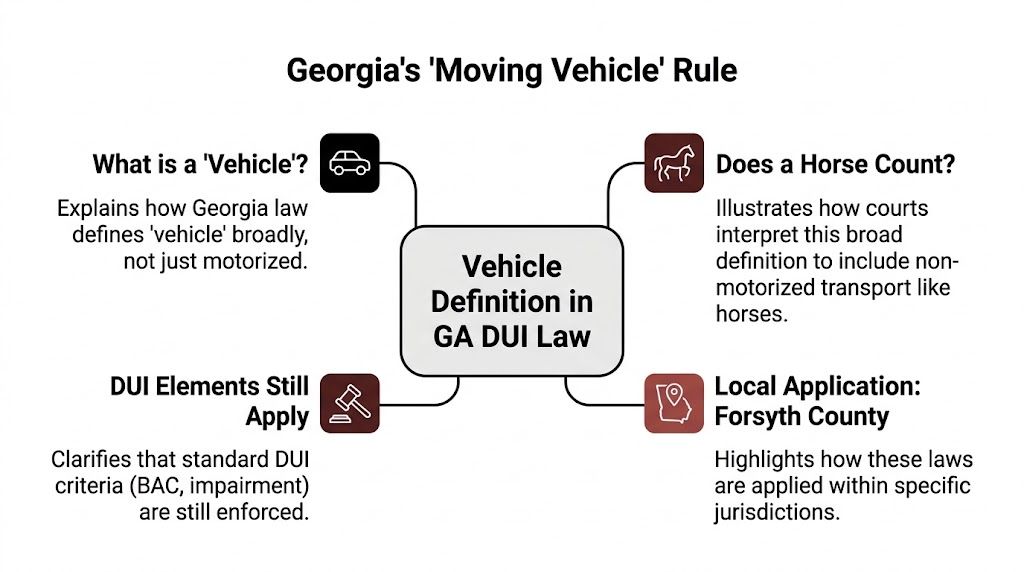
The legal issue in Georgia comes down to one phrase. Any moving vehicle.
Georgia's DUI statute, O.C.G.A. § 40-6-391, prohibits operating any moving vehicle while impaired or with a BAC of 0.08% or higher, and lawyers analyzing Georgia practice note that this broad wording has been applied in cases involving horse-drawn buggies, which is why a saddled horse on a public road in Forsyth County or Fulton County can create exposure under the statute, as discussed in this overview of whether you can get arrested in Georgia for a DUI on a horse.
What prosecutors may argue in Forsyth County
A prosecutor doesn't need a horse-specific Georgia statute if they believe the existing statute is broad enough. In a case filed in or around Forsyth County Superior Court or another local court handling the charge, the state may argue:
- The horse was being operated on a public road
- The rider had actual control over movement and direction
- The conduct created the same kind of public danger DUI law is meant to prevent
- The statute's wording is broad on purpose
That argument gets stronger if the stop happened on a visible roadway in Cumming, near GA 400, or on a route connecting rural property to more active traffic zones.
Why this issue is still gray
Georgia law is broad, but broad language doesn't answer every question. It leaves room for interpretation.
That matters because a horse isn't a car, truck, or motorcycle. A defense lawyer can attack the fit between the facts and the statute instead of accepting the state's framing.
Here's the practical split:
| Issue | State's position | Defense position |
|---|---|---|
| Meaning of vehicle | Broad enough to include a horse in motion on a road | Statute wasn't clearly written for horseback riding |
| Public safety concern | Road use creates danger similar to traffic offenses | Facts may show limited risk or private-land conduct |
| Control | Rider directed movement | Rider may not have had legal "operation" in the way DUI law requires |
Forsyth County cases often turn less on novelty and more on how convincingly the state can frame the conduct as a public-road safety problem.
How this plays out near Alpharetta and North Fulton
In Alpharetta, Roswell, Sandy Springs, and other parts of North Fulton, roadway context matters even more because traffic density changes how police and prosecutors view risk. A horse on a quiet private trail raises one set of issues. A horse on a road used by commuters raises another.
That doesn't mean every arrest holds up. It means officers in Fulton County may feel justified making the arrest first and leaving the legal fight for later.
For anyone searching for a DUI lawyer near me after an odd arrest involving a horse, the key question isn't whether the charge sounds ridiculous. The essential question is whether the state can prove its theory under Georgia law.
Potential Penalties for a Horse DUI in Alpharetta and North Georgia
The penalty question is where people often get blindsided. They hear "horse" and assume "minor ticket."
That isn't a safe assumption in Alpharetta, Cumming, Johns Creek, Suwanee, Canton, or elsewhere in North Georgia if the charge is filed as a DUI under Georgia law.
What a person may face
If the state treats the case as a DUI, the penalties can track standard DUI consequences in serious ways even though the underlying conduct involved a non-motorized animal.
That can include:
- Fines
- Jail exposure
- Probation
- Alcohol-related conditions
- A criminal record if convicted
National comparisons show how traditional car DUI penalties are usually heavier. First-offense car DUIs commonly involve fines from $500 to $2,000+, license suspensions of six months to one year, and potential jail time up to six months in many jurisdictions, while horse DUI cases more often result in lighter treatment because horses don't require registration and enforcement is less straightforward. That contrast is described in the earlier cited national analysis.
The key trade-off
A horse DUI may not carry the same driver's license consequences you'd expect in a standard car case. But that doesn't make it harmless.
The risks are often these:
- Criminal exposure: A conviction can still follow you even if a license suspension doesn't.
- Negotiation advantage: The charge itself gives the prosecution bargaining power.
- Collateral issues: Employment, professional reputation, and court costs can matter more than people expect.
- Local court pressure: Judges in busy North Georgia courts may focus on roadway safety, not novelty.
What local courts care about
A judge looking at a case from Forsyth County, North Fulton courts, or a nearby municipal court is likely to focus on facts like location, traffic danger, the rider's condition, and whether the animal was under control.
A strange fact pattern doesn't make a charge weaker by itself. Sometimes it makes prosecutors more determined to show that public safety rules still apply.
If the arrest involved a public road in Alpharetta or a visible area near Milton or Roswell, expect the state to frame the case around danger, not around whether horseback riding is common.
Building a Strong Defense Against a Cumming Horse DUI Charge
A horse DUI case is defensible because Georgia law leaves room to fight. That room matters most when the defense starts early and treats the case as a statutory interpretation problem, an evidence problem, and a credibility problem all at once.

The strongest defense angle in Georgia
One of the most important defense arguments is straightforward. Georgia does not have specific case law clearly defining a horse as a vehicle under O.C.G.A. § 40-6-391, and that ambiguity can support arguments for dismissal, reduction, or a negotiated outcome when public danger was limited, as explained in this discussion of whether you can get a DUI while on a horse.
That doesn't automatically defeat the case. But it gives the defense a serious place to start.
What usually works better than general denial
In unusual DUI cases, broad statements like "this law is stupid" or "it was only a horse" usually don't help. Specific legal pressure does.
A focused defense may examine questions like these:
Was the riding on public land or private land?
If the event happened off-road or on private property, the state's theory may become harder to sell.Was the client operating the horse in a way the statute contemplates?
That issue can matter when control was unclear, movement was limited, or the facts don't fit standard DUI logic.What did the officer really observe?
Officers often describe balance, confusion, odor, and coordination. Those observations can be challenged, especially in an outdoor setting involving an animal.Were sobriety methods reliable in the setting used?
Field evaluations designed around car stops don't always translate neatly to horseback situations. For a broader look at how officers use these evaluations, see how field sobriety tests determine drunk driving.
What doesn't work
Some defenses sound appealing but rarely carry the day on their own.
| Weak approach | Why it usually falls short |
|---|---|
| "I wasn't driving a car" | The statute may still cover non-motorized movement |
| "The horse knew the way home" | Legal control focuses on the rider's condition and conduct |
| "Nobody got hurt" | DUI charges don't require an accident |
| "It was just a short ride" | A short ride on a public road can still support arrest |
Good defense strategy narrows the case to proof problems. It doesn't rely on the court laughing at the facts.
The local advantage in Cumming and nearby courts
In Cumming, Dawsonville, Milton, and neighboring parts of North Georgia, local knowledge matters. The defense should know how a given judge reacts to statutory ambiguity, how a local prosecutor evaluates reductions, and which facts are likely to move the case toward a DUI disposition versus a lesser offense.
That is often where outcomes change. Not in a dramatic courtroom speech, but in how the defense frames the statute, the roadway facts, and the proof of actual impairment.
Practical Steps After a DUI Arrest in Fulton County
The first hours after an arrest matter. People talk too much, try to explain, or assume they can clear everything up with one statement.
Usually, they make the case harder.
What to do right away
If you were arrested in Fulton County, Forsyth County, Johns Creek, Roswell, or nearby North Georgia, keep your response simple.
Stay calm and stop explaining.
You don't need to convince the officer that riding a horse is different. That argument belongs in court, not in the back-and-forth after arrest.Use your right to remain silent.
Be polite. Be clear. Don't answer investigative questions without counsel.Write down what happened as soon as you can.
Include location, whether you were on a public road or private property, what the officer said, whether tests were requested, and who witnessed the stop.Preserve anything that helps show context.
Trail location, property boundaries, event details, and witness names can matter in a horse DUI case more than people realize.
What not to do
A lot of damage happens after release, not during the stop.
- Don't post about it online
- Don't call friends to compare stories in a way that can later be used against you
- Don't assume refusing or agreeing to testing has no consequences
- Don't miss your first court date
If you're trying to understand the testing side of a Georgia DUI investigation, this page on whether you may refuse to provide a breath or blood sample in Georgia is a useful starting point.
Why speed matters
An unusual case still moves through ordinary courts. That means deadlines, charging decisions, prosecutor review, and court appearances can come quickly in Fulton County and surrounding courts.
Early legal review can identify whether the facts support a true DUI theory, a reduction argument, or a challenge based on where the riding actually occurred.
If you're searching for a DUI lawyer near me after an arrest involving a horse, don't wait for the state to define the facts for you.
Why Choose Miles Hansford for Your DUI Defense Near Alpharetta
A horse DUI case needs more than general criminal defense language. It needs lawyers who can handle a strange set of facts without treating it casually.
Miles Hansford Law Firm serves Alpharetta, Cumming, Forsyth County, Fulton County, and the wider North Atlanta area. The firm handles criminal defense matters in the same local court systems where these cases would be prosecuted, including municipal, state, superior, and federal courts when needed.
Local knowledge matters
A local defense strategy isn't just about distance from the courthouse. It's about knowing how North Georgia courts process unusual cases.
That includes understanding:
- How prosecutors in Forsyth and Fulton counties tend to frame public-safety facts
- Which arguments are better made early in negotiation and which belong in motion practice
- How judges may respond to statutory ambiguity
- Why an unconventional DUI case still requires disciplined preparation
Former prosecutor insight matters too
The firm's team includes attorneys with former prosecutor experience. That's useful in a case like this because the state will often try to simplify unusual facts into a straightforward safety narrative.
A strong defense has to do the opposite. It has to separate assumption from proof, pressure the legal fit between the conduct and the statute, and identify where a reduction or dismissal argument has real traction.
For people searching near me in North Georgia
If you were stopped in Alpharetta, Cumming, Milton, Roswell, Sandy Springs, Johns Creek, Suwanee, or Canton, local representation can make the process more manageable and the defense more precise.
This kind of case doesn't need panic. It needs a strategic response built around the road location, the officer's observations, the charging language, and the weaknesses in the state's theory.
Frequently Asked Questions About Unusual DUIs in Georgia
Q: Can I get a DUI on a horse in Cumming if I was riding on a public road?
A: Yes, potentially. In Georgia, prosecutors may rely on the "any moving vehicle" language in O.C.G.A. § 40-6-391 if the riding happened on a public road in Cumming or elsewhere in Forsyth County.
Q: Is a horse automatically considered a vehicle under Georgia law?
A: No. That's one of the main legal disputes. Georgia's statute is broad, but there isn't specific Georgia case law clearly defining a horse as a vehicle for DUI purposes, which creates room for defense arguments.
Q: Does private property make a difference in Alpharetta or Fulton County?
A: It can. A case involving private land, a trail, or non-roadway riding may present a different defense posture than a stop on a public street in Alpharetta or another part of Fulton County.
Q: Will a horse DUI suspend my Georgia driver's license?
A: Not typically in the same way as a motor-vehicle DUI. In states where horse DUI is treated as a vehicle offense, it does not typically trigger a driver's license suspension through the National Driver Register because it is a non-motorized offense, as explained in this article about what states can you get a DUI on a horse.
Q: Could I face charges other than DUI?
A: Yes. Depending on the facts, police or prosecutors may consider other charges tied to public safety or conduct involving the animal. That often becomes part of plea negotiations or defense strategy.
Q: What if I was visiting Georgia from another state?
A: The facts still matter, especially where the riding happened and how the charge is classified. If you want another example of how Georgia treats unusual non-car DUI situations, see can you get a DUI on a bike.
Q: Should I treat this like a real criminal case even if it sounds minor?
A: Yes. Courts won't dismiss the issue just because the facts sound unusual. If the state files a criminal charge in Forsyth County or Fulton County, you need a defense plan right away.
If you're facing a dui on a horse charge in Cumming, Alpharetta, Forsyth County, Fulton County, or nearby North Georgia, speak with Miles Hansford Law Firm. The firm handles complex DUI and criminal defense matters with a strategic, local approach. Schedule a consultation today and get clear guidance before you make the next move.