


An emergency custody order is a fast-acting court directive, but it's reserved for truly dire situations. A Georgia judge will only grant one when a child faces immediate danger or the very real risk of being taken out of the state.
Unlike standard custody hearings, these orders can be issued without the other parent even knowing about it beforehand. It’s a powerful tool meant to provide an immediate shield for a child in a genuine crisis.
When Is an Emergency Custody Order Actually Necessary?

The first thing any parent in North Georgia needs to grasp is the incredibly high legal bar for getting an emergency order. Courts in places like Forsyth and Fulton County do not grant these orders lightly. They are reserved for situations where a child is at risk of imminent and irreparable harm.
This isn't a shortcut to resolve a frustrating co-parenting argument or to get a leg up in a standard custody case. You have to prove a genuine crisis is unfolding that simply cannot wait for the normal court process. The entire point is for a judge to step in before a child suffers serious physical or emotional trauma.
What Counts as an Imminent Threat?
When reviewing an emergency petition, judges are looking for specific, severe circumstances. Vague complaints or disagreements about the other parent's lifestyle will not be enough. Your focus must be on tangible, provable dangers.
Here are some common scenarios that might justify an emergency order:
- Documented Substance Abuse: You need evidence showing a parent's drug or alcohol use directly puts the child in harm's way, such as driving under the influence with the child in the car or leaving drugs and paraphernalia where a child can find them.
- Exposure to Violence: This applies to situations where the child has witnessed or been a victim of domestic abuse. These cases often involve protective orders.
- Credible Threats of Abduction: There must be clear signs that the other parent intends to flee with the child, especially across state or international lines, without your consent or court permission.
- Severe Neglect: This involves proof that a child's fundamental needs—food, shelter, supervision, or necessary medical care—are being dangerously ignored.
Is It an Emergency? Comparing Situations for Custody Orders
It can be tough to know if your situation meets the high standard for an emergency order or if it's better handled through a standard custody modification. This table breaks down some common scenarios to help you see the difference.
| Situation | Likely an Emergency Action | Likely a Standard Modification |
|---|---|---|
| Parent's New Partner | The new partner has a documented history of violence or child abuse and is now living in the home. | You simply do not like the new partner or disagree with their parenting style. |
| Substance Use | The parent was recently involved in a DUI with the child in the car, or you have photos of illegal drugs left on a coffee table. | You suspect the parent drinks too much on weekends when the child isn't present. |
| Relocation | The other parent suddenly quit their job, sold their furniture, and told the child they're "going on a permanent vacation" to another country. | The other parent mentioned they might want to move for a new job in six months and you disagree. |
| Living Conditions | The child is living in a home with no running water, electricity, or adequate food. | The other parent's home is messy, or you feel they let the child watch too much TV. |
Ultimately, a judge needs to see an immediate and severe risk. If the danger isn't happening right now, it will likely be addressed through the standard modification process.
Understanding Georgia’s Legal Threshold
In Georgia, an emergency order is a type of ex parte order, which means a superior court judge can grant temporary custody based on one parent's testimony alone. This is only done when there's compelling evidence of immediate danger.
Because these orders are granted without a full hearing, the system has a built-in protection. Georgia law requires the court to schedule a follow-up hearing very quickly, usually within 10 to 30 days. At that hearing, both parents have the chance to present their side of the story.
This process is designed as a swift, temporary safeguard. It stabilizes a dangerous situation while ensuring the other parent's due process rights are protected. While an emergency custody order is often crucial, sometimes other options, like figuring out how to get temporary guardianship without court, can be considered depending on the circumstances.
The core question a judge in Cumming, Alpharetta, or Roswell will ask is simple: "Does this child face a real, immediate threat of harm if I do not act right now?" Your petition must provide a clear and compelling "yes" to that question, backed by solid evidence.
Gathering Evidence to Prove Imminent Danger
An emergency petition is only as strong as the evidence you bring to the judge. Here in North Georgia, a judge in Fulton or Forsyth County needs to see a clear, undeniable picture of immediate danger to your child. This isn't about simply telling your side of the story; it's about proving it with credible, compelling facts.
Your job is to organize your proof into a straightforward narrative that shows the court why it must act right now. A judge has very little time to review these cases, so your evidence has to be powerful and easy to understand. Think of each piece of proof as a building block for your argument that your child's safety is at immediate risk.
Official Documents Carry Significant Weight
When you can present official records to the court, you’re providing objective, third-party validation for your claims. These documents often speak for themselves and can be the most persuasive evidence you have. Make it a priority to collect any of these that apply to your situation:
- Police Reports: If law enforcement was called to an incident in Johns Creek, Roswell, or anywhere else, get that official report. It’s crucial for documenting domestic violence, erratic behavior, or a parent’s substance-related incident.
- DFCS Findings: Any investigation or finding by the Georgia Division of Family & Children Services (DFCS) that substantiates claims of abuse or neglect is extremely powerful evidence.
- Relevant Court Records: A certified copy of the other parent's recent history involving violence, drugs, or anything that endangers a child can establish a clear pattern of dangerous behavior.
- Medical Records: If your child suffered physical harm or needed medical attention because of the other parent's actions or neglect, these records provide critical, unbiased documentation.
These aren't just your word against the other parent's. They are official records that a judge will take very seriously when deciding whether to grant an emergency custody order.
Digital and Personal Communications
So much of our lives happens online and through our phones, and that means a lot of evidence now exists in digital form. Text messages, emails, and even social media posts can give a judge a direct window into a parent's state of mind and intentions. Be sure to preserve any communication that shows a direct threat.
For example, a series of increasingly erratic text messages threatening to take the child and disappear is far more compelling than you just stating you’re afraid it might happen. It’s absolutely critical to save these communications exactly as they are, including the timestamps. Do not edit or crop your screenshots, because that can make them seem less credible. Print them out and organize them clearly for the court.
A judge needs to see the threat, not just hear about it. A single, time-stamped text message saying, "You will never see your child again," is often more persuasive than pages of your own testimony describing your fears.
The Power of Sworn Affidavits
Sometimes, the most compelling evidence comes from people who have witnessed the danger firsthand. A sworn affidavit is a formal, written statement made under oath. It's a way to bring another person's testimony to the judge without them having to be physically present at that first emergency hearing.
These statements must come from credible, unbiased people who can describe specific events they personally saw. A teacher in Marietta who noticed unexplained bruises, a neighbor in East Cobb who witnessed violent outbursts, or a family member in Cumming who saw a parent using illegal drugs around the child can all provide powerful support for your petition.
The key is that their statements must be based on facts they personally observed—not on their opinions or on things they heard from someone else. A well-written affidavit from a trusted person in the community can often be the final piece of evidence a judge needs to take immediate action.
How to File Your Petition in Fulton and Forsyth County
Walking into a courthouse during a crisis can feel completely overwhelming, but the actual process for filing an emergency custody order is more straightforward than you might think. Whether you're in Alpharetta or Cumming, the Superior Courts in Fulton and Forsyth Counties have a structured procedure designed to get your case in front of a judge immediately. The real key is having every piece of your paperwork in perfect order before you even step through the door.
You'll need a few critical documents. The most important one is your Petition for Emergency Custody. This is the formal document where you lay out your case, explain the immediate danger to your child, and officially ask the court to step in. It must be a verified petition, which simply means you sign it under oath, swearing that everything you've stated is true to the best of your knowledge.
You'll also need to draft a proposed Ex Parte Order. Think of this as the order you want the judge to sign. It clearly states the specific relief you're asking for, like giving you immediate temporary physical custody and ordering the other parent to have no contact until a full hearing can be held.
The Logistics of Filing Your Paperwork
With your documents prepared, the next move is to file them with the Clerk of Superior Court in the correct county. If your child lives in Roswell, you'll be filing in Fulton County. If your child's home is in the Cumming area, you'll go to the courthouse in Forsyth County.
Be ready to pay the required filing fees when you submit everything. If you cannot afford them, you can request a Pauper's Affidavit, which asks the court to waive the costs. Once filed, the clerk’s office assigns your case to a judge, and your petition is usually presented for review that very same day.
This flowchart breaks down the kind of foundational evidence you need to have in hand before you start the filing process.
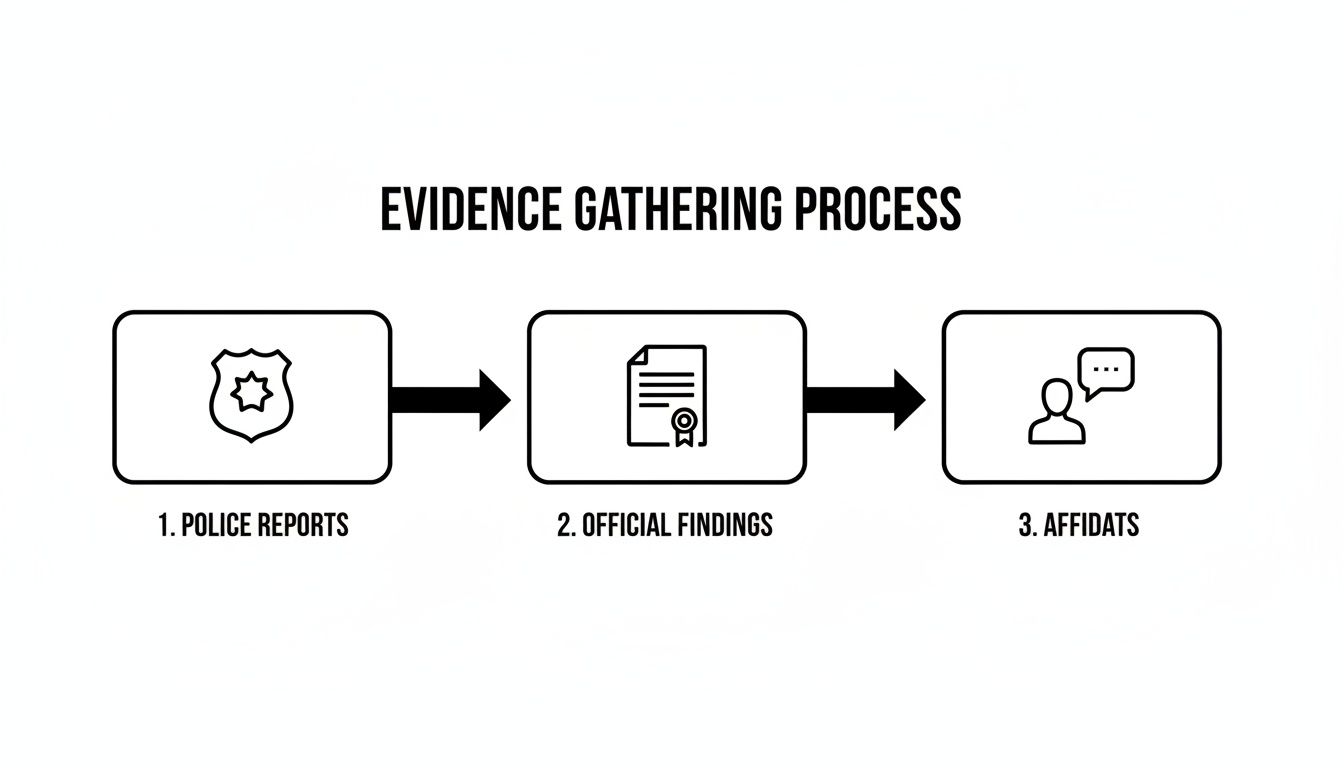
As you can see, the strongest petitions are built by combining official reports with sworn, personal testimony.
What Happens Immediately After Filing
Those first few moments after you file are crucial. The clerk takes your entire packet—petition, evidence, and proposed order—directly to the assigned judge's chambers. The judge will then review everything you've submitted, typically without you being present. This is the "ex parte" element; it's a decision based entirely on your side of the story.
The judge's initial decision hangs entirely on your written materials. Your petition needs to be so clear, organized, and compelling that it convinces the judge of the immediate danger without ever hearing you speak a word.
From there, the judge has a few options. They can sign your proposed order right away, granting the emergency relief you requested. They might deny the request if the evidence does not quite meet that high standard of imminent harm. Or, they could schedule a quick hearing, sometimes within a day or two, just to ask a few clarifying questions before ruling. The whole point is a swift review to decide if a child's safety is at risk right now.
What Happens at the Initial Ex Parte Hearing

The very first court appearance you’ll have for an emergency custody order is called an ex parte hearing. This is a Latin term that means "from one party," and it’s a critical difference from any other court date you might have experienced. The other parent won’t be there. They won’t even have been notified yet.
This hearing happens fast, usually right after you file your petition. It’s brief and incredibly focused. The judge isn't there to decide your entire custody case. Their job is to answer just one question: does your evidence prove a real risk of immediate and irreparable harm to your child?
You or your attorney will present your sworn petition and all the evidence you’ve gathered. This isn’t the time for long-winded stories or emotional pleas. It’s about methodically presenting the facts—guiding the judge through the police reports, the threatening text messages, or the sworn affidavits that prove the danger is real and happening now.
Presenting Your Case Clearly and Concisely
At this stage, the judge only has your side of the story, so how you present it matters immensely. Your argument needs to be organized, compelling, and straight to the point. The court has to quickly grasp the who, what, when, and where of the imminent threat.
Think of it like giving an emergency briefing. Your job is to connect the dots for the judge between the other parent's actions and the direct danger your child is in. A judge in Fulton or Forsyth County needs to see a clear, undeniable line from point A (the parent’s behavior) to point B (the potential harm).
An effective presentation usually involves:
- A Clear Timeline: Briefly walk the judge through the sequence of events that led to this emergency.
- Highlighting Key Evidence: Point directly to your most powerful pieces of proof, like a DFCS finding or a recent police report.
- Sticking to the Facts: This is crucial. Avoid guessing or sharing personal opinions. Focus only on what you can actually prove.
The judge is looking for a credible narrative of immediate risk. Your ability to present your evidence in a calm, factual, and organized manner can significantly impact the outcome of this crucial first step.
Managing Expectations for Possible Outcomes
The ex parte hearing can go one of three ways. It is important to be mentally prepared for any of these possibilities. Remember, the judge's decision is based strictly on the evidence you present and whether it meets the very high legal standard for an emergency order.
Here are the possible outcomes:
- The Order Is Granted: If the judge agrees you've shown sufficient evidence of immediate danger, they will sign a temporary ex parte order. This order gives you temporary emergency custody and sets a second court date, usually within 10 to 30 days, where both parents must appear.
- The Order Is Denied: The judge might feel that while the situation is serious, it doesn't legally meet the high bar of an imminent threat that requires an ex parte order. If this happens, your case isn't over. It simply moves forward as a standard custody modification, and a regular hearing will be scheduled down the road.
- An Expedited Hearing Is Scheduled: Sometimes, a judge wants to hear from both sides before making a call. In this scenario, they might deny the immediate ex parte request but schedule an expedited hearing within just a few days. This requires the other parent to be served and show up in court on very short notice.
Navigating this initial hearing requires careful preparation and a solid understanding of courtroom procedure. For a deeper look into what you should know before your Georgia child custody hearing, our firm has developed resources to guide you. Understanding what happens here is a vital part of protecting your child and getting ready for whatever comes next in your case.
Life After the Temporary Order Is Granted
That moment when the judge signs your emergency custody order is one of immense, immediate relief. It’s a validation. A judge has seen the danger your child is in and taken a swift, decisive step to keep them safe. While this is a huge victory, it's critical to understand that this isn't the end of the road. In many ways, it's just the beginning.
Think of this initial order as a temporary shield, not a permanent solution. The Georgia courts, especially in busy circuits like Fulton and Forsyth County, move very quickly to set a follow-up hearing. This is to ensure the other parent has their day in court—their legal right to be heard and to tell their side of the story. Your mindset must pivot from crisis management to building a rock-solid case for that next hearing.
The Crucial Step of Serving the Other Parent
Once the judge signs the order, it holds no legal power until the other parent has been properly served. Service of process is the formal, legal way of notifying the other parent that a lawsuit has started and giving them copies of everything you filed, including the judge's new order. This is not optional; it's a cornerstone of our legal system.
You absolutely cannot just hand the papers to the other parent yourself. In Georgia, service must be done by a sheriff's deputy or a certified private process server. This creates an official record proving the other parent received the order and knows about the upcoming court date. Getting this wrong can cause major delays and could even get your hard-won temporary order thrown out.
Strictly Following the Judge’s Directives
The temporary order will come with very specific, clear instructions. It will lay out exactly who has physical custody, what contact (if any) the other parent is allowed, and other rules you must live by. It is absolutely essential that you follow every single directive to the letter. No exceptions.
Do not try to read between the lines or make your own exceptions, even if you think you're being nice. If the order says "no contact," that means no phone calls, no text messages, no seeing the child. Period. If you violate the order, even with good intentions, you can destroy your credibility with the judge and put your entire case at risk. The court expects the parent who asked for its protection to be the one who respects its authority the most.
Remember, the temporary order is your child’s legal protection. By following it precisely, you are demonstrating to the court that you are a responsible, stable parent who can be trusted to uphold the law and prioritize your child’s well-being above all else.
Preparing for the Follow-Up Hearing
The next court date is usually where the real fight begins. The judge is going to hear from both sides. You must be ready to reinforce the evidence you already presented and show why the protections in the order need to stay in place.
This is no time to relax. You and your attorney should be using the time between now and that hearing to:
- Organize Your Evidence: Polish the presentation of the proof you have and gather any new evidence that has come to light since the emergency hearing.
- Prepare Your Testimony: Work closely with your lawyer to go over your story. You need to be able to tell it calmly, clearly, and factually when you're on the stand.
- Anticipate the Other Side: The other parent is almost certainly going to deny everything and present their own version of events. Your strategy must be ready to counter their arguments.
In some of the most frightening cases, an emergency order is needed because of a real threat of parental kidnapping. The risk is particularly high in international custody disputes. The U.S. State Department’s 2024 Annual Report on International Child Abduction highlighted that its Office of Children’s Issues was handling 721 active international parental abduction cases involving 982 children just last year. In these high-stakes situations, a judge might also issue travel restrictions or passport holds to stop a parent from fleeing the country with a child. You can read more about these international child abduction statistics to grasp just how serious these measures are.
This next phase is all about shifting from a reactive crisis footing to a proactive legal strategy, making sure you are fully prepared to fight for your child’s continued safety.
Why You Need an Experienced Family Law Attorney

Trying to handle a child custody emergency on your own is a mistake. The stakes are simply too high, the legal standard is incredibly strict, and the entire process moves at a breakneck pace that can leave anyone feeling overwhelmed.
An experienced North Georgia family law attorney isn't just a guide; they are your advocate, your strategist, and a steady hand when everything feels chaotic.
Their role goes far beyond filling out the right forms. A local attorney understands what a judge in Fulton or Forsyth County needs to see and hear to justify issuing an emergency order. This kind of local knowledge is priceless, as procedures and expectations can differ from one courthouse to the next.
Strategic Guidance and Advocacy
From the moment you walk into their office, a skilled attorney starts building a compelling, legally sound case. They know precisely how to gather admissible evidence, draft a persuasive petition, and frame the facts to clearly demonstrate the imminent danger your child faces.
When you're standing in front of a judge in a high-stress ex parte hearing, they speak for you with calm authority. This focused approach ensures every single action is deliberate and aimed at one thing: protecting your child.
When your child's safety is on the line, there is no substitute for having a skilled professional in your corner. An attorney ensures your case is presented correctly, your rights are protected, and you avoid critical mistakes that could jeopardize your child's future.
Often, the need for an emergency order arises within the context of a larger divorce or separation. It’s helpful to understand the different roles on a legal team; for example, paralegal services for divorce can provide critical support. Having a full team focused on your case is essential.
Our team is dedicated to providing comprehensive guidance on all aspects of Georgia family law, especially during urgent situations that require immediate court intervention.
Frequently Asked Questions About Emergency Custody Orders
When you're facing a crisis involving your child's safety, your mind is racing with questions. We understand. Here are some straightforward answers to the most common concerns we hear from parents in Alpharetta, Cumming, and across North Georgia.
How fast can I get an emergency custody order in Georgia?
In truly urgent situations, a judge can grant an emergency order the same day you file or within 24 to 48 hours. The speed depends on the court’s schedule and the severity of the immediate danger. This initial order is temporary, and the court is required to schedule a full hearing where both parents can be heard, typically within 30 days.
What happens if a judge denies my request for an emergency order?
If a judge denies your emergency petition, it does not mean your case is over. It means they did not find enough evidence of immediate and irreparable harm to take action without hearing from the other parent first. Your case will then proceed as a standard custody modification on a normal court timeline.
What is the difference between a difficult co-parent and a true emergency?
This is a critical distinction. Emergency orders are not tools for managing typical co-parenting frustrations, disagreements over bedtimes, or general uncooperative behavior. They are reserved exclusively for situations where a child is in immediate physical or psychological danger due to abuse, neglect, or serious parental misconduct. The legal standard is imminent harm, not parental frustration.
Do I have to tell the other parent before I file for emergency custody?
No, the initial filing is done ex parte, which means without advance notice to the other parent. This is a built-in protection to prevent them from potentially harming the child or fleeing with them once they know you're taking legal action. However, as soon as a judge grants the temporary order, the other parent must be legally served with all the court documents so they are aware of the situation and the upcoming hearing date.
When your child’s safety is on the line, you need clear-headed, experienced guidance, and you need it now. The attorneys at Miles Hansford Law Firm are ready to act swiftly to protect your family. Contact us to discuss your situation and understand your legal options. Learn more at https://mileshansford.com.