


When someone passes away, their will names a person or institution to see their final wishes through. This is the executor, and their role is crucial. Think of them as the project manager for the estate, tasked with steering everything through the legal system, settling all the financial loose ends, and making sure the right people get their inheritance.
Understanding The Executor's Core Mission
Being named the executor of a will in Georgia is a significant responsibility that often falls to a close family member or friend. For families in communities like Cumming, Alpharetta, and Johns Creek, it is often a final act of service for a loved one.
The job can feel overwhelming, but the mission itself is clear. Your main purpose is to honor the wishes of the person who passed away by managing their estate with integrity and care.
This mission boils down to three main goals:
- Secure the Assets: Your first task is to find and take control of everything the deceased owned. This means bank accounts, real estate, cars, investments, and personal belongings.
- Settle Final Debts: Next, you must notify creditors, pay any legitimate bills, and file the final income tax returns. This step clears the slate and ensures all financial and legal obligations are met before anything is distributed.
- Distribute to Beneficiaries: Once all debts and estate expenses are paid, your final job is to give the remaining assets to the people named in the will. You must follow the instructions in the will precisely.
The Weight of Fiduciary Duty
At the heart of an executor’s job is something called fiduciary duty. This is not a suggestion; it is a legal obligation to act only in the best interests of the estate and its beneficiaries.
What does that mean in practice? It means you cannot put your own interests first, you cannot play favorites among the beneficiaries, and you absolutely cannot be careless with the estate's assets. This duty demands complete transparency, meticulous record-keeping, and open communication with everyone involved.
An executor essentially steps into the shoes of the person who died, charged with closing one chapter of a family's financial life and opening the next. The role demands more than just good organizational skills; it requires a steady hand and an unwavering ethical compass.
To give you a clearer picture, here is a breakdown of what an executor’s journey looks like.
Executor's Primary Responsibilities at a Glance
This table provides a high-level overview of the key phases and tasks an executor will handle throughout the probate and estate administration process in Georgia.
| Phase | Key Tasks | Common Challenge |
|---|---|---|
| Initial Steps | Locate the will, file it with the probate court, and obtain Letters Testamentary. | Navigating the initial court filing procedures and deadlines in counties like Fulton or Forsyth. |
| Asset Management | Inventory all estate assets, secure property (like real estate), and open an estate bank account. | Finding and valuing all assets, especially digital ones or those without clear documentation. |
| Debt & Tax Settlement | Notify creditors, pay valid debts, and file the deceased's final income tax returns. | Determining which creditor claims are valid and handling potential disputes. |
| Distribution | Pay estate administration expenses and distribute remaining assets to beneficiaries per the will. | Managing beneficiary expectations and handling disagreements over the distribution plan. |
| Closing the Estate | File a final accounting with the probate court and formally close the estate. | Ensuring all paperwork is perfectly in order to receive a discharge from the court. |
Successfully managing these responsibilities requires careful attention to the legal procedures and deadlines set by Georgia's probate courts. It is a significant undertaking, but it becomes manageable when you approach it one step at a time.
Knowing who to pick for this critical role is a huge part of good estate planning. If you're creating your own will, it's worth thinking hard about this decision. You can learn more about what to consider when choosing the right executor for your will in our detailed guide.
Navigating the Georgia Probate and Appointment Process
Just because you have been named as the executor in a will does not mean you can start acting on it right away. That is a common misconception. Before you can legally touch a single asset or pay a single bill, you must be officially appointed by a Georgia probate court.
This court-supervised journey is called probate. It is the formal process of validating the will and giving you the legal green light to manage the estate's affairs.
It all begins when you file the original will along with a Petition to Probate Will in Solemn Form. This must be done in the probate court of the county where the person lived. So, for someone in Cumming, you would go to the Forsyth County Probate Court. For residents of Alpharetta or Roswell, it is the Fulton County Probate Court. This petition is your formal request asking the court to recognize the will as legitimate and to officially appoint you as the executor.
Obtaining Your Letters Testamentary
After you file, the court ensures all potential heirs and beneficiaries receive official notice. This is a critical step for transparency, giving everyone a fair chance to review the will or voice any concerns.
Assuming no one contests the will and all the paperwork is in order, the probate judge will issue an order officially admitting the will to probate. That is when the court grants you Letters Testamentary. This is not just a letter; it is the official court document that proves you are in charge. It's the key you will need to show banks, investment firms, and anyone else that you have the legal authority to handle the deceased's assets.
Think of Letters Testamentary as your official credentials. Without them, you are simply the person named in a document. With them, you are the court-recognized representative empowered to secure bank accounts, pay debts, and eventually distribute property.
Once you are officially appointed, your real work begins. The mission generally breaks down into three core phases.
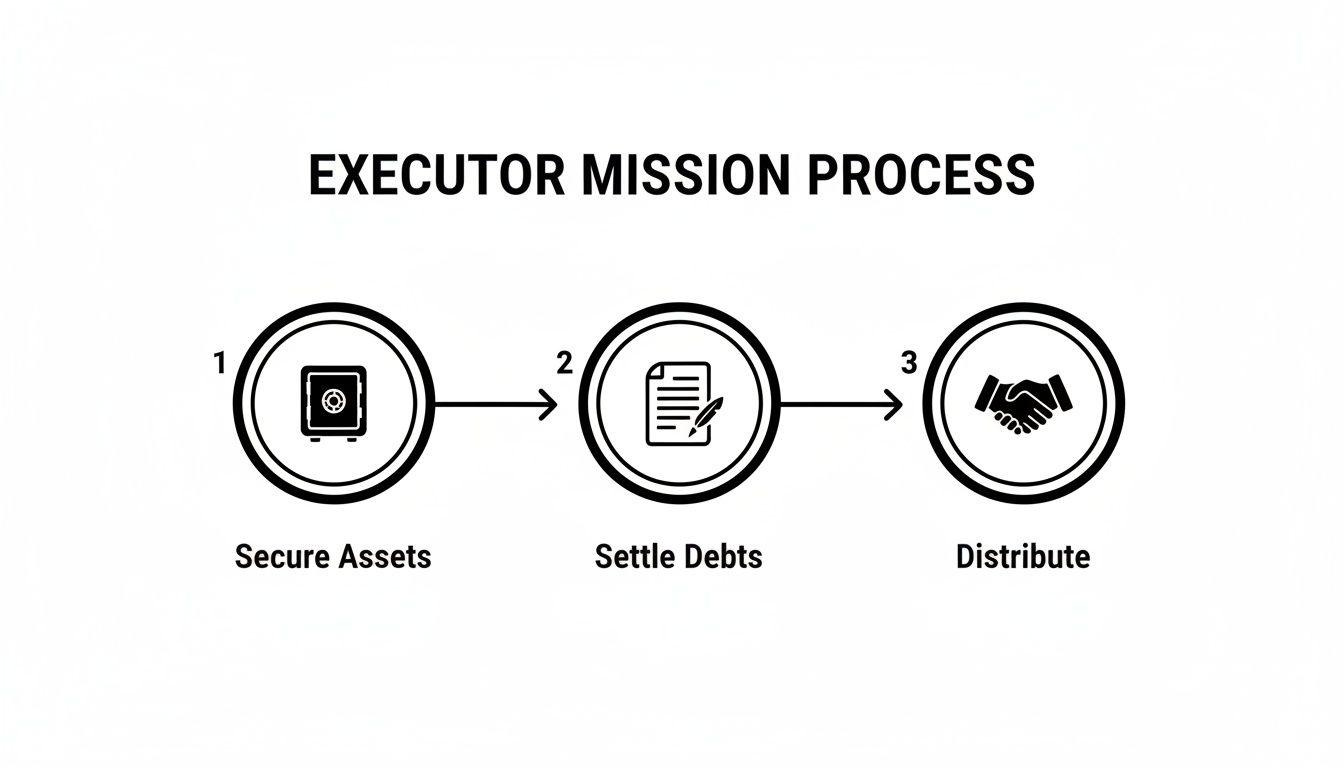
This roadmap shows you how the duties flow: first, you consolidate and protect everything the person owned. Then, you handle all their financial obligations. Finally, you carry out their wishes by distributing what is left.
Understanding the Timeline and Potential Hurdles
How long does this all take? In a best-case scenario, where the will is straightforward and nobody objects, you could have your Letters Testamentary in hand within a few weeks to a couple of months. But things do not always go that smoothly.
Several issues can slow everything down:
- Difficulty Locating Heirs: If an heir is hard to track down, serving them with the required legal notice can drag out the timeline.
- Challenges to the Will (Will Caveat): If a family member or beneficiary formally contests the will's validity, everything stops. The court must settle that dispute first, which can turn a simple probate into a long, drawn-out legal fight.
- Administrative Backlog: Probate courts in busy areas like Fulton and Forsyth County are often busy. Sometimes delays are simply due to the court's own packed schedule.
It is important to go into this process with patience and a sharp eye for detail. A simple mistake on the petition or a failure to notify an heir properly can cause major delays. You can dig deeper into the legal framework by reading about the Georgia probate and the personal representative in our other guide. Getting through this initial phase successfully is what lets you start the important work of honoring the deceased’s final wishes.
Your Step-by-Step Duties as a Georgia Executor

Once the Georgia probate court gives you the green light and issues your official Letters Testamentary, the real work begins. This is where the job shifts from court filings to hands-on management. Think of yourself as a project manager and financial steward for the estate, responsible for methodically gathering, protecting, and eventually distributing everything the deceased owned.
This is not a casual task; it demands careful organization and a commitment to your fiduciary duty. That is the legal and ethical requirement to always act in the best interests of the estate and its beneficiaries. Every move you make has to be transparent, well-documented, and perfectly aligned with the instructions left in the will.
Locating and Securing All Estate Assets
Your first major job is to find and take control of every asset the person owned. This process, known legally as "marshaling assets," can often feel like a mix of detective work and administrative tasks. It is frequently the most time-consuming part of being an executor.
You will need to dig through documents, statements, and records to build a complete picture of the estate.
- Financial Accounts: This means tracking down all bank accounts, investment portfolios, retirement plans (like 401(k)s and IRAs), and any life insurance policies.
- Real Estate: You are responsible for any property, whether it's the main home in Marietta, a vacation spot in Dahlonega, or a rental property. Your duties include securing the properties, keeping them maintained, and paying the mortgage and taxes.
- Personal Property: Tangible items like cars, jewelry, artwork, and furniture need to be inventoried. Some items may need a formal appraisal to determine their value.
- Business Interests: If the deceased owned a business in Forsyth County or Fulton County, you will need to determine its structure and take the right steps to manage or sell it based on the will's instructions.
Creating this initial inventory is essential. It gives you a clear understanding of the estate's total value, which you will need for tax purposes and the final distribution to heirs.
Managing Estate Finances and Notifying Parties
Once you have a handle on the assets, you need to set up proper financial controls. You cannot use the deceased’s old bank accounts. Instead, you are required to open a dedicated estate checking account. To do this, you will first need to get an Employer Identification Number (EIN) for the estate from the IRS.
All the estate's cash should be moved into this new account, and every bill, debt, and expense must be paid from it. This creates a clear financial trail, protecting you from any claims of mismanaging funds.
At the same time, you have a legal obligation to formally notify all interested parties. This includes:
- Beneficiaries and Heirs: Letting them know the will has been probated and that you are the appointed executor.
- Creditors: Publishing a "Notice to Debtors and Creditors" in the local paper. This starts a countdown, giving potential creditors a limited time to file a claim against the estate.
An executor's role is defined by trust and precision. Every financial transaction, from paying a utility bill to selling a stock, must be meticulously recorded. This diligence not only fulfills your legal duty but also provides a clear, defensible record for beneficiaries and the court.
Settling Debts and Filing Final Taxes
Before a single beneficiary receives anything, you must settle the estate's outstanding obligations. This means you will carefully review all creditor claims and pay the valid ones using money from the estate account. You also have to file the deceased’s final personal income tax returns (Form 1040) and, if the estate itself earns income while you are managing it, a separate income tax return for the estate (Form 1041). For larger estates, a federal estate tax return might also be necessary.
This is where good planning shows its value. In the U.S., courts handle over 1.2 million probate cases each year, and most are managed by family members, not professionals. A shocking 72% of Americans do not have a valid will, leaving it up to a court to appoint an administrator. This lack of planning often fuels conflict; one recent study found that 35% of American adults have been part of a family fight over an estate because there was no will.
After all debts, taxes, and administrative costs are paid, you can finally prepare for the last and most rewarding step. For a closer look at this entire process, check out our guide on the steps of estate administration.
Avoiding Common Pitfalls and Personal Liability
Taking on the role of an executor is an act of trust, but it is not a responsibility to take lightly. The job comes with serious legal risks. You are held to a high standard, and even honest mistakes can leave you financially responsible. Knowing the common tripwires is the best way to protect yourself and ensure you are doing right by the person who trusted you.
That pressure can feel immense, especially when you are navigating complicated family dynamics or high-value assets, like a family business in Canton or property in Dawsonville. One wrong move can spark disputes among beneficiaries, lead to court battles, and have real financial consequences for you personally.
Mismanaging Estate Funds
One of the biggest mistakes an executor can make is getting sloppy with the estate's money. The law is clear on this: you must keep the estate’s funds separate from your own.
- Commingling Funds: This is what happens when you deposit estate money into your personal bank account or use estate funds for your own expenses, even with the intention of paying it back. It is a serious breach of your duty and can lead to your removal and fines.
- Failing to Open an Estate Account: As soon as possible, all of the deceased’s cash needs to be gathered and deposited into a new bank account opened specifically for the estate. Every expense, debt payment, and distribution to the heirs must flow through this account. It creates a clean paper trail.
- Improper Investments: You have a duty to be a prudent steward of the estate's assets. Making risky investments with estate funds or failing to protect valuable property can make you personally liable for any losses.
Communication Breakdowns and Delays
Many problems start with poor communication. Beneficiaries have a legal right to be kept informed about the estate's progress. When you fail to do that, you create an environment of suspicion and resentment. An executor who suddenly goes quiet or ignores simple questions is inviting a legal challenge from frustrated family members.
Similarly, missing court deadlines can have big consequences. The probate courts in Fulton and Forsyth County run on strict schedules for filing an inventory of assets, notifying creditors, and closing the estate. If you miss those dates, you could face fines or be required to appear before a judge.
An executor’s best defense against personal liability is a relentless focus on transparency and detailed record-keeping. You should document every decision, every penny spent, and every conversation with a beneficiary as if you know it is going to be scrutinized by a judge one day.
Navigating Widespread Lack of Planning
Often, an executor walks into a situation made messy by a lack of estate planning. This multiplies the risk for everyone involved. Even when there is a will, it might be decades old and fail to account for the complex family situations that have occurred since it was written.
A 2023 survey revealed that 73% of people who believe having an estate plan is important do not actually have one. With nearly two-thirds of Americans not having a will, the odds of a dispute go up dramatically. This uncertainty is a major source of family fights, with another study finding that 35% of Americans have seen family disputes break out simply because there was no will or estate plan. You can learn more about the impact of these estate planning trends and see how they create challenges for executors.
These numbers paint a clear picture for any executor: you might be inheriting unresolved family baggage along with the assets. In an environment like that, getting professional legal advice is essential for protecting yourself. An experienced attorney can help you manage expectations, meet every legal deadline, and shield you from the personal liability that comes from these common but dangerous pitfalls.
Understanding Executor Compensation and Estate Expenses
Serving as an executor is a demanding job that requires a serious commitment of time and energy. Many people, especially family members who step into this role, do not realize they are entitled to get paid for their work under Georgia law. This is not a gift from the beneficiaries; it is a legitimate administrative expense of the estate.
Understanding how this payment structure works is critical for both the executor and the heirs. It creates transparency and sets clear financial expectations from the beginning.
How Executors Are Paid in Georgia
Georgia law has a standard framework for what an executor can be paid. Unless the will specifically lays out a different amount or method, an executor is typically entitled to a percentage of the estate's value.
The statutory commission is calculated like this:
- 2.5% on all money received by the estate.
- 2.5% on all money paid out from the estate.
This applies to funds from selling assets like stocks or real estate, as well as payments made to creditors, beneficiaries, and for administrative costs. If the estate is particularly complicated or the work becomes unusually time-consuming, an executor can also petition the probate court in Forsyth or Fulton County for additional, extraordinary compensation.
Distinguishing Compensation from Estate Expenses
It is important to draw a clear line between the executor's personal payment and the operating costs of settling the estate. Legitimate estate expenses are all the costs that arise while properly administering and closing the estate. The executor is responsible for paying these bills from the estate's bank account before any assets are distributed to the beneficiaries.
The role of an executor is becoming more technically demanding. The financial landscape has shifted, and estates often include complex assets like retirement accounts, business interests, and multiple properties that require careful management.
The economic backdrop is also changing. Retirees in the U.S. are projected to transfer over $124 trillion to their heirs by 2048, a wealth shift that will flow through millions of individual estates. You can read more about these evolving estate planning statistics and what they mean for executors.
Common and allowable estate expenses include:
- Legal and Attorney Fees: The cost for professional guidance to navigate the probate process.
- Court Filing and Administrative Fees: Required payments to the probate court.
- Appraisal and Valuation Costs: Fees to determine the value of real estate, businesses, or valuable personal items.
- Property Maintenance: Expenses for the upkeep, insurance, and taxes on real estate in areas like Canton or East Cobb.
- Final Tax Preparation Fees: The cost for filing the deceased's final income tax returns.
Keeping meticulous track of these expenses, along with the executor’s own compensation, is key to a smooth and defensible final accounting for both the court and the beneficiaries.
Knowing When to Partner with a Georgia Probate Attorney

While Georgia law does not force you to hire a lawyer to be an executor, trying to handle the probate process on your own can be a risky move. The role is a minefield of legal deadlines and responsibilities, and one wrong step can lead to personal liability. Working with a probate attorney is a smart decision to protect yourself and ensure the estate is handled correctly.
Think of an attorney as your professional guide. They make sure every form is filed properly with the Forsyth or Fulton County probate court, that every deadline is met, and every notice is sent out according to the law. This guidance can turn a confusing, high-stress situation into a clear, manageable process. For most people serving as executor, that peace of mind is invaluable.
Red Flags That Signal the Need for Legal Counsel
Some situations raise the stakes considerably, making an attorney not just helpful, but essential. If you run into any of these scenarios, getting legal advice right away is crucial to avoid expensive mistakes and protect yourself.
These are not just minor bumps in the road; they often involve high emotions and complex legal rules that are tough for anyone without a law degree to handle.
- A Contested Will: The moment an heir or beneficiary challenges the will's validity, you are in a legal fight. You will need an attorney to defend the estate's interests in court.
- Beneficiary Disputes: If beneficiaries are constantly arguing over property, timelines, or your decisions, things can get out of hand quickly. A lawyer can act as a neutral party to manage communication and ensure the will’s instructions are followed.
- Complex Assets: An estate with a family business in Cumming, commercial real estate in Alpharetta, or property in another state comes with unique administrative and tax challenges that demand professional expertise.
- Significant Debts or Insolvency: If you suspect the estate’s debts are greater than its assets, you must follow a very strict legal order for paying creditors. Messing this up could mean you are personally responsible for those unpaid bills.
A consultation with a probate attorney provides a clear roadmap. It helps you understand your specific duties, identify potential challenges early, and move forward with the confidence that you are fulfilling your role responsibly and legally.
At the end of the day, a good attorney is both your advocate and your shield. They take care of the complicated legal procedures so you can focus on what matters: carrying out the final wishes of the person who trusted you with this important responsibility.
Frequently Asked Questions About Being an Executor
If you have been named an executor for the first time, it is natural to have questions. Here are some of the most common concerns we hear from clients in Fulton County, Forsyth County, and across North Georgia.
Can I decline to be the executor of a will?
Yes, you can decline the role. To do so, you must formally renounce the position by filing a specific document with the appropriate Georgia probate court. Once you have officially stepped aside, the court will look for an alternate executor named in the will, or if there is none, it will appoint an administrator to handle the estate.
How long does probate usually take in Georgia?
The timeline for probate in Georgia can vary. A straightforward estate with a clear will and cooperative beneficiaries might be settled in about six to twelve months. However, if the estate is complex, the will is contested, or beneficiaries dispute the administration, the process can take much longer.
Do I need a lawyer to be an executor in Forsyth County?
While Georgia law does not require an executor to hire an attorney, it is highly recommended. The probate process involves strict legal procedures and deadlines that are easy to miss. An experienced probate attorney in Cumming or Alpharetta can help you avoid costly mistakes and protect you from personal liability.
Serving as an executor is a fiduciary role with significant personal risk. Professional legal counsel is not an expense of the executor, but a prudent expense of the estate, designed to protect both the executor and the beneficiaries from procedural mistakes and potential conflicts.
What happens if the executor doesn't follow the will?
An executor has a binding fiduciary duty to follow the will's instructions and act in the estate's best interest. If an executor fails to do this, beneficiaries can petition the probate court to compel compliance or have the executor removed. An executor can be held personally liable for any financial losses their actions cause to the estate.
Navigating the complexities of serving as an executor requires diligence, clarity, and often, professional legal guidance. At Miles Hansford, P.C., we provide the experienced counsel needed to manage estate administration efficiently, ensuring you meet your legal obligations while honoring your loved one’s final wishes.
To discuss your responsibilities and get clear, actionable advice, please contact us through our website at https://mileshansford.com.