


When people in Georgia talk about clearing a record, they are usually referring to a legal process called record restriction. This process limits public access to certain court files, providing a much-needed fresh start. While often associated with criminal cases, record restriction also applies to civil matters, giving individuals and businesses in North Georgia a way to seal old disputes and protect their privacy and reputation.
Giving Your Civil Record a Fresh Start
It is a common misunderstanding that only criminal cases leave a lasting, public mark. The reality is that a past civil dispute can follow you, impacting everything from business opportunities to your personal reputation in communities like Alpharetta, Roswell, or Cumming.

This guide clarifies how Georgia's record restriction process applies to non-criminal matters. We will walk through the specific kinds of civil case records in Fulton and Forsyth counties that may be eligible for sealing, bringing clarity to a complex but valuable legal tool.
Understanding Civil Record Sealing
The main goal of restricting a civil record is straightforward: remove it from public view. While law enforcement or certain government agencies might still have access, the general public will not. That includes potential employers, landlords, and business partners running a standard background check.
This does not happen automatically. It requires filing a formal petition with the court where you must show that your interest in privacy outweighs the public's general interest in having access to the record.
The legal standard for restricting a civil record is different and more nuanced than for criminal cases. It often involves balancing the right to privacy against the principle of open court records, a determination a judge makes based on the specific facts of your case.
Why Pursue Record Restriction?
Individuals and businesses across North Georgia seek to seal a civil record for several key reasons. When you successfully restrict a past civil litigation file, you can finally move forward with confidence, free from the shadow of a resolved dispute.
- Protecting Your Reputation: A publicly accessible lawsuit can create a negative impression, even if the case was resolved in your favor.
- Improving Business Opportunities: Partners, investors, and clients in areas like Johns Creek or Marietta often perform due diligence that includes checking for past litigation.
- Securing Personal Peace of Mind: Closing the book on a stressful legal chapter allows you to move on without worrying about old conflicts resurfacing.
Unfortunately, the path to a clean slate is often filled with procedural hurdles. Nationally, it has been found that fewer than 10% of eligible adults succeed in sealing their records, mainly due to confusing paperwork and a simple lack of awareness. You can read the full research about these second-chance policies and the challenges people encounter. Our goal is to demystify these legal pathways and help you effectively manage your public record.
Determining if Your Civil Case Qualifies for Sealing
Before you begin the process of sealing a civil record, the first step is to determine if your situation meets Georgia's legal standards. Not every case is eligible for record restriction, and knowing the criteria from the start can save you time and the frustration of a denied petition.
The most significant factor the court will consider is how your case ended. To be eligible, the case must have been resolved in your favor. The law is not designed to let someone found liable for damages hide that public judgment. Let's break down what a "favorable" outcome looks like in practice.
Outcomes That Usually Qualify for Restriction
In Georgia, several types of case resolutions can open the door to sealing a civil record. When a case ends in one of these ways, it signals to the court that the public's need to see the information is significantly lower.
-
Case Dismissals: If the lawsuit against you was dismissed, you have a strong foundation for a petition. This applies whether the other party voluntarily dropped it or the court dismissed it for procedural reasons. A contract dispute filed in a Fulton County court that was dismissed before trial is a prime candidate.
-
Judgments in Your Favor: This is straightforward. If your case went to trial and the judge or jury found you not liable, that is a clear win. The record from that case is very likely eligible for restriction.
-
Certain Settlements: This is where things can become more complex. If your settlement agreement leads to the case being dismissed "with prejudice" (meaning it cannot be refiled) and includes no admission of fault on your part, it can be seen as a favorable outcome.
Understanding these differences is key. For example, a property dispute in Alpharetta that is settled out of court and results in a formal dismissal is viewed very differently than a case where a judgment was entered against you as part of the settlement.
It's a common myth that any case that settles can be sealed. What truly matters are the specific terms of the settlement and the final court order. A judge will scrutinize these documents to make sure the outcome was genuinely favorable to you.
What Generally Does Not Qualify
It is just as important to know what will not qualify. We often see people waste time and money pursuing a petition for a case that was never going to be eligible.
As a general rule, you cannot restrict a civil record if a judgment was entered against you. This includes any situation where you were ordered to pay damages or comply with a specific court order. For instance, if a business owner in Johns Creek was found to have breached a contract and was ordered to pay the other party, that record will almost certainly remain public. The legal system is built on transparency, especially when liability has been officially established.
Confidently figuring out whether your case qualifies is the most important first step toward protecting your reputation and finally getting some peace of mind.
A Practical Guide to the Record Restriction Process
Navigating the legal system to get a record restricted can feel complex, but breaking it down into smaller steps makes the path clearer. The process in North Georgia, whether in Fulton County or Forsyth County courts, follows a defined route. It begins with careful preparation and gathering your original case documents.
Imagine a small business owner from Johns Creek who was once involved in a contract dispute that was dismissed. Years later, while trying to secure funding, she needs to restrict the record of that old lawsuit to prevent it from concerning potential investors. Her situation is a perfect example of the practical steps involved.
Gathering Your Court Documents
First, you need to collect all relevant documents from the original civil case. This is the foundation of your petition. You will have to get certified copies of key filings from the courthouse where the case was heard, which might be in Cumming for a Forsyth County case or Atlanta for one in Fulton County.
The essential paperwork usually includes:
- The Original Complaint or Petition: This is the document that initiated the lawsuit.
- Your Answer or Response: This is your initial, formal reply to the complaint.
- The Final Order or Judgment: This is the most crucial document. It must clearly show the case was dismissed or that the judge ruled in your favor.
Our Johns Creek business owner would start by contacting the Clerk of Court in the county where her lawsuit was filed. Her main goal is to get a certified copy of the final dismissal order, which is the official proof she needs. Without that document, her petition cannot move forward.
This flowchart lays out the most common ways a civil case becomes eligible for restriction.
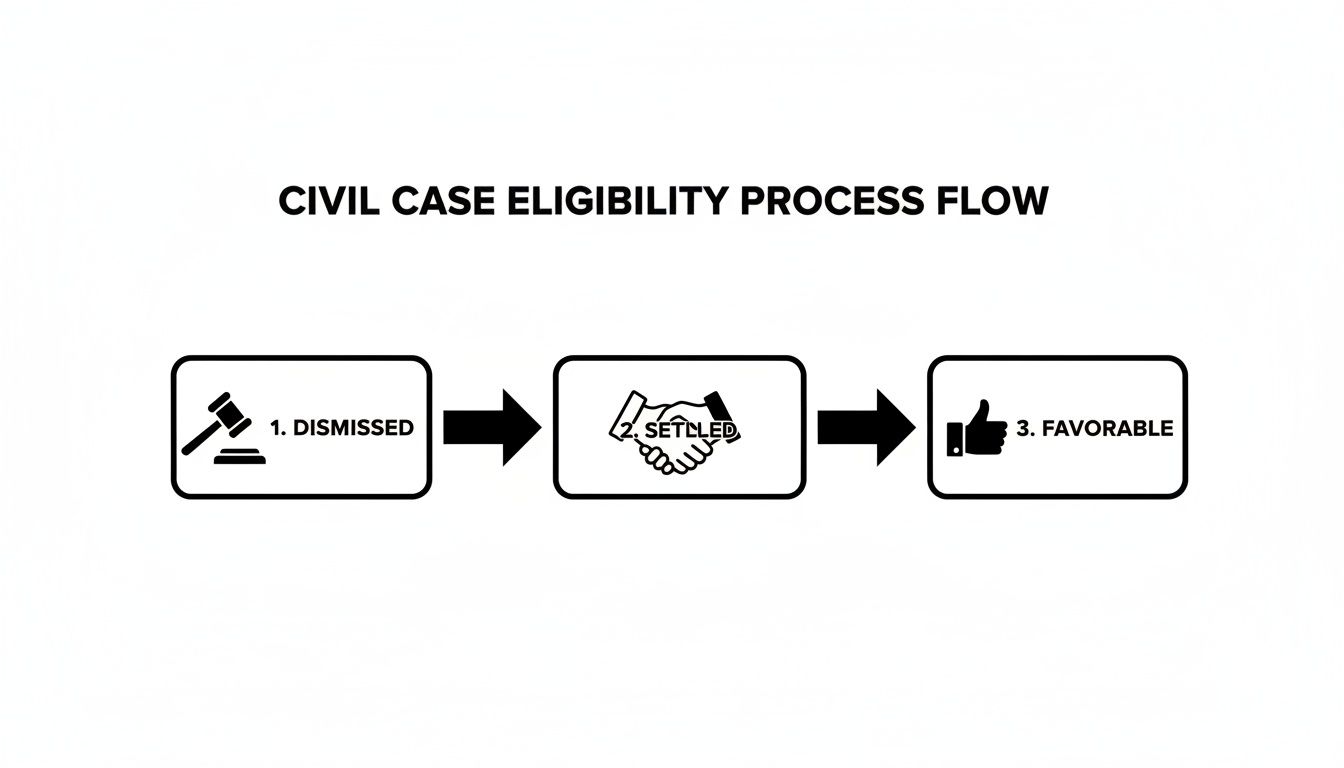
As you can see, a case must end with a conclusive, favorable outcome before you can begin the process of getting the record restricted.
Completing and Filing the Petition
With your paperwork in hand, the next step is to complete the formal Petition for Record Restriction. This legal document must be filled out with precision, detailing the specifics of your original case and making a strong argument for why your privacy interests outweigh the public’s right to see the record.
The petition is filed in the same court that handled the original case. If the dispute was heard in Roswell, you file there. If it was a Superior Court case in Forsyth County, you will file in Cumming. There is almost always a filing fee.
After filing, you must "serve" the petition on the opposing party from the original lawsuit. They then have a set amount of time, usually 30 days, to file an objection. This is a critical waiting period.
Key Stages of the Georgia Record Restriction Process
This table summarizes the main phases of petitioning for record restriction in Georgia.
| Phase | Key Action Required | Common Pitfall to Avoid |
|---|---|---|
| Document Gathering | Obtain certified copies of all relevant court filings, especially the final order showing a favorable outcome. | Forgetting to get the documents certified by the Clerk of Court. Regular copies are not sufficient. |
| Petition Drafting & Filing | Accurately complete the official petition form and file it with the original court, paying the required fee. | Submitting an incomplete petition or failing to make a persuasive legal argument. |
| Serving the Opposing Party | Formally notify the other party from the original case that you have filed the petition. | Improperly serving the documents, which can cause major delays or dismissal of your petition. |
| Court Review & Hearing | The judge reviews the petition. If there's an objection or the judge has questions, a hearing is scheduled. | Being unprepared to argue your case at the hearing, especially if the other party objects. |
Each phase has its own challenges, but being aware of them from the start can make the process smoother.
The Court's Review and Hearing
If no one objects, the process is much more straightforward. A judge will review your petition and the case file. If they agree you have met the legal standard, they will sign an order to restrict the record.
However, if the other party objects or the judge has concerns, a hearing will be scheduled. This is a formal court appearance where you will have to present your arguments. In our example, if the other party from the contract dispute objected, our Johns Creek business owner would have to go to court and explain to the judge why her need for privacy to secure investors is more important than the public record.
Successfully navigating these steps demands attention to detail. From ensuring every form is filled out correctly to presenting a compelling case to a judge, each phase is a critical step toward achieving a clean slate.
Even when you do everything right, the path to restricting your record is not always a straight line. Many cases hit unexpected snags that can complicate a simple process, especially in the busy courts of Fulton and Forsyth counties.
Knowing these potential hurdles ahead of time is half the battle. Most complications fall into one of three categories: paperwork mistakes, active opposition, or administrative delays. Any of these can stall your petition, but none are a dead end if you know how to handle them.
Dealing with Paperwork Errors and Omissions
The most common roadblock is a simple mistake on the paperwork. A petition can be rejected for a missing signature, a typo in the case number, or forgetting to include a certified court document. The clerks in places like Marietta and Roswell handle a high volume of cases and have little tolerance for incomplete or incorrect filings.
The best defense is a good offense. Double-check every field on every form before filing. Make sure you have the correct, certified copies of all necessary orders from your original case. An incomplete application causes delays and can force you to start over, costing more time and filing fees.
When the Opposing Party Objects
A more significant complication arises if the opposing party from your original case files a formal objection to your petition. They have a right to do this, and if they do, the court will schedule a hearing.
This is a serious development. You will have to stand before a judge and argue why your need for privacy and a clean slate outweighs any reason for keeping the record public.
An objection immediately changes the game. It is no longer just a filing process; it is a contested legal matter. The burden is now entirely on you to convince the judge that restricting your record is appropriate under Georgia law.
The opposing party might argue that the nature of the original case makes keeping the record public a matter of public interest. In that situation, you must be ready to present a solid, compelling case explaining the specific harm the public record is causing you in your career, business, or personal life. Having a petition that anticipates these arguments from the start is a massive advantage.
Overcoming Administrative Delays
Sometimes, a delay has nothing to do with you or the opposing party. The courts, particularly in larger counties, are often backlogged. Your petition could sit for weeks or months before it is reviewed. It is frustrating, but it is a reality of the system.
While you cannot force the court to speed up, you can ensure you are not making things worse. File everything correctly the first time and respond immediately to any requests for more information. A polite, periodic follow-up call to the clerk's office can sometimes help, but patience is often your best tool.
These kinds of snags are not just a Georgia problem. A national study found that many eligible individuals face procedural hurdles when trying to clear their records. You can learn more about these findings on procedural hurdles and see how common they are.
Being prepared for these potential setbacks is key. It turns them from overwhelming roadblocks into manageable bumps on the road to getting your fresh start.
Why a Civil Attorney Is Your Strongest Ally
You can technically file for record restriction on your own, but the process is more than just filling out a form. Bringing an experienced civil litigation attorney on board can turn a confusing task into a straightforward, managed process. It is about getting it right the first time.

This is about the real-world benefits of efficiency and peace of mind. When you are trying to secure a fresh start, a calm, professional hand guiding the process can make all the difference.
Precision and Procedural Knowledge
The single biggest advantage an attorney brings is a deep understanding of legal procedure and a commitment to precision. The local rules in Forsyth and Fulton County courts can be incredibly complex and unforgiving.
A minor mistake on a petition or serving a document incorrectly can get your case thrown out. That means you are right back at square one.
An attorney ensures every document is precise, every deadline is met, and every procedural box is checked. We know what judges from Alpharetta to Cumming expect to see, and we know how to frame your case in the strongest possible light from day one. This attention to detail sidesteps the common errors that trip up self-filed petitions, saving you a massive amount of time and stress.
Strategic Advocacy and Persuasive Arguments
If the other party objects to your petition, the game changes completely. What was an administrative filing suddenly becomes a contested legal matter. A hearing gets scheduled, and you will have to stand before a judge and argue your case. This is where an attorney becomes indispensable.
An experienced civil litigator knows how to:
- Craft a compelling legal argument that skillfully balances your right to privacy against the public’s access to records.
- Anticipate and counter objections with well-reasoned, professional arguments.
- Present your case with confidence, clearly explaining to the judge why restricting the record is justified under Georgia law.
This level of advocacy is difficult to replicate on your own. Having a professional articulate the real-world negative impacts the public record has had on your life provides a powerful advantage. A skilled civil attorney uses every tool available, like AI for legal research, to quickly analyze case law and find precedents that strengthen your position.
Hiring an attorney is an investment in certainty. It provides the assurance that your petition is not only filed correctly but is also positioned for the highest likelihood of success, especially if unexpected challenges arise.
By managing the entire process, an attorney takes the burden completely off your shoulders. We handle the paperwork, communications with the court, and represent you at any hearings. This frees you up to focus on your life, confident that your case is being handled with the utmost professionalism. Our goal is to make the path to a clean slate as smooth as it can be, giving you the guidance needed to finally turn the page.
Common Questions About Civil Record Restriction
When you're trying to put a past civil case behind you, many practical questions come up. Here are some of the most common concerns we hear from clients in Alpharetta, Cumming, and across North Georgia, along with straightforward answers.
Can every civil case be restricted in Georgia?
No, not every civil case is eligible. The most important rule in Georgia is that the case must have been resolved in your favor. This generally means the lawsuit against you was dismissed, or that a judge or jury decided you were not liable after a trial. Cases where a judgment was entered against you cannot typically be restricted.
How long does the record sealing process take?
The timeline can vary depending on the court's caseload and whether anyone objects. For a simple case in Forsyth or Fulton County with no opposition, you might be looking at a few months from the day you file. If the other party objects or the court schedules a hearing, that will add time. It’s best to expect the process to take anywhere from three to six months, and sometimes longer.
Will a restricted record still show up on a background check?
Once a civil record is successfully restricted, it is removed from public view. This means it should not appear on standard background checks run by employers, landlords, or business partners. While the record still exists for law enforcement and certain government agencies, its public life is over.
What's the difference between "sealing" and "expungement"?
You will hear these terms used, but in Georgia civil law, "record restriction" is the official legal term for sealing a record from the public. The term "expungement," which often implies the record is physically destroyed, is generally not used for civil cases. For a civil matter, the record gets sealed, not shredded, but the outcome is the same: a clean public slate.
What costs are involved in sealing a record?
There are a few different costs. You will have court filing fees, which vary by county but are usually a few hundred dollars. You will also need to pay the courthouse for certified copies of your original case documents. The largest expense is typically the legal fees if you hire an attorney, but this investment helps you avoid costly mistakes and ensures your petition is handled professionally.
Do I have to go to court for a hearing?
Not always. If you file a complete petition and the other party from the original lawsuit does not object, a judge in Fulton or Forsyth County may approve your request based on the paperwork alone. A hearing becomes necessary if the other party files an objection or if the judge has questions they want answered in person.
Working through the civil record restriction process demands close attention to legal rules and deadlines. If you're ready to take this step to protect your reputation and move on, the team at Miles Hansford, P.C. has the experience to guide you. We can determine your eligibility, handle the entire filing process, and advocate for you every step of the way. Contact us to discuss your case at https://mileshansford.com.