


Georgia law does not let you expunge a driving record, and a standard driving history entry won't vanish just because time passes. What you can do is use the tools Georgia allows, including point reduction and, in some cases, record restriction of the related criminal case, which is often the better path for someone in Cumming or Alpharetta trying to move forward.
If you're in Cumming, GA and a past ticket, reckless driving charge, or DUI is still following you around, you're not alone. People usually come looking for a way to “erase” the record because insurance is high, a job application asks about driving history, or they're worried about what a background check will show. The frustrating part is that Georgia uses different rules for a driving record and a criminal record, and a lot of online advice blurs that line.
That confusion matters in North Georgia. A person may think they can expunge the traffic side of the case, spend time chasing the wrong solution, and still end up with the same DDS history. The better approach is to understand what Georgia removes automatically, what stays visible, and what legal steps may still help protect your future. If you need the broader distinction between driving history and court records, this guide on expunging a record in Georgia is a useful starting point.
Can You Expunge Your Driving Record in Cumming GA?
In Cumming, GA, the short answer is no. Georgia doesn't allow a driver to expunge a driving record, even if the violation is old and even if the points have already dropped off.
That answer is hard to hear when you're trying to clean up your history for work, insurance, or peace of mind. A driver in Forsyth County may assume that once a case is closed, there must be a way to wipe it out. Georgia doesn't work that way with DDS records.
What Georgia Does Not Allow
A driving record is separate from the criminal side of a case. In Georgia, the state does not provide a process to erase the driving history itself. That means the official record maintained for driving purposes remains its own thing, even when people casually use the word “expunge” to describe what they want.
Practical rule: If your goal is to expunge a driving record in Georgia, you're asking for a remedy the state doesn't offer.
That's the first misconception to clear up for people in Cumming, Alpharetta, Johns Creek, and nearby communities like Suwanee or Dawsonville. The second is more important. Just because you can't expunge the driving record doesn't mean you have no strategy.
What May Still Help in Forsyth County
The useful question isn't “Can I erase the DDS record?” It's “What part of this situation can I improve?” In many cases, that means looking at the associated criminal file, especially if the underlying charge may qualify for restriction under Georgia law.
That distinction matters because some people only need to reduce the damage caused by a prior case, not perform the impossible task of deleting the driving history itself. A restricted criminal record can still be meaningful in employment, housing, and reputation terms, even if the driving side remains governed by DDS rules.
For residents dealing with old traffic-related cases in Forsyth County, Fulton County, or North Fulton courts, the practical path is usually a combination of realistic expectations and targeted action.
Why This Matters in Cumming GA
People searching “expunge driving record near me” are usually under pressure. They may be applying for a driving job, trying to lower insurance exposure, or worried that a past DUI or reckless driving matter will affect a custody or divorce dispute because it reflects poorly on judgment.
In a region that includes Cumming, Alpharetta, Milton, Roswell, Canton, and Sandy Springs, those concerns are real. The right legal advice starts by saying what works and what doesn't. In Georgia, expunging the driving record doesn't work. Focusing on lawful alternatives often does.
The 7-Year Myth How Georgia Driving Records Really Work
A driver in Cumming gets turned down for a job, pulls a record, and sees an old violation still sitting there. Then comes the question I hear all the time: “I thought Georgia only keeps that for seven years.” The problem is that people use one rule to describe several different systems, and that creates expensive misunderstandings.
As noted earlier in this Avvo explanation of Georgia driving record visibility, Georgia treats points, insurance visibility, and government access differently. Points tied to a conviction are temporary for suspension purposes. The underlying driving history entry can stay visible longer. Courts, police, and government agencies can still access the full historical record.
Georgia Driving Record Timelines
| Record Component | Timeline | Who Can See It? |
|---|---|---|
| License points | 24 months from date of conviction | DDS for point purposes during that period |
| Driving history violation for insurance visibility | Seven years | Third parties such as insurers during that period |
| Full historical driving record | Permanent retention | Courts, police, and government agencies |
The part that causes the most confusion is the gap between point expiration and record visibility. A ticket can stop counting toward suspension calculations while the conviction itself still appears on a driving history. For a client, that distinction matters more than the slogan about “seven years,” because insurance, employment screening, and later court consequences do not all follow the same clock.
Take a common example. A speeding conviction may stop counting as points after the DDS point period runs out. That does not erase the conviction from every record search, and it does not mean the case vanished from the legal system.
The Seven-Year Rule Is Not Expungement
The seven-year rule is a visibility issue for certain third parties. It is not deletion. It is not record restriction. It is not expungement.
That is why the phrase “expunge driving record” sends many Georgia drivers in the wrong direction. Time may reduce the practical effect of a violation in one setting, but time alone does not wipe the DDS history clean. If the underlying problem is a related criminal case, the legal work usually belongs on that side of the file. A Georgia record restriction strategy for eligible criminal records is often the issue worth examining, especially when a DUI or other charge created both driving and criminal consequences.
What This Means in Forsyth County
In Forsyth County, I regularly see drivers assume an old case no longer matters because the insurance impact has faded or the points are gone. Then a license issue, background check, or new court matter brings the old entry back into focus.
That is the practical reality. A cleaner insurance picture does not mean the record disappeared.
For someone in Cumming, Suwanee, or the surrounding North Georgia area, the useful question is narrower and more productive: who can still see this, and which part of it can be improved under Georgia law? That question leads to real options. The seven-year myth does not.
Your Real Strategy Record Restriction in Alpharetta and North Fulton
A common North Fulton problem looks like this. Someone in Alpharetta applies for a new job, pulls a background check, sees an old DUI or related charge, and starts searching for a way to expunge the driving record. That search usually points them in the wrong direction.
Georgia does not give you a procedure to erase the DDS history just because enough time passed or the case has become less important in day-to-day life. The practical question is different. Which part of the file is causing the current problem, the driving record, the criminal record, or both?
Point Reduction Helps With License Risk
If the immediate concern is points and suspension exposure, a DDS-approved defensive driving course may help reduce points. As noted earlier, that step can improve the license side of the problem, but it does not remove the underlying conviction from the driving history.
For a driver in Alpharetta, Johns Creek, or Milton who spends a lot of time on the road, that can still be a smart short-term move. It addresses pressure on the license. It does not fix what an employer, landlord, or professional board may see on the criminal side.
Record Restriction Is Often the Better Legal Target
A stronger long-term strategy is often record restriction of the related criminal case, not the DDS file. That distinction matters in DUI and serious traffic cases because one event can create two separate records with two separate sets of rules.
Georgia's process can also turn on timing and case posture. Older arrests may be handled differently from newer ones, and eligibility depends on the charge, the disposition, and whether the case qualifies under Georgia law. A person who focuses only on the driving record often misses the only part of the case that may be improved.
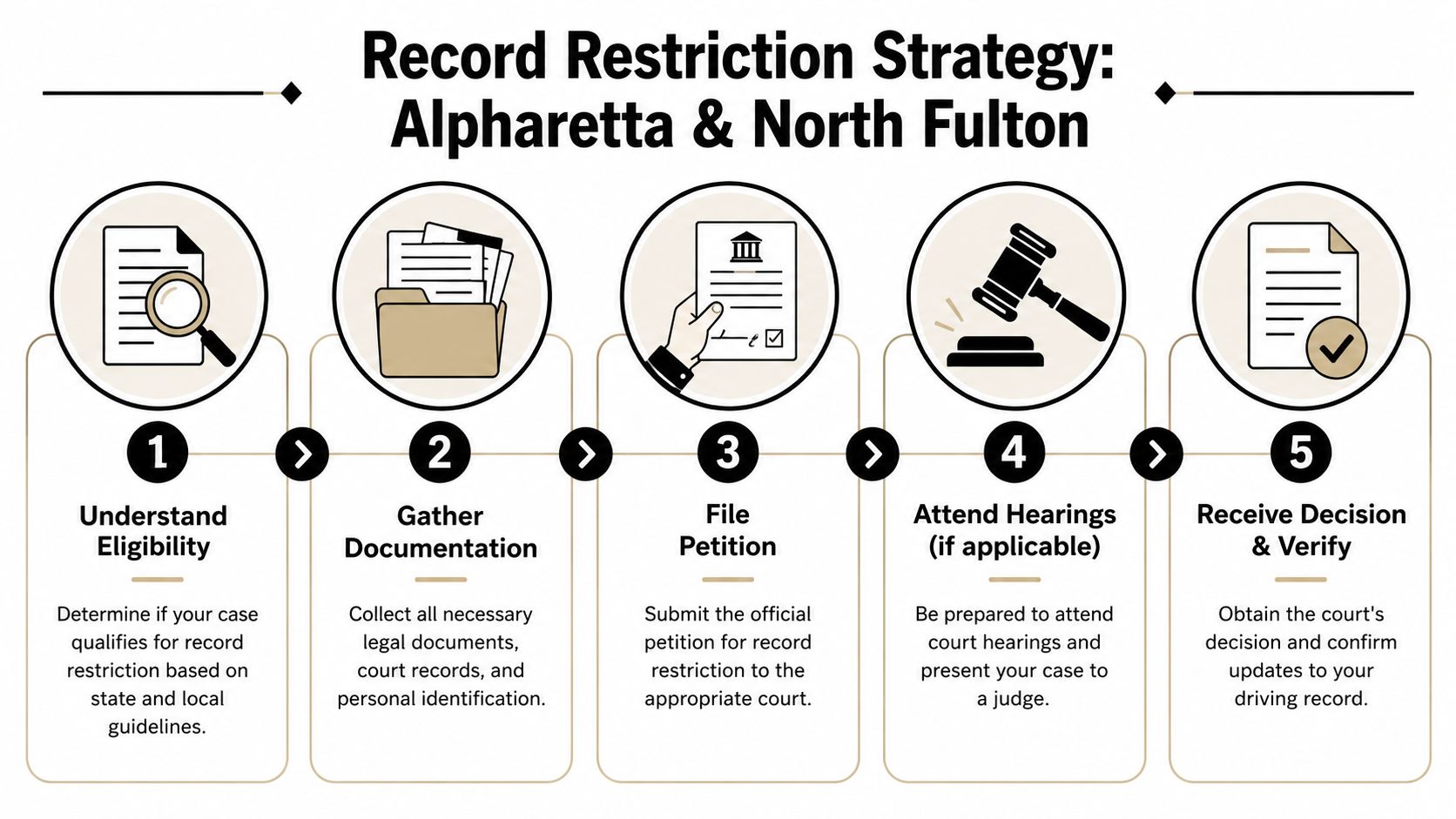
That is why the first review should be document-based, not assumption-based. Pull the accusation or citation, the final disposition, and the arrest date. Then determine whether the problem is a public criminal record that may be restricted, a driving history entry that will remain, or both.
Why This Matters in Alpharetta and North Fulton
In Alpharetta, Roswell, Sandy Springs, and nearby North Fulton communities, many clients are less worried about insurance than about hiring screens and professional consequences. In those cases, the useful legal work usually centers on the criminal file.
A restricted criminal record can change what private parties see, even while the DDS record stays in place. That is frustrating, but it is often the only path that offers meaningful relief. If you need to assess whether that path is available, review this page on Georgia record restriction options.
What Usually Works Best
- Identify the actual problem first. License pressure, background checks, and court records call for different solutions.
- Use point reduction for the driving side. It may help with accumulation issues, but it does not erase the case.
- Examine the criminal case separately. Eligibility for restriction depends on the charge and disposition, not on whether the DDS record is inconvenient.
- Treat DUI cases carefully. A DUI is not handled like a routine ticket, and many people waste time chasing a form of relief that Georgia does not offer for the driving record itself.
Navigating the Forsyth and Fulton County Court Process
A person in Cumming usually starts this process after realizing the online shorthand was wrong. They thought they could expunge a driving record. Instead, they're looking at court paperwork, agency forms, and deadlines that depend on where the case originated.
In Forsyth County, that often means dealing with the Forsyth County Superior Court if an appeal becomes necessary or if the related matter is tied to a qualifying criminal record issue. In Fulton County, the path may involve Fulton County Superior Court or other North Fulton court procedures depending on where the original matter was handled.

What the Filing Process Usually Looks Like
The first practical step is gathering the underlying case information. That includes the arrest date, the exact charge, the disposition, and which agency or prosecutor's office handled the case. Those details control where the request goes and whether the person is even using the right legal tool.
After that, the case usually turns on paperwork accuracy. A wrong date, wrong agency, or incomplete filing can stall the process quickly. That is especially common when someone from Dawsonville, Canton, or Roswell tries to work through an older case without matching the record to the correct court and prosecutor.
What People Often Miss in North Fulton and Forsyth
The court system doesn't fix a vague request just because the person had a good reason for filing it. The legal system expects precision. If a prosecutor denies the request, the next move may require a timely appeal to Superior Court. If you need to understand that part of the process better, this guide on appealing a court decision in Georgia explains the framework.
The hard part usually isn't wanting relief. It's identifying the correct record, sending the request to the correct office, and preserving the right to challenge a denial.
What Hearings Feel Like Locally
In local practice, hearings are usually less dramatic than people expect and more procedural. The court wants to know what record is at issue, what authority supports the request, and whether the statutory process was followed.
That means a resident of Cumming, Alpharetta, or Suwanee should approach the matter with organized documents and a clear theory of relief. Courts in Forsyth and Fulton are accustomed to lawyers who know the difference between DDS history, criminal restriction, and administrative point consequences. A filing that blurs those categories tends to create avoidable problems.
Why an Experienced Cumming Attorney Makes a Difference
A lot of clients come in asking how to expunge a driving record. That framing sends people in the wrong direction from the start.
In Georgia, the job is usually to separate three different problems. One is the DDS driving history. Another is points and license consequences. A third is the related criminal case, which may be the only part that qualifies for record restriction. If those categories get mixed together, people file the wrong request, ask the wrong office for relief, and lose time they cannot get back.
That mistake shows up often in Cumming, GA, Alpharetta, and the surrounding North Georgia courts. Local practice matters, but judgment matters just as much. An attorney who regularly handles matters in Forsyth County Superior Court, Fulton County Superior Court, and North Fulton courts can spot early whether the case calls for a restriction request, a licensing strategy, or a frank conversation that the driving history itself is going to remain.
Why Local Experience Affects Results
Knowing the statute is only part of the work. The harder part is matching the facts to a remedy the court or prosecutor can grant.
A lawyer with local experience can usually identify the problem quickly. Was there a DUI accusation that ended in a way that may support record restriction? Is the client's problem really insurance, employment screening, or a pending suspension issue? Is the person about to spend money chasing "expungement" when Georgia law does not offer that fix for a driving record? Those distinctions change the advice, the filing, and the timeline.
Clients also need clear answers. That sounds basic, but it matters when someone is dealing with work, family, or a professional license. Many firms are improving intake and response systems with tools like Voicedial.ai's complete law firm guide, especially for people who are tired of calling a law office and getting vague information.
The Trade-Off
Handling a matter yourself may save money at the beginning. The cost of a wrong filing can be much higher.
In this type of case, good legal work often looks quiet. It means identifying the record that can be addressed, avoiding requests Georgia law does not allow, preserving deadlines, and presenting the issue in a way the court and prosecutor will take seriously. That is usually where a lawyer earns the fee.
Frequently Asked Questions About Georgia Driving Records
Q: Can I expunge my driving record in Cumming, GA?
A: No. Georgia doesn't allow expungement of a driving record. For someone in Cumming or elsewhere in Forsyth County, the better question is whether you can reduce points or seek restriction of a related criminal record. Those are separate issues, and the available remedy depends on the facts of the case.
Q: How long do points stay on a Georgia license in Forsyth County?
A: Points expire 24 months from the date of conviction under Georgia's driving record rules discussed earlier. That timeline affects point accumulation for suspension purposes. It does not mean the underlying event is erased from every record, and local drivers often confuse those two ideas when reviewing DDS history.
Q: Does a traffic violation disappear after seven years in Alpharetta?
A: Not in the way commonly understood. In Georgia, many driving history violations fall off after seven years for insurance purposes, but that is not the same as expungement. Courts, police, and government agencies can still retain access to the full historical driving record.
Q: Can I remove points from my record without going to court in Georgia?
A: Yes, in some situations. Georgia allows a DDS-approved defensive driving course that can reduce up to seven points, and that option is available once every five years. For drivers in Alpharetta, Johns Creek, or Milton, that can be a practical step if the immediate concern is suspension risk.
Q: What's the difference between expungement and record restriction in Georgia?
A: Expungement is the term people commonly use when they want a record erased. In Georgia, the more accurate tool is often record restriction for the criminal side of a case. That does not expunge the DDS driving history. It addresses the criminal record, and only if the case qualifies under Georgia law.
Q: Does a DUI stay longer than a regular ticket on a Georgia record?
A: Yes. A DUI conviction remains on a Georgia driving record for 10 years from the date of the offense under the Georgia rule noted earlier. The criminal record side is a different issue. That distinction matters for drivers in Fulton County and Forsyth County who assume every traffic-related matter follows the same timeline.
Q: If my record restriction request is denied in Fulton County, what happens next?
A: You may have the right to appeal, but timing matters. For qualifying Georgia record restriction denials, the appeal must be filed in the Superior Court within 30 days under the process discussed above. In practice, that means acting quickly and confirming the denial fits the appeal route allowed by law.
Q: Can I handle this myself if I live near Cumming or Alpharetta?
A: You can try, but many self-filed requests fail because the person targets the wrong record or the wrong office. In Forsyth County and North Fulton, the issue is often not effort. It's legal fit. If you're trying to expunge a driving record, the first step is making sure you're not pursuing a remedy Georgia doesn't provide.
If you're trying to clean up the impact of a past driving case in Cumming, Alpharetta, Forsyth County, or Fulton County, start with the right legal question. The team at Miles Hansford Law Firm can help you evaluate whether point reduction, record restriction, or another strategy fits your situation. Schedule a consultation, speak with a family law attorney or related counsel who understands how criminal, driving, and family issues can overlap, and call today if you need to protect your rights, your record, or your future.
Meta Title: Expunge Driving Record in Cumming, GA
Meta Description: Learn why you can't expunge a driving record in Cumming, GA, and what legal options may still help in Forsyth County and Alpharetta.
Suggested URL Slug: /expunge-driving-record-cumming-ga/
Internal Link Suggestions:
- Expunge a Record in Georgia
- Georgia Record Restrictions
- How to Appeal a Court Decision
- DUI Defense in Alpharetta
- Family Law in Cumming
Schema Recommendations:
- Attorney
- LegalService
- FAQPage