


When you're navigating a divorce in Cumming, GA, you may come across the legal term failure to exercise due care. This isn't just a legal phrase; it's a serious issue that can profoundly impact your financial future and your children's well-being. Put simply, it means one spouse acted carelessly or irresponsibly, causing tangible harm. If you believe your spouse's negligence has put your family at risk, it is critical to understand your rights in Forsyth and Fulton County courtrooms.
The attorneys at Miles Hansford are here to provide the calm, strategic guidance you need during this overwhelming time. To discuss your case and protect your rights, call us today to schedule a consultation.
Why This Matters in Cumming, GA
In Georgia family law, spouses have a duty to act reasonably and protect shared interests. A failure to exercise due care occurs when one person’s recklessness or negligence breaks that trust, leading to a loss. For families in Cumming, Alpharetta, and surrounding communities like Johns Creek or Milton, this breach of trust can manifest in several ways:
- Financial Negligence: A spouse gambles away joint savings or makes a high-risk investment with marital funds without consulting you.
- Property Negligence: The family home in Forsyth County is allowed to fall into disrepair or face foreclosure because mortgage payments were ignored.
- Parental Negligence: A child’s significant medical or educational needs are consistently overlooked, putting their future at risk.
This goes beyond just making a poor choice. It's a level of carelessness that a reasonable person would have avoided. Georgia courts, particularly those in Forsyth County and Fulton County, have the authority to hold the negligent party accountable.
The Key Difference: Carelessness vs. Intentional Harm in Georgia
It's critical to understand the distinction between simple carelessness and deliberate misconduct. While both are damaging, judges in Forsyth and Fulton County will likely treat them differently.
- Negligence (Failure to Exercise Due Care): This is about being careless. Imagine a spouse in Suwanee forgets to pay the insurance premium for a valuable piece of art, and it's later destroyed in a fire. The loss happened because of an oversight, not malicious intent.
- Intentional Misconduct: This involves a deliberate act to cause harm. For instance, a spouse in Roswell secretly sells that same artwork for cash and hides the funds right before filing for divorce. This is often called "dissipation of assets."
We've found it's helpful for clients to see how these actions compare, especially in the context of Georgia family law.
Negligence vs. Intentional Misconduct in Georgia Family Law
| Action Type | Definition | Example in Divorce | Potential Court Response in Forsyth County |
|---|---|---|---|
| Negligence | A careless or irresponsible act that results in harm, but without malicious intent. | Forgetting to pay property taxes on the marital home in Cumming, leading to significant penalties. | The judge may assign the resulting debt to the negligent spouse or award the other spouse a larger share of assets to compensate for the loss. |
| Intentional Misconduct | A deliberate action taken to harm the other spouse financially or emotionally. | Hiding marital assets by transferring funds to a secret bank account just before a divorce filing in Alpharetta. | The judge can hold the spouse in contempt, assign all hidden assets to the other party, and order the at-fault spouse to pay the other's attorney's fees. |
In either situation, the damage is real. A judge in a North Fulton court has the power to hold the responsible person accountable, frequently by adjusting the equitable division of assets to make the wronged spouse whole. Whether you're dealing with a complex, high-asset estate in Alpharetta or a custody issue in Dawsonville, identifying spousal negligence is key to securing a fair outcome under Georgia law.
The Legal Process: Proving the Four Elements of Negligence
When arguing that your spouse’s carelessness caused financial harm—a failure to exercise due care—you can’t just make a blanket accusation. Georgia law, especially in courtrooms across Forsyth and Fulton Counties, demands that your attorney proves four specific legal elements to build a successful claim.
Your claim for negligence needs all four elements—Duty, Breach, Causation, and Damages—to stand up in a Georgia court.
1. Duty
First, we must show that your spouse had a duty of care. In a marriage, this is straightforward. Spouses have a legal and moral obligation to protect the family's well-being, including preserving the value of shared assets and caring for children. A judge in Cumming or Alpharetta will begin with the assumption that this duty exists.
2. Breach
Next is the breach of that duty. This is where we demonstrate that your spouse failed to act as a reasonable person would have under the same circumstances. For instance, if a spouse in Milton lets a valuable rental property fall into disrepair by ignoring basic maintenance, they have likely breached their duty to protect a marital asset.
3. Causation
The third piece is causation. It isn't enough to show your spouse was careless. You must draw a direct line from that carelessness to the financial harm you suffered. If that neglected Milton property now needs $50,000 in repairs before it can be sold, the failure to perform maintenance is the direct cause of that loss.
4. Damages
Finally, you must prove damages—the actual, measurable loss. In our property example, the damages are clear: the $50,000 that must be spent on repairs is $50,000 less in your marital pot. During a divorce, these damages can be factored into how the court divides your assets under Georgia's equitable division standard.
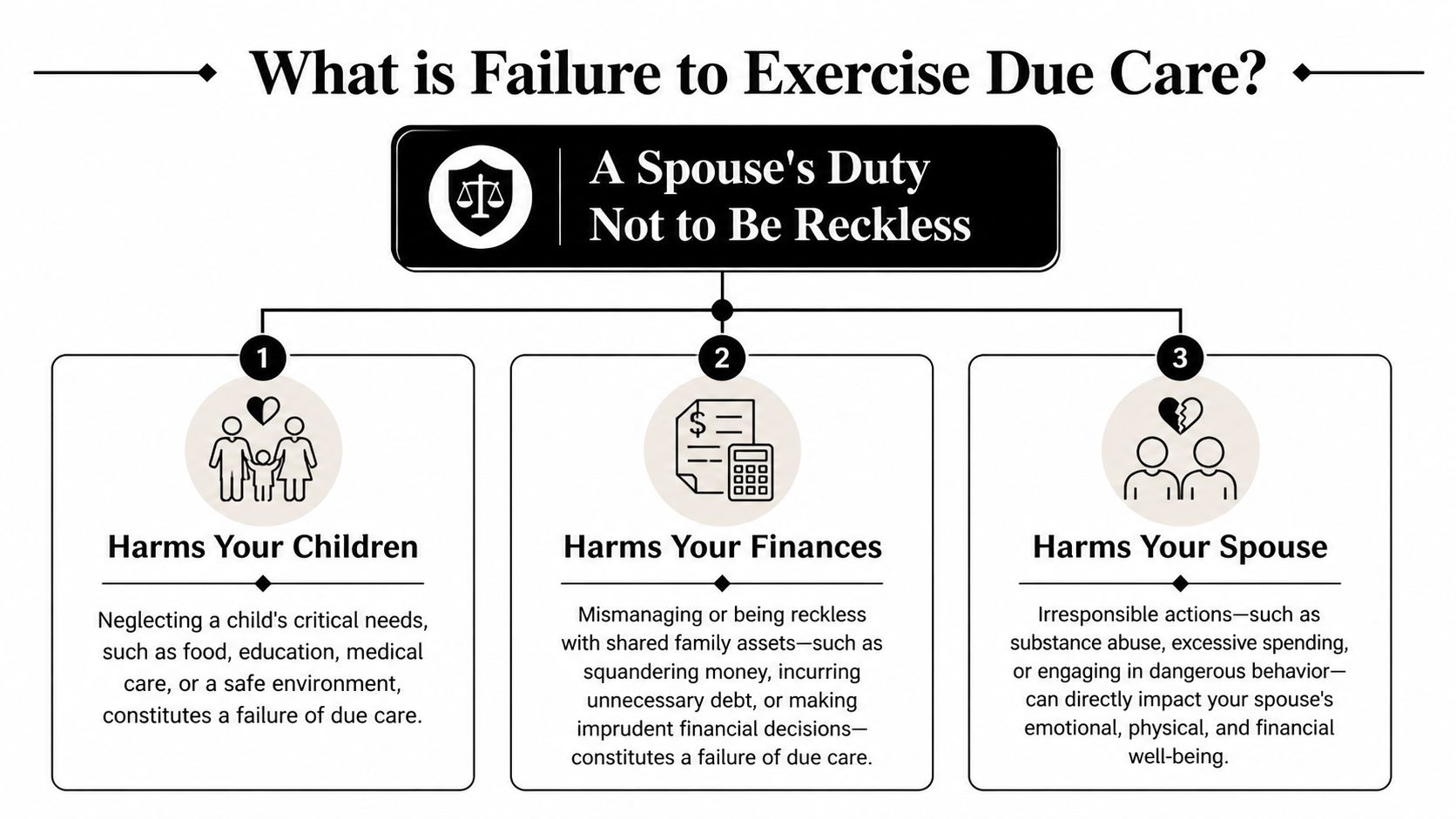
The duty of care covers money, property, parenting, and a spouse's general welfare. While most of these are civil matters handled in family court, some actions can cross into criminal behavior. You can learn more about how our firm handles these sensitive situations by reading about our criminal defense law practice. Successfully proving these four elements in a Forsyth or Fulton County court requires a detailed strategy and strong evidence.
Strategic Considerations for Negligence Claims in Cumming and Alpharetta
Legal theory is one thing; real-world situations show how a failure to exercise due care can truly impact a family's future. These concepts stop being abstract when they put your financial security or your children’s well-being on the line. The scenarios below are based on the kinds of issues we regularly see for our clients across Cumming, Alpharetta, and the rest of North Georgia.
Financial Negligence in an Alpharetta High-Asset Divorce
Consider a couple with significant assets in Alpharetta. One spouse, acting alone, moves marital funds from a shared retirement account into a series of risky, speculative investments that fail. This isn’t just a poor decision; it's a breach of the duty to prudently manage shared assets. In a Fulton County divorce court, a judge can see this as dissipation of the marital estate and "add back" the lost funds to the negligent spouse’s share during property division.

Parental Negligence Impacting Child Custody in Cumming, GA
Now, think about a separated family in Cumming where one parent is responsible for taking a child with a chronic health issue to the doctor. That parent repeatedly misses appointments and fails to give the child their medication. This shows a failure to exercise the due care required to protect a child’s health. In a Forsyth County custody hearing, this documented negligence would be a major factor in determining the "best interests of the child" and could lead a judge to modify the parenting plan.

Property Negligence in Johns Creek
Imagine a separating couple who co-own a home in Johns Creek. One spouse agrees to make mortgage payments but deliberately stops, causing foreclosure warnings. This act not only risks a major marital asset but also inflicts long-term credit damage. This is a clear failure to maintain marital property. A judge can order the negligent spouse to be solely responsible for all late fees and penalties.
Proving this kind of behavior requires a deep dive into financial records and other evidence. It’s vital to have a clear picture of how all assets and debts, like mortgages, were managed. For those trying to understand these complexities, there are helpful guides on options for transferring a mortgage during a separation.
What to Expect in Forsyth and Fulton County Courts
In North Georgia courts, proving a failure to exercise due care requires meticulous documentation and a clear, persuasive argument. A single mistake by your spouse may not be enough; judges in Forsyth and Fulton County look for a pattern of negligent behavior that caused demonstrable harm.
In custody cases, documented proof of parental negligence—missed doctor’s appointments, poor school attendance, or exposure to unsafe environments—can be a powerful reason for a judge to modify a parenting plan or award primary physical custody. In high-asset cases common in Alpharetta, financial negligence can lead a judge to unequally divide marital property to compensate the wronged spouse. To learn more about this strategy, review our guide on how to win a custody battle.
Our attorneys frequently work with forensic accountants to trace every dollar and build an undeniable case of financial misconduct. This strategic approach is critical to protect your assets in a high-asset divorce and ensure you are not unfairly punished for your spouse’s irresponsibility.
Why Choose Miles Hansford for Your Cumming Divorce Case
When your spouse’s careless actions damage your family’s financial future or compromise your parental rights, you need a protective legal team. If a failure to exercise due care has put your security at risk in Cumming or Alpharetta, you need a firm that builds its cases on a solid foundation of Georgia law and local court experience.
At Miles Hansford, our attorneys have spent years investigating and proving negligence in complex family law matters across North Georgia. We are in the Forsyth County and Fulton County Superior Courts nearly every day. This gives us direct knowledge of how local judges operate and what they expect to see. We don't just file paperwork; we build a comprehensive strategy focused on protecting your future.
Proving negligence is not simple. The courts take the duty of care seriously, and the consequences for failing to meet that standard can be steep. You can learn more about the legal and financial risks associated with negligence from legal experts. Our goal is to translate these complex legal standards into a clear, effective plan for you, ensuring the court understands the real harm you’ve suffered and has the evidence required to hold the other party accountable.
If you suspect your spouse’s negligence has caused serious harm, do not wait. Contact our team to protect what matters most. We are here to offer the calm, strategic, and protective legal support you need.
Frequently Asked Questions About Negligence in a Cumming, GA Divorce
When a spouse's carelessness causes serious financial or personal harm, it’s natural to have urgent questions. Families in Cumming and Alpharetta often come to us seeking clarity. Here are answers to common questions, grounded in our experience with Forsyth and Fulton County courts.
Q: How can I prove my spouse was financially negligent in our Cumming divorce?
A: Proving financial negligence in Forsyth County requires showing a pattern of waste or recklessness. We gather evidence like bank statements, investment records, and credit card bills. In many cases, we partner with forensic accountants to trace where dissipated assets went, demonstrating a clear breach of your spouse's duty to the court and protecting your share of the marital estate.
Q: Could my spouse's negligence affect my alimony award in Alpharetta?
A: Yes, it can. If your spouse's reckless spending depleted funds that would have been available for your support, a Fulton County judge is allowed to consider it. This type of "marital misconduct" is a key factor under Georgia's alimony laws (O.C.G.A. § 19-6-5). Presenting a strong, evidence-based case of negligence can often lead to a more favorable alimony award for you.
Q: What is the difference between bad parenting and legal negligence in a custody case?
A: Georgia courts do not police every parenting disagreement. Legal negligence is a consistent pattern of behavior that puts a child’s health, safety, or well-being at risk. This could mean failing to get necessary medical care, exposing them to dangerous situations, or creating a home so unstable it causes harm. These actions violate the “best interests of the child” standard used by all Georgia courts.
Q: What if my spouse crashes a car we both own in Forsyth County? Is that a failure to exercise due care?
A: It can be. The key is whether the crash resulted from reckless behavior, such as a DUI, and if it caused a significant financial loss to the marital estate. If the crash led to a large liability payout or the total loss of a valuable vehicle, a Forsyth County court might see it as marital waste. The specific facts are critical in making that determination.
Q: My spouse let our joint investments lose value. Is that negligence?
A: Not necessarily. Poor investment outcomes alone are not typically considered negligence in Georgia. However, if your spouse made unusually high-risk investments without your consent, engaged in speculative day-trading with marital funds, or acted against the advice of a financial professional, it could rise to the level of negligence. It depends on whether their actions were reasonable under the circumstances.
If you believe your spouse's failure to exercise due care has damaged your financial security or parental rights, you need a strategic legal partner. The attorneys at Miles Hansford, P.C. have extensive experience proving these claims in North Georgia courts. Schedule a confidential consultation to protect what you have worked for.