


Meta Title: Field Sobriety Tests in Alpharetta GA
Meta Description: Pulled over in Alpharetta, GA? Learn how field sobriety tests work, your rights in Georgia, and how DUI defenses are built in Fulton and Forsyth County.
Suggested URL Slug: /field-sobriety-tests-alpharetta-ga/
Internal Link Suggestions:
- DUI defense overview page
- Georgia implied consent page
- What to expect in a Georgia DUI court appearance
- Blog on how field sobriety tests determine drunk driving
- Criminal defense attorney page
Schema Recommendations: Attorney, LegalService, FAQPage
A traffic stop in Alpharetta can turn serious fast. One minute you're driving on Old Milton Parkway, GA-400, or Windward Parkway. The next, blue lights are behind you, an officer asks if you've had anything to drink, and then comes the request to step out of the car.
That moment matters. For many people in Alpharetta, Cumming, Johns Creek, Milton, Roswell, and the rest of North Georgia, field sobriety tests feel like a quick roadside check. They aren't. They are evidence-gathering tools that officers use to build probable cause for arrest and prosecutors later use to support a DUI charge in Fulton County or Forsyth County court.
A lot of good people assume that if they tried their best, the test results must be fair. That's not how these cases work. Small mistakes in administration, poor roadside conditions, stress, fatigue, footwear, and medical issues can all change how a person performs. In Georgia DUI defense, those details often decide whether the evidence holds up or falls apart.
Pulled Over in Alpharetta? What to Know About Field Sobriety Tests
If you've just been stopped in Alpharetta, your heart is probably still racing. Most drivers remember the same sequence. The officer approaches the window, asks a few questions, watches your hands, listens to your speech, and then asks you to get out of the car. Once that happens, the stop usually shifts from conversation to investigation.
On roads around Alpharetta and North Fulton, that investigation rarely happens under ideal conditions. It may be dark. The shoulder may slope. Traffic may be moving close by. Flashing patrol lights can distract anyone. If you've been pulled over near Cumming, Johns Creek, Milton, Roswell, Sandy Springs, Suwanee, Canton, or Dawsonville, the same basic reality applies. The roadside is not a controlled testing environment.
What the officer is really doing
Field sobriety tests are commonly presented as neutral tests of balance and coordination. In practice, they are also a way for the officer to document clues of impairment. Those clues then appear in the arrest report and later in testimony.
That means your performance isn't judged casually. It's judged with an eye toward whether the officer can justify an arrest.
Immediate concern: If you're reading this after an Alpharetta or Cumming stop, time matters. Video can be requested, reports can be reviewed, and mistakes in the roadside investigation can be identified early.
Why this issue keeps growing
Alcohol isn't the only topic shaping DUI enforcement now. Police and lawmakers continue looking for new ways to detect impairment tied to substances beyond alcohol, including cannabis. If you want context on where that conversation is heading, this overview of upcoming marijuana breathalyzer technology is useful background. It helps explain why officers increasingly rely on observational tools when a clean, immediate roadside answer isn't available.
The practical takeaway in North Georgia
If an officer asks you to perform field sobriety tests in Alpharetta or nearby, understand the stakes. The tests are not a formality. They are one of the central building blocks in many DUI cases filed in North Fulton courts and elsewhere in North Georgia.
The good news is that these tests can be challenged. A "failure" on the roadside is not the end of the case.
The Three Standardized Field Sobriety Tests Used in Georgia
Georgia officers typically rely on a three-test battery called the Standardized Field Sobriety Tests, or SFSTs. These are the only roadside tests that were formally developed and validated through the National Highway Traffic Safety Administration's research process. According to the validated history summarized at field sobriety test accuracy research, the SFSTs were developed and validated through key studies funded by NHTSA in the late 1970s and 1990s, and early research found that standardized administration could predict a BAC of ≥0.10% with 81% accuracy when all three tests were combined.
That background matters because prosecutors often treat the SFSTs as if they are settled science. In court, they may describe them as standardized, accepted, and widely used. All of that can be true while still leaving room to challenge how the tests were administered in your case.
The three tests you will usually see in Alpharetta and Cumming
The standardized battery includes:
- Horizontal Gaze Nystagmus: The officer tracks your eyes while moving a stimulus, often a pen or finger.
- Walk-and-Turn: You must follow instructions, keep heel-to-toe contact, turn as directed, and return the same way.
- One-Leg Stand: You balance on one foot and count as instructed.
These tests are supposed to help officers decide whether they have probable cause to arrest. They are not the same thing as a breath or blood test. They are observational and depend heavily on how the officer gives instructions, what the roadside looks like, and whether the officer followed training.
Standardized does not mean foolproof
The key word is "standardized." The tests only carry their claimed value if the officer follows the protocol closely. A slight change in instructions, timing, positioning, or testing conditions can undermine the result.
That's one reason defense lawyers study bodycam and dashcam footage so closely. A video may show that the officer rushed the instructions, chose a poor location, talked over the driver, or scored clues that are not supported by what the camera shows.
For a useful overview of how these tests are used in DUI cases, Miles Hansford also discusses how field sobriety tests determine drunk driving.
These tests were built for consistency. Many roadside stops are anything but consistent.
What this means in practice
In Alpharetta, Cumming, Forsyth County, and Fulton County, the SFSTs are common because they give the officer a structured script. But structure on paper and accuracy in the field are two different things. A defense often turns on that gap.
Deep Dive The Horizontal Gaze Nystagmus Test
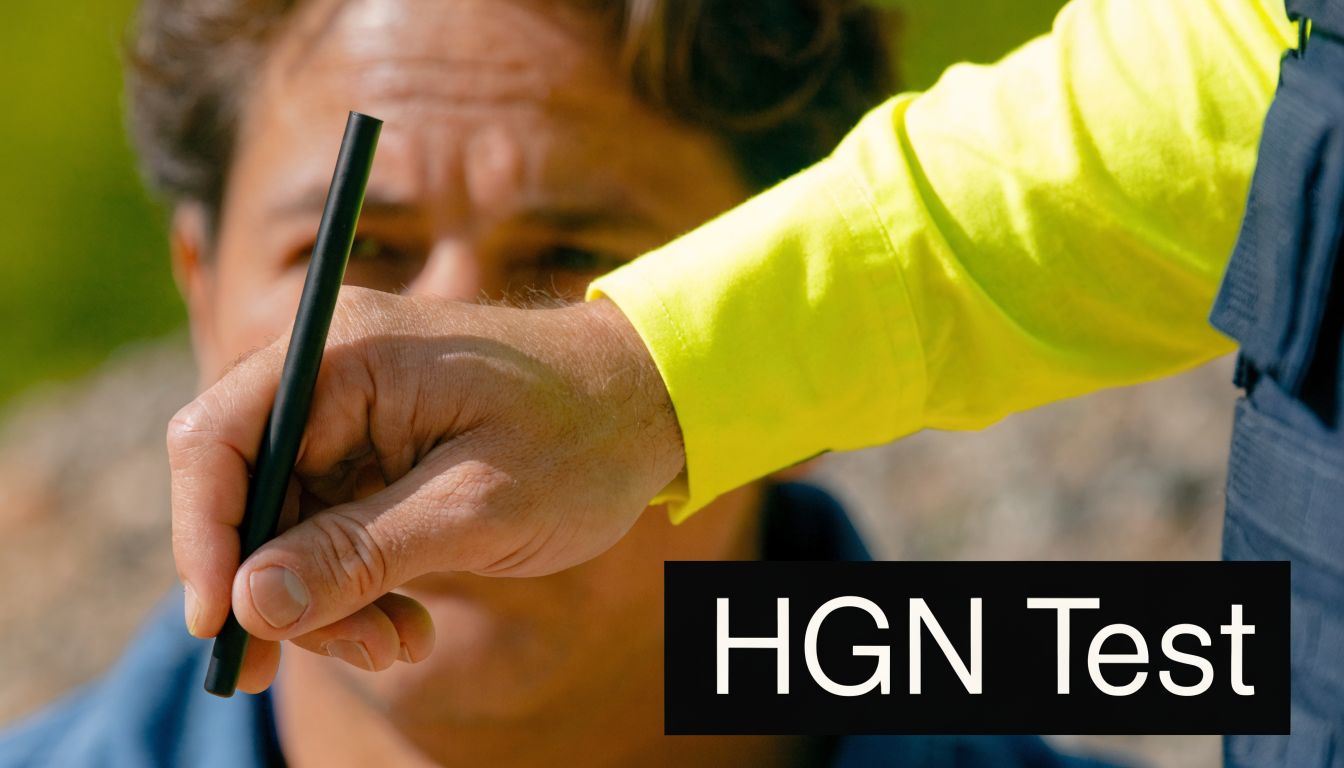
The Horizontal Gaze Nystagmus test, usually called HGN, is often the state's favorite field sobriety test. Officers and prosecutors frequently treat it as the most technical of the three. That's because it focuses on involuntary eye movement rather than balance alone.
How the HGN test is supposed to work
According to the Georgia-focused explanation at how field sobriety tests are conducted in Georgia DUI cases, the officer should position the stimulus 12 to 15 inches from the subject's nose and slightly above eye level. The officer first looks for resting nystagmus and equal pupil size, then checks for three clues in each eye:
Lack of smooth pursuit
The eyes do not track smoothly as the stimulus moves.Distinct and sustained nystagmus at maximum deviation
The officer should hold the eye at maximum deviation for a minimum period while observing visible jerking.Onset of nystagmus prior to 45 degrees
The eye begins jerking before the stimulus reaches that angle.
Under that same source, 4 or more clues out of 6 indicate a BAC of ≥0.08% with 77% accuracy.
Where officers often make mistakes
HGN is only persuasive if it is administered correctly. In real traffic stops, the common problems are simple and damaging:
Stimulus position problems
If the pen, finger, or light is too close, too far, or not slightly above eye level, the test can be compromised.Timing errors
The speed of the passes matters. If the officer moves too fast, the result becomes harder to trust.Poor roadside conditions
Flashing lights, passing traffic, wind, and divided attention can interfere with the observation.Skipped screening questions
Officers should consider whether a medical issue may affect the result.
Why sober people can still show clues
Consequently, HGN becomes a powerful defense issue in North Fulton and Forsyth County DUI cases. The same Georgia-focused source notes that common medical conditions, certain medications, or natural nystagmus can produce false positives. Fatigue can also matter. So can inner ear or neurological issues.
Practical rule: If the HGN test is central to the arrest, the defense should compare the officer's report to the bodycam frame by frame.
A careful review often focuses on whether the officer aligned the stimulus properly, whether the subject's head moved, whether patrol lights contaminated the setting, and whether the officer completed each required portion of the test. In many cases, the report sounds clean. The video does not.
Why HGN gets challenged in Georgia courtrooms
In Fulton County and Forsyth County, the HGN test can look stronger on paper than it does in person. Jurors may hear technical language and assume precision. But once the court sees the roadside setting and the officer's actual method, the confidence level often drops.
That is especially true where the officer treated the test as routine rather than exact. With HGN, exactness is the whole point.
Understanding the Walk-and-Turn Test in a Cumming Traffic Stop
Blue lights hit the rear window on GA-9. The officer has you step out near uneven pavement, explain a set of instructions, and ask for nine heel-to-toe steps out, a turn, and nine back. In Forsyth County cases, that sequence often looks clean in the report and much less clean on bodycam once you slow it down.
The Walk-and-Turn is a divided-attention test. The officer is asking you to listen, remember, balance, count, place each foot carefully, and turn the way you were told, all while standing on the side of a public road under stress. Small mistakes by the driver get labeled as clues. Small mistakes by the officer can make the whole test far less reliable.
The two phases matter
This test starts before the first step.
During the instruction phase, the officer usually tells the driver to stand heel-to-toe, keep arms at the sides, and remain in that position while the instructions are given. If the officer rushes the explanation, talks over traffic noise, fails to confirm the driver understood, or demonstrates the turn poorly, the walking phase becomes much easier to challenge later.
During the walking phase, the driver is told to take nine heel-to-toe steps, turn in a specific series of small steps, and return the same way. In court, I want to know exactly what was said, exactly what was demonstrated, and whether the bodycam matches the arrest report.
What officers usually look for
Officers commonly score the Walk-and-Turn by looking for these claimed clues:
- Starts too soon
- Misses heel-to-toe
- Steps off the line
- Uses arms for balance
- Improper turn
- Wrong number of steps
- Stops while walking
- Cannot keep balance during instructions
That list sounds objective. On the roadside, it often is not.
A missed heel-to-toe step may be an inch issue, not an impairment issue. A "line" may be imaginary. A turn may be marked wrong even though the officer's own demonstration was incomplete. Those details matter in Fulton and Forsyth County courtrooms because jurors usually see the test only after the officer has already framed it as a failure.
Why roadside conditions in Cumming matter
The average driver does not practice heel-to-toe walking on the shoulder of a busy North Georgia road while a uniformed officer watches every movement.
That matters more than many people realize. In Cumming stops, the surface may slope toward a ditch. Gravel, broken asphalt, wet pavement, poor lighting, headlights, and passing traffic all interfere with balance and concentration. Boots, dress shoes, work shoes, age, back pain, knee issues, and anxiety can all affect performance in ways that have nothing to do with alcohol.
Another recurring problem is administration. Officers are supposed to give clear instructions and watch for standardized clues, but in real cases I often see preventable errors: interrupting the instructions, starting the test before the driver is set, choosing a poor surface, or failing to account for a physical limitation the driver mentioned. Those are not technicalities. They go straight to whether the result deserves any weight.
Where this test often breaks down in a defense case
The Walk-and-Turn can hurt a driver in a borderline case because it creates a long list of opportunities to mark "clues." That does not make every result worthless. It means the result has to be tested against the specific conditions of the stop and the officer's actual method.
In many Forsyth and Fulton County DUI cases, the strongest attack is simple and specific. Compare the report to the video. Check whether the officer used a reasonably level, dry surface. Check whether the instructions were complete. Check whether the officer demonstrated the turn correctly. Check whether the driver was wearing footwear that made heel-to-toe walking harder. Check whether the officer counted clues that the camera does not clearly show.
One or two minor errors in administration can change how this test should be viewed. Sometimes that is enough to weaken probable cause. Sometimes it is enough to reduce the jury's confidence in the officer's entire DUI investigation.
Breaking Down the One-Leg Stand Test and Its Challenges
The One-Leg Stand test is another divided-attention task, but it adds a physical demand that many people are not built to perform well on command. During a traffic stop, the officer typically asks the driver to raise one foot several inches off the ground, keep the raised foot parallel, look at it, and count aloud until told to stop.
That may sound manageable in a quiet room. It is very different on the roadside in Alpharetta, Cumming, Johns Creek, or Milton.
What the officer is watching
This test is commonly scored through four broad types of behavior:
| Observation | Why officers score it |
|---|---|
| Swaying | May be treated as a sign of impaired balance |
| Using arms for balance | May be scored if the driver lifts arms noticeably |
| Hopping | Suggests trouble maintaining position |
| Putting the foot down | Often treated as a failure to maintain the stance |
The problem is obvious. Those same movements can happen for countless innocent reasons.
Who is at a disadvantage before the test begins
A person doesn't need to be impaired to struggle with the One-Leg Stand. Common issues include:
Age-related balance limits
Some drivers have reduced balance even when fully sober.Prior injuries
Knee, ankle, back, or hip problems can interfere immediately.Body type and physical condition
Some people have genuine difficulty balancing on one leg under stress.Footwear
Dress shoes, heels, boots, and work shoes can make stable balance harder.Roadside setting
Uneven pavement, gravel, wet asphalt, and road crown all matter.
Why the officer's instructions matter so much
This test depends on clarity. If the officer talks too fast, interrupts counting, demonstrates poorly, or places the driver in a bad location, the reliability of the score drops. Bodycam footage often shows a gap between the polished wording in the report and the hurried delivery at the scene.
A defense lawyer will also look at whether the officer asked about injuries or physical limitations. If the officer knew, or should have known, that the driver had a condition affecting balance, the scoring becomes much easier to challenge.
A person can be honest, cooperative, and sober, yet still look unsteady on one foot beside a roadway.
Why this test creates arrests in Georgia
The One-Leg Stand can feel decisive to an officer because it appears visible and easy to explain in court. But appearance is not reliability. In many North Georgia cases, the strongest answer is not arguing over whether the foot touched the ground. It is showing why that result says little about actual impairment.
The Truth About FST Accuracy and False Positives
A driver gets stopped in Alpharetta after dinner, answers politely, steps out, and tries to follow directions on the shoulder of the road with blue lights flashing behind them. By the end of that encounter, the officer may write "failed field sobriety tests" as if the result were clear and scientific. In practice, these tests often produce results that are far less reliable than the report suggests.
Why accuracy becomes a real defense issue
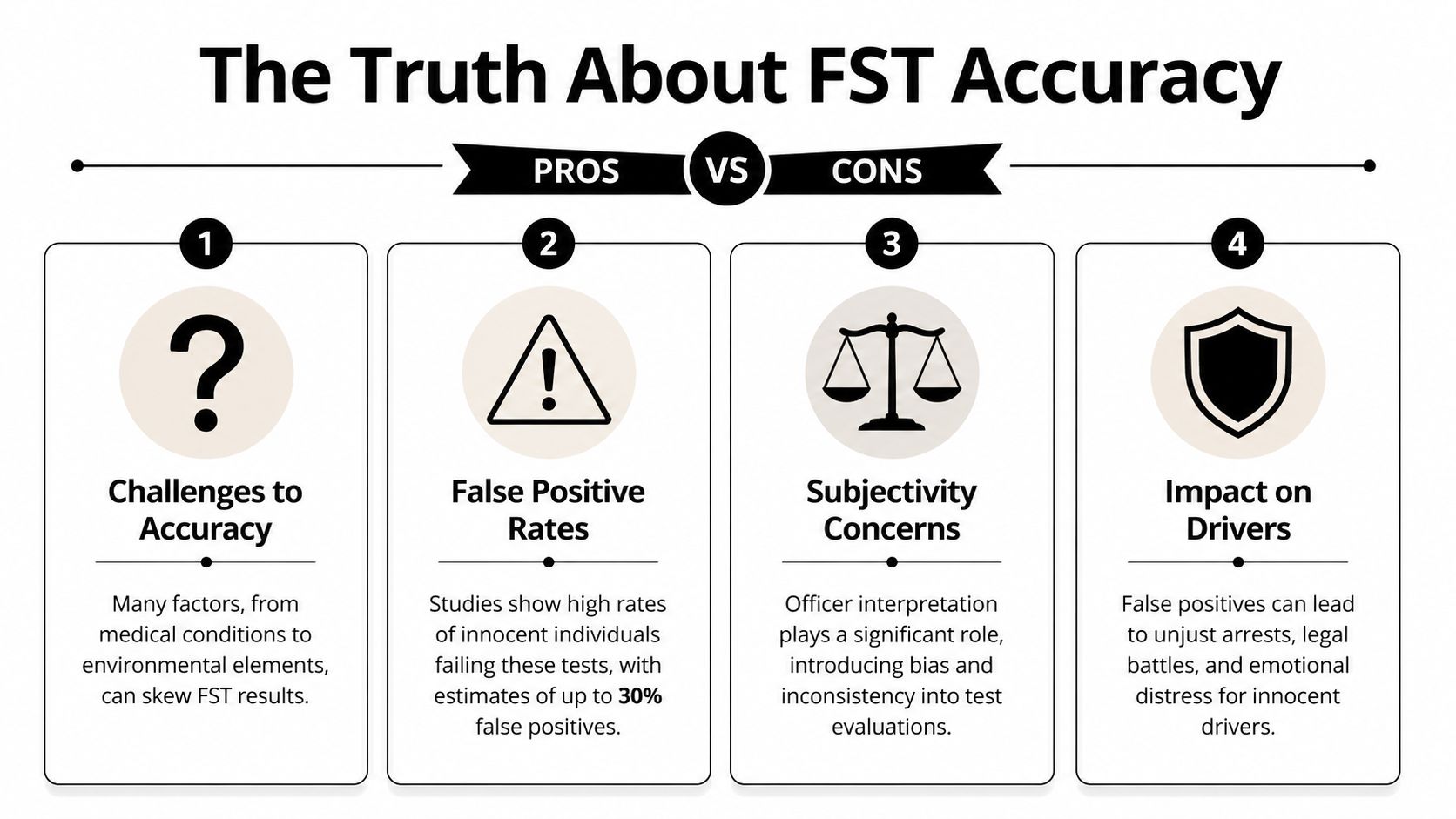
Field sobriety tests are screening tools. They are not direct measurements of blood alcohol concentration, and they are not immune from error. That matters in the cases I see most often in Forsyth and Fulton County. A person can look nervous, rushed, confused, or physically awkward and still be fully capable of driving safely.
The practical problem is simple. Once an officer decides the tests showed impairment, that conclusion tends to shape everything that follows, including the arrest decision, the report, and later testimony in court.
Where false positives come from
False positives usually do not come from one dramatic mistake. They come from small problems layered together.
An officer gives instructions too quickly. The demonstration is incomplete. The driver starts a moment early. The patrol car lights are flashing directly into the driver's field of vision. The surface slopes more than the report admits. In many roadside videos from Cumming, Alpharetta, and the north end of Fulton County, those details are easy to miss at first and very important once the case is examined carefully.
Common sources of false positives include:
Rushed or unclear instructions
A driver cannot perform a divided-attention test fairly if the instructions were confusing from the start.Scoring that depends on judgment calls
Slight pauses, arm movement, stance issues, or turn mechanics are often described in ways that sound more definite on paper than they appear on bodycam.Environmental interference
Traffic, headlights, noise, uneven pavement, cold weather, and roadside slope can affect performance.Ordinary human reactions
Anxiety, fatigue, age, eye conditions, prior injuries, and natural coordination issues can look like "clues" even when alcohol is not the cause.
The North Georgia defense angle most people miss
In court, the strongest challenge is often not "my client did everything perfectly." That is rarely the right fight. The better question is whether the officer administered and scored the tests in a way that makes the result trustworthy.
That is where many DUI cases turn.
Minor administration errors are common. Officers may interrupt the count, fail to confirm understanding, choose a poor testing location, or score clues before the instruction phase is even complete. In Forsyth and Fulton County cases, those are not technical side issues. They are facts that can reduce the weight of the entire roadside investigation.
What this means after an arrest
A reported "failure" on field sobriety tests does not end the case. It creates a target for careful review. Bodycam, dashcam, dispatch timing, road conditions, footwear, medical history, and the officer's exact wording all matter. Small mistakes at the roadside can become strong cross-examination points later.
That review also affects strategy beyond the tests themselves. If your case involves a chemical test issue after arrest, the rules are different, and Georgia's implied consent law and the consequences of refusing a state-administered chemical test need to be analyzed separately.
The key point is this. "Failed the test" is not the same as "the test was reliable." In many North Georgia DUI cases, that distinction protects a license, a record, and a future.
Your Rights at a DUI Stop in Alpharetta Do You Have to Take the Tests
One of the most common questions after an Alpharetta DUI arrest is simple. Do you have to take field sobriety tests in Georgia? In practical terms, roadside field sobriety tests are generally treated as voluntary. You can refuse them.
That said, people need the full answer, not the comforting half-answer.

Refusing field sobriety tests versus refusing a chemical test
These are not the same choice.
If you refuse roadside field sobriety tests, the officer will usually continue the investigation using other observations. That may include driving behavior, odor, speech, admissions, appearance, and any other facts the officer claims to have noticed. In many Georgia cases, refusal of the roadside tests still leads to arrest.
If you are arrested and then refuse the state-administered chemical test, you enter a different legal category under Georgia implied consent law. That refusal can create separate license consequences and requires immediate attention. For a detailed explanation, review Georgia's implied consent law and what happens if you refuse a chemical test.
What drivers in Alpharetta should actually do
You should stay calm, polite, and careful with your words. Don't argue on the roadside. Don't volunteer explanations. Don't assume cooperation means the officer will "let you go" if you perform well. Once a DUI investigation starts, the officer is documenting evidence.
A practical approach includes:
Provide identification and required documents
Handle the basics without turning the stop into a long conversation.Avoid admissions
Statements about drinking, medication, or being tired often appear later in the report.Understand that roadside tests are evidence collection
They are not a fair contest with a neutral referee.Take the post-arrest stage seriously
If a chemical test issue arises, the timing of your legal response matters.
The trade-off nobody explains well
People often ask whether refusing field sobriety tests is the "right" move. The honest answer is that it depends on the circumstances, but one fact is consistent. Performing the tests gives the officer more material to describe, score, and use against you. Refusing may increase the chance of arrest in the moment, but it limits that particular category of evidence.
You can be respectful without helping build the roadside case against you.
In Alpharetta, Roswell, Milton, Johns Creek, Cumming, and across North Georgia, the smartest next step after any DUI stop is to get legal advice quickly and preserve the video.
How We Challenge Field Sobriety Test Evidence in Fulton and Forsyth County Courts
Strong DUI defense work starts with the details. In Fulton County Superior Court, Forsyth County Superior Court, and the related North Fulton courts where many DUI matters begin, field sobriety test cases often look stronger in the incident report than they do on video.
What we look for first
The first job is gathering the evidence before it disappears or gets harder to access. That usually includes:
Dashcam and bodycam footage
The video often shows the location, the officer's instructions, and whether the alleged clues are really there.Arrest reports and supplemental narratives
These are checked against the footage for consistency.Training and protocol issues
HGN timing, stimulus placement, divided-attention instructions, and medical screening all matter.Roadside conditions
Shoulder slope, traffic, lighting, rain, and footwear can become central issues.
How those problems become legal arguments
A good defense doesn't stop at pointing out flaws. It connects those flaws to admissibility, weight, and probable cause. If the officer failed to follow standardized procedures, the defense may attack the reliability of the SFSTs directly. If the poor testing undermines probable cause, the arrest itself may come under pressure.
That is where motions practice becomes important. Depending on the facts, counsel may file a motion to suppress or other evidentiary challenge aimed at limiting or excluding flawed field sobriety testimony.
For clients trying to understand the courtroom phase, this guide on preparing for court when facing a DUI charge in Georgia gives a useful overview of what follows the arrest.
Why local court experience matters
Judges in Fulton County and Forsyth County each have their own courtroom expectations. Prosecutors differ in how they present officers and how aggressively they rely on roadside testing. A lawyer who handles North Georgia DUI cases regularly knows where to press hard, when to use video as the lead exhibit, and how to frame the officer's mistakes clearly.
Miles Hansford Law Firm handles DUI defense matters that include reviewing roadside testing, bodycam footage, and suppression issues in local courts.
Frequently Asked Questions About Georgia Field Sobriety Tests
| Question | Answer |
|---|---|
| Can I refuse field sobriety tests in Alpharetta, GA? | Yes. Roadside field sobriety tests are generally voluntary in Georgia. But refusal does not mean you'll avoid arrest. In Alpharetta and North Fulton cases, officers often proceed based on their other observations and then request a state-administered chemical test after arrest. |
| Are field sobriety tests the same as a breath test? | No. Field sobriety tests are observational tasks. A breath, blood, or urine test is a chemical test. That distinction matters in Georgia because the legal consequences tied to implied consent apply to the post-arrest chemical testing stage, not the same way to roadside balancing exercises. |
| Can bad weather or uneven pavement affect my results in Cumming? | Absolutely. In Forsyth County cases, roadside location often becomes a major issue. Wet pavement, sloped shoulders, gravel, poor lighting, and nearby traffic can all affect balance, attention, and the ability to follow precise instructions during field sobriety tests. |
| What if I have a medical condition that affected the HGN or balance tests? | That can be important. Conditions involving the eyes, inner ear, balance, joints, or neurological function may undermine the state's interpretation of the tests. In Georgia DUI defense, medical records, testimony, and bodycam review can all help challenge the officer's conclusions. |
| Will a failed field sobriety test automatically convict me in Fulton County or Forsyth County? | No. A roadside "failure" is not a conviction. Courts still examine how the test was administered, whether the officer followed training, what the video shows, and whether the prosecution can prove impairment under Georgia law with reliable evidence. |
| What should I do after a DUI arrest in Alpharetta or Cumming? | Act quickly. Preserve paperwork, write down what happened, identify any medical or physical issues that may have affected the tests, and speak with a Georgia DUI attorney promptly. Early review is especially important if a chemical test refusal or license issue is involved. |
If you were arrested after field sobriety tests in Alpharetta, Cumming, Johns Creek, Milton, Roswell, Sandy Springs, Suwanee, Dawsonville, or Canton, get a clear review of what happened at the roadside. Miles Hansford Law Firm handles DUI defense in Fulton County, Forsyth County, and across North Georgia, including cases where small testing errors can make a major difference. Schedule a consultation if you need practical guidance on protecting your license, your record, and your next step.