


If you've filed a case in federal court and then learned your complaint needs work, you're not alone. That moment often comes after new documents surface, a defendant files a motion to dismiss, or the court's questions expose a gap in the original pleading. For clients in Alpharetta, GA, that can feel like the case is already slipping. In many situations, it isn't. An amended complaint is often the tool that gets the case back on solid footing.
That matters for people and businesses across Alpharetta, Cumming, Johns Creek, Milton, Roswell, and the rest of North Georgia. Many local legal disputes stay in Georgia state court, including divorce, custody, contempt, legitimation, and modification actions in Forsyth County Superior Court or Fulton County Superior Court. But some business, civil, and high-stakes disputes land in the U.S. District Court for the Northern District of Georgia, where the Federal Rules of Civil Procedure control. Knowing how a FRCP amended complaint works can protect claims, sharpen strategy, and keep a case moving.
Navigating an FRCP Amended Complaint in Alpharetta GA
A complaint is rarely drafted in perfect conditions. Clients are under pressure. Facts are still developing. The other side may have the records you need, and you may not see the weak spots until they attack them. In federal litigation, that doesn't automatically mean the case was badly filed. It often means the pleadings need to catch up to the facts.
For Alpharetta business owners, professionals, and individuals involved in serious civil disputes, the amended complaint process is one of the most important early-case tools available. A strong amendment can add missing factual detail, tighten legal theories, or fix issues the defense highlighted. A careless amendment can create delay, invite a fresh attack, or miss a deadline that was avoidable.
Practical rule: Early amendments usually work best when they solve a specific pleading problem, not when they simply restate the same allegations with more adjectives.
This issue comes up locally more often than people expect. A dispute may begin with conduct in Alpharetta or Cumming, involve parties in Fulton County or Forsyth County, and still end up in federal court because of the type of claim or the parties involved. That creates a real need for counsel who understand both local litigation realities and federal procedure.
Why Amending a Complaint is a Critical Step in North Georgia Litigation

An amended complaint isn't just a correction. In many cases, it's the first real chance to present the dispute in a way the court can work with. The original filing often happens fast. The amendment is where strategy starts to show.
That is especially true in North Georgia litigation involving business disputes, partnership breakdowns, contract claims, fraud allegations, and reputational harm. A company in Alpharetta may file quickly to stop damage from spreading, then later realize the complaint needs cleaner factual sequencing or a better explanation of who did what. An individual in Johns Creek may discover after filing that a key communication, payment trail, or witness statement changes how the claims should be framed.
What a good amendment actually does
A useful amendment usually improves one or more of these areas:
- Factual clarity: It tells the story in a way the judge can follow without filling gaps.
- Claim structure: It matches the facts to the right legal theories instead of hoping a broad accusation will survive.
- Party alignment: It identifies whether the correct people or entities are in the case.
- Defense response: It reduces the easy targets a defendant would otherwise attack in a motion to dismiss.
A weak complaint can diminish your position early. The court may dismiss claims that were salvageable with better pleading. The other side may sense disorganization and push harder. Discovery may get narrower before you've fully explained why the case matters.
Why business owners in Alpharetta and Cumming should care
Most clients don't care about pleading doctrine in the abstract. They care whether the case survives, whether unnecessary cost can be avoided, and whether the judge understands the dispute. That's the right way to look at it.
In practice, amending a complaint can serve several protective purposes:
| Concern | Why amendment matters |
|---|---|
| New facts surfaced | The complaint should reflect the strongest current version of the case |
| Motion to dismiss filed | The plaintiff may be able to cure defects before the court rules |
| Wrong defendant named | The case may need to be realigned before delay becomes more expensive |
| Claims poorly stated | Better pleading can preserve pressure and credibility |
A smart amendment tells the court that the plaintiff has moved from reaction to control.
This kind of disciplined pleading matters whether the dispute touches Alpharetta, Cumming, Suwanee, Sandy Springs, Canton, or Dawsonville. It also reflects a broader truth local clients already know from family litigation. In Georgia matters like custody, equitable division, temporary hearings, mediation, and parenting plan disputes, details shape outcomes. Federal civil litigation works the same way. Precision matters.
The Legal Process for Filing an Amended Complaint in Federal Court
The federal rule starts with timing. Under FRCP 15(a)(1), a plaintiff may amend a complaint once as a matter of course within 21 days after serving it, or, if the pleading requires a responsive pleading, within 21 days after service of the responsive pleading or a Rule 12(b), (e), or (f) motion, whichever is earlier, as stated in the text collected at FRCP 15 amended and supplemental pleadings.
That window matters because it lets the plaintiff fix problems without first asking the court for permission. If the deadline has passed, the case usually moves into a different posture. At that point, amendment generally requires the other side's written consent or leave of court.
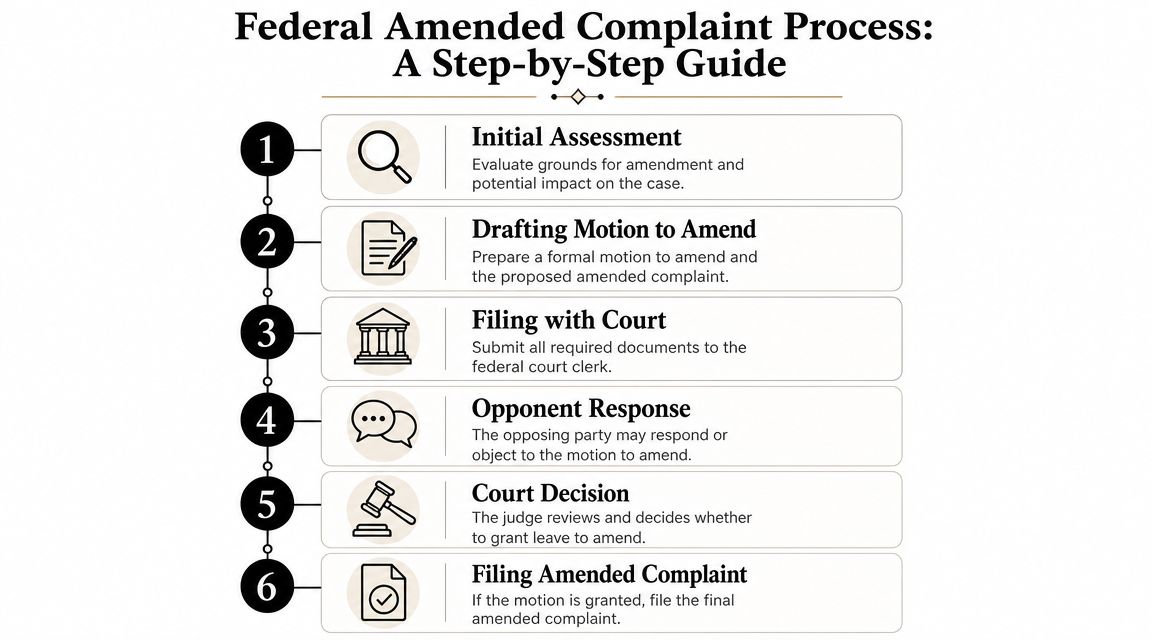
Amendment as a matter of course
This is the cleanest path. If you're within the allowed period, you typically prepare the amended complaint, file it, and serve it in compliance with the applicable rules and local practice. No motion for leave is usually needed.
That doesn't mean the amendment should be rushed. Before filing, counsel should check:
- What changed since the original complaint
- Whether the new version cures the problem that prompted the amendment
- Whether adding detail creates new issues, such as inconsistent allegations
- Whether exhibits, dates, and party names are accurate
A hasty amendment can fix one problem and create two more.
Amendment with consent or leave of court
Once the automatic amendment window closes, the plaintiff usually needs either the defendant's written consent or permission from the judge. Courts are instructed to freely grant leave when justice so requires, but that doesn't mean every proposed amendment is a good one or that timing no longer matters.
In practical terms, the filing often includes:
- A motion for leave to amend
- The proposed amended complaint
- A short explanation of why the amendment is necessary
- A response to any claim of delay, prejudice, or futility
Some cases also require attention to local rules and judge-specific procedures in the Northern District of Georgia.
What Alpharetta litigants should do early
For clients in Alpharetta, Milton, Roswell, and North Fulton, the best move is usually to assess amendment needs as soon as a Rule 12 motion arrives. Waiting can narrow options. If the complaint involves multilingual records, foreign-language contracts, or communications that need to be presented cleanly, it's worth understanding why legal documents need expert services before revising a pleading that depends on precise wording.
A second early move is to think about the defense's likely next step. If you're on the receiving end of a lawsuit instead, the practical issues overlap with motion practice and deadlines explained in this guide on how to respond to a lawsuit.
The 21-day rule is only the first checkpoint
The 2009 amendment to Rule 15(a)(1), effective December 1, 2009, replaced older, more open-ended amendment practice with a tighter 21-day structure, as discussed in this Rule 15 analysis. That change made early amendment more predictable, but not simpler in every case.
Two practical points often get missed:
- The first amendment window closes fast: clients often spend much of that time gathering records and deciding what the defense is arguing.
- Scheduling orders can matter sooner than expected: in many cases, the court's case schedule becomes the main pressure point.
File with a purpose. Judges usually respond better to an amendment that clearly fixes something than to one that reads like a rolling draft.
The Relation-Back Doctrine What It Means for Your Claims
Relation back is one of those rules that sounds technical until it suddenly becomes the issue that saves a claim.
A simple way to think about it is this. The original complaint opens the file on a particular dispute. Later, the plaintiff learns that a claim needs to be stated differently, or that a party needs to be added. Rule 15(c) may allow that amendment to be treated as though it was filed on the date of the original complaint, rather than the later date. That can matter when limitation defenses are in play.
Why this doctrine has real value
An amended complaint generally supersedes the original, and in most circuits it also moots a pending motion to dismiss. The same body of law explains that Rule 15(c) relation back can protect claims from statute of limitation problems when the new allegation arises from the same conduct, transaction, or occurrence, as described in this discussion of amended complaints and pending dismissal motions.
That combination creates both opportunity and risk. If the amended complaint is strong, it can reset the pleadings fight on better terms. If it wanders too far from the original factual core, relation back may become contested.
A practical example for North Georgia litigants
Take a business dispute that begins with allegations about a specific set of negotiations and follow-up conduct in Alpharetta. Later, emails and accounting records show that the same underlying events support an additional theory that wasn't clearly stated at the outset. If the amended allegations still arise from the same core conduct, relation back may become a key argument.
That issue often overlaps with limitation analysis in claims like defamation and related business torts. Anyone dealing with timing questions should understand the local implications discussed in this overview of the Georgia defamation statute of limitations.
Relation back works best when the amendment develops the same factual story rather than replacing it with a new one.
Where litigants get into trouble
Courts don't usually reward loose pleading followed by broad reinvention. Problems tend to arise when a plaintiff tries to add claims or parties that feel disconnected from the original case narrative.
Watch for these issues:
- New facts that point to a different dispute
- A new defendant with weak notice arguments
- An amendment that changes the theory more than the detail
- A filing that assumes relation back without explaining why
This is why amendment strategy should start before the deadline pressure becomes severe. By the time relation back is the only thing keeping a claim alive, every word in the pleading matters.
Strategic Considerations for Litigants in Cumming and Alpharetta
A business owner in Alpharetta may file suit based on what was known at the start, then learn through early document review or a defense motion that the complaint needs sharper allegations, a narrower theory, or an added count tied to the same dispute. At that point, the amendment decision becomes a case strategy question, not just a rule question.
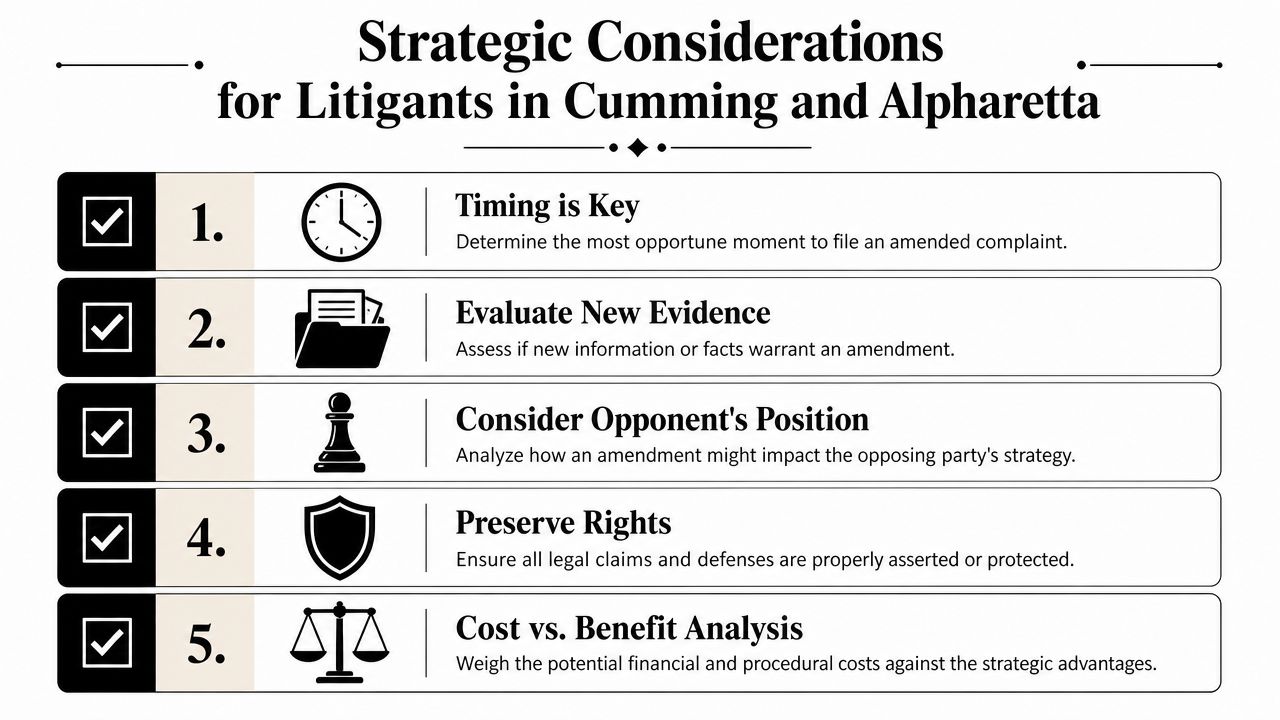
A well-timed amendment can strengthen credibility with the court. A poorly timed one can signal that the case was not investigated carefully enough before filing. In federal court, judges notice the difference.
Using amendment to answer pressure from the defense
One of the most common pressure points is a motion to dismiss. Sometimes the right response is to amend before the court rules, clean up weak allegations, and put the case in better shape for the next round. Sometimes the better course is to stand on the complaint if the defense is overstating the defect and an amendment would only hand over a more polished preview of your theory.
That judgment call matters in business cases. A contract dispute, shareholder fight, fraud claim, or unfair competition case often turns on whether the complaint connects specific conduct to specific claims. If you are still at the stage of deciding how a business claim should be framed in the first place, this guide on how to sue a company in Georgia gives useful context on choosing parties, claims, and forum before amendment issues start compounding.
Good amendments usually do three things. They add facts that matter, remove claims that do not carry their weight, and make the pleading easier for the judge to follow. Weak amendments tend to do the opposite. They get longer, more argumentative, and less precise.
Rule 16 changes the analysis
Many clients are surprised by this. Once the scheduling order deadline to amend has passed, the discussion often shifts away from Rule 15's liberal amendment language and toward Rule 16(b)'s good-cause standard. Courts then focus on diligence. If the facts were available months earlier, a late request is harder to justify.
That is where record-keeping matters. Save the emails, production dates, and timeline showing when the new information surfaced. In practice, amendment fights are often won or lost on chronology.
Judges are more receptive to an amendment tied to newly confirmed facts than one tied to a late change in strategy.
Local strategy in North Fulton and Forsyth County matters
Clients in Cumming and Alpharetta are often dealing with a practical choice, not an abstract one. Fix the complaint now, or keep the existing pleading and push the case toward discovery, mediation, or an early ruling.
A disciplined review usually starts with a few direct questions:
| Question | Why it matters |
|---|---|
| Does the amendment fix a real pleading defect? | Courts have little patience for revisions that change wording but not substance |
| Will the new allegations narrow the issues? | Narrower pleadings often help with discovery control and settlement posture |
| Does amendment help more than it delays? | A better complaint can still be a poor strategic move if it resets motion practice without adding real value |
| Can you show diligence if the deadline has passed? | In federal court, that showing may decide the motion before the merits are even reached |
This is one place where local experience helps. A litigant with a case in the Northern District of Georgia has to account for federal scheduling orders, motion practice, and judicial expectations that differ from what many people have seen in Fulton County or Forsyth County Superior Court. The underlying lesson is familiar across courts, but the pressure points are different. In federal court, delay is often framed as a Rule 16 problem much sooner.
For that reason, the best amendment decisions are usually made early, with a clear record and a realistic view of cost, delay, and strategic advantage. The goal is not to amend whenever possible. The goal is to amend when it improves the position of the case.
Federal vs Georgia State Courts How Amendment Rules Differ
Many clients in Alpharetta and Cumming don't start by asking whether Rule 15 or O.C.G.A. § 9-11-15 applies. They ask a simpler question. "Can we still fix the complaint?" The answer depends first on where the case is pending.
Federal and Georgia state courts both allow amendment, but they don't use the same timing structure. In federal court, the early amendment window is tied to Rule 15 and specific deadlines. In Georgia state court, amendment practice is generally more flexible before entry of a pretrial order. That difference can shape the entire approach to motion practice, discovery, and settlement posture.
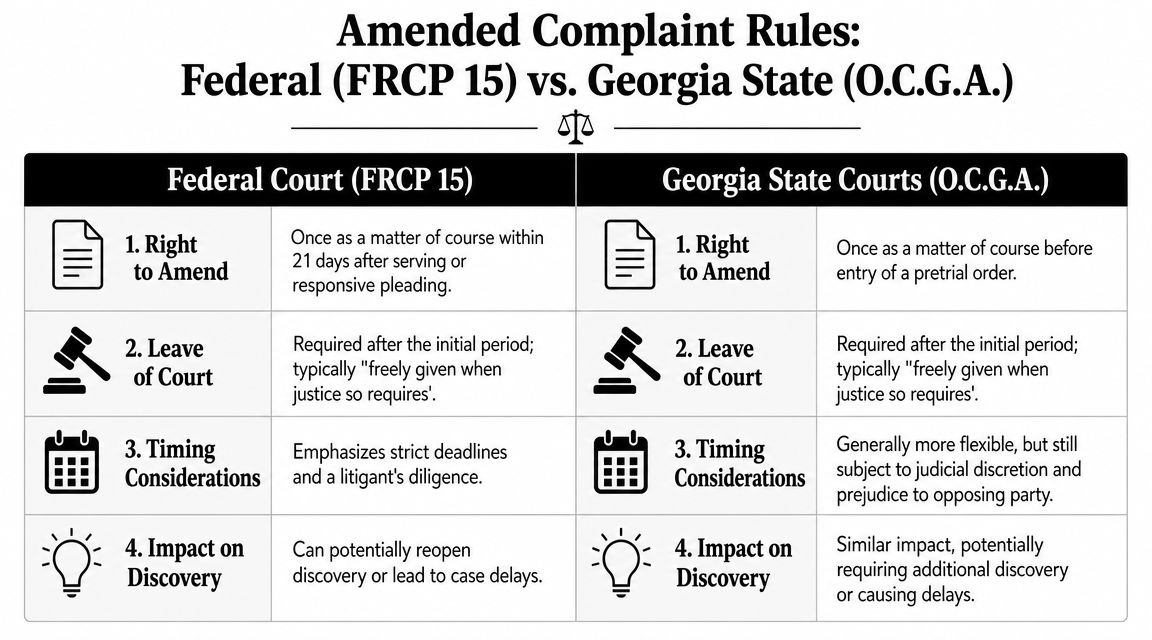
A side-by-side practical comparison
| Issue | Federal court | Georgia state court |
|---|---|---|
| Early amendment right | One amendment as of course within the Rule 15 timing framework already discussed above | Amendment as a matter of course is generally available before entry of a pretrial order |
| Later amendment | Usually requires consent or leave of court | Also generally requires court involvement once the automatic period ends |
| Scheduling pressure | Rule 16 deadlines can become decisive | Trial court management and prejudice concerns still matter |
| Effect on case management | Amendment may affect motions, responses, and discovery | Similar practical effects, though state-court pacing can feel different |
What this means in Alpharetta and Cumming cases
If a dispute is in the Northern District of Georgia, the federal deadlines often arrive faster and with less room for improvisation. Lawyers need to evaluate amendment needs early, particularly if a Rule 12 motion is pending or a scheduling order is approaching.
If the same type of dispute is in Forsyth County Superior Court or Fulton County Superior Court, the amendment conversation may unfold differently. Georgia state practice can offer more flexibility before a pretrial order, but flexibility isn't the same as safety. Judges still care about delay, fairness to the other side, and whether the proposed change would complicate the case.
This distinction matters across the firm's local footprint, including Johns Creek, Milton, Roswell, Sandy Springs, and surrounding North Georgia communities. The right procedural move in federal court may be unnecessary, premature, or even counterproductive in state court.
The family law contrast matters too
Most domestic relations cases stay in Georgia state court, not federal court. So if you're dealing with divorce, child custody, child support, legitimation, contempt, alimony, mediation, or property division, your case will usually follow Georgia procedure rather than the FRCP.
That local context matters because clients often have more than one legal problem at once. A business owner in Alpharetta may be managing both a civil dispute and a high-asset divorce. A parent in Cumming may be handling a custody case while also defending a separate business claim. In Georgia family law, the court applies equitable division in Georgia, local mediation requirements, temporary hearing practice, and parenting plan requirements. In federal civil litigation, the court applies Rule 15, Rule 16, and related pleading doctrine. Good strategy starts with knowing which system you're in.
The first procedural question is often the most important one. Federal court or Georgia state court.
Why Choose Miles Hansford for Your Cumming Civil Litigation Needs
Complex procedure doesn't need to feel unmanageable. What clients usually need most is clear judgment about timing, risk, and what move improves the case. That is true in federal civil litigation, and it's just as true in local matters filed in Forsyth County Superior Court, Fulton County Superior Court, and other North Georgia courts.
For clients in Cumming, GA, Alpharetta, GA, Johns Creek, Milton, Roswell, Suwanee, Dawsonville, Sandy Springs, and Canton, the benefit of experienced counsel isn't just rule knowledge. It's knowing when to amend, when to hold position, when to press for a ruling, and when a procedural issue is really a larger case strategy issue.
That perspective matters across a broad range of disputes. Some clients need help with business litigation in state or federal court. Others are facing divorce, contested custody, child support, legitimation, modifications, contempt actions, alimony, or mediation under Georgia law. In both settings, deadlines matter, local court practice matters, and early decisions often shape the outcome of the case.
If you're looking for a litigation or family law attorney "near me" in Alpharetta, Cumming, Forsyth County, or Fulton County, the right next step is a focused case review with someone who can tell you what applies, what doesn't, and what needs to happen now.
Frequently Asked Questions About Amending Complaints in Georgia
Q: Can I amend a complaint without asking the judge in federal court?
A: Sometimes, yes. Federal Rule 15(a)(1) allows one amendment as a matter of course within the rule's early timing window. After that, you usually need written consent from the other side or leave of court. In the Northern District of Georgia, timing and local procedure both matter.
Q: Does an amended complaint replace the original complaint?
A: Usually, yes. In federal practice, an amended complaint generally supersedes the original pleading. That can affect pending motions and response deadlines. The practical result is that the court and the parties often focus on the amended pleading as the operative complaint going forward.
Q: Is federal court different from Forsyth County or Fulton County amendment practice?
A: Yes. Federal court uses Rule 15 and scheduling-order analysis. Georgia state court follows different procedural rules, including broader amendment flexibility before a pretrial order in many cases. Whether you're in Forsyth County Superior Court or Fulton County Superior Court can change the timing analysis.
Q: What if I discover new facts late in the case?
A: Late-discovered facts don't automatically block amendment, but they can make the motion harder. Once a scheduling-order deadline has passed in federal court, the court will often focus on diligence and good cause. Documenting when the information was found and why it wasn't available earlier becomes important.
Q: Does this affect family law cases in Alpharetta or Cumming?
A: Usually not in the same way, because divorce, custody, child support, legitimation, and modification cases are generally handled under Georgia procedure in state court, not under the FRCP. Still, the same strategic lesson applies. In local family law, temporary hearings, mediation, and parenting plans all reward early, organized action.
Q: How does Georgia family law differ from a federal civil case?
A: Georgia family law involves issues like Georgia no-fault divorce laws, the 30-day minimum waiting period in Georgia, equitable division, child custody standards, and court-required parenting plans. A federal civil case focuses on pleading rules, motions, and federal scheduling orders. They are different systems with different procedural demands.
Q: Should I wait to amend until the other side points out the defect?
A: Usually no, if the defect is real and curable. Waiting can waste the easiest amendment window and may create a harder Rule 16 issue later. The better approach is to evaluate the pleading promptly and make a deliberate choice based on the actual strength of the complaint.
If you're dealing with a federal pleading issue, a business dispute, or a family law matter in Alpharetta, Cumming, Forsyth County, or Fulton County, Miles Hansford Law Firm can help you assess the rules, the deadlines, and the strategy that fits your case. Schedule a consultation, speak with a family law attorney or civil litigator, and get clear guidance before a timing issue turns into a bigger problem. Call today to protect your rights, your assets, and your next move.
Meta Title: FRCP Amended Complaint in Alpharetta GA Guide
Meta Description: FRCP amended complaint guide for Alpharetta, GA. Learn federal vs Georgia amendment rules, local court strategy, and when to schedule a consultation.
Suggested URL Slug: /frcp-amended-complaint-alpharetta-ga
Internal Link Suggestions:
- How to Respond to a Lawsuit
- How to Sue a Company
- Defamation Statute of Limitations
- Business Litigation
- Divorce Attorney in Cumming, GA
- Child Custody Attorney in Alpharetta, GA
Schema Recommendations:
- Attorney
- LegalService
- FAQPage