


When you're facing a child custody dispute in Cumming, GA, the weight of what happens next can feel overwhelming. Protecting your children’s future and your parental rights is your only priority. The team at Miles Hansford understands. We are seasoned family law attorneys who practice in Forsyth and Fulton County every day. This guide is designed to provide a calm, direct path through the Georgia child custody laws that will shape your case.
Your first step is to understand your rights. Schedule a consultation with a protective family law attorney today.

Why Child Custody Laws Matter in Cumming, GA
In Georgia, every custody ruling is driven by a single, guiding principle: the best interests of the child. A judge’s focus will be on your child's well-being and need for stability, not on what might seem "fair" to you or the other parent. The local courthouse matters immensely. A judge in the Forsyth County Superior Court might have procedural habits that are different from a judge in a North Fulton courtroom. An attorney who is in these specific courts every day brings a real-world advantage to the table.
We can walk you through all the fundamental concepts, from drafting the required parenting plan to understanding the fine points of sole versus joint custody. With our deep experience in Alpharetta and Cumming courtrooms, we are ready to help you find stability for your family.
Key Custody Concepts in Georgia Law
For parents living in Cumming, Alpharetta, Johns Creek, and Milton, the first step is often learning the language of the court. Georgia law breaks custody down into two main categories. Understanding these distinctions is the foundation of your case.
| Custody Type | What It Means for Parents | Common Application in Forsyth & Fulton County |
|---|---|---|
| Legal Custody | This is the right to make major decisions for your child. Think education, healthcare, religion, and other significant life choices. | Courts often award joint legal custody, requiring parents to cooperate on big-picture decisions. |
| Physical Custody | This simply determines where the child lives the majority of the time. The parent with primary physical custody has the child most often. | One parent is typically named the primary physical custodian, while the other has a set visitation schedule. |
Courts across North Georgia, including those in Roswell and Suwanee, are increasingly leaning toward joint custody arrangements where parents share these duties. To make that work, you absolutely need a clear, court-approved parenting plan. We can provide a closer look at the process, and you can learn much more about how to prepare for your Georgia child custody case in our detailed article.
It’s a common myth that courts automatically favor mothers in custody battles. Georgia law is explicitly gender-neutral. The decision comes down to which parent is better able to provide a stable and nurturing home.
The Legal Process for a Custody Case in Cumming

When a Georgia court makes a decision about child custody, whether in Cumming, Alpharetta, or anywhere else in North Georgia, every ruling comes back to one legal standard: the best interests of the child. This standard, found in O.C.G.A. § 19-9-3, is the single most important factor in your case.
It's natural for parents to focus on what feels "fair" to them, but that's not how the court sees it. The analysis is an exclusively child-focused process designed to secure a safe, stable, and nurturing life for your child.
What Georgia Courts Consider in Custody Cases
A Forsyth County Superior Court judge has a legal roadmap they must follow. They are required to weigh a specific list of 17 factors to figure out what arrangement truly serves a child’s well-being. The job of an experienced attorney is to build a strategic case around these very factors.
Some of the key considerations include:
- Emotional Bonds: The love, affection, and emotional connection between the child and each parent.
- Parental Capacity: Each parent’s ability to give the child love, guidance, education, and the necessities of life.
- Knowledge of Needs: How well each parent knows and can provide for the child’s unique needs—be they medical, educational, or emotional.
- Home Environment: The stability and safety of the home each parent provides. A judge will be looking for a consistent and supportive environment.
- Parental Conduct: Any history of family violence, substance abuse, criminal activity, or other conduct that could harm the child.
This list isn't the final word. The court can look at any other factor it believes is relevant. Much of our work with families in Johns Creek and Roswell involves gathering the right evidence, from school records to witness statements, that directly addresses these points.
The Role of a Child’s Preference in a Cumming Custody Case
One of the most common questions we get from parents in Milton and Dawsonville is, "Does my child get a say?" Georgia law provides a clear answer, but it comes with important boundaries.
- Children Aged 14 and Older: A child who is 14 years or older has the right to choose which parent they want to have primary physical custody. That choice is usually honored by the court, unless there is a compelling reason not to.
- The Judge's Veto Power: This right isn't absolute. A judge in Forsyth County can overrule the child’s election if they find that the chosen parent is unfit or that living with them would not be in the child's best interests.
- Children Aged 11 to 13: For children between the ages of 11 and 13, the court can listen to their wishes, but their preference is not binding. It’s just one piece of the puzzle the judge considers.
Presenting a successful case is about much more than telling your side of the story. It’s about translating your dedication as a parent into the specific legal language the court understands—the language of the "best interests" standard. Do not agree to any custody terms without speaking to an attorney. Your next step should be a confidential consultation to discuss how to build a case that protects what matters most: your child.
Strategic Parenting Plans Required by Alpharetta Courts
In any Georgia child custody case, a detailed, written Parenting Plan isn't just a suggestion—it's a legal requirement. For parents in Alpharetta, a vague or incomplete plan is a direct path to future conflict and more time spent in court. Fulton County and Forsyth County Superior Court judges expect a strategic plan that does much more than just outline a basic calendar.
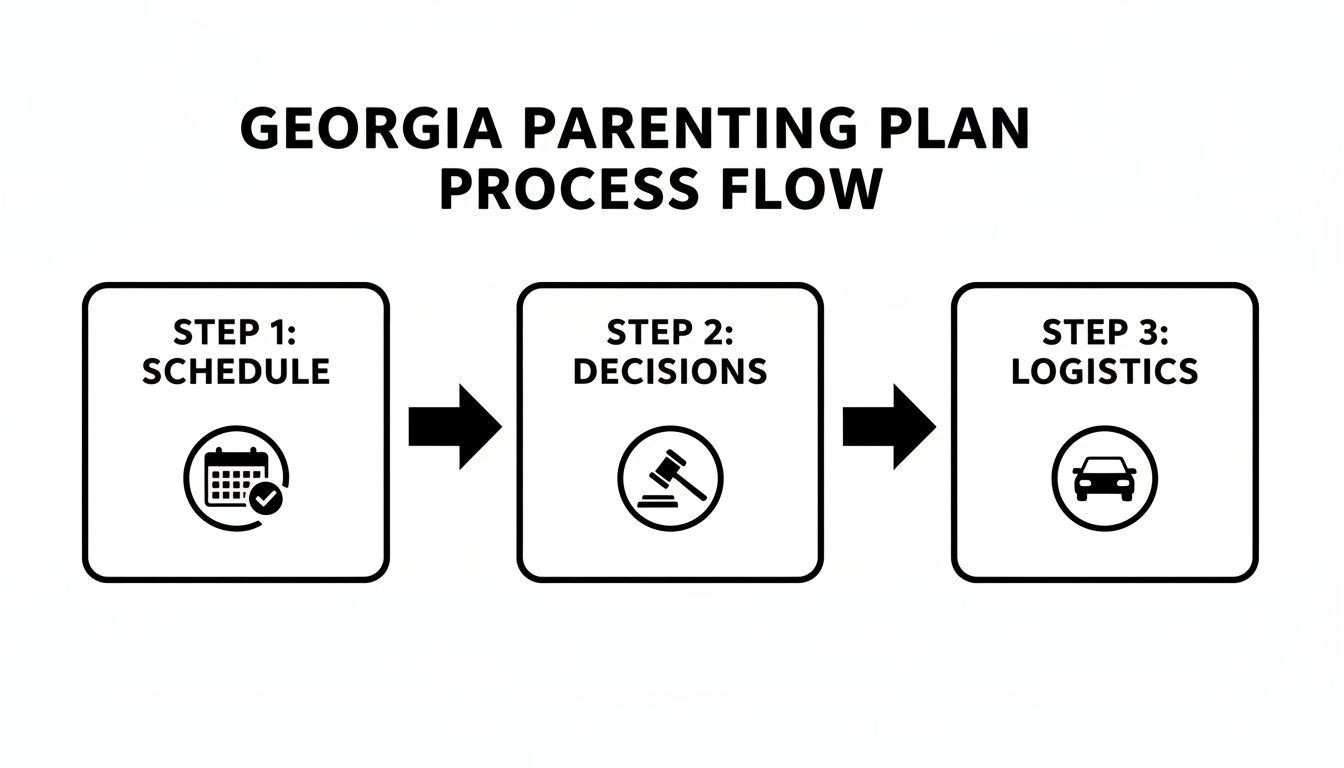
Think of this document as your family's operating manual for the years to come. It must lay out a clear schedule not only for day-to-day parenting time but also for holidays, school breaks, birthdays, and other significant dates. Getting these details right now prevents major disagreements later.
The image below breaks down the essential parts that every Georgia Parenting Plan needs to cover.
Decision-Making Authority in a Cumming Parenting Plan
Beyond the physical schedule, your plan must clearly state who has the final say in the four major areas of a child's life:
- Education: Decisions on school enrollment, tutoring, or special educational programs.
- Non-Emergency Healthcare: Choices about doctors, dentists, therapists, and routine medical care.
- Religion: The child’s religious upbringing and community involvement.
- Extracurricular Activities: Participation in sports, music lessons, clubs, and similar activities.
While parents can agree to make these decisions jointly, a critical component for families in Cumming and throughout Forsyth County is the tie-breaker provision. This clause names one parent who can make the final call if you reach a deadlock. Judges look for this specifically, as it ensures a disagreement won’t leave the child’s needs in limbo.
Proactive Logistics and Communication
An effective parenting plan anticipates future problems. We work with parents in Milton and Roswell to negotiate terms that prevent common conflicts by focusing on logistical details.
- Transportation: Who handles pick-ups and drop-offs? Where will exchanges take place?
- Communication Protocols: What are the rules for communication? When should you call, text, or email?
- Access to Records: How will you ensure both parents have full access to school and medical records?
Many families find a co-parenting schedule app helpful for managing logistics and keeping communication organized.
A well-drafted parenting plan is your best defense against future court dates. It creates the predictability and stability that children need and that Georgia judges demand to see. Ambiguity is the enemy of a peaceful co-parenting relationship.
Recent changes in Georgia law have reinforced the state’s move toward shared parenting. This has led to an increase in 50/50 physical custody schedules across the Atlanta metro area where it is workable. Building a parenting plan that will hold up in Fulton County or Forsyth County Superior Court is a detailed process. Speak with a family law attorney to make sure your plan is built to protect both your child and your parental rights.
What to Expect in Forsyth and Fulton County Courts
Walking into a custody case can feel overwhelming. For parents in Cumming, Alpharetta, and surrounding areas like Sandy Springs and Canton, knowing the steps involved—from filing the first papers to getting a final order—can make all the difference.
Every custody case, whether part of a divorce or a separate legitimation or modification action, follows a structured legal journey. It begins by filing a petition with the correct court, either the Forsyth County Superior Court or the Fulton County Superior Court.

Temporary Hearings Strategy in a Cumming Case
Soon after a case begins, you will likely face a temporary hearing. A judge makes quick, initial decisions on physical custody, parenting time, child support, and even who stays in the family home.
Temporary orders are incredibly powerful. While not permanent, they create a "status quo." If a judge sees an arrangement is working well for the children after a few months, they are often very hesitant to disrupt that stability later. Your temporary hearing shapes the outcome of your case.
This is why arriving at that first hearing fully prepared is non-negotiable. A strong attorney can help you make a compelling case from the start. To help you prepare, we've put together a guide on what you should know before your Georgia child custody hearing.
Mediation and Discovery in an Alpharetta Case
Before a final trial, your case will go through discovery and mediation.
Discovery: This is the formal fact-finding process where your attorney gathers information using legal tools like written questions (interrogatories) and sworn testimony (depositions). The goal is to collect all the evidence needed to build your case.
Mediation: In both Alpharetta and Cumming, mediation is required. You and the other parent will sit down with a trained, neutral mediator to try and work out a settlement. This process is confidential and keeps you in control of the outcome, and a huge number of cases in Forsyth and Fulton counties are resolved this way.
High-Conflict Cases and the Guardian ad Litem
When parents in places like Roswell or Sandy Springs cannot agree, a judge might appoint a Guardian ad Litem (GAL). A GAL is an attorney who represents the child's best interests. They act as the court's independent investigator, tasked with figuring out what custody situation would be best for the child by interviewing all parties, conducting home visits, and reviewing records before making a recommendation to the judge. A GAL's report carries tremendous weight in North Georgia courts.
Navigating these procedures demands local experience and a protective strategy. Call Miles Hansford today to speak with an attorney who knows the Forsyth and Fulton County court systems inside and out.
How to Modify or Enforce a Custody Order in Cumming
A final custody order offers stability, but Georgia law understands that life changes. Jobs, schools, and children's needs evolve. When a major life event happens, your current parenting plan might no longer be in your child’s best interest, which means it’s time to seek a formal modification. At other times, the problem is not the plan, but one parent's refusal to follow it.
When Can You Modify Custody in a Cumming Case?
You cannot change a custody order just because you dislike it. In Georgia, you must prove to the court that there has been a “substantial and material change in circumstances” since the last order was signed. This change must also directly affect the child’s well-being.
A judge in the Forsyth County Superior Court will look for clear evidence of a significant shift. Common reasons that justify a modification include:
- Parental Relocation: One parent plans a move that makes the current visitation schedule unworkable.
- Change in Work Schedule: A parent’s new job makes it hard to keep up with parenting time.
- Concerns About the Child’s Environment: New evidence of substance abuse, neglect, or other unsafe conditions.
- The Child’s Evolving Needs: As children age, their schedules change, and the custody arrangement may need to adapt.
Even if both parents agree on a change, you must file the proper paperwork with the court. A verbal agreement is not legally enforceable.
Enforcing a Custody Order in an Alpharetta Case
What can you do if the other parent repeatedly violates the parenting plan? In an Alpharetta or Fulton County courtroom, the primary tool is a contempt action.
Filing a Motion for Contempt means you are asking a judge to officially rule that the other parent has willfully disobeyed a court order. This is a legal step to force them to comply and restore stability for your child.
If the judge finds the parent in contempt, they can order solutions, such as granting make-up parenting time, ordering the non-compliant parent to pay your attorney’s fees, or even imposing fines or jail time for serious violations. Life changes are a given. Whether you are in Dawsonville, Canton, or right here in Cumming, you have the right to ask for a custody modification or enforce an existing order. Call today to speak with a family law attorney and protect your rights.
Why Choose Miles Hansford for Your Cumming Child Custody Case
Deciding on legal representation when your family's future is involved is one of the most critical choices you will make. For families in Cumming and Alpharetta, you need a team that understands the local courts and can guide you with a calm, strategic, and protective hand.
At Miles Hansford, our attorneys don't just know Georgia child custody laws—we work with them every day in the courtrooms of Forsyth County and Fulton County. This daily practice gives us a crucial understanding of how judges in our community, from Johns Creek to Milton and Suwanee, handle complex family law cases.
Strategic and Protective Representation in Your Cumming Case
We know this is an overwhelming time. Our attorneys aim to cut through the legal complexity and offer a clear, straightforward path to protect your interests. A custody matter in Cumming is handled differently than one in Roswell, and knowing the specific procedures of the Forsyth County Superior Court is vital.
Your case is about your life and your children. Our focus is on protecting your parental rights and working to shield your children from the conflict of the legal process.
Our firm is committed to helping you find a stable path forward. We have experience representing a wide range of parents, including high-income professionals in Alpharetta and families in Dawsonville and Canton. We know the local system and what it takes to build a strong case that addresses what North Fulton judges need to see. Choosing a family law attorney "near me" means finding a firm that is part of the local legal community. Call Miles Hansford today to protect what matters most.
Frequently Asked Questions About Georgia Child Custody Laws
Q: At what age can my child choose which parent to live with in Georgia?
A: In Georgia, a child who is 14 years or older has the right to elect which parent they want to have primary physical custody. A Forsyth County judge will generally honor this choice unless there is evidence that the chosen parent is unfit or the decision is not in the child's best interests. For children between 11 and 13, their preference may be considered but is not controlling.
Q: Is 50/50 custody common in Cumming, GA?
A: Yes, 50/50 joint physical custody is increasingly common in Cumming and Forsyth County courts, especially when parents live relatively close and can cooperate. Judges support arrangements that keep both parents actively involved. However, a 50/50 schedule does not automatically eliminate child support; the calculation is still required under Georgia law, though the equal time is a factor for deviation.
Q: What happens if we can't agree on a parenting plan in Forsyth County?
A: If you and the other parent cannot agree, the Forsyth County Superior Court will almost always require you to attend mediation. This process uses a neutral third party to help you find a resolution. If mediation fails, a judge will hold a hearing or trial and create a parenting plan for you based entirely on the child's best interests.
Q: How do I get emergency custody in Cumming, GA?
A: To get emergency custody, you must file a specific motion with the Forsyth County Superior Court and provide clear evidence that your child is in immediate physical or emotional danger. These "ex parte" orders are granted only in urgent situations. If successful, the court issues a temporary order and schedules a full hearing with both parents very quickly.
Q: What is the difference between legal and physical custody in Georgia?
A: Physical custody determines where the child lives, with one parent often named the "primary physical custodian." Legal custody is the right to make major decisions about the child's education, healthcare, religion, and activities. In most Cumming and Alpharetta cases, courts award joint legal custody, requiring both parents to consult on these important matters.
Q: Does Georgia law favor mothers in custody cases?
A: No. Georgia child custody laws are explicitly gender-neutral. The courts do not have a preference for mothers or fathers. Every decision made by a judge in Fulton County or Forsyth County is based on the "best interests of the child" standard, focusing on which parent can provide a more stable, safe, and nurturing environment for the child.
Q: What happens if my ex violates the custody order in Alpharetta?
A: If the other parent willfully violates a court-ordered parenting plan, you can file a contempt action in the Fulton County Superior Court. If the judge finds them in contempt, they can enforce the order by granting you make-up parenting time, ordering the other parent to pay your attorney’s fees, or imposing other penalties to ensure compliance.
Q: How does child support work with custody in Georgia?
A: Child support is calculated using a formula based on both parents' incomes. The parenting time schedule is a key factor. While a 50/50 schedule may lead to a deviation from the standard calculation, it does not automatically mean no support is paid. You can learn more about Georgia child support laws on our site.