


The thought of giving up your parental rights is one of the most difficult and emotional decisions a person can face. If you are in Cumming, GA, or anywhere in North Georgia and exploring this path, you need clear, direct information from a team that understands the gravity of the situation. At Miles Hansford, we are here to explain what this process truly involves, offering professional guidance without judgment.
The choices you make now will have permanent consequences. It is critical to have a strategic legal partner who can protect your interests and guide you through the complexities of the Forsyth County and Fulton County court systems. Schedule a consultation with our compassionate family law team today.
Why Giving Up Parental Rights Matters in Cumming
In Georgia, terminating parental rights is a permanent and irreversible legal action that completely severs the legal ties between a parent and their child. This is not a modification of a child custody agreement; it is a final, binding decision made by a Superior Court judge, whether in Forsyth County or a neighboring jurisdiction like Fulton County.

Once a judge signs the final termination order, the legal relationship of parent and child is gone forever. You lose all legal rights and responsibilities associated with being that child's parent.
The Irreversible Nature of This Decision
We cannot overstate the finality of this court order. A termination of parental rights is not something you can reverse if your circumstances change or you have second thoughts. It is a complete and total legal separation.
This means you lose:
- All rights to custody and visitation with your child.
- The legal authority to make any decisions about your child’s schooling, medical care, or religious upbringing.
- Any right to inherit from your child, and they likewise lose the right to inherit from you.
In the eyes of Georgia law, you essentially become a stranger to the child. While this action does end your obligation to pay future child support, it is important to know that any past-due support (arrears) you already owe typically remains a debt.
Why Forsyth and Fulton County Courts Take This So Seriously
In Georgia family law, terminating the parent-child relationship is the most drastic measure a court can take. It’s a decision with lifelong consequences for everyone involved.
A Georgia judge in Cumming or Alpharetta will only approve a termination of parental rights if they are convinced it is truly in the child’s best interest. This often happens only when another stable, permanent home is waiting for the child, such as through an adoption.
One of the most common scenarios we handle is a stepparent adoption. In these cases, one biological parent voluntarily agrees to give up their rights, allowing their child's stepparent to step in and legally adopt them. This process provides stability for children in families throughout communities like Johns Creek, Milton, and Suwanee. Understanding how this process works is crucial, and you may find our guide on what you should know about adoption in Georgia helpful.
The Legal Process: Voluntary vs. Involuntary Termination in Georgia
When it comes to the termination of parental rights, Georgia law draws a clear line between two distinct situations: a parent willingly giving up their rights (voluntary surrender) and a court forcing the issue against a parent's wishes (involuntary termination). The path a case follows fundamentally changes everything, from the paperwork filed in the Forsyth County Superior Court to the arguments made before a judge.
For parents in Cumming, Alpharetta, and surrounding North Georgia communities, understanding this difference from the very beginning is critical. One path is cooperative; the other is an intense legal battle.
Voluntary vs. Involuntary Termination in Georgia
| Aspect | Voluntary Termination | Involuntary Termination |
|---|---|---|
| Parental Consent | The parent willingly agrees to give up their rights through a legal surrender. | The parent does not consent and actively opposes the termination. |
| Typical Scenario | Often part of a stepparent adoption where the biological parent agrees to the adoption. | A parent, relative, or DFCS files a petition due to serious concerns like abandonment or abuse. |
| Legal Nature | Cooperative. The process focuses on ensuring the parent's consent is genuine and informed. | Adversarial. It's a legal fight where one party must prove the other is unfit under Georgia law. |
| Burden of Proof | The court must confirm the consent was given freely, without pressure or coercion. | The person seeking termination must prove their case with “clear and convincing evidence.” |
The Strategy for Voluntary Surrender in Cumming, GA
A voluntary surrender of parental rights is precisely what it sounds like: a parent makes a conscious, willing decision to legally end their relationship with their child. We see this most often in the context of a steppare`nt adoption. For example, a mother in Cumming has remarried, and her new husband wants to adopt her child. If the child's biological father is no longer involved, he can sign a specific legal consent form to give up his rights.
This clears the way for the adoption to proceed, giving the child the stability of two legal parents in the home. The Forsyth County Superior Court still oversees the process to ensure the decision was made freely and without duress.
Facing Involuntary Termination in Alpharetta, GA
Involuntary termination, on the other hand, is a lawsuit. One party petitions the court to sever another parent's rights completely, and it is always a contentious and serious matter. These actions can be brought by the other parent, another family member, or Georgia's Division of Family & Children Services (DFCS) in the Fulton County Superior Court or other North Fulton courts.
Georgia law sets an extremely high bar for involuntary termination. The party seeking to terminate rights must prove their case with “clear and convincing evidence.”
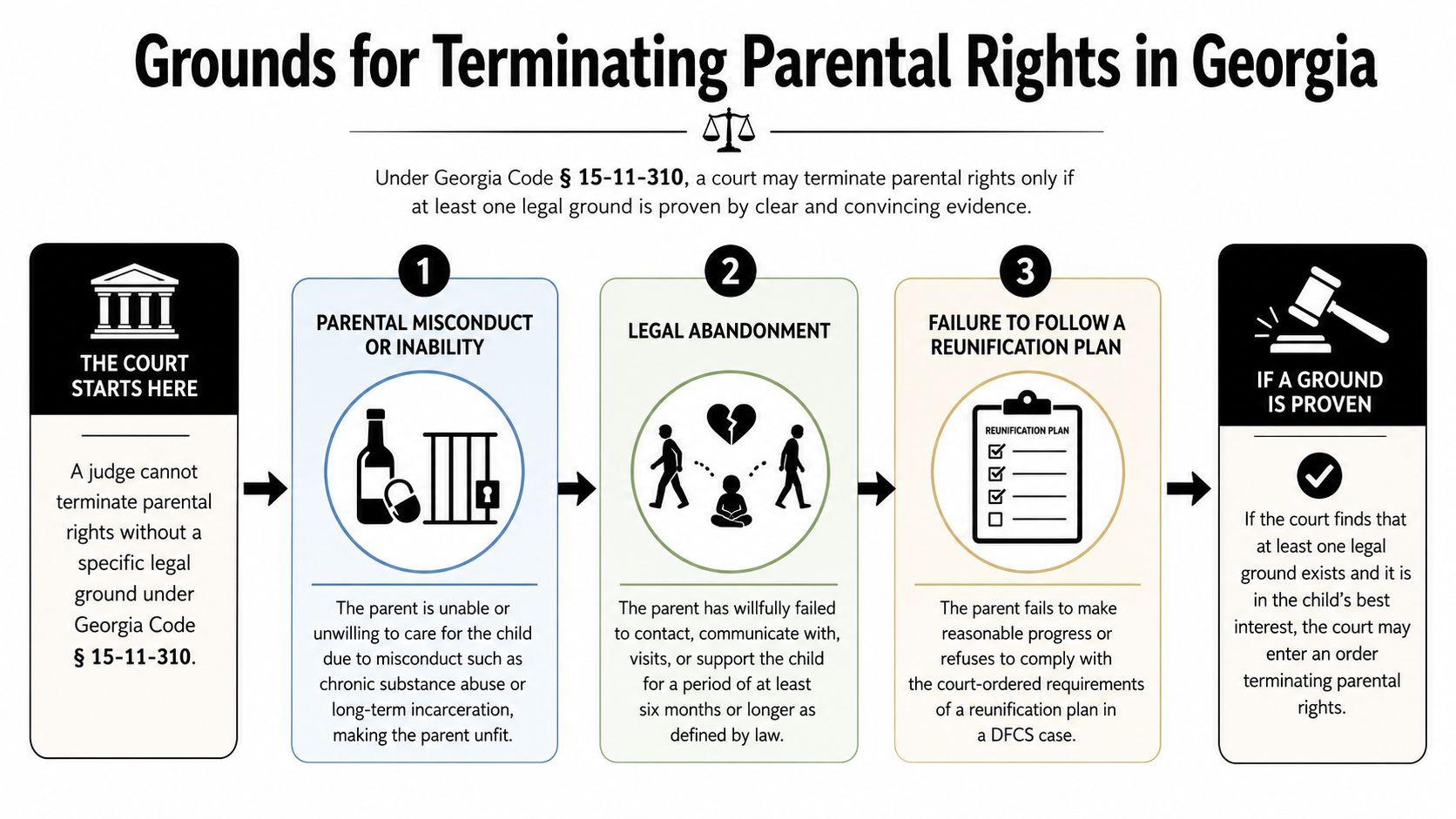
This is a much tougher standard than in most civil cases, reflecting the gravity of ending a parent-child relationship. A judge will not take away a parent's rights lightly. The person filing the case must prove legally recognized grounds, which could include:
- Abandonment: A demonstrated failure to communicate with or provide financial support for the child for a year or more.
- Parental Misconduct or Inability: Proof that a parent's circumstances, such as chronic substance abuse or long-term incarceration, make them unfit.
- Failure to Comply with a Court-Ordered Plan: Often seen in DFCS cases where a parent fails to complete required steps for reunification.
Whether you are considering a voluntary surrender to facilitate an adoption in Suwanee or defending against a termination petition in Roswell, you need to know where you stand. Each situation demands a very different legal strategy. Speak with a family law attorney at Miles Hansford to understand your rights and protect your family.
What to Expect in Forsyth and Fulton County Courts
Few actions are as permanent or emotionally significant as terminating parental rights. In Georgia, a judge in Forsyth County or Fulton County will not take this step lightly. The court’s decision must be grounded in specific, provable reasons, always with the child's best interest as the guiding principle, as outlined in Georgia Code § 15-11-310. For families in Cumming, Milton, and Johns Creek, understanding what a judge considers is the first step in knowing where you stand.
Parental Misconduct or Inability
A primary reason a court might consider termination is parental misconduct or inability. This is not about disagreements over parenting styles. It refers to severe, ongoing problems that prove a parent is unfit to provide a safe and stable home.
A North Fulton judge will require clear and convincing evidence of serious issues, such as:
- Chronic, un-rehabilitated substance abuse that puts the child's well-being at risk.
- A long-term prison sentence making it impossible for the parent to fulfill their responsibilities.
- Felony convictions for crimes against the child or a sibling.
- A medically verifiable mental or emotional illness so severe it prevents the parent from providing adequate care.
For instance, a parent in Roswell with a long, documented history of drug addiction who has failed multiple treatment programs may face a termination petition if their behavior continues to endanger their child.
Abandonment Under Georgia Law
Another significant ground is abandonment, which has a very specific legal definition in Georgia. It’s more than just being an absent parent. In Georgia, abandonment is legally defined as a parent failing to communicate with or provide financial support for their child for a period of one year or longer before the petition is filed.
Imagine a parent who moves out of Canton or Dawsonville, cuts off all contact—no calls, no letters, no support—for over a year. A Forsyth County Superior Court judge could view this lack of action as legal abandonment.
Failure to Comply with a DFCS Reunification Plan
When Georgia’s Division of Family & Children Services (DFCS) becomes involved, the court often creates a reunification plan—a formal, court-ordered roadmap of steps a parent must take to safely reunite with their child.
If a parent substantially fails to follow this plan—by refusing mandatory counseling, failing drug tests, or not securing stable housing as ordered—this can become grounds for terminating their parental rights. It demonstrates to the court an inability or unwillingness to create a safe environment.
Navigating these legal grounds is complex. Do not agree to custody terms without legal representation. Whether you believe grounds exist to terminate another parent's rights or you are facing such a petition, it is critical to have experienced guidance. Contact Miles Hansford today to protect your parental rights.
The Strategy: Navigating the Legal Process in Alpharetta Courts
The legal process for giving up parental rights in Georgia can feel incredibly complex and intimidating. Our strategy is to provide a straightforward, protective overview of what you can expect in the North Georgia court system, whether your case is heard in Forsyth County or a North Fulton court.
It all starts with filing a formal Petition for Termination of Parental Rights. This is a detailed legal document that must clearly state the legal grounds for the request and be filed with the correct Superior Court—which, for residents of Alpharetta or Johns Creek, is typically in Fulton County.
Key Stages in a Termination of Parental Rights Case
After the petition is filed, the case unfolds in several distinct stages, each with strict legal rules and deadlines.
First, the other parent must be formally notified through service. This usually means a sheriff's deputy or a private process server hand-delivers a copy of the lawsuit. If the parent can't be found in places like Milton or Suwanee, the court may require service by publication, where a notice is posted in a local newspaper.
Next, the court will often appoint a Guardian ad Litem (GAL), a neutral attorney appointed to represent the child's best interests. The GAL investigates the case, interviews all parties, and makes a recommendation to the judge.
The Termination of Parental Rights Process in North Georgia
Here’s a step-by-step look at how a typical Termination of Parental Rights (TPR) case proceeds in courts like those in Forsyth or Fulton County.
| Step | Description | Local Consideration |
|---|---|---|
| 1. Petition Filing | An attorney drafts and files the Petition for Termination of Parental Rights, outlining specific legal grounds. | Must be filed in the Superior Court of the county where the child resides, such as Cumming for Forsyth County cases. |
| 2. Service of Process | The other parent is formally served with the lawsuit paperwork. | If the parent is hard to locate in the North Georgia area, additional steps may be needed. |
| 3. Guardian ad Litem | The court appoints a GAL to investigate the child's best interests independently. | The GAL's report carries significant weight with judges in Forsyth and Fulton County family courts. |
| 4. Discovery Phase | Both sides exchange information through written questions (interrogatories), document requests, and depositions. | This critical evidence-gathering stage builds the foundation for your case. |
| 5. Mediation/Hearings | The court may order mediation or hold temporary hearings to address immediate issues. | Many North Georgia judges require mediation before allowing a case to proceed to a final trial. |
| 6. Final Trial | If no settlement is reached, a formal trial is held where a judge hears evidence and makes a final ruling. | This is an evidentiary hearing where witness testimony and documents are presented to prove the case. |
Building Your Case for Court
The discovery phase is where the case is built. Attorneys request documents, send written questions (interrogatories), and conduct depositions (sworn testimony taken outside of court).
A judge in Cumming or Alpharetta will not terminate parental rights without clear and convincing evidence. Organizing this evidence is vital. Bates numbering, which gives every page a unique identifier, is essential for organization. For those dealing with extensive paperwork, knowing how to customize Bates numbering in PDFs can be a lifesaver.
The final step is the trial itself. Because the outcome is permanent, preparation must begin from day one. You can get more insights by reading our guide on how to prepare for a custody hearing.
Why Choose Miles Hansford for Your Cumming, GA Case
When facing a legal issue as personal and significant as parental rights, you need more than just a lawyer; you need a strategic advocate deeply familiar with the local court systems in Cumming and Alpharetta. At Miles Hansford, our attorneys provide both compassionate counsel for you and strong, assertive representation in the courtroom. Our mission is to protect your rights and secure the best possible outcome for your family.
Local Knowledge of Forsyth and Fulton County Courts
We are in the Forsyth County Superior Court and Fulton County Superior Court on a regular basis. This isn't a talking point; it means we have a real, practical understanding of local procedures, judicial tendencies, and the specific legal details that can make or break a case involving parental rights. Our attorneys know how judges across North Georgia, from Roswell to Dawsonville, handle these sensitive matters. This allows us to build a case strategy that anticipates challenges and protects your interests.
We provide the calm, authoritative guidance you need to navigate this difficult time. We ensure you fully understand the permanent nature of these decisions, whether you are completing a stepparent adoption or defending against a termination petition.
When the stakes are this high, local experience is not just an advantage; it's a necessity. We are in these courts every day, fighting for families like yours.
You do not have to face this alone. Schedule a confidential consultation to discuss your case with a seasoned family law attorney near me.
Frequently Asked Questions About Giving Up Parental Rights in Cumming, GA
Q: Can I give up parental rights in Georgia just to avoid child support?
A: No. A Georgia court will never terminate parental rights solely to end a child support obligation. A judge in Forsyth County or Fulton County will only grant a termination if it's proven to be in the child’s best interest, which almost always requires another qualified adult, like a stepparent, to be ready to legally adopt the child and assume full financial responsibility.
Q: Can I get my parental rights back after they are terminated in Georgia?
A: No. In Georgia, a court order terminating parental rights is both permanent and irreversible. Once a judge in a North Georgia court finalizes the order, the legal relationship is completely and forever severed. There is no legal process to "undo" the decision or have your rights restored later, regardless of how your circumstances change.
Q: Does the other parent have to agree for me to give up my rights in Cumming, GA?
A: Not always, but the other parent's position is a major factor. In a voluntary surrender for a stepparent adoption, their consent is a key part of the cooperative process. However, if you are facing an involuntary termination petition in a Forsyth County court, their agreement isn't needed. The court is being asked to terminate your rights against your will based on specific legal grounds.
Q: What happens if a parent cannot be found for a case in Forsyth County?
A: When a parent cannot be located for a termination case, the petitioner must prove to the court that they made a diligent effort to find them. If those attempts fail, the Forsyth County Superior Court may authorize service by publication. This involves publishing a legal notice in a local newspaper, like the Forsyth County News, allowing the case to move forward.
Q: How long does it take to terminate parental rights in Fulton County?
A: The timeline varies significantly. An uncontested voluntary surrender for a straightforward adoption in Fulton County might take only a few months. In contrast, a contested, involuntary termination case involving complex evidence and court schedules can easily take a year or longer, especially if a Guardian ad Litem needs time for a thorough investigation.
Q: What are the main grounds for involuntary termination in Georgia?
A: A Georgia court will only grant an involuntary termination based on specific legal grounds proven by clear and convincing evidence. The most common grounds include parental abandonment (no contact or support for over a year), significant parental misconduct or inability (like chronic substance abuse), or failure to comply with a court-ordered DFCS reunification plan.
Q: Will I still owe back child support if my rights are terminated?
A: Yes. While a termination order ends your obligation to pay future child support, it does not erase any past-due support, known as arrears. Any child support debt you owed before the termination order was signed remains a legally enforceable debt that you are still required to pay.
Meta Title: Giving Up Parental Rights in Cumming, GA | Miles Hansford
Meta Description: Considering giving up parental rights in Cumming, GA? Learn about the irreversible legal process in Forsyth & Fulton County. Call Miles Hansford to protect your rights.
URL Slug: /giving-up-parental-rights-cumming-ga/
Internal Link Suggestions:
- Link "child custody agreement" to the Child Custody page.
- Link "stepparent adoption" to the Adoption page.
- Link "high-asset divorce" (if mentioned, contextually) to the High-Asset Divorce page.
- Link "family law attorney near me" to the main contact or homepage.
Schema Recommendations:
{
  "@context": "https://schema.org",
  "@type": "LegalService",
  "name": "Miles Hansford & Tallant, LLC",
  "description": "Expert legal guidance on giving up parental rights in Cumming, GA. Our family law attorneys navigate the complexities of Forsyth and Fulton County courts to protect your interests.",
  "url": "https://www.mileshansford.com/giving-up-parental-rights-cumming-ga/",
  "image": "https://cdnimg.co/de707790-5550-4abd-b884-e7ebe4766cef/2219088e-97ab-4d9e-ab7e-6129af0d1932/image.jpg",
  "telephone": "+1-770-887-1209",
  "address": {
    "@type": "PostalAddress",
    "streetAddress": "315 Dahlonega St",
    "addressLocality": "Cumming",
    "addressRegion": "GA",
    "postalCode": "30040",
    "addressCountry": "US"
  },
  "geo": {
    "@type": "GeoCoordinates",
    "latitude": 34.2098,
    "longitude": -84.1402
  },
  "areaServed": {
    "@type": "GeoCircle",
    "geoMidpoint": {
      "@type": "GeoCoordinates",
      "latitude": "34.2098",
      "longitude": "-84.1402"
    },
    "geoRadius": "50000"
  },
  "hasOfferCatalog": {
    "@type": "OfferCatalog",
    "name": "Family Law Services",
    "itemListElement": [
      {
        "@type": "Offer",
        "itemOffered": {
          "@type": "Service",
          "name": "Termination of Parental Rights"
        }
      }
    ]
  }
}
{
  "@context": "https://schema.org",
  "@type": "FAQPage",
  "mainEntity": [{
    "@type": "Question",
    "name": "Can I give up parental rights in Georgia just to avoid child support?",
    "acceptedAnswer": {
      "@type": "Answer",
      "text": "No. A Georgia court will never terminate parental rights solely to end a child support obligation. A judge in Forsyth County or Fulton County will only grant a termination if it's proven to be in the child’s best interest, which almost always requires another qualified adult, like a stepparent, to be ready to legally adopt the child and assume full financial responsibility."
    }
  },{
    "@type": "Question",
    "name": "Can I get my parental rights back after they are terminated in Georgia?",
    "acceptedAnswer": {
      "@type": "Answer",
      "text": "No. In Georgia, a court order terminating parental rights is both permanent and irreversible. Once a judge in a North Georgia court finalizes the order, the legal relationship is completely and forever severed. There is no legal process to 'undo' the decision or have your rights restored later, regardless of how your circumstances change."
    }
  },{
    "@type": "Question",
    "name": "Does the other parent have to agree for me to give up my rights in Cumming, GA?",
    "acceptedAnswer": {
      "@type": "Answer",
      "text": "Not always, but the other parent's position is a major factor. In a voluntary surrender for a stepparent adoption, their consent is a key part of the cooperative process. However, if you are facing an involuntary termination petition in a Forsyth County court, their agreement isn't needed. The court is being asked to terminate your rights against your will based on specific legal grounds."
    }
  },{
    "@type": "Question",
    "name": "What happens if a parent cannot be found for a case in Forsyth County?",
    "acceptedAnswer": {
      "@type": "Answer",
      "text": "When a parent cannot be located for a termination case, the petitioner must prove to the court that they made a diligent effort to find them. If those attempts fail, the Forsyth County Superior Court may authorize service by publication. This involves publishing a legal notice in a local newspaper, like the Forsyth County News, allowing the case to move forward."
    }
  },{
    "@type": "Question",
    "name": "How long does it take to terminate parental rights in Fulton County?",
    "acceptedAnswer": {
      "@type": "Answer",
      "text": "The timeline varies significantly. An uncontested voluntary surrender for a straightforward adoption in Fulton County might take only a few months. In contrast, a contested, involuntary termination case involving complex evidence and court schedules can easily take a year or longer, especially if a Guardian ad Litem needs time for a thorough investigation."
    }
  },{
    "@type": "Question",
    "name": "What are the main grounds for involuntary termination in Georgia?",
    "acceptedAnswer": {
      "@type": "Answer",
      "text": "A Georgia court will only grant an involuntary termination based on specific legal grounds proven by clear and convincing evidence. The most common grounds include parental abandonment (no contact or support for over a year), significant parental misconduct or inability (like chronic substance abuse), or failure to comply with a court-ordered DFCS reunification plan."
    }
  },{
    "@type": "Question",
    "name": "Will I still owe back child support if my rights are terminated?",
    "acceptedAnswer": {
      "@type": "Answer",
      "text": "Yes. While a termination order ends your obligation to pay future child support, it does not erase any past-due support, known as arrears. Any child support debt you owed before the termination order was signed remains a legally enforceable debt that you are still required to pay."
    }
  }]
}