


Meta Title: Minor Guardianship in Alpharetta, GA
Meta Description: Minor guardianship in Alpharetta, GA. Learn Fulton and Forsyth probate steps, local court issues, and how to protect a child's stability.
Suggested URL Slug: /minor-guardianship-alpharetta-ga
A child may already be sleeping at your house every night. You may be the grandparent in Alpharetta getting school calls, packing lunches, and handling doctor visits while a parent struggles with illness, addiction, instability, or absence. Or you may be in Cumming trying to help a niece or nephew after a family crisis and realizing that good intentions alone don't let you enroll a child in school or consent to care.
That is usually the moment families start searching for answers about guardianship of a minor. They aren't looking for legal theory. They need a way to protect a child, keep life stable, and avoid making a bad move that creates more conflict later. In North Georgia, especially in Alpharetta, Cumming, Johns Creek, Milton, Roswell, and surrounding communities, this is often a probate court issue with very practical consequences.
A proper guardianship can create order when a child's life feels uncertain. It can also go wrong if the paperwork is incomplete, notice isn't handled correctly, or the order doesn't clearly define who can make decisions and what role the parents still keep. If you're worried about what happens next, the best next step is to schedule a consultation and get a case-specific plan before filing anything.
Securing a Child's Future with Guardianship in Alpharetta
A common North Fulton situation looks like this. A grandmother in Alpharetta has had her grandson for months. The child's mother is trying to recover and isn't consistently available. The father may be out of state, uninvolved, or objecting only when legal papers appear. School staff want formal authority. A pediatric office wants legal consent. The grandmother isn't trying to take over anyone's life. She is trying to keep the child safe and keep the week from falling apart.
Georgia law gives families a legal tool for that problem. Guardianship of a minor can give a responsible adult authority to make daily decisions for a child when the parents can't do so reliably. That authority matters in ordinary moments, not just emergencies. It matters when school starts, when a prescription needs approval, and when a child needs one adult the system recognizes as responsible.
In Alpharetta and Cumming, families often wait too long because they hope things will settle down on their own. Sometimes they do. Often they don't. Delay tends to create the same pattern over and over. The child remains with a relative, but the adult providing care has uncertain legal authority and no court order to fall back on when a school, doctor, or agency asks questions.
Stability starts with legal authority
Guardianship isn't only about court filings. It is also about reducing chaos for a child who has already had enough of it. The adults need a plan for school, medical decisions, transportation, routines, and communication with the parents. Families also need to think about how to talk to the child in a way that lowers fear instead of increasing it. A helpful outside resource on supporting student emotional growth through dialogue can make those conversations more thoughtful while the legal process moves forward.
A child usually doesn't need every adult to agree on the past. The child needs one stable plan for the present.
If you're the person already doing the work, you are not powerless. Georgia probate law gives you a path. The key is choosing the right one, and handling it carefully from the beginning.
Guardianship vs Custody What Georgia Law Says
Families often use the words custody and guardianship as if they mean the same thing. In Georgia, they don't. That distinction matters in Alpharetta, Johns Creek, Milton, and every other community served by Fulton County and Forsyth County courts.
Under Georgia law, Probate Courts hold exclusive jurisdiction for minor guardianship, and the law separates a guardian of the person from a conservator of property. A conservator may be required if the minor has assets exceeding $15,000, and for minors age 14 or older, the court must consider the child's guardian preference unless there is a valid reason not to do so, as reflected in Georgia's minor guardianship statute.
What guardianship actually does
A guardian of the person handles the child's daily care. That usually includes living arrangements, school-related decisions, and medical decision-making authority within the scope of the court's order.
A conservator is different. That role focuses on the child's money or property. In some cases, one person serves in both roles. In others, the court separates them because caregiving and financial management are not always best handled by the same person.
Guardianship compared with other options
| Factor | Guardianship | Custody | Power of Attorney for a Minor |
|---|---|---|---|
| Main purpose | Gives a non-parent legal authority to care for a child | Determines legal rights and responsibilities between parents or in some non-parent custody cases | Lets a parent delegate limited authority for a period |
| Court involvement | Filed in Georgia Probate Court | Usually handled in family law or superior court context depending on the case | Can avoid court if properly executed |
| Decision-making authority | Defined by court order | Broader parental decision-making rights | Limited to what the document grants |
| Best fit | Parent cannot presently provide stable care | Disputes over parental rights and child custody | Temporary school or medical access when parents still direct the arrangement |
| Duration | Can last until modified or terminated under law | Controlled by court order and future modifications | Temporary by design |
What works and what doesn't
What works is matching the legal tool to the actual problem. If the issue is that a child is living with a relative and that relative needs enforceable authority, guardianship is often the right fit. If the issue is a dispute between parents over rights and parenting time, custody law may be the applicable framework.
What doesn't work is forcing a probate solution onto a family law problem. That usually creates delay, objections, and expense.
For a deeper probate overview, see this discussion of Georgia probate law and guardianships.
Practical rule: The right filing starts with the right diagnosis. Families get into trouble when they file for what sounds familiar instead of what actually fits.
Why Guardianship is Critical for Families in North Georgia

North Georgia families usually don't reach this point because they want a courtroom involved. They reach it because real life stopped being manageable without legal authority.
In Alpharetta, Suwanee, Dawsonville, Roswell, Sandy Springs, and Canton, the patterns are familiar. A parent has a serious medical condition and can't manage daily care. A parent is incarcerated. A military parent is away. A grandparent has effectively become the child's daily caregiver. A family friend has stepped in because no one else would.
Why informal arrangements break down
For a while, many families make an informal arrangement work. Teachers know who picks the child up. Doctors may cooperate until they need formal consent. The parent may agree in principle but disappear when signatures are needed. Then one conflict exposes the weakness in the arrangement.
At that point, the caregiver is doing the job without the authority. That is hard on the adult and unfair to the child.
Guardianship can protect the child without ending parental rights
One reason guardianship matters is that it can create stability without automatically erasing the parent-child relationship. In many families, that is exactly the right balance. The child needs a reliable adult with legal authority now, but the long-term goal may still be a parent's recovery and return to a fuller role later.
That is especially true when relatives are trying to help, not replace, a struggling parent. In those situations, a carefully structured guardianship can reduce emergencies, lower conflict, and give everyone a clearer framework for decision-making.
Families looking at state involvement sometimes ask whether court action is avoidable or whether a less disruptive route exists. This overview of when state guardianship may become necessary is a useful starting point for that question.
- Illness or incapacity: A parent may still love the child and still be unable to handle school, medical, and daily decisions.
- Absence or instability: Repeated disappearances, unsafe housing, or chronic inconsistency often push relatives into a parental role.
- Prevention: A timely guardianship can stop avoidable crises with schools, hospitals, and agencies before they become emergencies.
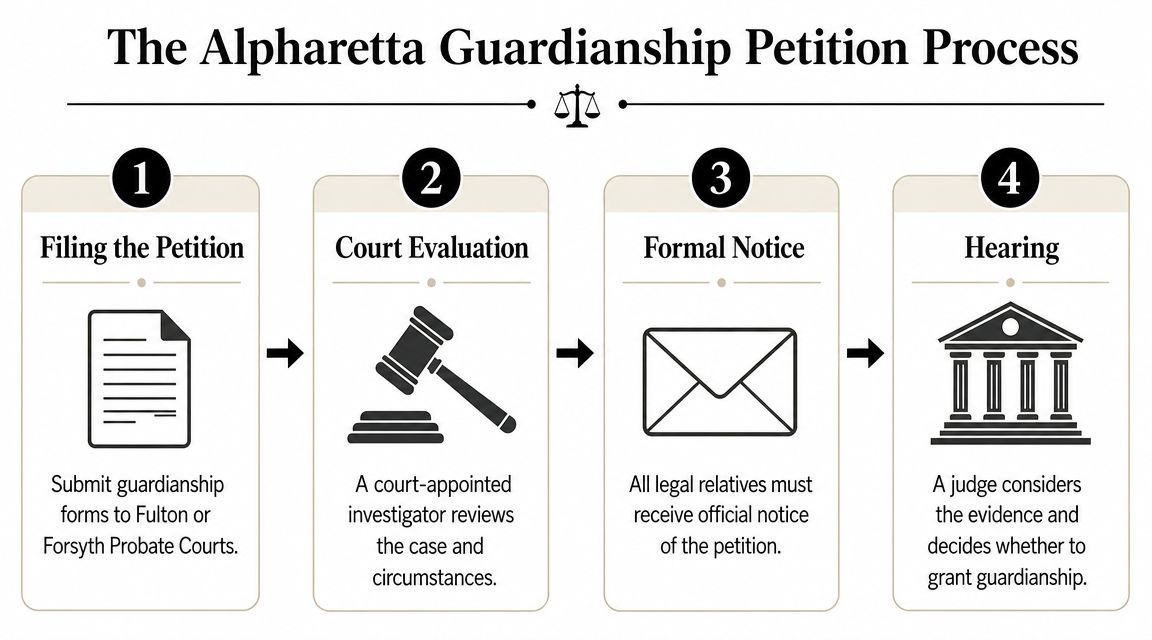
The Alpharetta Guardianship Petition Process Step by Step
The process is easier to handle when you know what the court will expect. In Alpharetta cases, that usually means dealing with Fulton County Probate Court. In Cumming, it usually means Forsyth County Probate Court. The exact forms and scheduling practices can vary, but the sequence is broadly similar.
Start with the right documents
Before anything is filed, gather the documents the court is likely to require or ask about. That often includes the child's identifying information, family relationship information, and records that explain why guardianship is necessary. If a parent consents, that should be handled carefully and formally.
If the proposed guardian is seeking authority over property as well as care, the court will want clear financial information. If the case involves an older child, the child's preference may also need attention.
File in the proper probate court
A guardianship petition for a minor belongs in Probate Court, not Superior Court. That is an important local distinction because many North Georgia families are more familiar with Forsyth County Superior Court or Fulton County Superior Court from divorce, custody, child support, contempt, legitimation, and modification cases. Those courts regularly address Georgia no-fault divorce, the 30-day minimum waiting period, equitable division, child custody standards, parenting plans, temporary hearings, and mediation requirements in family law matters. Minor guardianship, by contrast, is a probate court process.
Expect notice, review, and possible investigation
After filing, the court will focus on notice. Interested parties must be properly informed, and errors here can cause serious delay or even jeopardize the case. If a parent objects, the matter becomes more involved quickly.
The court may also require background checks or other screening steps before issuing authority. In contested situations, details matter. Contradictions in the paperwork, unclear timelines, or weak explanations about the child's living situation can raise concerns.
The judge is looking for stability, credibility, and a legally sound reason to place authority in a non-parent's hands.
Prepare for the hearing
At the hearing, the court wants a clean explanation. Why is guardianship necessary? Why is this proposed guardian appropriate? What arrangement is in the child's best interest right now?
The strongest cases are practical, documented, and restrained. Angry family narratives usually hurt more than they help. Courts respond better to facts than to accusations.
Special issue in DFCS related permanent guardianships
A different rule set can apply when the case involves DFCS and permanent kinship guardianship. In those Georgia cases, there is a 6-month minimum residency requirement with the relative caregiver before the court can transfer guardianship, and the juvenile court's role depends on a prior non-reunification determination, as explained in this guidance on Georgia kinship guardianship as a permanency option.
A practical filing checklist
- Confirm the child's county connection: File in the correct probate court tied to the child's domicile.
- Organize the family map: Courts want clarity about parents, relatives, and who is currently providing care.
- Handle notice carefully: This is one of the most common places avoidable mistakes occur.
- Prepare a child-focused hearing presentation: Judges want a workable plan, not a family grievance session.
- Treat the order as operational: The final order should be specific enough to function at school, in medical settings, and in daily life.
Common Pitfalls and Strategic Planning in Your Guardianship Case
The families who struggle most are often the ones who assume the basic filing is enough. It usually isn't. A strong guardianship case isn't just about getting an order signed. It is about getting an order that works in real life and doesn't create the next fight.

The money question families get wrong
One of the most common misunderstandings involves financial support. A guardian must make sure the child's needs are addressed, but the guardian is not legally required to use the guardian's own funds for ongoing support. The underlying support obligation remains with the parents, as noted in this guide for guardians of minors discussing financial responsibility.
That distinction matters. If no one discusses it early, relatives in Roswell or Sandy Springs can end up carrying expenses they assumed would be reimbursed, while parents assume the new guardian has taken over everything. That is how resentment starts.
Hybrid family arrangements need precise drafting
Some cases are not all-or-nothing. A parent may support a guardianship and still want visitation, regular updates, or input on major decisions. Those arrangements can work, but only if the order is clear.
A vague order invites future conflict. If the guardian can make daily decisions but major medical treatment requires notice to a parent, the order should say so. If school placement decisions belong to the guardian but the parent gets records access, that should also be stated.
Strategy matters more than emotion
Good strategy often includes the following:
- Define authority clearly: School enrollment, medical consent, activities, and access to records should not be left to guesswork.
- Address parent involvement in writing: If the parent keeps some role, spell it out.
- Think past the hearing: The order should still make sense six months later when a new school administrator or physician reads it.
- Avoid overreaching: Asking for authority you don't need can trigger unnecessary objections.
Families often think the biggest risk is losing the hearing. In practice, a common risk is winning a vague order that doesn't solve the day-to-day problem.
The right planning reduces friction with parents, lowers the chance of future court returns, and gives the child a more durable routine.
What to Expect in Forsyth County and Fulton County Courts
A probate hearing in Cumming or North Fulton is usually more focused and practical than families expect. The judge isn't there to referee every family grievance. The judge is there to decide whether a child needs a guardian and whether the proposed guardian is the right person.
In Forsyth County, families often appreciate that the local court process can feel more direct and personal, but that doesn't mean it is casual. Preparation still matters. The court will pay close attention to notice, family relationships, the child's living arrangement, and whether the proposed plan is stable.
In Fulton County, especially for Alpharetta and other North Fulton matters, families should expect formality and careful scrutiny of the paperwork. If the filings are incomplete or internally inconsistent, that problem often shows up quickly.
Questions the court tends to care about
Judges often focus on practical issues such as:
- Who is caring for the child now
- Why the parents are not currently able to do so
- Whether the proposed guardian can provide stability
- What contact or involvement the parents will retain
- Whether the proposed order is specific enough to work
Georgia courts also see many cases where guardianship coexists with parental rights. Those hybrid arrangements require careful limits and definitions of authority, especially where grandparents or other relatives are stepping in with parental support, as discussed in this overview on protecting your children through Georgia probate planning.
What helps in the courtroom
The adults who do best are usually the ones who stay child-focused. They answer the judge's questions directly. They avoid exaggeration. They show up with organized facts and a workable plan.
If your story is true, keep it clean. Probate judges do not need drama to recognize instability.
That approach matters whether the family lives in Alpharetta, Cumming, Johns Creek, Milton, Suwanee, Dawsonville, Roswell, Sandy Springs, or Canton.
Why Choose Miles Hansford for Your Cumming & Alpharetta Guardianship Case
Families dealing with guardianship of a minor need more than forms. They need judgment. They need a lawyer who understands the difference between a probate guardianship issue and a family law custody fight, and who knows how local practice in Forsyth County and Fulton County affects the path forward.
Miles Hansford serves Cumming, Alpharetta, Forsyth County, Fulton County, and the surrounding North Georgia communities with a calm, strategic, protective approach. That matters when the child is already living with a grandparent, when a parent may partially agree but still want ongoing involvement, or when a filing mistake could delay authority the child needs right now.
The firm also understands the broader local court system. Many families come in juggling overlapping issues involving divorce, child custody, child support, legitimation, modifications, contempt, mediation, temporary hearings, or parenting plans in Georgia courts. Getting the guardianship piece right means seeing the whole family picture, not just the probate form in front of you.
Alpharetta Guardianship FAQs
| Question | Answer |
|---|---|
| How do I get guardianship of a minor in Alpharetta, GA? | You generally file a petition in Fulton County Probate Court if the child is domiciled in Alpharetta. The court will review the filing, require notice to the proper parties, and determine whether guardianship is necessary and in the child's best interest. |
| Is guardianship the same as custody in Georgia? | No. Guardianship of a minor is a probate matter that gives a non-parent defined legal authority. Custody disputes are usually handled in Georgia family law proceedings, often in superior court, and involve parental rights and parenting arrangements. |
| Does a child get a say in who becomes guardian in Georgia? | Yes. For minors age 14 or older, Georgia law requires the court to consider the child's preference unless there is a valid reason not to. That can be very important in contested cases in Fulton County or Forsyth County. |
| Will I have to support the child with my own money if I become guardian? | Not automatically. A guardian must make sure the child's needs are met, but the parent's support obligation remains. This is one of the most misunderstood parts of minor guardianship and should be addressed clearly before the case is filed. |
| What court handles minor guardianship in Cumming, GA? | Minor guardianship cases for children domiciled in Cumming are typically handled in Forsyth County Probate Court. That is separate from Forsyth County Superior Court, where divorce, custody, and other family law matters are commonly heard. |
| Can parents keep some rights after a guardianship is entered? | Yes, in many situations they can. Georgia families often use arrangements where a guardian handles daily decisions while parents retain defined visitation or input. The court order needs to state those limits and responsibilities clearly. |
| Do I need a lawyer for a guardianship case near me? | You are not required to have one in every case, but legal help is valuable when a parent may object, when relatives disagree, when the child is older, or when the order needs to address school, medical, and financial issues with precision. |
If you need help with guardianship of a minor in Alpharetta, Cumming, Forsyth County, or Fulton County, Miles Hansford Law Firm can help you evaluate the right legal path and build a child-focused plan. Schedule a consultation to speak with an attorney, protect your parental rights or caregiving role, and get clear guidance before you file.
Internal link suggestions:
- Georgia probate guardianships overview
- Protecting children through probate planning
- When state guardianship is necessary
- Child custody representation in Forsyth County
- Family law services in Alpharetta and Cumming
Schema recommendations:
- Attorney
- LegalService
- FAQPage