


When you're facing a legal dispute, the thought of a courtroom battle can be overwhelming. Fortunately, there is another way. Mediation offers a practical, confidential path forward where you and the other party, guided by a neutral professional, work together to find common ground.
This process is less like a trial and more like a structured, productive conversation. Instead of a judge imposing a decision, you are in control, crafting a voluntary agreement that both sides can accept. It is a collaborative process designed to solve a problem, not win a fight.
Understanding Mediation and When to Use It
Mediation is designed to avoid the high costs, public nature, and unpredictability of going to trial. It is a flexible process where you and the other party maintain control over the final outcome, with an experienced, impartial mediator helping to keep the discussion on track. The goal is to find a mutually acceptable solution that works for everyone involved.
Here in Georgia, courts in Fulton County and Forsyth County often require parties to try mediation before a case can proceed to trial. This is especially true for sensitive legal issues where privacy and preserving relationships are top priorities.
Common Situations for Mediation
This problem-solving approach is effective for a wide range of civil disputes. It is a good fit for any situation that calls for a creative, customized solution, such as:
- Divorce and Family Law: Working through sensitive disagreements over asset division, alimony, and child custody in a setting that is far less adversarial than a courtroom.
- Child Custody and Parenting Plans: Creating detailed, practical parenting schedules that put the children’s best interests first.
- Business and Contract Disputes: Settling conflicts between partners, vendors, or customers in communities from Alpharetta to Cumming without damaging valuable business relationships.
- Property and Asset Disputes: Finding fair and logical ways to divide real estate, investments, or other shared property.
Key Differences Between Mediation and Litigation
To see why mediation is often the preferred first step, it helps to understand how it compares to traditional litigation. For a deeper dive, you can learn more about the pros and cons of alternative dispute resolution in Georgia civil litigation in our detailed guide. In family law disputes with children, resources like co-parent counselling can also provide valuable support.
Here is a quick side-by-side comparison to make the differences clear.
Mediation vs. Litigation at a Glance
| Aspect | Mediation | Litigation |
|---|---|---|
| Control | You and the other party create and agree to the final outcome. | A judge or jury makes the final decision for you. |
| Cost | Almost always significantly less expensive than a trial. | Can lead to extensive legal fees and court costs. |
| Timeline | Can be resolved in a single day or a few sessions. | Often continues for many months, or even years. |
| Privacy | The entire process and all discussions are kept confidential. | Court proceedings and records are generally public. |
| Formality | Informal, flexible, and focused on problem-solving. | A formal process bound by strict rules of evidence and procedure. |
As you can see, the two paths offer vastly different experiences. One is about collaboration and control, while the other involves formal rules and surrendering the final decision to a third party.
The Step-by-Step Mediation Process in Georgia
Knowing what to expect on mediation day can make a world of difference. It helps reduce anxiety and lets you focus on what really matters: finding a way forward. The entire process is structured and confidential, designed to guide everyone toward a resolution.
The process starts long before you sit down in the same room. Your attorney will help you find a neutral, third-party mediator who is a good fit for your situation. Once a mediator is selected, both sides will share a confidential summary of the case, outlining the key issues and their positions. This gives the mediator needed context before the session officially begins.
This visual flow shows how mediation takes a complex dispute and channels it into a clear path toward a potential agreement.
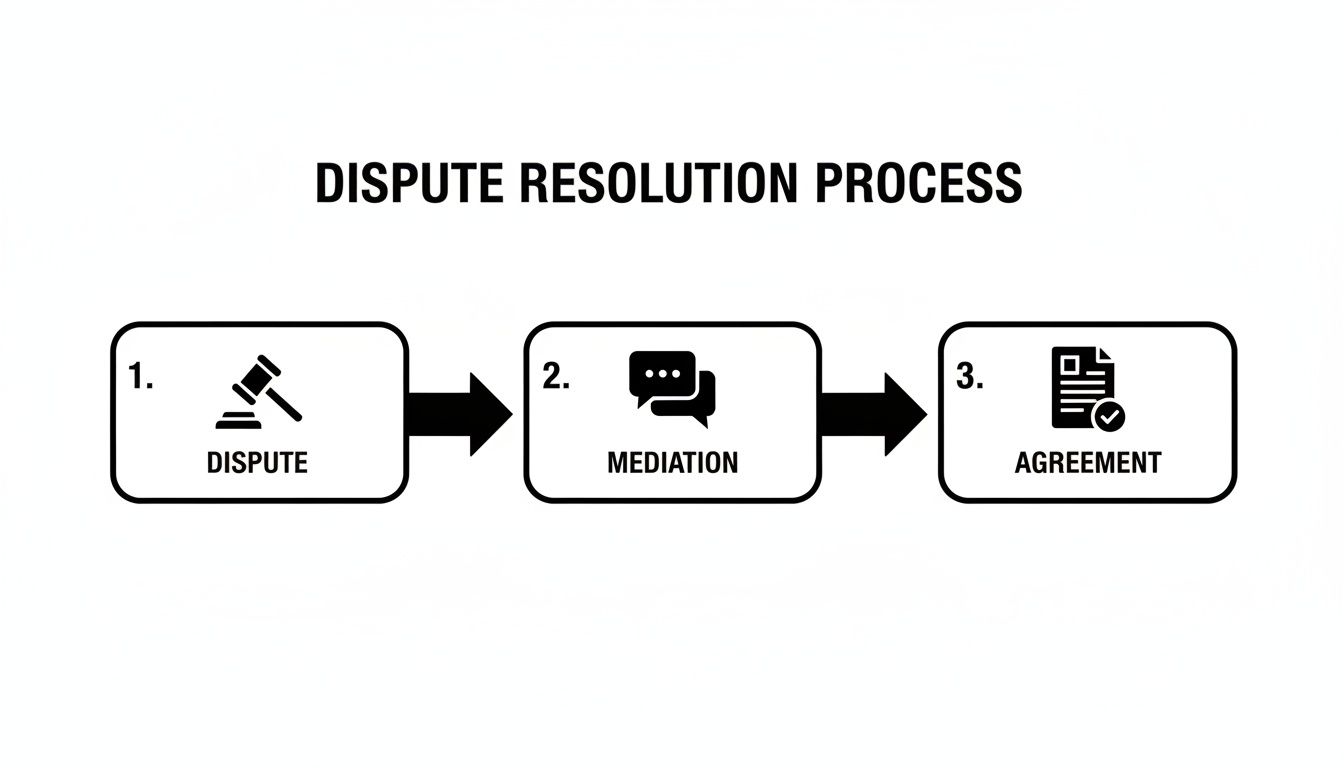
Mediation is that crucial middle step, the bridge that can transform a heated dispute into a cooperative, written agreement.
The Joint Session
Most mediations begin with a joint session. This is where everyone—you, your attorney, the other party, and their lawyer—gathers in the same room with the mediator.
The mediator starts by explaining the ground rules for the day. They will clarify that the process is voluntary, everything said is confidential, and their role is to be a neutral guide, not a judge.
After that, each side gets a chance to make a short, uninterrupted opening statement. This is not a time to argue. It is an opportunity to calmly state your view of the conflict and what you hope to achieve.
Private Caucuses and Shuttle Diplomacy
Once the joint session concludes, the real work begins in separate, private meetings called caucuses. You and your attorney will move to one room, while the other party and their attorney go to another.
From here, the mediator will go back and forth between the rooms in a process often called "shuttle diplomacy." In these private sessions, you can be completely candid. You can talk freely with the mediator about your biggest concerns, what is most important to you, and what terms you might be willing to consider.
The mediator’s job in these private meetings is about more than just carrying offers back and forth. They are trained to dig deeper, explore the real interests behind each position, and gently test the strengths and weaknesses of each side's case. They help brainstorm creative solutions you might not have thought of on your own.
This back-and-forth allows for honest conversations without the stress of a direct confrontation. The mediator keeps the momentum going, helps everyone see the risks of not settling, and steers the focus toward finding common ground.
Finalizing the Agreement
If you and the other party reach an agreement, the last step is to make it official. The mediator will help draft a memorandum of understanding or a settlement agreement that details every term you have agreed to.
This is not just a simple summary. Once your attorney has reviewed it and both parties have signed it, this document becomes a legally binding contract in Georgia. For family law cases in Fulton or Forsyth County, this agreement is then filed with the court to be incorporated into a final order, giving it the full power of law.
Getting ready for this day is key, and you can learn more by reading our guide on how to prepare for mediation.
The Roles of Your Mediator and Your Attorney
To get the most out of mediation, it is critical to understand the two key professionals in the room: the mediator and your attorney. They both want to help you find a solution, but they have completely different jobs. Confusing their roles is a common mistake that can cost you time, money, and a favorable outcome.
Many people think the mediator acts as an informal judge, but that is not the case. The mediator is a neutral third party. Their only goal is to help you and the other side have a productive conversation and reach an agreement you can both live with.
The Mediator: The Neutral Facilitator
Think of the mediator as the referee of the negotiation. They do not pick a team or decide who wins. Their job is to manage the process itself. Mediators are impartial guides trained in dispute resolution, and they create a safe, structured space for difficult conversations to happen.
A mediator’s main duties are to:
- Set the Ground Rules: They make sure the discussion is fair, confidential, and respectful.
- Manage Communication: They help each person feel heard and understood, keeping emotions from derailing progress.
- Find the "Why": A good mediator digs deeper than the stated positions to uncover the underlying needs and goals driving each side.
- Brainstorm Solutions: They help everyone think creatively to find common ground and explore options you might not have considered on your own.
The most important thing to remember is that a mediator cannot give you legal advice. They will not tell you if a settlement is "fair" or whether you should accept a deal. Their role is to keep the conversation moving forward.
Your Attorney: The Dedicated Advocate
While the mediator is neutral, your attorney is 100% on your side. Their loyalty is to you and you alone. They provide the private legal counsel, strategic advice, and protection that a mediator cannot offer.
In a mediation session, your attorney is your strategic advisor. They are the person you turn to in a private caucus to ask, "Is this a good deal for me?" or "What are the legal risks if I agree to this?"
Hiring an experienced attorney who practices in Fulton and Forsyth County courts gives you a significant advantage. They do not just know the law; they know how local judges are likely to rule if your case goes to trial. This insight gives you a realistic benchmark for evaluating any settlement offer on the table.
Why This Partnership Is So Critical
Having both a neutral mediator and a dedicated attorney creates the ideal environment for a successful mediation. The mediator keeps the negotiation on track, while your attorney ensures your rights and best interests are protected every step of the way. This structure allows you to negotiate from a position of strength, knowing you are making fully informed decisions.
A good mediator is active, not passive. Research on successful mediator characteristics shows that when mediators actively suggest new perspectives and push parties to explore different options, the chance of reaching an agreement increases.
Your attorney is the key to making this dynamic work for you. They help you analyze offers, craft smart counteroffers, and make sure any final agreement is legally sound. Without that guidance, especially in complex family law or business cases, you could agree to terms that negatively affect your finances or rights for years to come.
Why Choose Mediation Over a Court Battle?
When you are facing a legal dispute, the idea of a long, drawn-out court battle can be overwhelming. For many people, mediation is not just an alternative to court; it is a smarter, more strategic path forward. When you compare a private, structured negotiation to a public courtroom fight, the benefits become clear.
It is about taking back control over a situation that can feel chaotic and out of your hands. Instead of leaving your future up to a judge, you and the other party stay in the driver's seat.

Significant Cost and Time Savings
One of the most compelling reasons to mediate is the massive savings in both time and money. A traditional lawsuit can easily continue for months or years, piling up tens of thousands of dollars in legal fees, expert witness costs, and court expenses. The whole process is slow, costly, and emotionally draining.
Mediation, in contrast, is built for efficiency. It is common for a single, focused day of mediation to resolve an entire case that might otherwise take a year to move through the congested court dockets in Fulton or Forsyth County. By settling your dispute quickly, you save a significant amount on legal bills and can get back to your life or business.
The Critical Benefit of Confidentiality
Another major advantage of mediation is privacy. Court proceedings are public record. That means every document filed and every word spoken in the courtroom can be accessed by anyone, from business rivals to neighbors. For families in Alpharetta going through a divorce or business partners in Roswell navigating a contract dispute, this kind of public exposure can be damaging.
Mediation is completely confidential. What is said in the room, stays in the room. This privacy allows for much more honest and open conversations, since everyone can discuss sensitive issues without fearing public judgment or disclosure.
This protected space is essential for preserving your dignity and protecting personal or business secrets.
You Control the Final Outcome
Perhaps the most empowering part of mediation is that you craft the solution. In a lawsuit, a judge, who knows very little about you, your family, or your business, makes a final, binding decision that you must live with. You hand over all control.
Mediation gives that power back to you. No agreement is reached unless you voluntarily agree to it. This opens the door to flexible, creative solutions that a court cannot order.
This control also goes a long way toward preserving important relationships. For example:
- Co-parents can build a parenting plan that works for their unique family, which fosters a more cooperative relationship for their children's benefit.
- Business partners in Cumming or Johns Creek can resolve a financial issue while keeping their professional relationship intact for future projects.
The process is remarkably effective. Recent studies show that mediation not only preserves business relationships with 94% satisfaction but also maintains confidentiality with 89% satisfaction, two things litigation rarely accomplishes. You can explore more insights on the effectiveness of mediation on ojp.gov.
By focusing on common ground instead of conflict, mediation provides a more constructive and efficient way to resolve even the most difficult disputes. For a closer look, check out our guide comparing business litigation or mediation and which is better for you.
What Happens If You Cannot Reach an Agreement
A common worry is, "What if we go through this whole mediation process and still can't agree?" While mediation is an incredibly effective tool for resolving legal disputes in Georgia, it is important to go in with realistic expectations. Not every case settles on the day of mediation, and that is okay.
Understanding what happens when you do not reach a final agreement helps take the pressure off. It allows everyone to focus on making good-faith progress instead of feeling like it is an all-or-nothing situation.
The High Success Rate of Mediation
The good news is that mediation works far more often than it fails. Data shows that the vast majority of cases that enter mediation eventually settle. The process itself encourages practical, open communication in a way that courtroom litigation cannot.
For instance, one independent analysis of over 400 cases found that mediation successfully settled a remarkable 78% of them. The Centre for Effective Dispute Resolution noted an even higher 92% settlement rate in their 2022 audit, which shows how powerful this approach can be. You can dive deeper into these findings and see how effective mediation can be on cedr.com.
This success is not just luck. It is driven by key factors. First, both parties have chosen to be there, which signals a willingness to find common ground. Second, a skilled mediator can help reframe the conflict, uncovering potential solutions that were invisible before.
Partial Agreements Are Still a Win
Even if you cannot resolve every single issue, mediation is rarely a waste of time. It is very common for people in a Forsyth County divorce or a Fulton County business dispute to reach a partial agreement.
For example, you might agree on the parenting plan but still need to work out the final details of dividing assets. That is a huge victory. By resolving some of the issues, you have already achieved several important goals:
- Narrow the Issues: You have reduced the list of things a judge will need to decide.
- Lower Litigation Costs: The less you have to fight about in court, the lower your future legal bills will be.
- Build Momentum: Finding common ground, even on small points, can create the goodwill needed to resolve tougher issues down the road.
Moving Forward Without a Full Agreement
What if you reach a complete impasse? You have not lost anything. This is a critical point to understand: mediation is a confidential and non-binding process until a final agreement is signed by everyone.
If no settlement is reached, you lose none of your legal rights. All discussions and offers made during the session remain private and cannot be used against you in court. Your case simply proceeds along the path toward litigation as if mediation never happened.
You are no worse off for having tried. In fact, most people leave mediation with a much clearer picture of the other side’s position and a better understanding of the strengths and weaknesses of their own case. That knowledge is invaluable. It helps you and your attorney build a stronger, more informed strategy for trial if it becomes necessary.
How an Experienced Attorney Can Help You Succeed
Even though mediation is a collaborative process, it is still a serious negotiation with real legal and financial consequences. The goal is to find a good outcome without the costs and stress of a trial, and an experienced attorney is your most important partner in getting there. Their job is not to create conflict, but to be your calm, strategic advocate.
Success in mediation starts long before you walk into the room. We work with clients across Forsyth and Fulton County to prepare down to the last detail, making sure they understand every step and feel confident. This preparation allows you to navigate tough conversations with a clear head.
Your Advocate Before, During, and After Mediation
An attorney’s guidance is crucial at every stage. Here is how we help you succeed:
- Developing a Clear Strategy: We analyze the facts of your case, pinpoint your non-negotiables, and help you set realistic goals for a settlement. This is key to preventing emotional decisions made under pressure.
- Organizing Essential Documents: Whether you are dealing with a business dispute in Roswell or a divorce in Alpharetta, we make sure you have all the necessary financial records, contracts, or parenting plans ready to support your position.
- Providing Private Legal Counsel: During private meetings (caucuses) with the mediator, we are right there with you. We will help you weigh offers, explain the long-term impact of a decision, and give you direct advice on when to stand firm and when to compromise.
In the end, a successful mediation produces a solid, final agreement. A huge part of an attorney’s job is to ensure that whatever you agree on is turned into a strong, legally binding document. They can help you make a contract that protects your business or secures your family’s future.
With our deep experience in North Georgia courts, our firm provides the guidance you need to protect your rights and make sure your voice is heard. We are here to work toward the best possible negotiated outcome for you.
Your Top Questions About Mediation in Georgia, Answered
If you are heading into mediation, it is natural to have questions. We have heard most of them from our clients across Fulton County, Forsyth County, and the rest of North Georgia. Here are clear, straightforward answers to the most common ones.
Is the agreement we reach in mediation legally binding?
Yes, a mediated agreement is legally binding once signed. After both parties agree on the terms, they are written into a formal settlement document. When both sides sign it, it becomes an enforceable contract. For family law matters like a divorce, we then submit the signed agreement to the court, where a judge incorporates it into a final order, giving it the full force of law.
I'm getting divorced in Forsyth County. Do I have to go to mediation?
It is very likely that you will. Courts in Forsyth and Fulton counties often require couples in contested divorce or custody cases to attend mediation before they will schedule a final trial. While attendance may be mandatory, reaching an agreement is always voluntary. No one can force you to sign a settlement that you do not believe is fair.
How much does mediation cost?
Mediation costs depend on the mediator's hourly rate and the complexity of your dispute, with the fee typically split between the parties. While a full day may cost a few hundred to a few thousand dollars per side, this is almost always far less expensive than preparing for and going through a multi-day trial. Settling your case through mediation can save you a significant amount in legal fees and court costs.
What should I bring to my mediation session?
Your attorney will help you gather and organize all necessary documents. Generally, you should bring any paperwork that supports your position, such as financial records, a proposed parenting plan, a list of assets and debts, or key documents like contracts or important emails. Having this information organized and available helps ensure the negotiation is productive and based on facts.
The goal of mediation is to find a clear path forward so you can move on. At Miles Hansford, P.C., we bring the experienced legal guidance and strategic thinking needed to protect what matters most to you during these negotiations. If you are facing a family law or civil dispute in North Georgia, contact us to learn how we can help.