


Meta Title: Annulment Timeline in Cumming, GA | Georgia Law
Meta Description: Learn how long you can get an annulment in Cumming, GA, filing deadlines, court timelines, and what to expect in Forsyth and Fulton County.
Suggested URL Slug: /annulment-timeline-cumming-ga
Schema Recommendations:
- Attorney
- LegalService
- FAQPage
Internal Link Suggestions:
- Annulment vs. Divorce
- How to File for Divorce
- How Long Does Divorce Take
- Child Custody in Georgia
- Mediation in Family Law
- Temporary Hearings in Georgia
If you're in Cumming, GA and you've started to suspect that your marriage may never have been legally valid in the first place, the question usually comes fast and hard: how long can you get an annulment? People ask it in a dozen different ways. Is it too late? Does the length of the marriage matter? Will Forsyth County Superior Court even take the case seriously if you've been living together for a while?
Those are fair questions. They're also urgent ones.
In real life, this usually starts with a sick feeling, not a legal theory. A spouse learns the other person hid a prior marriage. Someone realizes they were pressured into the wedding. Someone in Alpharetta, Johns Creek, or Milton discovers that what they thought was a bad marriage may be a void or voidable one. The problem is that by the time many people start looking for answers, they're already worried they waited too long.
Georgia law does leave a path forward in the right case. But annulment is narrower than divorce, and timing has two parts that people often confuse. One is the deadline to file. The other is how long the court process itself may take in Forsyth County or Fulton County. Knowing the difference can keep you from making a costly mistake.
Annulling a Marriage in Cumming GA Your Path to Clarity
A lot of people who search for an annulment aren't looking for a technical legal definition. They're looking for relief.
In Cumming, GA, that often means someone is sitting at the kitchen table late at night replaying the marriage from the beginning and asking whether the whole thing was built on something false. Maybe the wedding happened quickly. Maybe there was pressure from family. Maybe a spouse lied about something so central to the marriage that you now feel trapped between embarrassment and uncertainty.
That emotional spiral is common. It doesn't mean you're overreacting. It means you need clear answers fast.
An annulment isn't available just because a marriage turned out badly. Georgia courts look for specific legal defects that existed at the start of the marriage. But when those defects are present, annulment can be the right remedy, and asking about timing is one of the smartest first steps you can take.
People in Forsyth County often come in thinking they need to know one thing: "How long do I have?" Usually, what they need are answers to three separate questions:
- Is there a filing deadline: Some grounds are time-sensitive.
- Has the marriage been ratified: Your conduct after the wedding can affect whether the claim still works.
- How long will the court process take: A straightforward case and a contested one move very differently.
Practical rule: If you're even considering annulment, don't keep waiting for perfect certainty. Delay can make a viable case much harder.
That matters in North Georgia because local practice is practical. Judges want evidence, not just regret. If you're in Cumming, Alpharetta, Suwanee, Dawsonville, or Canton, the next step is to look carefully at the Georgia framework and decide whether annulment or divorce fits your facts better.
What Does 'How Long' Really Mean for an Annulment in Georgia?
One question is often used to ask about two different legal issues. That's where confusion starts.
When someone says, "How long can you get an annulment?" they may mean how long do I have to file, or they may mean how long will the case take once I file. Those aren't the same thing, and treating them as the same can lead to bad decisions.
The filing deadline question
The first issue is the legal window to bring the case. In some situations, Georgia law is less about a fixed calendar deadline and more about whether the spouses' conduct after the wedding effectively accepted the marriage.
There is one especially important exception. Georgia has a strict 60-day filing deadline for annulments based on marriages entered under the influence of drugs or alcohol, as noted in this discussion of annulment filing limits across jurisdictions. For other grounds, the bigger question is often whether the marriage was later ratified by continued marital conduct.
That distinction matters. A person may assume, "There's no deadline, so I have time." But if the facts suggest acceptance of the marriage after learning the problem, the court may view the case very differently.
The court timeline question
The second issue is the practical timeline after filing. Courts in and around Cumming and Alpharetta don't move every case at the same pace. A short, uncontested annulment can move far more efficiently than a contested case involving disputed facts, service issues, document requests, or hearings.
If you're also weighing whether divorce may be faster or more predictable, it's worth reviewing how long divorce can take in Georgia. That comparison often helps people decide whether pursuing annulment is worth the evidentiary burden.
Why this distinction matters in local practice
In Forsyth County and Fulton County, strategy starts with naming the actual timing problem. Is the risk that you've waited too long to file? Or is the concern that the case will take too long to resolve?
Those are different problems, and they require different solutions. One calls for immediate legal analysis of the underlying grounds. The other calls for realistic case planning, evidence organization, and a clear decision about whether the matter is likely to be contested.
Valid Grounds for Annulment A Legal Guide for Cumming GA Residents
Georgia does not grant annulments merely because a marriage was brief, painful, or disappointing. The court looks for a flaw that existed from the beginning and made the marriage void or voidable under O.C.G.A. § 19-4-1.

In Georgia, there is no statutory time limit on how long a marriage must last before filing an annulment petition, but courts apply a judicial presumption of validity to longer marriages, and extended cohabitation can strengthen a ratification argument, as discussed in this Georgia annulment overview. In plain terms, a longer marriage can still be challenged, but it becomes harder to persuade the court that the marriage should be treated as invalid from the start.
Grounds Georgia courts recognize
Here are the grounds that commonly matter in a Georgia annulment case:
Bigamy: One spouse was already legally married to someone else at the time of the marriage. A hidden prior marriage is one of the clearest examples of a marriage that was invalid at inception.
Incest or prohibited relationship: Georgia bars marriages between certain close blood relatives. If the parties fall within a prohibited relationship, annulment may be available.
Underage marriage: If a party was under the legal age required for a valid marriage under the applicable circumstances, the marriage may be voidable.
Mental incapacity: If a person lacked the mental capacity to consent to marriage at the time of the ceremony, the marriage may be subject to annulment. The focus is on capacity at the time of marriage, not on later developments.
Duress: Pressure alone isn't enough. The question is whether one party's will was overborne so seriously that genuine consent was missing. That can arise in coercive family situations or threats tied to the ceremony itself.
Fraud: This is one of the most misunderstood grounds. Not every lie supports annulment. The misrepresentation must go to the essence of the marriage relationship.
What fraud can look like in practice
A spouse in Johns Creek may discover after the wedding that the other person concealed a fact so central that they would never have married had they known the truth. A spouse in Milton may realize the marriage was entered for a hidden purpose inconsistent with a real marital relationship. Those facts may support an annulment claim if the evidence is strong and the conduct after discovery didn't ratify the marriage.
A judge isn't deciding whether the marriage was unhappy. The judge is deciding whether valid consent existed in the first place.
What usually doesn't work
These arguments often fall short unless tied to a legally recognized ground:
| Situation | Why it may not support annulment by itself |
|---|---|
| You married too quickly | Regret is not a legal ground |
| Your spouse changed after marriage | Post-marriage misconduct usually points toward divorce, not annulment |
| The marriage was short | Length alone doesn't create annulment grounds |
| You simply want the marriage erased | Courts require proof, not preference |
This is why local analysis matters so much in Cumming, Alpharetta, Roswell, and Sandy Springs. The facts have to fit the statute, and the evidence has to fit the facts.
Annulment vs Divorce in North Georgia Key Differences and Outcomes
Many people start by asking for an annulment and end up learning that divorce is the more realistic legal path. That doesn't mean the marriage wasn't serious or that your concerns aren't valid. It means the legal remedy has to match the facts.
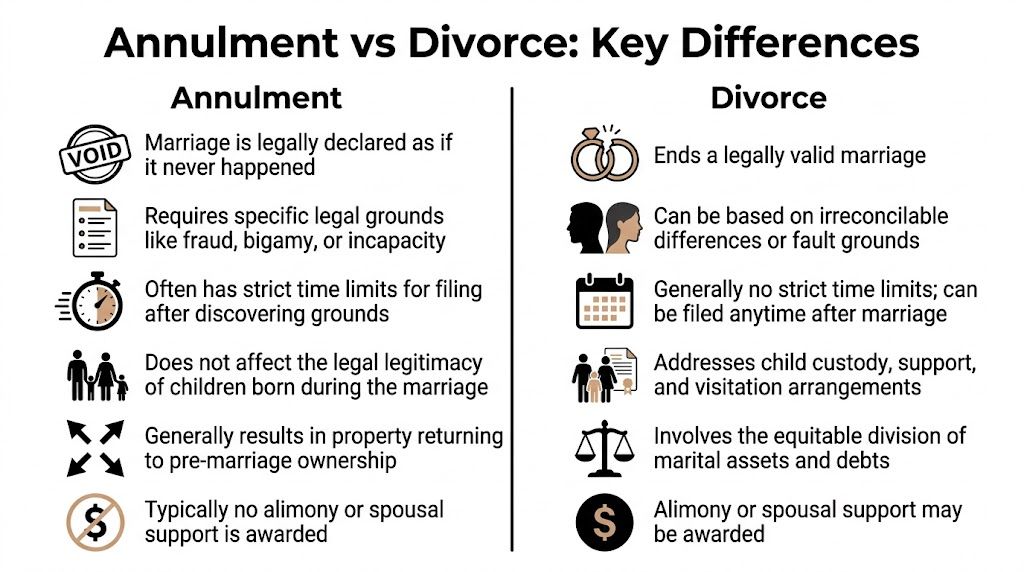
Georgia divorce law is broader. Georgia allows no-fault divorce, and a divorce ends a legally recognized marriage even if no defect existed at the time of the wedding. Annulment is narrower because it asks the court to treat the marriage as invalid from the beginning.
If you're comparing both routes in detail, this Georgia annulment vs divorce resource is a helpful starting point.
Annulment vs. Divorce in Georgia A Side-by-Side Comparison
| Factor | Annulment | Divorce |
|---|---|---|
| Legal effect | Treats the marriage as invalid from the start | Dissolves a legally valid marriage |
| Grounds required | Specific legal defect such as fraud, duress, bigamy, incapacity, or prohibited relationship | Can proceed under Georgia no-fault divorce law |
| Timing focus | May involve filing limits or ratification issues | Can generally be filed without the same narrow grounds analysis |
| Property issues | Often framed around restoring parties to pre-marital positions, though courts may still address property issues as needed | Georgia follows equitable division for marital assets and debts |
| Alimony | Typically not available in annulment matters | May be considered in a divorce case |
| Children | Child-related issues can affect whether annulment is the right path | Courts regularly address custody, support, and parenting plans in divorce |
Why divorce is sometimes the better tool
In North Georgia practice, divorce often becomes the better choice when there are children, disputed finances, or no clean evidence of a defect at the start of the marriage. Georgia courts also require a 30-day minimum waiting period in divorce cases, and divorcing spouses may face temporary hearings, mediation requirements, parenting plan issues, and equitable division questions. Those procedures are familiar territory in Forsyth County divorce filings and Fulton County custody hearings.
If children are involved, divorce usually gives the court the cleanest framework to address child custody standards in Georgia, child support, and the parenting plans Georgia courts require. Annulment doesn't erase the legal legitimacy of children, but it isn't always the practical vehicle for resolving a family with ongoing parenting issues.
Real-world trade-offs
Some people prefer annulment because it feels morally or emotionally different. Others assume it will be simpler. Sometimes it is. Sometimes it isn't.
A contested annulment can become more evidence-heavy than a no-fault divorce because the petitioner must prove a defect that existed at the beginning of the marriage. If the marriage involved records from another country, a prior foreign decree, or documents in another language, obtaining a certified translation for a divorce decree or related family law document can be important before those records are presented in court.
The best legal path isn't the one that sounds better. It's the one the facts can actually support.
The Annulment Process in Forsyth and Fulton County Step by Step
Once you've decided to pursue annulment, the process becomes less mysterious when you break it into stages. Whether you're filing in Forsyth County Superior Court or Fulton County Superior Court, the court expects precision from the start.

If you've looked at general family law filing steps before, this guide on how to file for divorce in Georgia gives useful context on court filing mechanics, even though annulment requires different legal grounds.
Step one starts before filing
The first question is jurisdiction and residency. Georgia family law requires the case to be filed in the proper court with the proper connection to the state and county. That means verifying where the petition belongs and whether residency requirements are satisfied before anything is filed.
For people in Cumming, that often points to Forsyth County Superior Court. For people in Alpharetta, Roswell, Johns Creek, Milton, or Sandy Springs, venue questions may involve Fulton County depending on the facts and where the other spouse lives.
The petition must be fact-specific
An annulment petition isn't a formality. It has to state the legal ground clearly and tie that ground to specific facts. A vague filing that says the marriage was a mistake won't carry the case forward.
That usually means the petition should identify:
- The ground asserted: Fraud, duress, bigamy, incapacity, or another recognized basis.
- The key dates: When the marriage occurred and when the defect was discovered.
- The requested relief: A decree declaring the marriage annulled and any related relief the court may need to consider.
Service and response shape the timeline
After filing, the other spouse must be properly served. If service is clean and the other spouse doesn't contest the case, the matter can move much more efficiently. If service is disputed, the spouse answers aggressively, or jurisdiction is challenged, the case slows down.
In a default setting, the court still expects legal sufficiency. In other words, lack of opposition doesn't automatically guarantee an annulment.
Contested cases become evidence cases
If the other spouse denies the grounds, the case can move into discovery and hearings. That may involve document requests, witness testimony, affidavits, records, and credibility issues. In family law matters generally, parties in Fulton County and Forsyth County may also encounter mediation expectations and temporary issues that need attention while the case is pending.
That local court experience matters. North Fulton courts and Forsyth County judges expect organized pleadings, clean evidence, and clear testimony.
The final order is the finish line
If the court finds the legal grounds were proven, it enters a Final Decree of Annulment. If the proof falls short, the court may deny the request, and the person may need to consider divorce instead.
Court procedure feels less overwhelming once you know the sequence. File correctly, serve properly, prove the ground, and stay consistent with your evidence.
For people coming from Dawsonville, Suwanee, Canton, or nearby communities, that structure matters. It turns a chaotic problem into a series of manageable legal tasks.
Building Your Case Strategic Considerations for a Successful Annulment
An annulment case is won or lost on proof. That's what makes strategy so important.

Judges begin from a practical place. Marriage is presumed valid unless the evidence shows otherwise. The longer the marriage lasted and the more the parties lived publicly as spouses, the harder it usually becomes to convince the court that the marriage should be treated as invalid from day one.
Evidence beats outrage
Strong annulment petitions usually rely on concrete proof, not general accusations. Depending on the ground, useful evidence may include:
- Records: Prior marriage certificates, official filings, medical records where legally appropriate, or written communications.
- Witnesses: People who observed coercion, heard admissions, or can confirm key events surrounding the wedding.
- Timeline evidence: Messages, emails, travel records, or other documents that show when the truth was discovered.
- Affidavits: Sworn statements that organize facts clearly for the court.
A fraud case without documents is hard. A duress case without corroboration is hard. A bigamy case without records is hard. That doesn't mean the claim fails automatically, but it does mean strategy has to start with proof collection.
Ratification can quietly damage the case
Ratification is one of the biggest problems in annulment matters. If a spouse learns of the defect and then continues acting as though the marriage is fully accepted, the court may treat that conduct as confirmation rather than rejection.
That issue often shows up in longer marriages in Forsyth County and Fulton County. The petitioner's argument becomes more difficult because the other side can say, "You knew, and you stayed."
Case strategy: Once you discover facts that may support annulment, your later conduct matters. Consistency helps. Delay and mixed signals hurt.
What works and what usually doesn't
What tends to help:
A clean factual theory
One clear legal ground is stronger than several weak ones.
Prompt action
Courts respond better when the filing aligns closely with discovery of the problem.
Third-party support
Neutral records and witness testimony often carry more weight than a spouse's unsupported claim.
What tends to undermine a case:
| Problem | Why it hurts |
|---|---|
| Long delay after discovery | Suggests acceptance or waiver |
| Changing explanations | Damages credibility |
| Minimal documentation | Leaves the court with a credibility contest |
| Treating the case like a divorce complaint | Misses the narrower annulment burden |
Strategic planning matters most when the facts are real but messy. That's common in North Georgia. People rarely come in with a perfectly labeled file. The job is to sort the facts, identify the strongest ground, and present a case the court can trust.
What to Expect in Alpharetta and Cumming Family Courts
Court experience in North Georgia is shaped by local docket reality as much as legal theory. Someone filing from Alpharetta may deal with the pace and procedure of Fulton County. Someone in Cumming will usually be focused on Forsyth County Superior Court. Both require preparation, but not every case moves at the same speed.
Georgia annulment processing timelines are heavily influenced by whether the case is contested. Uncontested petitions can be resolved in as little as 30 days post-service in some circuits, but may take 2-6 months in high-volume dockets like Fulton Superior Court. Contested annulments average 6-18 months due to evidentiary hearings and possible jury trials, according to this Georgia discussion of annulment versus divorce timelines.
Forsyth County and Fulton County feel different in practice
Forsyth County cases often feel more manageable when the facts are clear and the matter is uncontested. Fulton County, especially for parties in Alpharetta, Roswell, Johns Creek, and Sandy Springs, can involve heavier dockets and more scheduling friction.
That doesn't mean one venue is better than the other. It means your expectations should match the local court environment. A party who expects immediate resolution in a disputed fraud case is setting themselves up for frustration.
Temporary issues and local family court procedure
Even though annulment is different from divorce, local family court procedure still matters. In broader Georgia family law practice, temporary hearings can shape possession of property, access to records, and immediate conduct between the parties while litigation continues. Mediation may also come into play, particularly when the dispute is less about whether a legal defect existed and more about how the parties will resolve practical issues around separation.
For readers also considering divorce as an alternative, remember that Georgia divorce cases bring their own county-specific procedures. Those often include parenting plans, custody standards, equitable division disputes, and mediation requirements in both Forsyth County and Fulton County.
How to prepare for the courtroom side
Three habits help clients most in Alpharetta and Cumming family courts:
- Bring organized records: Judges and staff appreciate clean, chronological evidence.
- Stay consistent: Your petition, affidavit, and testimony should tell the same story.
- Treat every hearing as meaningful: Small procedural appearances can affect momentum and credibility.
People searching for a family law attorney near me usually want certainty. Family court rarely offers that. What it does reward is preparation, discipline, and a realistic understanding of how the local system operates.
Important 2026 Update Georgia's New Law on Annulment for Duress and Fraud
Georgia annulment law is changing in a way that may matter for people who delayed coming forward because coercion was part of the marriage itself.
In response to a 22% surge in family violence filings in metro Atlanta, Georgia passed Senate Bill 189, effective January 2026, which extends the discovery period to 7 years for annulments based on duress, and the update is prospective only, meaning it does not retroactively apply to marriages from 2024 or earlier, as described in this discussion of the 2026 Georgia annulment change.
Why this matters in real cases
This change recognizes something family lawyers see often. Coercion doesn't always look obvious from the outside, and people under pressure don't always disclose it quickly. Some spouses in the North Atlanta metro area don't identify what happened as duress until much later, after separation, counseling, or outside intervention.
That doesn't mean every delayed claim will succeed. Evidence still matters, and delay still raises factual questions. But the new law may give some people a legal window they previously thought had closed.
Fraud claims and online deception concerns
Some marriages begin with deception that unfolds partly online. If you're trying to sort out whether the relationship involved fabricated identity, false intentions, or manipulative conduct before marriage, practical resources on signs you are being catfished can help you identify patterns worth discussing with counsel.
For Cumming, Alpharetta, and North Fulton residents, the key point is simple. If force, pressure, or major deception played a role in the marriage, don't assume you've missed your chance without having the facts reviewed under current Georgia law.
Why Choose Miles Hansford for Your Annulment Case in Cumming
Annulment cases demand more than general family law familiarity. They require careful factual analysis, disciplined evidence work, and a strong feel for how local judges evaluate credibility and legal grounds in Forsyth County Superior Court and Fulton County Superior Court.
For clients in Cumming, Alpharetta, Forsyth County, and North Fulton, Miles Hansford brings exactly that kind of local, strategic representation. The firm handles family law matters across North Georgia every day and understands how local procedure, contested hearings, mediation, and courtroom preparation affect outcomes.
That matters in annulment cases because these claims are narrow and often emotionally charged. A lawyer has to separate what feels unfair from what Georgia law will recognize. The firm also offers the advantage of attorneys with prosecutor experience, which can be especially valuable when a case depends on document development, witness preparation, and exposing inconsistencies in the other side's story.
If you're overwhelmed, that's normal. You don't need to have the whole case figured out before you call. You do need a plan that protects your rights and gives you a clear next step.
Frequently Asked Questions About Annulment in North Georgia
Q: How long can you get an annulment after marriage in Cumming, GA?
A: It depends on the ground. In Georgia, there is no general statutory limit on how long the marriage must have lasted before filing, but some claims are time-sensitive and longer marriages can be harder to annul because courts may view the marriage as ratified. In Forsyth County, early case review is important.
Q: Can I get an annulment in Alpharetta if we have children?
A: Usually, divorce is the more practical route when children are involved. Georgia courts focus heavily on child custody standards, child support, and parenting plans. In Fulton County family court, those issues are routinely handled in divorce cases, along with temporary hearings and mediation when needed.
Q: Is annulment faster than divorce in Forsyth County?
A: Sometimes, but not always. An uncontested annulment may move quickly if service is straightforward and the legal ground is clear. A contested annulment can take much longer because the court has to decide whether the marriage was invalid from the beginning, which often requires evidence and hearings.
Q: What court handles annulment cases in Cumming and Alpharetta?
A: Annulment cases are generally filed in superior court. For Cumming residents, that often means Forsyth County Superior Court. For Alpharetta residents, venue may involve Fulton County Superior Court depending on where the parties live and the specific facts of the case.
Q: Does Georgia require mediation in annulment cases?
A: Local practice can make mediation relevant, especially when the dispute includes practical separation issues or related family law conflicts. In Fulton County and Forsyth County, mediation is a familiar part of family court procedure even when the legal claim itself is for annulment rather than divorce.
Q: Can I file for divorce instead if my annulment claim is weak?
A: Yes. Georgia no-fault divorce law gives people a broader path when they can't prove a defect required for annulment. Divorce also provides a clearer framework for equitable division, custody, parenting plans, and temporary relief through local family courts.
Q: Do I need proof, or can I just tell the judge what happened?
A: You need proof. Your testimony matters, but Georgia courts usually expect documents, witnesses, affidavits, or records that support the legal ground. In contested cases in Forsyth County or Fulton County, evidence quality often decides whether the petition succeeds.
If you're in Cumming, Alpharetta, Forsyth County, or Fulton County and need clear guidance on whether annulment or divorce is the right path, schedule a consultation with Miles Hansford Law Firm. You don't have to sort through Georgia family law alone. Speak with a family law attorney, protect your rights early, and get a practical strategy for what comes next. Call today.