


When you are facing the end of a marriage, one of the first and most urgent questions is often, "How long is this going to take?" In Georgia, the answer is not a simple one. A divorce can be finalized in just over a month in the simplest cases, or it can stretch on for well over a year when things get complicated.
The biggest factor influencing the timeline is how much you and your spouse can agree on. At Miles Hansford, we provide calm, steady guidance to clients in Alpharetta, Cumming, and throughout North Georgia, helping them navigate this process with confidence.
Your Georgia Divorce Timeline: What to Realistically Expect
To understand how long a divorce might take in Georgia, you first need to know that every case follows one of two paths: uncontested or contested. The path your case takes will have the single greatest impact on its length, cost, and the emotional toll it takes on your family.
For our clients in Forsyth County, Fulton County, and the surrounding areas, we believe setting realistic expectations from the very beginning is absolutely critical.
The Uncontested Path vs. The Contested Path
An uncontested divorce is the fastest and most direct route to a final decree. This is only possible when you and your spouse are in complete agreement on every single major issue, including:
- How to divide all your property, assets, and debts
- The terms of alimony (spousal support), including if any will be paid at all
- A complete parenting plan and child custody arrangement
- The final amount of child support
If there is disagreement on even one of these points, the case becomes a contested divorce. This path is much longer because it involves formal legal procedures like exchanging financial information, attending temporary hearings, mandatory mediation, and if all else fails, a trial. Each of these steps adds significant time to the process.
This visual timeline gives you a clear picture of the fundamental differences between the two divorce paths here in Georgia.
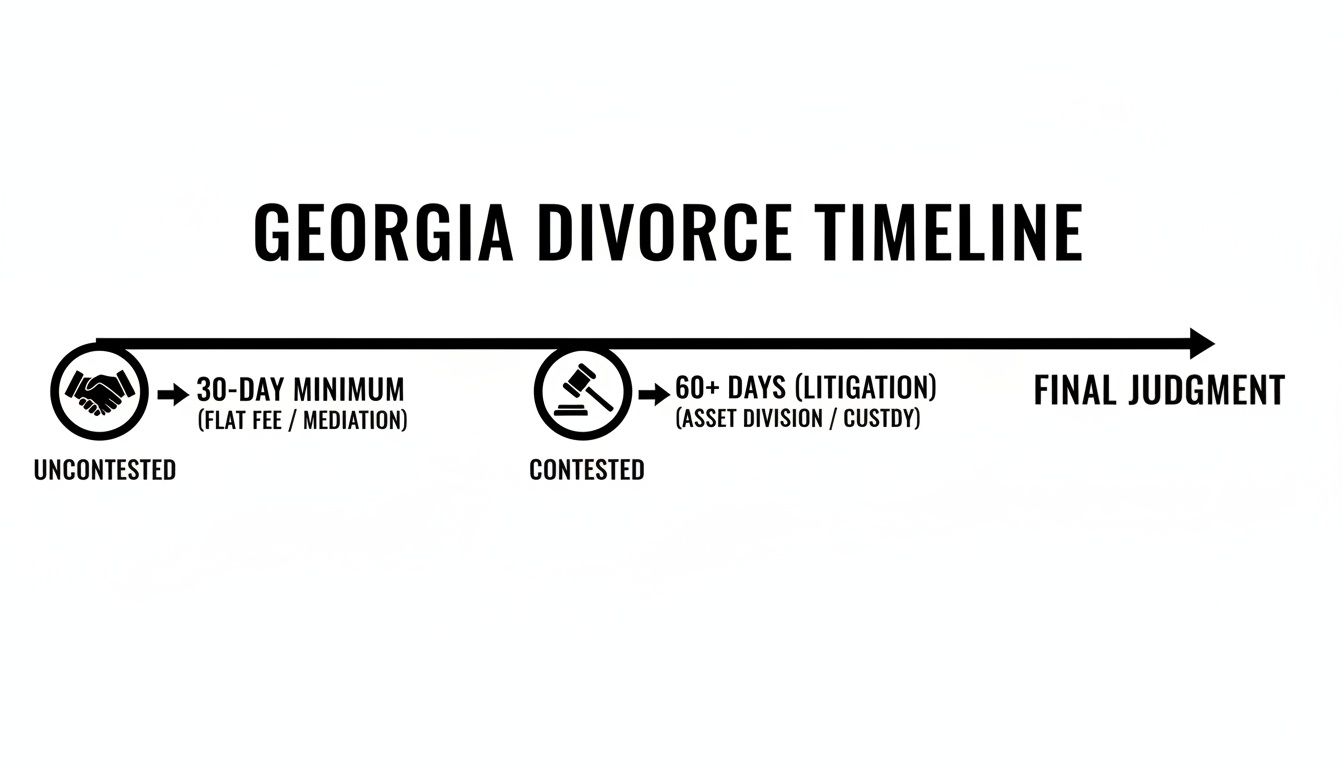
As you can see, an uncontested divorce follows a much more streamlined track. A contested case, on the other hand, involves multiple stages that can extend the timeline considerably.
To give you a clearer view, here is a quick breakdown of what you can generally expect for each type of case.
Estimated Divorce Timelines in Georgia
This table provides a quick overview of the expected duration for different types of divorce cases in Georgia, helping clients set realistic expectations.
| Divorce Type | Typical Timeline | Key Influencing Factors |
|---|---|---|
| Simple Uncontested | 31 – 90 days | Full agreement on all issues; no minor children or complex assets. |
| Uncontested with Children | 2 – 4 months | Agreement on a parenting plan and child support is required. |
| Contested (Settled in Mediation) | 6 – 12 months | Level of conflict; complexity of finances; scheduling mediation. |
| Contested (Goes to Trial) | 12+ months | High conflict; disputes over custody, assets, or alimony; court backlogs. |
It's important to remember these are just estimates. Every family's situation is unique, and various factors can speed up or slow down the process.
An experienced family law attorney can provide the clarity and guidance needed to navigate the process efficiently, whether you are in Alpharetta pursuing a simple separation or resolving a complex case in Johns Creek. Our goal is to help you move forward with confidence.
The Uncontested Divorce: The Fastest Path to Resolution
If you are looking for the most direct and efficient way to finalize a divorce in Georgia, an uncontested divorce is the answer. You can think of it as the express lane through the legal system, allowing you to sidestep the significant time and expense that come with court hearings and long, drawn-out disputes.

This option is only on the table when both spouses have reached a complete and total agreement on all the major issues before a single document is even filed with the court.
What Does Full Agreement Mean?
For a divorce to be truly uncontested in the eyes of a Fulton County or Forsyth County judge, there can be absolutely no lingering disagreements. The spouses must have already worked out a comprehensive settlement that covers every single aspect of their separation.
This includes:
- Division of Assets and Debts: How every piece of property will be divided, from the family home in Roswell to retirement accounts. It also clarifies who is responsible for any shared debts.
- Alimony or Spousal Support: Deciding whether one spouse will pay support to the other, for how long, and exactly how much.
- Child Custody and Parenting Plan: A detailed plan that outlines legal and physical custody, visitation schedules, and how major decisions for the children will be handled.
- Child Support: The calculation of child support payments according to Georgia's specific guidelines.
If even one of these items is still a point of conflict, the case is considered contested and will, without a doubt, take much longer to resolve.
The Uncontested Divorce Process in Georgia
Once you and your spouse have a full agreement in place, the legal process becomes quite straightforward. It primarily involves filing the necessary petition and a signed settlement agreement with the court.
From that point, Georgia law mandates a 31-day waiting period. This "cooling-off" period starts after the divorce is filed and the other party has been served. A judge cannot legally grant the final divorce decree until this time has passed.
This means that even the absolute quickest divorce in Georgia will take at least 31 days from the date of filing and service. In practice, most uncontested divorces we handle in the Cumming and Alpharetta areas are finalized within 60 to 90 days. This accounts for the time needed for proper document preparation and court processing.
An uncontested divorce is a collaborative process that gives you and your spouse control over the outcome. Instead of leaving life-altering decisions to a judge, you craft the solutions that work best for your family's future.
For many couples, reaching this point of agreement is a significant accomplishment. The average length of a marriage in the U.S. before a divorce is around eight years. As detailed in this study on global divorce statistics, that shared history often creates complexities around assets and family life that require careful negotiation to resolve amicably.
Even when a divorce is amicable, having an experienced attorney is vital. A family law attorney can ensure your settlement agreement is drafted correctly, is legally sound, and truly protects your rights. At Miles Hansford, our role is often to facilitate these amicable resolutions through skilled negotiation and mediation, making sure the process is handled properly and efficiently from start to finish.
Why Contested Divorces Take Significantly Longer
When you and your spouse cannot agree on at least one major issue, the divorce becomes “contested.” This single fact completely changes the process. The case shifts from a relatively simple administrative filing to a full-blown legal dispute that must be resolved step-by-step through the court system.
Unlike an uncontested divorce where the finish line is in sight from the start, a contested case is a journey. For families in Roswell, Johns Creek, and across North Georgia, understanding these stages helps explain why the process can stretch from six months to well over a year. The timeline is no longer about just signing papers; it is about investigation, negotiation, and potentially, litigation.
The Discovery Process: Getting the Facts on the Table
The first major time consumer in a contested divorce is the discovery phase. This is the official, court-supervised process where each side, through their attorneys, gathers information and evidence from the other. It is designed to make sure all final decisions are based on a complete and honest financial picture.
Discovery is not just one action; it involves several methods, each with its own timeline:
- Interrogatories: These are formal written questions one spouse sends to the other, who then must provide sworn written answers.
- Requests for Production: This is a formal demand for documents like bank statements, tax returns, business records, and property deeds.
- Depositions: This is an out-of-court proceeding where one attorney questions the other spouse (or a key witness) under oath, with a court reporter transcribing everything.
This stage alone can easily take several months. It gets even longer if one person is uncooperative or if the finances are complicated, like trying to put a value on a family business in Forsyth County or tracing assets that were owned before the marriage.
Temporary Hearings and Mandatory Mediation
While discovery is underway, some issues cannot wait for a final decree. If you disagree on who stays in the house, where the children will live temporarily, or who pays the mortgage, a temporary hearing might be necessary. Just getting a date on a packed Fulton or Forsyth County court calendar can add weeks, or even months, to the timeline.
Furthermore, before a contested case can ever go to trial in Georgia, the court will almost always require you to attend mediation. This is a negotiation session guided by a neutral professional who helps you and your spouse try to find common ground and settle the case. While mediation is a fantastic tool for resolving things faster than a trial, scheduling it with both attorneys and the mediator, preparing for it, and attending the session all add more time to the clock.
The Friction Points That Cause Delays
At its heart, the reason contested divorces drag on is conflict over very specific, high-stakes issues. These are the common friction points where agreements break down and require significant legal work to resolve.
For example, figuring out the true market value of a business, deciding on a fair amount and duration for alimony, or creating a detailed parenting plan that is truly in the children's best interests can all become major battlegrounds. Every single dispute adds another layer of negotiation, often requiring outside experts like business appraisers or custody evaluators, and all of it takes time. If these key issues cannot be settled along the way, the case has no choice but to head toward a final trial, the longest and most unpredictable part of the entire process.
Key Milestones That Shape Your Divorce Timeline
While every divorce is legally classified as either contested or uncontested, it is the specific issues within your case that truly set the pace. Think of them as major milestones on a road trip. How quickly you and your spouse can navigate disagreements on a few critical, life-altering topics will determine how long the entire journey takes.
Each one of these issues presents a potential bottleneck that can add significant time to the process. For families in Alpharetta, Canton, and across North Georgia, understanding these potential friction points from the start is the best way to plan for a more efficient resolution.
Settling Child Custody and Parenting Plans
Nothing in a divorce is more personal or emotionally charged than decisions about your children. It is no surprise, then, that disagreements over custody and parenting time are one of the most common reasons a divorce timeline gets stretched out.
When parents cannot find common ground, the court must step in. Judges in Forsyth and Fulton County are required to make every custody decision based on a single guiding principle: the best interests of the child. This standard is intentionally broad and requires a judge to weigh numerous factors, which can be a very lengthy process.
This could involve:
- Appointing a Guardian ad Litem, an attorney who represents the children’s interests.
- Ordering psychological evaluations or in-depth custody assessments.
- Holding extensive hearings where each parent must present their case.
Every one of these steps adds another layer of complexity and time, turning what might have been a few weeks of negotiation into many months of court proceedings. Coming to an agreement on a parenting plan outside of court is the single most effective way to shorten the timeline for a divorce involving children.
Dividing Marital Assets and Debts
The second major milestone that dictates your timeline is property division. In Georgia, this is handled under the legal principle of equitable distribution. A judge will divide all marital property in a way they consider fair, which might not be a simple 50/50 split. This subjectivity creates a lot of room for disagreement and drawn-out negotiations.
The process of equitable distribution can become incredibly time-consuming, particularly for couples with complex finances. The timeline often gets stretched by the need to:
- Identify and value every single asset, from the family home in Roswell to investment portfolios and retirement accounts.
- Figure out which property is "marital" (acquired during the marriage) versus "separate" (owned before the marriage).
- Assess the value of a family-owned business, which often means hiring forensic accountants or business appraisers.
- Trace assets that one spouse may have tried to hide or spent improperly.
A dispute over a single asset or debt can trigger a whole new round of discovery requests, legal motions, and hearings, slowing the entire case to a crawl. Proactively gathering your financial documents is a vital step in preparing for this stage, a topic we cover in our guide on how to file for divorce in Georgia.
Resolving Alimony and Spousal Support
Finally, the question of alimony, or spousal support, can be a major sticking point that delays a final agreement. Unlike child support, which is calculated using a strict formula in Georgia, alimony is far more subjective.
A judge has wide discretion in deciding whether to award alimony and, if so, for how much and for how long. The court will look at many factors, including the length of the marriage, each spouse's financial resources, their contributions to the marriage, and even their conduct.
Because there is no set calculator, negotiations over alimony can become intense and prolonged. One spouse might believe they are entitled to significant support to maintain their lifestyle, while the other feels they should not have to pay anything at all. This kind of disagreement often requires detailed financial analysis and forceful legal arguments, both of which take time to prepare and present effectively, whether in mediation or in the courtroom.
Using Mediation to Shorten Your Divorce Process
When you are facing a contested divorce, the road ahead can look long and uncertain. Thankfully, there is a powerful tool designed to get a case from a place of conflict to a place of resolution much faster than a traditional court battle ever could. That tool is mediation, a confidential process that puts you back in the driver's seat.

Mediation brings both you and your spouse together with a neutral, third-party professional. This mediator is not there to make decisions for you. Instead, their job is to open up productive lines of communication, help you both find areas of agreement, and guide you toward a settlement on all the outstanding issues that works for everyone.
How Mediation Works in Georgia
For many contested divorce cases here in Fulton County, Forsyth County, and across Georgia, mediation is not just a good idea, it is a required step. A judge often will not even schedule a final trial until you have tried it. The court system knows from experience that it is an incredibly effective way to resolve disputes without taking up precious court time.
The process itself is structured, but it is far less formal than a courtroom hearing. This allows for a kind of creative problem-solving that a judge, who is bound by a strict set of legal rules, simply cannot offer.
The single greatest benefit of mediation is control. Instead of handing over massive, life-altering decisions about your finances and your children to a judge, you and your spouse get to keep control over the final agreement. This control does not just lead to better, more personalized outcomes. It also dramatically shortens the divorce timeline by letting you skip the long, agonizing wait for court dates.
The Clear Advantages of a Mediated Settlement
Choosing to mediate offers some very clear benefits over battling it out in front of a judge. It helps to think of it less as another legal hurdle and more as a strategic opportunity.
- It is Faster: Reaching a settlement through mediation can resolve your entire case months, or even a year, sooner than if you were waiting for a trial date on a slammed court docket.
- It is More Private: Unlike public court proceedings, everything discussed during mediation is completely confidential. This creates a safe space for open and honest negotiation without your personal business becoming part of the public record.
- It is Less Adversarial: Mediation is about collaboration, not conflict. This cooperative spirit helps lower the emotional stress on your family, which is especially important when there are children involved.
- It is Less Expensive: When you avoid the massive amount of preparation and the high costs that come with a court trial, you can save a significant amount in legal fees.
By focusing on finding common ground, mediation essentially transforms a contested divorce into something much closer to an uncontested one. It puts you on the fast track to a final resolution. For anyone looking to make the most of this process, knowing how to prepare for mediation like a pro can make a huge difference in the outcome.
At our firm, we are always focused on finding the most efficient and effective path for our clients. Time and again, we find that mediation is the ideal setting to protect our clients' interests while moving their cases toward a timely and fair conclusion. To learn more about how this works, feel free to explore our detailed guide on what divorce mediation can do for you.
Partnering With an Attorney to Navigate Your Timeline
Knowing the difference between an uncontested and contested divorce, or how mediation can speed things up, is one thing. But turning that knowledge into a clear, confident strategy is another challenge altogether. This is where having an experienced legal guide in your corner makes all the difference.
An attorney brings much more than just legal knowledge to the table. They are a steady hand to guide you through one of the most stressful experiences of your life, setting realistic expectations and mapping out a path forward that fits your unique situation.
A Calm Approach to a Difficult Process
For our clients here in Cumming, Alpharetta, and Marietta, the first thing we do is bring clarity to the chaos. We cut through the legal jargon to explain your options and give you an honest assessment of what your timeline might look like, whether that requires tough negotiation or a strong presence in the courtroom.
Your attorney is your advocate and your buffer. They handle the stressful communications with your spouse's lawyer and manage all the complex legal deadlines, freeing you up to focus on your family. To ensure you have expert guidance throughout the process, consider partnering with experienced family law firms that specialize in divorce proceedings.
Your Advocate at the Negotiating Table and in Court
Ultimately, a family law attorney’s job is to protect your interests and help you start your next chapter on solid ground. We push for a fair outcome, work to de-escalate conflict when we can, and are always ready to litigate when it is necessary. You absolutely should not have to face this alone.
For a deeper look into this partnership, you can read our article on why you need a family law attorney for your divorce.
An attorney's goal is to replace uncertainty with a clear plan. By understanding your unique situation and legal options, you can regain a sense of control over your future and make informed decisions every step of the way.
If you are facing a divorce in North Georgia, the very first step is getting clear, honest advice. Schedule a consultation with us to discuss your case. We can provide a realistic view of your situation and explain how we can help you navigate the road ahead with confidence and purpose.
Frequently Asked Questions About Georgia Divorce Timelines
Even when you think you have a handle on the process, specific questions always come up about how long a divorce will actually take here in Georgia. Let's tackle some of the most common ones we hear from families across North Georgia.
Does it matter who files for divorce first in Georgia?
No, it does not matter from a purely legal perspective who files first. A judge in Fulton County or Forsyth County will not favor the person who files the case (the Plaintiff) over the person responding (the Defendant). The final outcome is not decided by who gets to the courthouse first. That being said, there can be a small strategic benefit to filing first, as the person who initiates the divorce gets to set the initial pace and has the first opportunity to frame the issues for the court.
Can I get divorced in Georgia if my spouse lives in another state?
Yes, you can file for divorce in Georgia even if your spouse lives elsewhere. As long as you meet Georgia's residency requirement of living in the state for at least six consecutive months before filing, the Georgia courts have jurisdiction. Your attorney will then manage the specific legal procedures required to properly serve the divorce papers to your out-of-state spouse.
What is the 31-day waiting period in a Georgia divorce?
Georgia has a mandatory 31-day "cooling off" period for every divorce. The clock starts the day after the divorce petition is filed and officially served on the other spouse. A judge is legally prohibited from signing a final divorce decree until those 31 days have passed. This means even the simplest, most amicable uncontested divorce in Georgia will take a minimum of 31 days.
How do court backlogs in North Georgia affect my case?
Court backlogs can cause significant delays, especially in contested divorce cases. In busy jurisdictions like Fulton and Forsyth counties, a crowded court calendar could mean waiting months just to get a hearing date for temporary issues or a final trial. This is precisely why resolving your case through negotiation or mediation is often a faster and more predictable path. An experienced family law attorney will always look for efficient ways to settle your case and help you avoid unnecessary delays caused by an overburdened court system.
At the Miles Hansford Law Firm, our job is to give you the clear, straightforward legal guidance you need to understand your options and set realistic expectations for your divorce. If you're thinking about divorce in Alpharetta, Cumming, or anywhere in North Georgia, contact us to schedule a consultation. It is time to get the clarity you deserve. Visit us at https://mileshansford.com to get started.