


Probate in Georgia usually can't close in less than 5 to 6 months because of the required notice period for unknown creditors, and for many estates in places like Cumming and Alpharetta, 12 months or more is a more realistic expectation once paperwork, assets, and family issues are involved. The good news is that probate moves through clear stages, and once you understand those stages, the process feels far more manageable.
If you've just lost a parent, spouse, or other loved one and now you're the executor, the legal side can feel like too much at once. You're grieving, people are asking questions, bills are still arriving, and somewhere in the middle of that you're supposed to deal with court filings, notices, and deadlines. That pressure is real.
Families in Cumming, GA, Alpharetta, and across North Georgia usually feel better once they understand two things. First, probate is slow for legal reasons, not because you've done something wrong. Second, the timeline can often be protected by making good early decisions, especially in Forsyth County and Fulton County, where local procedure matters.
Navigating Probate in Cumming GA After a Loss
Being named executor sounds simple when it's one sentence in a will. In real life, it means collecting records, protecting property, answering beneficiaries, and dealing with the probate court while you're still trying to process a loss.
For a straightforward estate in Georgia, some cases do finish near the minimum timeline. But that's the exception, not the expectation. As noted in this discussion of Georgia probate timing for contested and uncontested estates, simple, uncontested estates in Georgia can often be resolved within the 6-month minimum timeframe, while moderate estates frequently extend to 12 months or longer, and complex estates involving litigation can last several years.
In Cumming and the rest of Forsyth County, that usually means thinking in phases instead of hoping for one quick court appearance that wraps everything up. If the estate includes a house, several financial accounts, unresolved debts, or even mild disagreement between heirs, the process often stretches beyond what families first expect.
What families in Cumming usually need first
The first job isn't to "finish probate fast." The first job is to get control of the facts.
- Locate the original will: The court will want the original if one exists.
- Identify the decision-maker: The executor named in the will, or the person asking the court to appoint an administrator, needs legal authority before acting fully.
- Secure assets: Homes, vehicles, mail, online accounts, and financial statements need attention early.
- Stop informal distributions: Don't hand over money, jewelry, vehicles, or household items before the estate process authorizes it.
Practical rule: Executors who move carefully in the first few weeks usually avoid the kind of mistakes that create months of delay later.
Why this matters in Cumming and North Georgia
Local practice matters. A family handling an estate in Cumming, Alpharetta, Johns Creek, Milton, or Suwanee may be dealing with similar Georgia law, but the pace of the file still depends on the court's procedures, the quality of the initial filing, and whether the estate is organized from the start.
Looking for probate help near me to sort this out quickly is usually the right instinct. Early guidance is often what keeps a normal estate from becoming a drawn-out one.
Understanding Probate and Why It Takes Time
Probate is the court-supervised process for settling a person's legal and financial affairs after death. In plain English, it's the formal closing of accounts for a life: confirming the will if there is one, appointing the right person to act, identifying property, paying valid debts, and transferring what's left to the correct beneficiaries.

That process takes time because the law is trying to protect everyone involved. Creditors need a fair chance to file claims. Heirs need notice. The court needs confidence that the right assets were found and the right debts were paid before anyone receives final distributions.
A national benchmark helps explain why Georgia probate often feels deliberate. According to national probate timeline data compiled by Trust & Will, the average probate process lasts approximately 20 months nationwide, with a typical range of 6 to 24 months depending on state procedure and estate complexity. Georgia sits inside that larger system. It isn't unusually slow only because families are waiting. The rules themselves create a measured pace.
What actually slows probate down
Several parts of probate can't be rushed much:
| Probate task | Why it takes time |
|---|---|
| Court appointment | The court has to review the filing and issue authority |
| Notice process | Heirs and creditors must receive proper notice |
| Asset inventory | Real estate, bank accounts, vehicles, business interests, and personal property must be identified |
| Debt review | Claims must be evaluated and paid or disputed correctly |
| Final distribution | The estate shouldn't distribute too early and risk personal liability for the executor |
A lot of frustration comes from expecting probate to work like an ordinary bank transaction. It doesn't. It's closer to an audit plus a transfer process, all under court supervision.
The trade-off most executors don't see at first
Fast decisions aren't always smart decisions. If an executor rushes to distribute funds before debts, tax questions, or ownership issues are resolved, the estate can end up in worse shape.
Probate is meant to create order. Families usually feel better once they stop measuring progress only by speed and start measuring it by whether each step is being handled correctly.
That's especially important in Forsyth County Probate Court and matters that connect to Fulton County assets or beneficiaries. A careful file often moves better than an urgent but incomplete one.
The Georgia Probate Timeline A Step-by-Step Guide
In Georgia, one of the most important timing rules is mandatory. As explained in this overview of the required creditor notice period that sets the minimum probate duration, the probate process typically requires a minimum of 5 to 6 months solely because of the statutory notice period for unknown creditors after the Personal Representative is appointed. Even a clean estate can't close before that window runs.
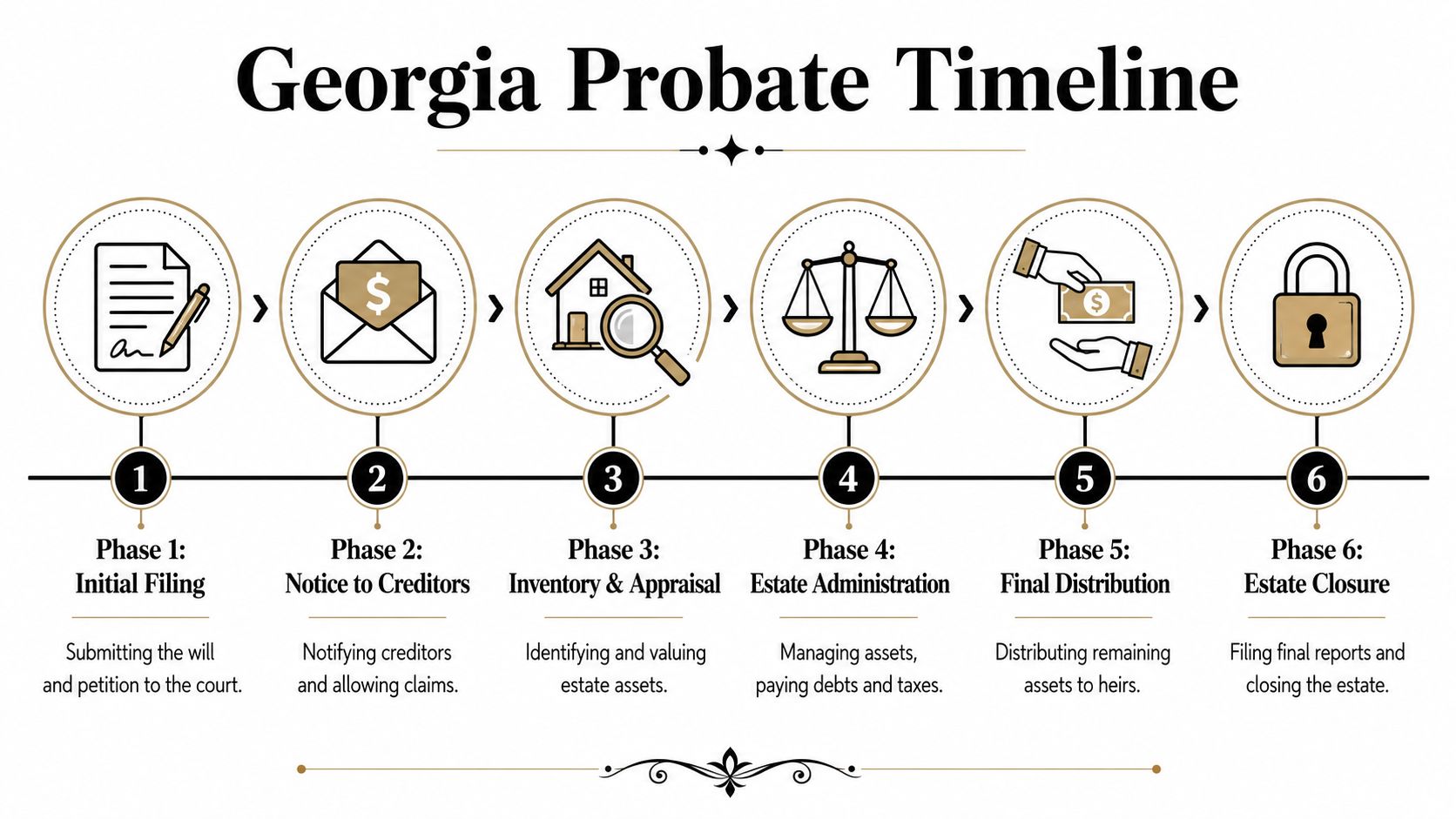
The practical duration of probate follows this sequence, which most families in Cumming, Alpharetta, Forsyth County, and nearby parts of Fulton County should expect.
First phase in Forsyth County Probate Court
The case starts with filing the petition in the proper probate court, usually where the deceased lived. For families in Cumming, that's often Forsyth County Probate Court. If the deceased lived in Alpharetta, venue may involve Forsyth County or Fulton County, depending on the address.
Early filings usually include:
- The petition asking the court to probate the will or appoint an administrator.
- The original will, if one exists.
- Death certificate information and heir details.
- Requests for notices or waivers depending on the family situation.
If the filing is complete and there isn't an immediate dispute, the court can move to appoint the Personal Representative. That appointment matters because the executor doesn't have full legal authority until the court says so.
After appointment in Cumming and Alpharetta estates
Once appointed, the Personal Representative begins formal estate administration. A useful companion resource is this explanation of the steps of estate administration in Georgia, which outlines the sequence from appointment through closing.
The next stage usually includes:
- Publishing and sending notices: Creditors and interested parties must receive legally proper notice.
- Opening the estate account: Estate money should move through a dedicated account, not a personal one.
- Collecting assets: Bank accounts, brokerage assets, deeds, titles, and personal property need to be identified and controlled.
- Protecting property: Homes in Dawsonville, Roswell, Milton, or elsewhere in North Georgia may need insurance review, maintenance, or sale planning.
The inventory and administration period
Georgia requires structure during administration. According to this guidance discussing inventory timing and creditor claim issues tied to probate administration deadlines, a Personal Representative must file an Inventory within 90 days of appointment and deal properly with creditor claims before final closing. Missing that kind of deadline can slow everything down.
This middle period is where many estates spend most of their time. Assets may need to be valued, sold, transferred, or held. Debts may need review. Some claims are obvious and valid. Others need closer analysis.
A good probate file usually moves in order: authority first, notice second, asset control third, debt resolution fourth, distribution last.
For readers comparing other states because part of the family or property is elsewhere, this realistic timeline for Texas probate is a useful contrast. It helps show how much of probate timing turns on local court procedure and state-specific claim periods.
Final distribution and estate closure
Only after debts, claims, and administrative tasks are resolved should the executor move toward final distribution. That often means preparing the final accounting, documenting what came into the estate and what went out, then closing the case properly.
For straightforward estates, this final phase can be relatively smooth. For estates involving real estate sales, business interests, missing documents, or family friction, this phase often takes longer than expected.
Common Probate Delays in Forsyth and Fulton County
The clean version of probate on paper rarely matches what happens in actual files. In Forsyth County and Fulton County, delays usually come from a handful of practical problems. Most of them are preventable or manageable if spotted early.
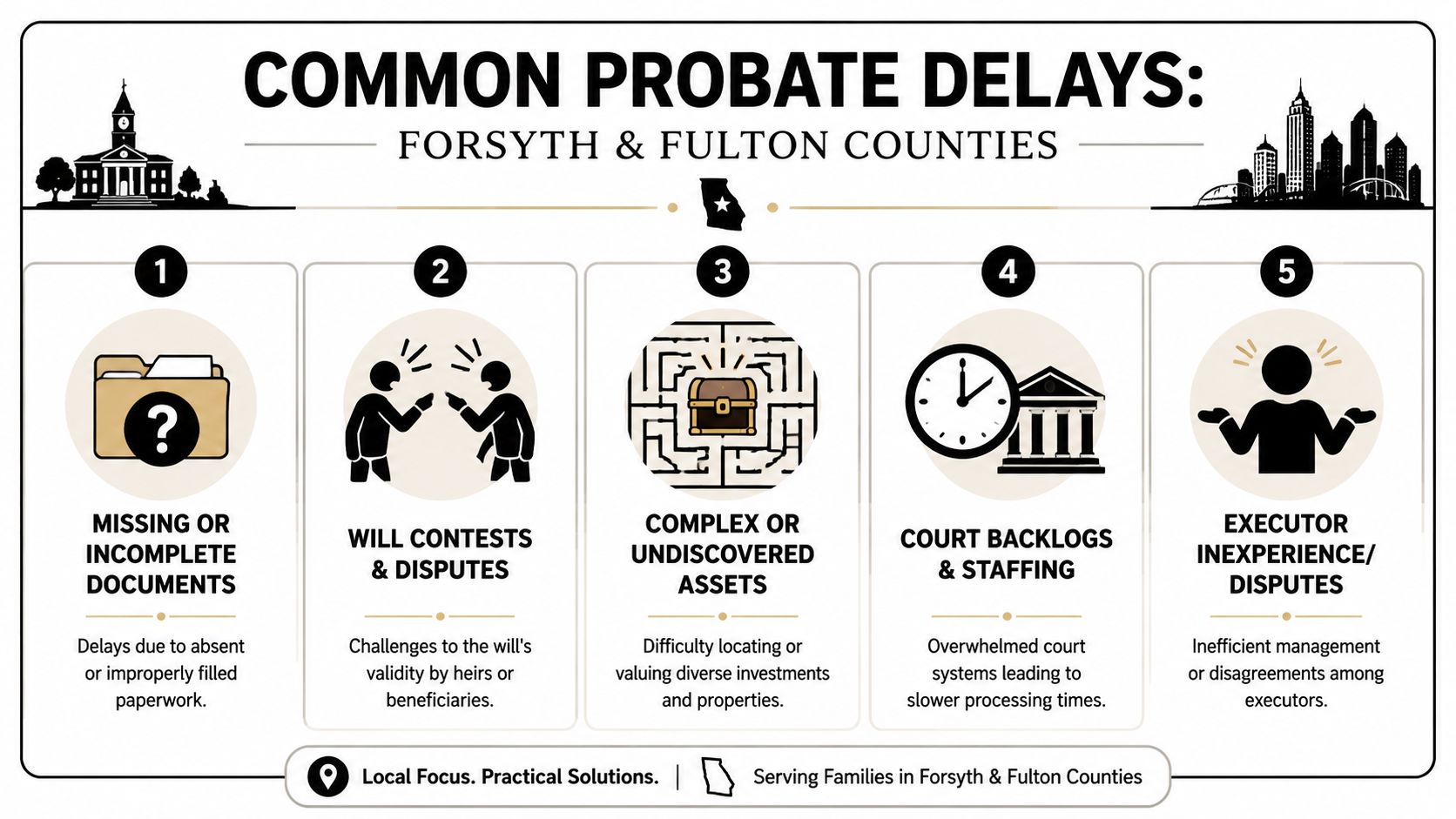
Family conflict and will contests in Alpharetta and Milton
A calm family can still become a divided one once property is involved. That often shows up in estates tied to Alpharetta, Milton, Johns Creek, or Sandy Springs, where the estate may include a valuable home, retirement funds, or a business interest.
Common conflict points include:
- Questions about the will's validity
- Disagreement over who should serve as executor
- Claims that property was promised outside the will
- Suspicion about missing funds or recent account changes
Once a dispute becomes formal, the timeline changes. Instead of simple administration, the estate starts moving through contested issues that require hearings, responses, and sometimes litigation.
Multi-state property and ancillary probate
North Georgia families often own more than one property. A family based in Cumming may have a vacation condo in Florida or inherited land elsewhere. That matters because one probate case may not be enough.
The National Association of Estate Planners & Councils finding on ancillary probate notes that 38% of U.S. probate cases involve assets in multiple jurisdictions, and ancillary probate can add 6 to 12 months. In practice, that means the Georgia estate may be moving along while a second state requires its own filing, notice process, and court approval.
Court volume, paperwork problems, and executor inexperience
Not every delay is dramatic. A lot of them are procedural.
Missing signatures, incomplete heir information, incorrect notices, or poorly organized financial records can slow a file in both Forsyth County Probate Court and courts connected to the broader Fulton County system. The same is true when an executor tries to handle a moderate estate as if it were a simple one.
The most expensive delay is often the first avoidable one. A missing document at the beginning can affect every deadline that follows.
A few local pressure points show up often:
| Delay source | What it looks like on the ground |
|---|---|
| Incomplete filing | The court asks for corrections before moving forward |
| Hard-to-value assets | Closely held businesses, unique real estate, or investment accounts need more work |
| Missing heirs | Notices can't be completed until people are identified and located |
| Debt issues | Credit card claims, tax concerns, or disputed obligations stall distribution |
| Scheduling backlog | Hearings and administrative review can take longer in busy dockets |
Business interests and unusual assets
An estate tied to a company in Roswell, rental property in Canton, or layered investment holdings near North Fulton courts takes longer because valuation and transfer aren't automatic. The executor may need appraisers, accountants, or litigation support. That isn't a sign of failure. It's often just the price of doing the job correctly.
How Executors in Alpharetta Can Streamline the Process
Executors can't eliminate the legal waiting periods, but they can reduce avoidable delay. That's where the biggest difference is usually made.
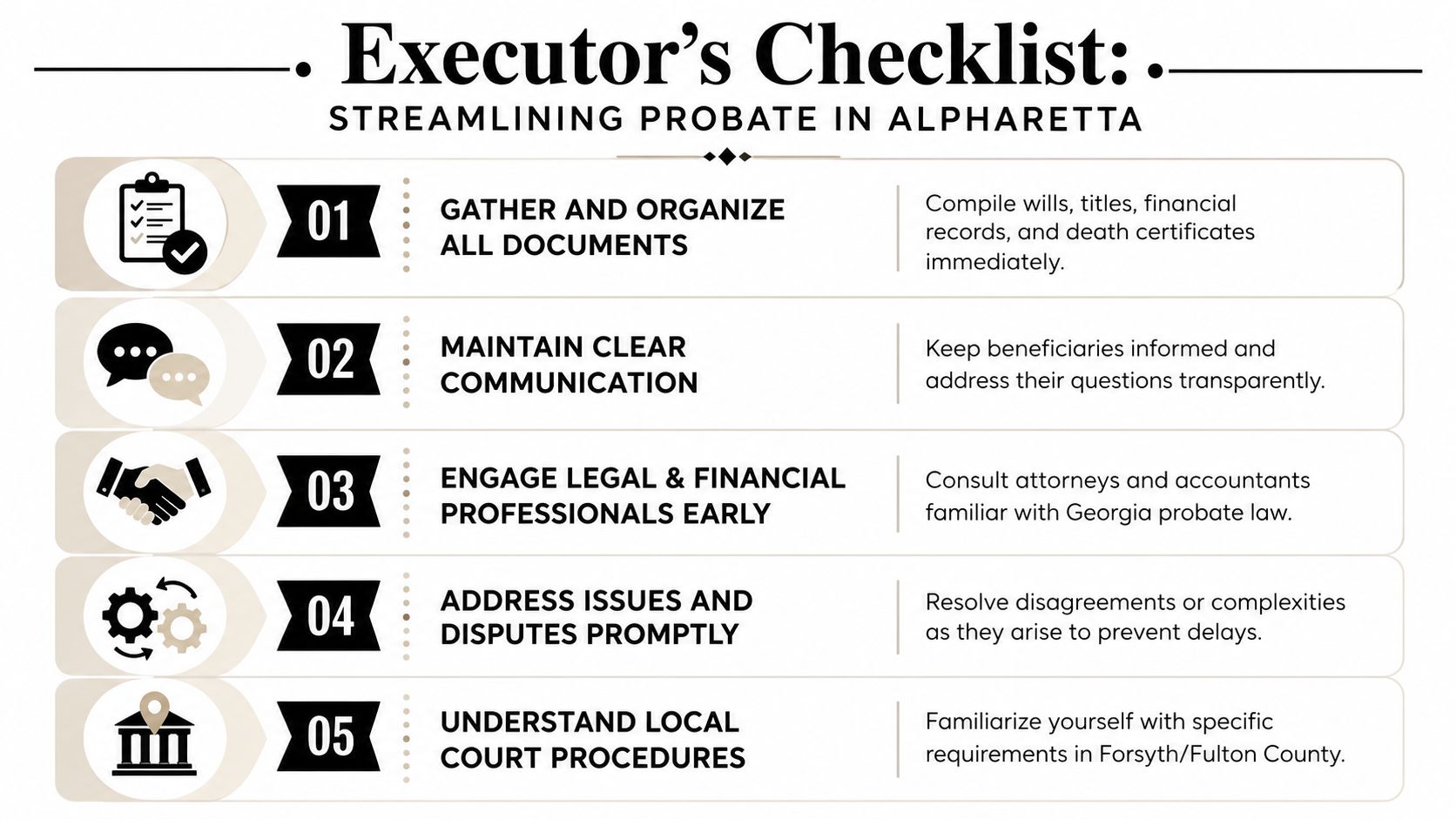
What works in real probate files
If you're handling an estate in Alpharetta, Suwanee, Roswell, or nearby communities, focus on execution, not speed for its own sake.
- Gather records before filing: Pull deeds, titles, account statements, insurance policies, tax records, and contact information for heirs as early as possible.
- Create one master asset list: Don't rely on memory or scattered email threads.
- Respond quickly to requests: Court clerks, attorneys, banks, and title companies all move better when documents come back complete.
- Keep beneficiaries informed: Silence creates suspicion. Simple updates often prevent unnecessary conflict.
- Use professionals early when needed: Appraisers, accountants, and probate counsel can solve problems before they become bottlenecks.
For executors who want a practical overview of responsibilities, this guide on what an executor of a will does in Georgia is a useful starting point.
What doesn't work
A few habits almost always create delay:
- Distributing property too early
- Mixing estate funds with personal funds
- Waiting to deal with disputed assets
- Assuming every heir understands the process
- Treating a business interest like an ordinary bank account
Some families also wait too long to ask for help because they think probate should be simple if everyone is getting along. That's not always true. Even peaceful estates can become slow if real estate, creditor issues, or court-specific filings are involved.
In practice, executors often benefit from coordinated help from probate counsel, a CPA, and local valuation professionals. Miles Hansford Law Firm is one option for Georgia probate administration and related disputes in Forsyth County, Fulton County, and the North Atlanta area.
Good executors don't try to do everything alone. They keep records clean, communicate early, and bring in the right help before a small issue turns into a court problem.
Why Choose Miles Hansford for North Georgia Probate
Probate in Cumming, Alpharetta, Forsyth County, and Fulton County isn't just about knowing Georgia law in the abstract. It requires knowing how local courts expect files to be prepared, how estate issues intersect with real property and business interests in North Georgia, and when a routine administration is starting to become a contested matter.
That local knowledge matters if the estate includes property in Johns Creek, Milton, Dawsonville, Roswell, or Sandy Springs, or if heirs are spread across counties and states. It also matters when timing, communication, and filing quality can affect whether the matter stays orderly.
Families usually need two things at the same time. They need efficiency when the estate is straightforward, and they need protection if conflict develops. A probate matter can shift from administrative to adversarial quickly. When that happens, the executor needs counsel that can both manage the paperwork and defend the estate's interests.
When an estate in Forsyth County or Fulton County Superior Court territory starts to feel unmanageable, finding a probate attorney near me and obtaining local legal guidance early is often the most practical next step.
Frequently Asked Questions About Georgia Probate
Q: How long does probate take in Cumming, GA?
A: In Cumming, GA, probate usually can't finish in less than the required creditor notice period, and many estates take longer once property, debts, or heir communication are involved. In Forsyth County, a straightforward case may move steadily, but moderate estates often run closer to a year than a few weeks.
Q: Is probate faster in Forsyth County or Fulton County?
A: It depends on the estate and the filing quality more than the county alone. Forsyth County Probate Court and matters touching Fulton County both require complete filings, proper notices, and organized administration. A clean, well-prepared estate generally moves better than a rushed or incomplete one in either court.
Q: What causes probate delays in Alpharetta estates?
A: In Alpharetta, delays often come from real estate issues, business interests, family disagreement, incomplete records, or assets outside Georgia. Estates tied to Fulton County or Forsyth County can also slow down when heirs aren't aligned or when valuations need outside professionals.
Q: Do all assets go through probate in Georgia?
A: No. Some assets may pass outside probate depending on title, beneficiary designation, or trust ownership. The executor still needs to identify what is and isn't part of the probate estate before making decisions, especially when a home, joint accounts, or payable-on-death designations are involved.
Q: Can an executor distribute assets before probate is finished?
A: Usually, that should be handled very carefully. Early distribution can create problems if debts, claims, taxes, or ownership questions are still unresolved. In Georgia probate, the safer approach is to wait until the estate is ready under the court-supervised process.
Q: What if the estate includes property in another state?
A: That often means an additional proceeding may be required in that other state. Families in Cumming, Alpharetta, and nearby areas commonly run into this with Florida property. Multi-state estates usually take longer because the executor may need to coordinate separate filings and approvals.
Q: Do I need a lawyer for probate near me in North Georgia?
A: Not every estate requires the same level of legal help, but many executors benefit from guidance early. If the estate involves real property, multiple heirs, creditor issues, business interests, or possible disputes in Forsyth County or Fulton County, legal counsel can help prevent costly mistakes.
If you're handling an estate in Cumming, Alpharetta, Forsyth County, Fulton County, or elsewhere in North Georgia, schedule a consultation with Miles Hansford Law Firm to get a clear probate roadmap. A focused review can help you understand the likely timeline, avoid preventable delay, and take the next step with confidence.
Meta Title: How Long Does Probate Take in Cumming, GA
Meta Description: Learn how long probate takes in Cumming, GA and Alpharetta, including Forsyth and Fulton County timelines, delays, and next steps.
Suggested URL Slug: /how-long-does-probate-take-cumming-ga
Internal Link Suggestions:
- Estate planning services page
- Probate litigation page
- Wills and trusts page
- Business succession planning page
Schema Recommendations:
- Attorney
- LegalService
- FAQPage