


Probate in Georgia is not a single fee. It's a combination of court filing fees, attorney fees, executor compensation, and other expenses, and probate often runs 3% to 8% of the estate's total value in the United States, with costs in Cumming, GA and Alpharetta depending heavily on estate complexity and county-specific procedures. If you're settling a loved one's estate in Forsyth County or Fulton County, the answer to how much probate costs is that local rules, the type of assets involved, and who is serving as executor will shape the final bill.
If you're reading this after a recent loss, you're probably not looking for theory. You want to know what you'll have to pay, what happens first, and whether anyone can give you a straight answer before the estate starts losing money to fees.
That concern is reasonable. Probate costs come out of estate assets before heirs receive distributions, so every filing fee, legal invoice, publication charge, and executor commission affects what ultimately passes to family. In North Georgia, especially around Cumming, Alpharetta, Johns Creek, Milton, Suwanee, Dawsonville, Roswell, Sandy Springs, and Canton, the biggest mistake families make is assuming there's one standard probate price. There isn't.
A routine estate may stay relatively contained. A more involved estate with real property, creditor issues, business interests, or family disagreement can become far more expensive. The useful way to approach probate is to break the cost into parts, understand what each part pays for, and then match that framework to the county where the case will be filed.
Understanding Probate Costs in Cumming After a Loss
A son in Cumming comes in with a will, a house, three bank accounts, and one urgent question: “What is this going to cost before my mother's estate can close?” The honest answer is still that probate costs vary, but in Forsyth and Fulton County, the reasons are usually identifiable early if you know what to look for.
Probate cost is not one bill. It is a stack of expenses tied to court filings, notice requirements, legal work, asset values, and the amount of follow-up the estate needs. A clean estate with cooperative heirs and well-titled assets usually stays within a predictable range. An estate with missing documents, hard-to-value property, creditor issues, or family conflict does not.
A useful starting point is timing. The American Bar Association explains in its overview of probate administration that probate often takes months, not weeks, and longer matters usually cost more because more attorney time, more court interaction, and more administrative work are involved. For families trying to budget, that matters as much as the filing fee.
Here is how that plays out locally. A $300,000 Forsyth County estate made up of a home, one checking account, and no dispute may involve court costs, publication, some attorney time, and modest out-of-pocket expenses. A $500,000 estate in Fulton County with multiple financial accounts, a retirement asset that needs title review, and an executor who wants to be paid often costs more because the administration work increases. A $1 million estate with real estate in more than one county, business interests, or disagreement among heirs can become expensive quickly even if nobody files a formal contest.
That is why families should ask better first questions, not just ask for one number.
What families in Forsyth County usually need to know first
Start with these:
- Which probate court will handle the estate: Most estates for Cumming families are filed in Forsyth County Probate Court, but some Alpharetta and north Fulton matters go through Fulton County, where local procedure and timing can affect the total cost.
- How the attorney is billing: Some lawyers charge hourly, some quote a flat fee for routine administration, and some use a percentage approach in limited situations. Families comparing options should review this guidance on attorney rate setting so they understand why one estate generates more billable work than another.
- Whether the personal representative will be paid: Executors and administrators may be entitled to compensation under Georgia law unless a will says otherwise. Families who want a clearer sense of that piece should review how estate executors are due a fee.
- What non-attorney costs will apply: Publication, certified mail, copies, recording charges, appraisals, and accounting help can all add to the final bill.
The practical rule is simple. Once the executor identifies the assets, the debts, the heirs, and the county where the petition will be filed, the cost estimate usually becomes much more reliable. That early review is where families in Cumming, Alpharetta, and north Fulton save money, because it exposes problems before the estate spends months reacting to them.
The Seven Key Components of Probate Costs in Georgia
A family in Cumming may open what looks like a simple estate and still face seven separate cost categories before the probate case is finished. In Forsyth and Fulton County, the total bill usually turns on which of these items apply, how much work each one requires, and whether any dispute slows the administration.
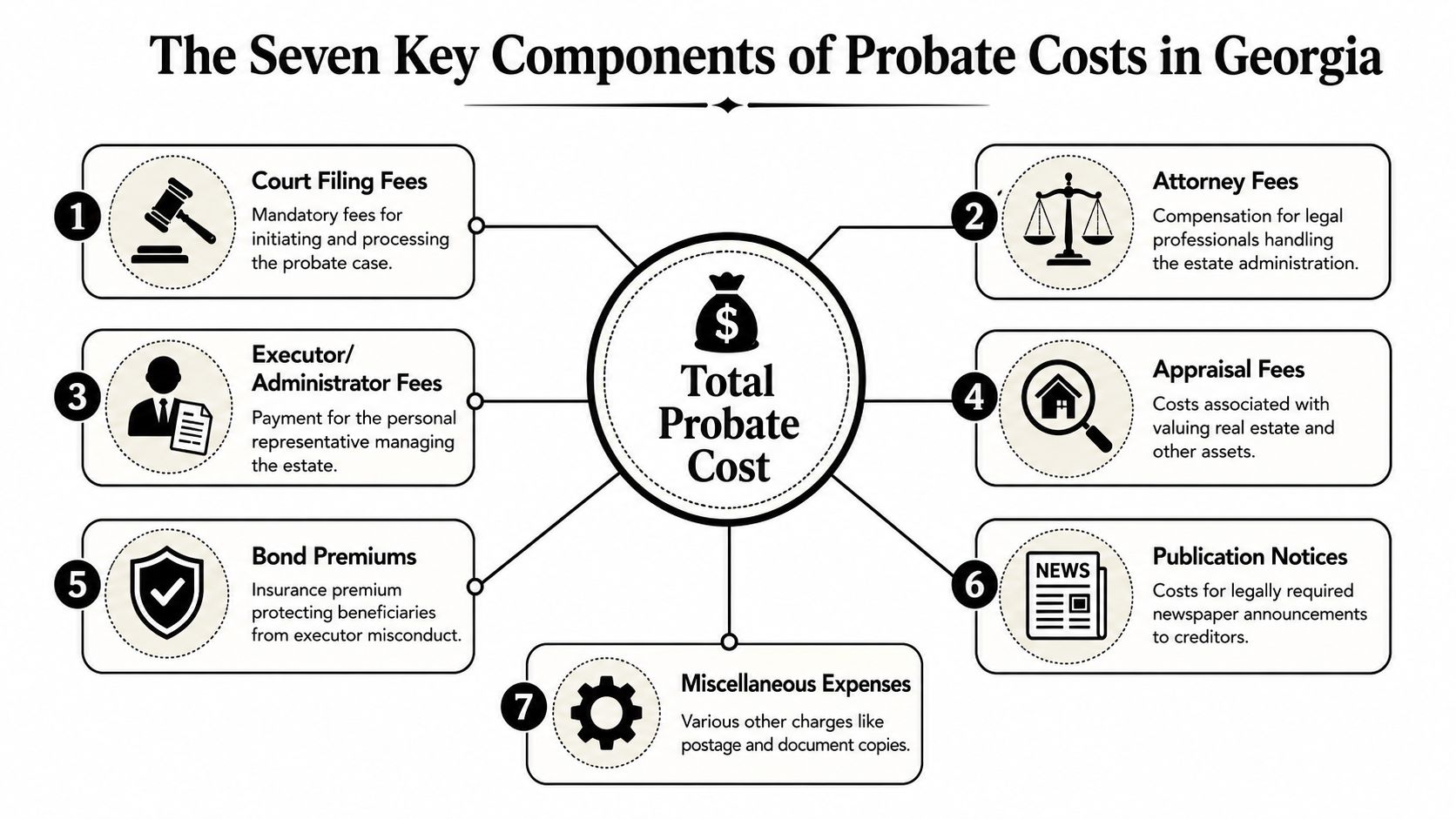
Attorney fees
Attorney fees are usually the largest probate expense. Georgia does not set one fixed probate fee, so lawyers may bill hourly, quote a flat fee for routine administration, or use a percentage approach in limited matters. The State Bar of Georgia explains that fees must be reasonable under the circumstances, which is the standard families effectively pay under in practice, not a one-size-fits-all number. See the State Bar of Georgia fee guidance.
In Forsyth and Fulton matters, the difference often comes down to the work involved. A straightforward estate with one house, a few bank accounts, and cooperative heirs usually costs far less than an estate with unclear titles, unpaid creditors, or family conflict. Families comparing billing models should review this guidance on attorney rate setting before deciding that the lowest quote is the best value.
Executor or administrator compensation
The personal representative may also be paid. Under Georgia law, that compensation is usually based on money received and money paid out by the estate, unless the will sets a different amount or the representative waives payment. The statute is O.C.G.A. § 53-6-60.
This point surprises families. A son or daughter serving as executor often starts out assuming the role is unpaid, then learns later that Georgia law treats it as work with a compensation structure attached. For a closer explanation, see when estate executors are due a fee.
Court filing fees
Every probate case starts with filing fees paid to the probate court. The statewide fee statute appears at O.C.G.A. § 15-9-60, but the amount a family pays can vary because local courts add service, recording, or certified copy charges depending on the petition.
That local variation matters. A Forsyth filing and a Fulton filing may not produce the same total at the clerk's window, even when the legal issue is similar.
Publication costs
Many estates require publication of notice in the county's legal organ. In practice, that means the estate pays a newspaper charge separate from the filing fee. The exact amount depends on the publication used by the court and the notice required in that case. The Council of Probate Court Judges of Georgia explains the notice requirements in its standard probate materials, including petitions that call for publication. See the Georgia probate court standard forms and instructions.
This is usually not the biggest line item, but it is one of the first out-of-pocket costs an executor sees.
Certified mail and administrative costs
Notice also has to go to the right people, and that creates smaller but real expenses. Certified mail charges, copies, service costs, recorded documents, and certified copies of the court order all add up over the life of the estate. The United States Postal Service publishes current certified mail services and pricing, which is useful because mailing costs change over time. See the USPS certified mail service page.
These charges rarely drive the whole budget. They still matter, especially in estates with many heirs or out-of-state beneficiaries.
Appraisal and valuation work
Valuation costs are where two estates with the same gross value can separate quickly. A $500,000 estate made up of one house and one checking account is simpler to value than a $500,000 estate that includes a small business, disputed personal property, or real estate that needs a date-of-death appraisal.
Courts and beneficiaries do not want guesses. If the estate includes real property in north Fulton, a closely held company, mineral interests, or collectibles, the representative may need an appraiser, realtor opinion, accountant, or business valuation professional before the administration can move cleanly.
Bond premiums and other professionals
Some estates require a bond. Others need a CPA to prepare fiduciary income tax filings, or outside help to clear title problems, sell property, or sort out records from a decedent who handled everything on paper.
That is why broad percentage estimates only go so far. In a $300,000 estate, these extra costs may stay modest if the assets are easy to identify and transfer. In a $1 million estate in Fulton County with multiple properties and several heirs, bond premiums, accounting help, and valuation work can materially change the final bill even if no one files an objection.
Estimating Total Probate Costs for an Estate in Cumming GA
A son in Cumming comes in after his mother dies. The house is paid off, there is money in the bank, and no one in the family is fighting. His first question is almost always the same. What is this going to cost?
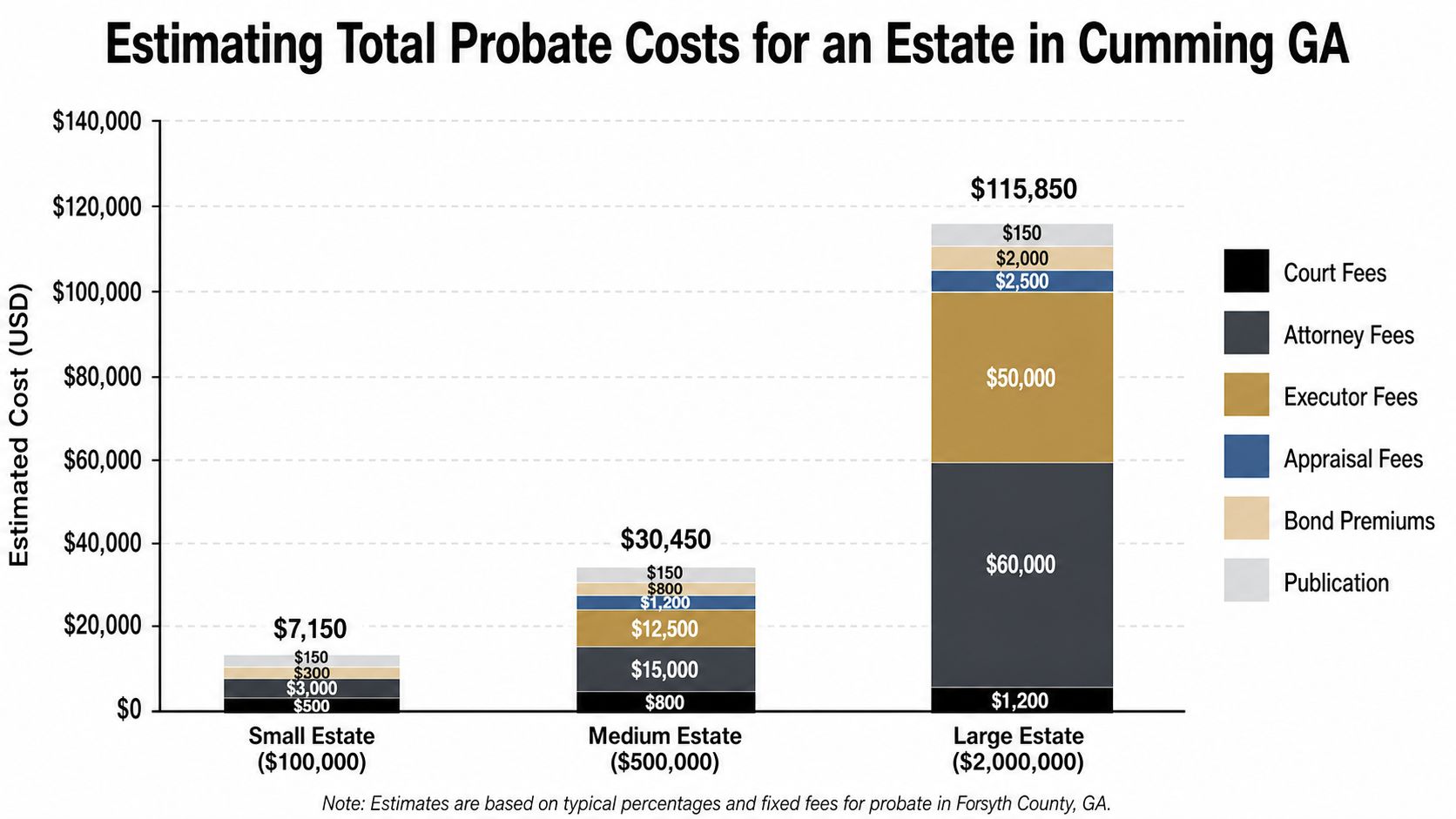
The honest answer is still, "it depends." But families deserve more than that. In Forsyth and Fulton County, the total bill usually turns on the same few variables: whether there is real estate, whether assets are easy to identify, whether heirs cooperate, and how much hands-on legal work the estate needs. Georgia attorneys also use different billing methods, including hourly, flat-fee, and in some matters a percentage-based arrangement, as discussed by the State Bar of Georgia's consumer guidance on attorney fees.
A $300,000 estate in North Georgia
A $300,000 estate often feels "simple" to a family because it is not unusually large. It may still require formal probate, notice to interested parties, publication, certified copies, deed work, and time spent gathering account information from reluctant institutions.
In a cleaner case, a family might see costs stay in the lower range for the county filing, publication, routine legal work, and a small amount of administrative expense. If that same estate includes a home that needs to be sold, a missing beneficiary, or questions about who owns a joint account, the cost rises fast. The estate value did not change. The workload did.
For a practical benchmark, national consumer estimates from the Trust & Will probate cost guide place overall probate costs in a broad range that often falls around a few percent of the estate, but local facts matter more than national averages in a Forsyth County file.
A $500,000 estate
A $500,000 estate is where the "it depends" answer starts to frustrate people. That frustration is understandable. At this level, a house, retirement account issues, several heirs, or a creditor claim can add enough work to change the legal bill by thousands of dollars.
A straightforward $500,000 estate in Cumming with one home, liquid accounts, and cooperative beneficiaries may remain fairly controlled. A similar estate with property in Fulton County, a need for appraisals, and repeated calls among siblings will cost more because the representative and counsel have more to do. Families often underestimate the cost of ordinary delays. Waiting on statements, cleaning up title, arranging a sale, and answering beneficiary questions all take time.
A $1 million estate in Cumming or Alpharetta
A $1 million estate does not always mean a courtroom fight. It usually means more moving parts.
Higher-value estates in Cumming, Alpharetta, Milton, and Johns Creek often include multiple financial institutions, larger investment accounts, tax coordination, and property that must be transferred or listed for sale. If the estate is opened in Fulton County, local procedure, scheduling, and filing practice can affect timing and cost in ways families do not expect. Anyone trying to compare local court process should review how probate matters are handled in Fulton County Probate Court.
Here is the trade-off I explain to families. Paying for careful legal work on the front end can reduce the chance of larger problems later, especially where there are several beneficiaries or high-value assets. On the other hand, a family that agrees on everything and has organized records may not need the same level of attorney involvement as an estate with business interests, blended-family tension, or disputed transfers made before death.
The right estimate is not a statewide average. It is a case-specific budget built around the county, the asset mix, and the people involved.
Navigating the Probate Courts in Forsyth and Fulton County
A daughter in Cumming and a son in Alpharetta can inherit estates with similar bank balances and still face different probate costs because they are filing in different courts. That is one reason the answer to "how much does probate cost" changes from one North Georgia family to the next.

Forsyth County filings for Cumming families
For a Cumming estate filed in Forsyth County, the opening cost starts with the court's filing charges, then grows from the practical items families do not see at first. Certified copies, service or mailing costs, publication, and any later pleadings can all add to the total. The court's own Forsyth County Probate Court fee schedules and forms are the best place to confirm current local filing amounts.
In a routine $300,000 estate, those court-related charges may stay modest if the will is clear, heirs cooperate, and assets are easy to collect. In a $500,000 estate with a house, several financial accounts, and one out-of-state heir, the same court file often generates more notices, more certified paperwork, and more follow-up. At $1 million, the filing fee itself is still only one line item, but the administrative burden around the case usually grows because there is more to transfer, document, and protect.
Fulton County procedures for Alpharetta and North Fulton estates
Fulton County often feels less predictable to families, especially when the estate includes real property, multiple institutions, or beneficiaries who expect frequent updates. The court costs still matter, but the larger issue is how procedure affects time. More filings, more certifications, and longer waits between steps can increase the total cost of administration even when nobody is fighting.
That is the trade-off I explain in practice. A family may save money by handling part of the paperwork themselves, but one missed notice or one incomplete filing can slow the case and create more legal work later. For a practical overview of probate court procedure in Fulton County, Georgia, families should review the local process before assuming a Fulton case will move like one in Forsyth.
What usually happens in the courthouse process
The courthouse process is usually straightforward on paper:
- Petition filed: The executor or proposed administrator opens the estate in the proper county.
- Heirs and creditors addressed: Required notice goes out, and publication may be required.
- Assets identified and controlled: Accounts, real estate, and personal property are gathered and valued.
- Debts and expenses paid: Valid claims, taxes, and estate expenses are handled in order.
- Distributions made: Remaining property is transferred to the right beneficiaries, and the estate is closed when the court's requirements are met.
Where families get surprised is not the outline. It is the friction inside the outline.
A missing death certificate, an unreleased lien, a bank that asks for extra documentation, or disagreement over who should serve can turn a routine filing into a longer and more expensive matter. In Forsyth and Fulton County alike, probate costs rise when the estate has to wait on people, paperwork, or property problems.
Strategic Ways to Reduce or Avoid Probate Costs in North Georgia
A daughter in Cumming may spend a few thousand dollars to settle one parent's estate, then realize her surviving parent owns the same house, the same accounts, and the same problem is likely coming again. That is usually the moment families stop asking only, "What will this probate cost?" and start asking, "How do we keep the next one smaller, faster, and simpler?"
In Forsyth and Fulton County, the answer depends less on a single document and more on how each asset is owned today. A $300,000 estate made up mostly of one bank account and a vehicle raises different planning issues than a $500,000 estate with a home in Alpharetta, or a $1 million estate with real property, investment accounts, and a blended family. The cost savings come from keeping the right assets out of the probate estate before a death occurs.
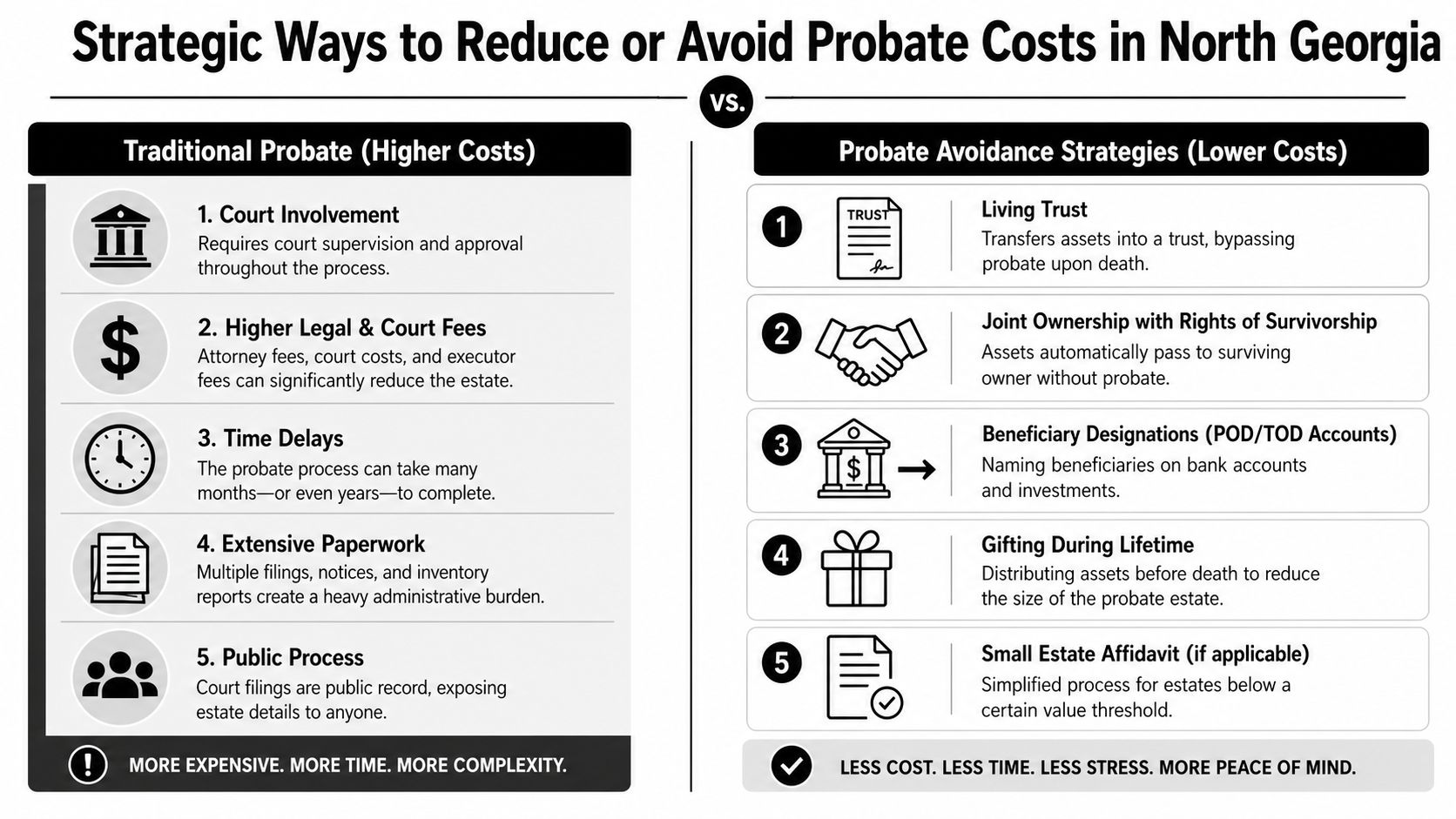
The tools that usually work best
The best planning tools are the ones that match the asset.
- Revocable living trust: Property properly transferred into a trust usually avoids probate and can be managed privately after death. This often makes the biggest difference when the estate includes real estate in Fulton or Forsyth County.
- Beneficiary designations: Life insurance, retirement accounts, and some financial accounts can pass directly to the named beneficiary.
- Payable-on-death and transfer-on-death designations: These are often effective for bank and brokerage accounts that a family wants to transfer without court involvement.
- Joint ownership, used carefully: Some jointly owned assets pass to the surviving owner automatically, but joint ownership can also create tax, control, or creditor concerns if it is used casually.
- Title review: A good estate plan fails if the deed, account registration, or beneficiary form says something different.
That last point causes trouble more often than families expect.
A couple may sign a trust in Johns Creek, then leave the house deed in their individual names and never retitle a major account. After death, the family still ends up opening an estate for the assets that were never aligned with the plan. I see this regularly. The paperwork exists, but the funding work was never finished.
Where local cost savings show up
For a $300,000 estate, avoiding probate on a house may not be the issue if there is no real estate. The better move may be updating account beneficiaries and using payable-on-death designations so a child is not paying legal fees and court costs to collect modest liquid assets.
For a $500,000 estate with a home in Cumming or Alpharetta, title planning usually matters more. If the home is the main asset, one change in ownership structure can remove the largest reason the estate would need a full probate proceeding.
For a $1 million estate, families usually need more than one tool. Trust planning, current beneficiary forms, and a review after remarriage or a death in the family often save far more than any do-it-yourself shortcut later. Larger estates also tend to have more friction points, including multiple beneficiaries, investment accounts, and property in more than one name.
What does not work well
A will by itself usually does not avoid probate in Georgia. It gives instructions, but the court process is often still required to carry them out.
Verbal promises also fail. So do old beneficiary forms that still name an ex-spouse, a deceased relative, or one child while ignoring later family changes. Those mistakes are expensive because they create disputes at the exact moment the family is already under stress.
Families trying to cut costs should also be realistic about joint ownership. It can work well in the right case. It can also create problems during life if the added owner has creditors, gets divorced, or disagrees with how the asset should be handled.
For a practical explanation of the options, including trusts, beneficiary designations, and title strategies, review this guide on how to avoid probate in Georgia.
Why Choose Miles Hansford for Probate in Alpharetta and Cumming
Probate is legal work, but for most families it feels personal before it feels procedural. You may be sorting through financial records while planning a service, answering calls from relatives, and trying not to make a costly mistake in court. That's why local knowledge matters.
A firm serving Alpharetta, Cumming, Forsyth County, Fulton County, Johns Creek, Milton, Roswell, Sandy Springs, Suwanee, Dawsonville, and Canton sees the difference between a generic probate answer and a county-specific strategy. Filing in a local probate court is not just about forms. It's about understanding how the court expects the petition to be presented, what supporting documents create delay, and how to keep an estate moving when beneficiaries need clarity.
Families looking for a probate lawyer near me usually aren't looking for a slogan. They're looking for someone who can tell them, with confidence, whether the estate needs full probate, what the likely cost drivers are, and what can be done to prevent unnecessary expense.
That kind of representation is especially important when an estate includes real property, blended-family concerns, disputed expectations, or a personal representative who has never handled probate before. Good probate counsel protects the estate by reducing avoidable error, keeping the executor on track, and helping the family make decisions with a clear record.
Frequently Asked Questions About Georgia Probate Costs
Q: How much is the filing fee to start probate in Georgia?
A: Georgia probate courts charge a base filing fee set by state law, and the final amount usually increases once the county adds its own surcharges and certified copies. In Forsyth County and Fulton County, the total is usually higher than the base number families see quoted online. For current local fees, check the court directly through the Fulton County Probate Court fee schedule.
Q: Is probate more expensive in Alpharetta than in Cumming?
A: Sometimes, yes. An Alpharetta estate filed through Fulton County can carry different local court costs than a Cumming estate filed in Forsyth County. But county filing charges rarely decide the full bill by themselves.
A $300,000 estate with one house, one bank account, and cooperative heirs may stay relatively controlled in either county. A $500,000 estate with multiple beneficiaries, sale proceeds, and missing paperwork often costs more because the administration takes longer. A $1 million estate can still be efficient if the records are clean, or expensive if there is a business interest, a disputed will, or a fight over distributions.
Q: Do executors get paid in Georgia?
A: Yes, in many cases. Georgia law allows compensation for the personal representative unless the will changes that arrangement or the executor declines payment. That cost matters more in larger estates because more money may move through the estate account, and executor work often expands with the size and complexity of the assets.
Q: Are attorney fees fixed in Georgia probate cases?
A: No. Georgia probate lawyer fees are usually billed as a flat fee, an hourly fee, or, in some matters, by another agreed structure based on the work involved. A routine Forsyth County estate with clear heirs and organized records is very different from a Fulton County estate with creditor issues, real estate transfers, or a will contest.
That is why families often hear, "it depends." The better question is what is driving the cost.
Q: What other costs show up besides filing fees and lawyer fees?
A: Publication costs are common because many probate matters require notice in the county's legal organ. Mailing costs, certified copies, appraisals, bond premiums, recording fees, and accounting help can also appear. In a small estate, those charges may feel manageable. In a $500,000 or $1 million estate, they can add up quickly if there are several assets to transfer or sell.
Q: Does every estate in Forsyth County or Fulton County cost the same percentage?
A: No. Probate cost is not a fixed percentage of the estate.
A clean $1 million estate can cost less than a disorganized $300,000 estate if the larger estate has a valid will, payable-on-death accounts, and no beneficiary conflict. I regularly tell families to focus less on a percentage estimate and more on the actual cost drivers: court filings, notice requirements, executor work, legal time, tax questions, and whether anyone is likely to object.
Q: Can probate costs be reduced before someone dies?
A: Yes. Trust funding, updated beneficiary designations, joint ownership used carefully, and accurate asset titling can reduce or avoid probate on some assets. The planning has to match the way the assets are owned. That is where families often run into trouble.
If you are facing probate after a loss in Cumming, Alpharetta, Forsyth County, or Fulton County, the next step is to get a clear local assessment before fees and delays grow. Miles Hansford Law Firm helps families understand what probate is likely to cost, what the court will require, and how to move the estate forward with less confusion and less risk. If you need practical guidance now, schedule a consultation, speak with a probate attorney, and call today for direction specific to your situation.