


When you receive a court order in a family law case that feels fundamentally wrong, it's easy to feel overwhelmed and unsure about what happens next. This is especially true in emotionally charged matters like child custody, alimony, or how your property was divided after a divorce in Cumming, GA. Many people in Forsyth and Fulton County assume a judge's ruling is the final word, but Georgia law provides a way to challenge a decision you believe is legally flawed. The first step is to seek strategic advice.
This process is called an appeal. An appeal is not a second trial or a chance to re-argue your case with new evidence. Instead, it’s a formal request to a higher court to look for significant legal mistakes made by the first judge. The attorneys at Miles Hansford are here to provide the calm, protective guidance you need.
Schedule a consultation to have your case reviewed by our experienced appellate team.
Why This Matters in Cumming

If a judge in a Cumming, GA, family law case issues an order that feels unjust, there is a structured path forward. An appeal asks a higher court, like the Georgia Court of Appeals, to review the original trial for legal errors that were serious enough to affect the final outcome. However, the window to act is extremely short, and the process is unforgiving.
The Purpose of an Appeal in Georgia Family Law
The entire goal of the appellate court is to spot a "reversible error." This is a very high standard to meet. Judges in Forsyth County Superior Court and Fulton County Superior Court, for instance, are given a great deal of discretion in family law. Simply disagreeing with how a judge weighed the evidence in your Cumming divorce or Alpharetta custody case is almost never enough for a successful appeal.
A valid appeal has to pinpoint specific legal mistakes. These might include situations where the judge:
- Misinterpreted or incorrectly applied a Georgia law, like equitable division statutes.
- Did not follow the required legal procedures during a temporary hearing or trial.
- Made a ruling based on a flawed understanding of Georgia’s child custody standards.
For example, if a judge in a Fulton County case misapplies the state's equitable division laws or overlooks the required factors for determining a child's best interests for a parenting plan, that could be a reversible error.
An appeal is a highly technical legal proceeding with strict deadlines and procedural rules. Do not assume an unfavorable outcome is the final word, but attempting to navigate the appellate process without an experienced Cumming family law attorney is exceptionally risky.
The Legal Process of an Appeal in Georgia

Many people think an appeal is a chance to retry their case, but that’s one of the biggest misconceptions. You don’t get to present new evidence or ask a higher court to simply disagree with the trial judge’s decision. The appellate court’s role is very specific: to review the trial record for a significant legal mistake, which we call a reversible error. Finding these errors is the absolute foundation of a successful appeal and requires intensive legal research, a process sometimes supported by tools like an AI Legal Case Researcher.
Common Grounds for an Appeal in Cumming, GA Family Law
In the family law cases we handle across Forsyth County and Fulton County, we see certain types of errors crop up more often than others. Our years of experience in courtrooms from Alpharetta and Johns Creek to Milton have taught us exactly what to look for when reviewing a case for appeal.
Some of the most common grounds we find include:
- Misapplication of Child Custody Laws: Georgia law mandates that judges weigh specific "best interest of the child" factors. If a judge fails to properly consider these factors when creating a parenting plan, it can be a solid basis for an appeal.
- Errors in Equitable Division: Georgia is an equitable division state, meaning marital property is divided fairly—but not always 50/50. A reversible error could occur if a judge incorrectly labels separate property as marital or doesn't follow the legal steps for dividing assets in a high-asset divorce.
- Procedural Errors: The court system runs on strict rules. A significant mistake made during a temporary hearing or an error in how critical evidence was admitted or excluded can sometimes be enough to warrant an appeal. This is very different from other post-judgment actions like filing a motion to dismiss.
The real challenge is telling the difference between a judge’s legal error and a discretionary call you just don’t like. An attorney with appellate experience knows how to comb through your case transcript to spot these subtle but critical mistakes. We've seen how these issues play out in cases from Dawsonville to Roswell, and we use that insight to build a powerful appellate argument.
Discretion vs. Legal Error: A North Georgia Example
Understanding what makes a valid case for appeal versus simply disagreeing with a judge's decision is crucial. The following table breaks down a few common family law scenarios to illustrate the difference.
| Scenario | Potential Grounds for Appeal (Legal Error) | Unlikely Grounds for Appeal (Disagreement) |
|---|---|---|
| Child Custody | Judge ignores evidence of substance abuse, stating it's not relevant to a parent's fitness under Georgia law. | Judge weighs all factors but gives more weight to one parent's flexible work schedule in Cumming. |
| Asset Division | Judge classifies an inheritance received during the marriage as marital property, contrary to Georgia law. | Judge divides the marital assets 60/40 after finding one spouse was more at fault for the marriage's failure. |
| Alimony | Judge refuses to consider alimony at all because the marriage lasted "only" nine years, ignoring statutory factors. | Judge awards a lower amount of alimony than you requested after reviewing both parties' finances. |
| Evidence | Judge allows hearsay testimony from a neighbor about a parent's conduct over a proper objection. | Judge finds your ex-spouse's testimony more credible than yours on a disputed financial matter. |
This table shows how an appeal hinges on how a judge reached their decision, not just the decision itself. The difference between a disappointing outcome and a legally flawed one is often found in the small details of the court record. An experienced appellate attorney knows how to find those details and build a compelling legal argument around them. For a real-world look at how these principles are applied, you can learn more about appealing a divorce ruling in our discussion of the Alicia Stephenson case.
Our Strategy for Appeals in North Georgia
Challenging a final court order isn't just another legal step; it's a completely different process with its own set of unforgiving rules. The entire process runs on a strict, non-negotiable schedule. Every deadline is absolute. For our firm, managing these dates is a top priority, and we rely on tools like professional legal calendar software to ensure nothing ever gets missed. A single misstep, like a late filing, can end your appeal before it even has a chance to be heard.
The Critical 30-Day Deadline for a Notice of Appeal
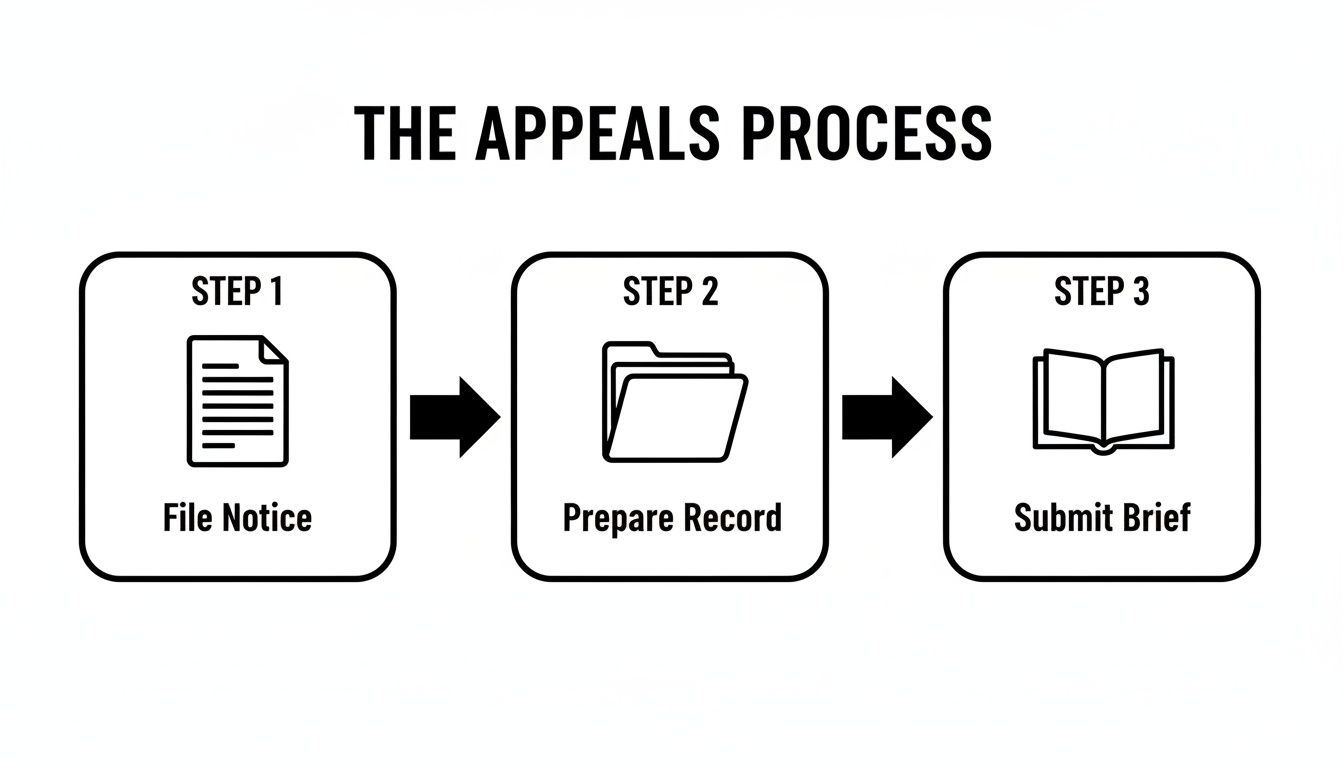
After a judge issues a final order in your case, a clock starts ticking. You have exactly 30 days from the date that order is filed with the court clerk to file a Notice of Appeal. This isn't a guideline—it's a hard-and-fast rule under Georgia law.
Miss this 30-day window, and your right to appeal is gone forever. It doesn't matter how wrong the judge's decision might have been. This is why you must contact an appellate attorney immediately after receiving a disappointing outcome in a court in Cumming, GA, Alpharetta, or anywhere in our North Georgia communities like Suwanee or Johns Creek. There is no time to waste.
Preserving and Preparing the Trial Record in Cumming, GA
An appeal is not a new trial. The appellate court won't hear from new witnesses or look at new evidence. Their only job is to review what already happened in the lower court to see if a legal mistake was made. This means the official "record" from your trial has to be perfectly compiled.
This record is the foundation of your entire appeal and typically includes:
- The Pleadings: Every official document filed in the Forsyth or Fulton County court.
- The Exhibits: All documents, photographs, or other items accepted as evidence.
- The Transcript: A complete, word-for-word written account of everything said in the courtroom.
Without the transcript, the appellate court has no official way to review what was said or how the judge arrived at their decision. Our team handles the entire process of ordering the complete record and making sure it's properly sent to the appellate court.
Crafting the Core of Your Appeal: The Appellate Brief
With the record assembled, the real work begins: writing the appellate brief. This is a formal, persuasive legal argument, built on Georgia law and previous court decisions, designed to convince the appellate judges that the trial court made a reversible error.
Our attorneys, who regularly represent clients in Johns Creek, Milton, and Suwanee, pour immense time and focus into this phase. It’s a meticulous process that involves:
- Deep Legal Research: We dig through Georgia statutes and decades of case law to find legal precedents that support your position.
- Strategic Argument Development: We carefully build the argument, pinpointing the specific errors and explaining precisely why they justify overturning the decision.
- Meticulous Citation: Every point we make must be backed up by a direct reference to the trial transcript or a specific legal authority.
The sheer complexity of brief-writing highlights why professional legal help is so essential. You can find more information on our firm's appellate practice area.
What to Expect in Forsyth or Fulton County Courts
It’s the first question nearly every client in Cumming or Alpharetta asks: what are my chances of winning? We believe in giving you a straightforward and realistic answer: successfully appealing a court decision in Georgia is difficult. Appellate courts give significant deference to the lower court's decisions, especially in the Forsyth County Superior Court and Fulton County Superior Court.
Understanding the Standard of Review in Cumming, GA Appeals
Your odds of winning an appeal are directly tied to the standard of review the higher court will apply. For many family law cases, that standard is "abuse of discretion." This is an extremely high bar to clear. An abuse of discretion means the trial judge’s decision wasn’t just a tough call; it was so blatantly unreasonable, arbitrary, or unsupported by evidence that it defies Georgia law.
Simply being unhappy with a child custody outcome or an alimony award isn't enough grounds for an appeal. You must be able to show that the judge’s ruling was fundamentally unjust because they failed to properly apply the law.
How Strategic Representation Improves Your Odds
While the statistics on appeals can seem discouraging, the right legal strategy can dramatically change the outlook. National findings on success rates in appeals and a study of appellate case outcomes show that reversal rates can be low, but these numbers don't capture the nuances of Georgia family law cases.
Success often comes down to the quality of your legal representation. An appellate attorney who regularly practices in North Georgia communities like Alpharetta, GA, Roswell, and Sandy Springs understands how to find the kind of subtle but critical legal errors that form the basis of a winning appeal. They know how to craft arguments that will be persuasive to the appellate judges who will decide your case.
Why Choose Miles Hansford for Your Cumming Appeal
Hiring a lawyer for an appeal isn’t the same as finding one for your original divorce or custody case. When you're looking at how to appeal a court decision in Cumming, GA, you need a strategist who understands both the appellate courts and the local trial courts of North Georgia.
Local Insight From Forsyth and Fulton County Courtrooms
Our attorneys at Miles Hansford spend their days in the same courtrooms where appeals get their start, like the Forsyth County Superior Court and the Fulton County Superior Court. This daily presence in Cumming and Alpharetta gives us a real advantage. We know the local judges and how they tend to rule on key issues like property division, child support, and parenting plans. A strong appeal is often built on mistakes that were properly "preserved" during the original trial. Since we are trial lawyers first, we know how to find those critical moments.
Strategic Evaluation of Your Appeal
Not every disappointing outcome is a good candidate for an appeal. We see it as our job to give you a straightforward, candid evaluation of your case's potential. Before you commit your time and money, we’ll help you weigh the risks, the costs, and the statistical chance of success. Our team brings decades of combined experience to the table, analyzing every case to ensure you have a clear, realistic picture of the road ahead, whether you’re in Cumming, Alpharetta, Roswell, or Sandy Springs.
A Team Dedicated to North Georgia Families
Our firm is deeply rooted in the North Georgia community. We proudly serve clients in our home cities and also in surrounding areas like Canton and Dawsonville. Our mission is to be a calm, protective force during what can be one of the most stressful legal fights you’ll ever face. When you hire Miles Hansford, you get a team of dedicated strategists who will fight to protect your rights, your family, and your future.
Frequently Asked Questions About Appeals in Georgia
The appeals process can feel like a maze of unfamiliar rules and unforgiving deadlines. We often field questions from clients across North Georgia, from Cumming to Alpharetta, who are considering challenging a court’s final order. Here are some of the most common ones we hear.
How long do I have to appeal a family law decision in Cumming, GA?
In Georgia, you have a strict 30-day deadline from the date a final judgment is entered to file a Notice of Appeal. This is an absolute, non-negotiable window. If you miss that deadline in Forsyth County Superior Court or any other trial court, you permanently lose your right to challenge the decision. It is critical to speak with an attorney immediately.
Can I introduce new evidence in an appeal of a Cumming court decision?
No. An appeal is not a second trial or a "do-over." You cannot present new evidence or re-argue facts. The Georgia Court of Appeals will only review the existing record from your original case—transcripts, evidence, and filings—to look for legal mistakes made by the trial judge in the Cumming or Alpharetta court.
What is the cost to appeal a court decision in Georgia?
The cost of an appeal varies depending on the case's complexity and trial length. Key expenses include court filing fees, transcript costs (which can be thousands of dollars for a multi-day trial), and attorney's fees for extensive research and brief writing. We provide a clear cost-benefit analysis during our consultation so you can make an informed decision.
What happens if I win my appeal in Georgia?
Winning an appeal might lead to the appellate court "reversing" (invalidating) the trial court's decision. More often, the court will "vacate and remand" the case, sending it back to the Cumming or Alpharetta trial court with specific instructions for a new hearing or trial. A victory gives you a vital second chance to have your case heard correctly.
What is the difference between an appeal and a modification?
An appeal argues that the original judge made a legal error, and it must be filed within 30 days of the order. A modification is a request to change an existing order (like for child custody or support) based on a significant change in circumstances that has occurred since the original order was issued. They are two entirely different legal actions.
If you believe a legal error was made in your family law case, time is not on your side. The Miles Hansford Law Firm provides the strategic, experienced, and protective appellate representation needed to navigate this complex process. Contact us today to schedule a consultation and understand your options for challenging a court order. Schedule your consultation.