


You went to court in Georgia and won. The judge issued a final order, and you walked out with a judgment in your favor. That should be the end of it, right? Unfortunately, that piece of paper isn't a check. In the practical world of collecting what you're owed, winning your case is often just the beginning of the process.
You Won in Court—So Where Is the Money?
Getting a favorable judgment in a Fulton County or Forsyth County court is a significant victory, whether it was over a contract dispute, a business disagreement, or an unpaid family law obligation. But here’s the frustrating reality: the Georgia court system does not automatically collect the money for you. That responsibility falls squarely on your shoulders.
For individuals and business owners from Cumming to Alpharetta, this can be a difficult realization. You followed the rules, presented your case, and won. Now what?
A judgment is your legal authority to pursue a debtor’s assets. Without taking the next steps, it’s just a declaration that you're owed money. Many debtors are banking on you getting overwhelmed or discouraged by the post-judgment process and simply giving up. It is important not to let that happen.
Turning a Paper Judgment into Real Assets
The key to actually getting paid is knowing which legal tools to use and when. These are not passive requests; they are assertive, legal actions designed to compel payment. A smart collection strategy often combines these tools based on what you can find out about the debtor's finances.
Here are the primary tools in your post-judgment toolkit:
- Garnishments: This allows you to intercept money that belongs to the debtor but is held by someone else. Common examples include wage garnishments from their employer or freezing funds directly from their bank account.
- Liens: By placing a lien on the debtor's property (like a house or land), you make it nearly impossible for them to sell or refinance without paying you first.
- Levies: This is where the local sheriff's department gets involved. A levy allows the sheriff to physically seize the debtor’s property—such as cars or equipment—and sell it at auction to pay off your judgment.
Even after you have a judgment, a formal written demand can sometimes prompt a debtor to pay before you have to use more forceful methods. Using resources like demand for payment letter templates can provide a structured, professional way to make that final request. While these are often used before a lawsuit, they can be surprisingly effective afterward as well.
A common misconception is that the court handles collection. In reality, the court provides the legal authority, but the creditor must drive the enforcement process. Success depends on persistence and using the right legal tools at the right time.
Navigating this process requires a solid grasp of Georgia law and a persistent strategy. In the sections that follow, we'll explain exactly how to make your judgment official, track down the debtor’s assets, and use the state’s most powerful collection methods to finally turn that court victory into a financial recovery.
Making Your Judgment Official: The First Critical Step
A judgment from a Georgia court is a powerful document, but on its own, it has no enforcement power. To begin collecting what you're owed, you must transform that court order into a legally enforceable tool. This initial part of the process is administrative, but it is the absolute foundation for every collection action that follows.
The work begins at the courthouse. You will need to take your final judgment to the Clerk of Superior Court in the county where the debtor owns property, or where you think they might own property in the future. For our clients in North Georgia, this often means a trip to the courthouses in Forsyth County (in Cumming) or Fulton County (in Atlanta). This is where you officially record your judgment and obtain a specific legal instrument.
Securing a Writ of Fieri Facias, or "Fi. Fa."
The key document you need is called a Writ of Fieri Facias, but you will almost always hear it called a Fi. Fa. (pronounced "fi-fa"). Think of this writ as a directive from the court to the local sheriff, empowering them to seize and sell the debtor’s property to satisfy your judgment. It is the official warrant that authorizes all your collection activities.
Once the clerk issues the Fi. Fa., it must be recorded on the county’s General Execution Docket (GED). This is a non-negotiable step. Recording the Fi. Fa. on the GED is what creates a legal lien against all the debtor’s property in that county, covering everything from real estate to personal property.
Recording the Fi. Fa. is like planting your flag. It secures your place in line and puts the world on notice that you have a legal claim to the debtor's assets, making it difficult for them to sell property or secure new loans without addressing your judgment first.
This lien is incredibly powerful. It attaches to any property the debtor currently owns in that county. Even more importantly, it will automatically attach to any property they acquire in the future for as long as your judgment remains active. To better understand the legal actions that lead up to this point, you can learn more about the civil litigation process in Georgia.
Why Every County Matters
Here’s a crucial detail: a Fi. Fa. is only effective in the county where it’s recorded. If you got your judgment in Forsyth County but suspect the debtor has a bank account in Roswell or owns a business in Johns Creek, you must also record the Fi. Fa. in Fulton County.
A smart collection strategy almost always involves recording the Fi. Fa. in multiple counties:
- The county where the debtor lives.
- Any county where you know they own real estate.
- Counties where they work or may have business interests.
Doing this ensures your lien covers as many potential assets as possible. Without a properly recorded Fi. Fa. on the GED, you have no legal basis to proceed with wage garnishments, bank levies, or property seizures. It is the essential first move that turns your paper victory into a proactive collection campaign.
Finding a Debtor’s Hidden Assets and Income
After you have recorded your Fi. Fa. in the right counties, the toughest hurdle remains: you cannot seize what you cannot find. Debtors may attempt to hide funds or transfer assets to avoid payment. Georgia’s post-judgment discovery process gives you the legal authority to investigate their financial world.
This is not a polite request. It is a court-backed demand for full transparency which provides a roadmap from a judgment on paper to an actual recovery.
Formal Discovery Tools
To piece together the debtor’s finances, you will rely on a few precise methods:
Post-Judgment Interrogatories
These are written questions served under oath. You can ask about bank balances, employment details, real estate holdings, vehicles, and business interests.Requests for Production of Documents
This is a formal demand for pay stubs, bank statements, tax returns, property deeds, vehicle titles, partnership agreements, and more.
For instance, in Forsyth County you might ask:
“List all bank accounts held in your name, or jointly with any other person, at any financial institution located in Cumming, Johns Creek, or Alpharetta within the past two years.” This focused approach often uncovers assets the debtor hoped you would not find.
Debtor’s Examination In Court
When written answers are not enough, you can schedule a Debtor’s Examination. This is a court-supervised hearing where the debtor appears in person and answers questions under oath before a judge or court reporter.
Putting a debtor on the witness stand helps eliminate vague or evasive responses. You can follow every lead in real time and address inconsistencies on the spot.
At this hearing, you can ask about employment in Roswell, ownership of East Cobb real estate, or the destination of proceeds from a recent sale. A false statement under oath risks contempt of court charges, so most debtors understand the importance of being truthful.
Ultimately, post-judgment discovery is about leverage. Every document you obtain and every answer you secure strengthens your position, whether you are pushing for a negotiated settlement or moving forward with a garnishment or levy. It is the investigative groundwork that transforms your judgment into a real financial recovery.
Putting Georgia's Most Effective Collection Tools to Work
Once your Fi. Fa. is recorded and you have completed post-judgment discovery, you are in a powerful position. You now have both the legal authority and the financial roadmap needed to finally take action. This is the tactical phase where you choose the right legal tools designed specifically to seize a debtor’s assets. Each method works differently, and the best one for you depends entirely on what your investigation uncovered.
This flowchart lays out the typical decision-making process we follow when helping a client figure out the best way to collect.
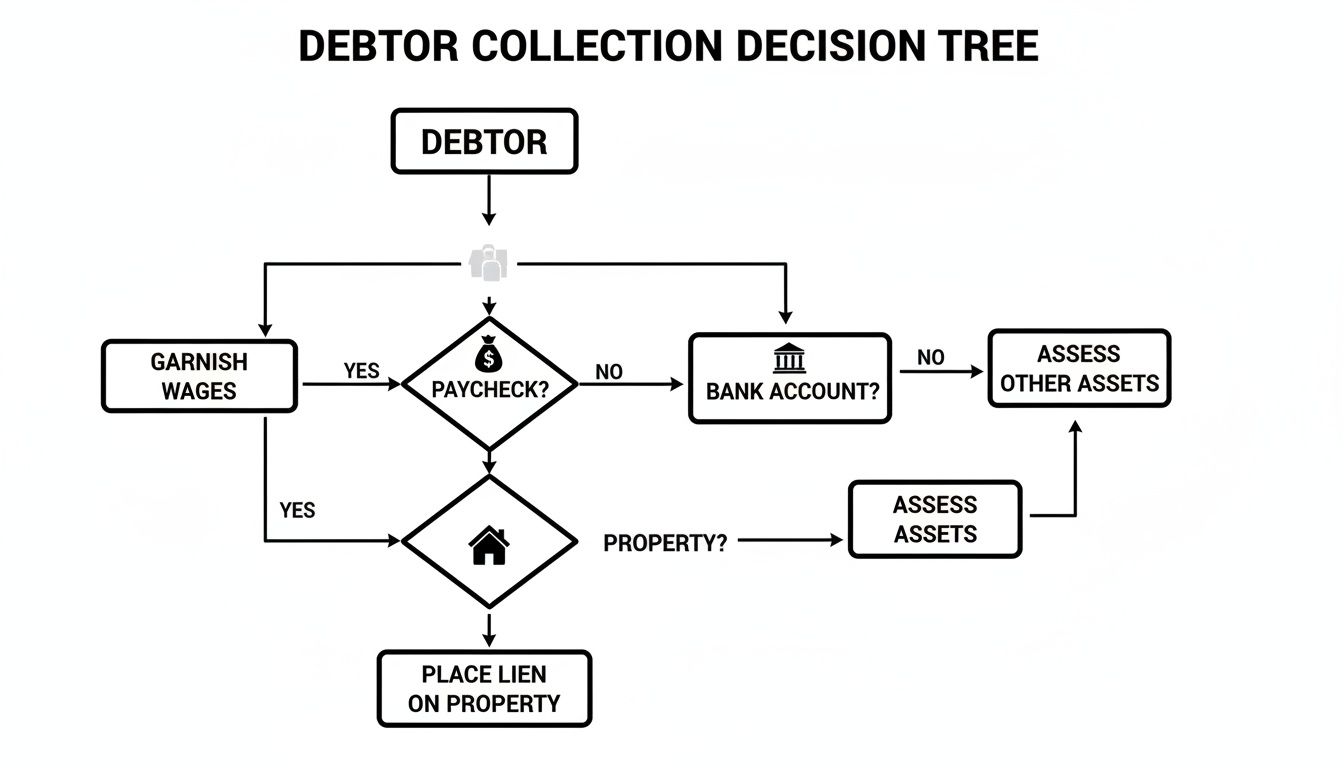
As you can see, the path logically follows the money. We almost always start with the most liquid and common assets, like paychecks and bank accounts, before escalating to physical property.
Garnishing a Debtor's Wages
Did your discovery process confirm the debtor has a steady job? If so, a continuing wage garnishment is often the most reliable tool. This is not just a one-time seizure. It is an order sent directly to the debtor’s employer, legally requiring them to withhold a portion of every paycheck and send it to you until the judgment is paid in full.
In Georgia, the law protects a certain amount of a debtor’s income so they can cover basic living expenses. Generally, you can garnish the lesser of 25% of their disposable earnings or the amount their weekly earnings exceed 30 times the federal minimum wage. For a business owner in Cumming or a salaried employee in Marietta, this creates a steady stream of payments that reduces the debt without you having to file new legal actions every month.
Seizing Funds with a Bank Account Garnishment
When post-judgment discovery uncovers a debtor's banking information, a bank account garnishment is your next move. This legal action freezes the debtor’s account, instantly preventing them from moving or withdrawing funds. The bank is legally obligated to hold that money and, after a set period, turn it over to you to satisfy the judgment.
This tool can be incredibly effective, but it demands precision. You must have the correct bank and account information. A well-timed bank garnishment in Alpharetta or Roswell can be a powerful motivator for a debtor who thought their funds were safe, often pushing them to the negotiating table to regain access to their account.
A garnishment is a direct, forceful action that almost always gets a debtor's immediate attention. It transforms the debt from an abstract problem into a very real financial consequence, compelling them to finally address the judgment.
It is worth noting that debt collection can be a contentious field. According to one industry analysis, third-party debt collection in the U.S. is a multi-billion dollar industry facing significant scrutiny. In 2023, the Consumer Financial Protection Bureau (CFPB) received over 100,000 debt collection complaints. This data shows just how often judgments lead to disputes and why professional guidance is so crucial for navigating the process successfully.
Comparing Common Judgment Collection Methods in Georgia
Choosing the right collection tool is critical. What works for one debtor might be completely ineffective for another. This table breaks down the most common methods we use in Forsyth and Fulton County to help you see which one might be the best fit for your situation.
| Collection Method | Primary Target | Best For… | Key Consideration |
|---|---|---|---|
| Continuing Wage Garnishment | Debtor's regular paycheck | Debtors with consistent W-2 employment. Provides a steady, predictable payment stream. | You need to know their current employer. Limited by state and federal exemption amounts. |
| Bank Account Garnishment | Funds in checking/savings | A quick, one-time seizure of liquid assets. Highly effective if you have bank details. | Requires precise bank and account information. Funds may be exempt (e.g., Social Security). |
| Sheriff's Levy | Tangible personal property | Debtors who own valuable assets like vehicles, equipment, or inventory. | Can be complex and costly. The value of seized property at auction may be low. |
| Real Estate Lien (Fi. Fa.) | Real property (land/home) | A long-term strategy for large judgments. Secures your debt against valuable property. | Does not provide immediate cash. You only get paid when the property is sold or refinanced. |
Ultimately, the best approach often involves a combination of these tools, deployed based on the specific assets your discovery uncovers.
Using a Sheriff's Levy to Seize Physical Property
What if the debtor does not have a W-2 job or much cash in the bank? If they own valuable personal property—things like vehicles, business equipment, or other tangible assets—you can request a sheriff's levy.
A levy is a court order that directs the sheriff in Forsyth or Fulton County to physically seize the debtor’s property. The sheriff then sells the asset at a public auction, and the proceeds are used to pay down your judgment. A levy is a more involved process and is often a last resort, but sometimes it is the only way to collect from a debtor whose wealth is tied up in physical goods instead of cash.
Placing a Lien on Real Estate
That Fi. Fa. you recorded automatically acts as a lien on any real estate the debtor owns in that county. This lien is what lawyers call a "cloud on the title," which means the debtor cannot sell their property or refinance their mortgage without paying your judgment first. While it does not put immediate cash in your pocket, a real estate lien is an incredibly powerful long-term strategy.
It ensures that if the debtor ever decides to sell their property in Johns Creek or Dawsonville, you are in line to get paid from the proceeds. For creditors holding large judgments, this provides excellent security.
Before jumping to more aggressive legal actions, sometimes the simplest tool is the most effective. A well-crafted legal demand letter template, sent by an attorney, can formally request payment and sometimes get results without the cost of a garnishment or levy. And if you are dealing with a financial fallout from a broken agreement, you might want to read our guide on the common remedies for contract disputes. Each of these tools serves a distinct purpose, and a truly successful collection strategy often means using them in combination, tailored to the debtor's financial picture.
What to Do When the Debtor Fights Back: Defenses and Exempt Property
You have won the judgment and even tracked down some of the debtor's assets. That's a huge step, but the process may not be over.
Debtors in Georgia have legal protections that can shield certain assets from being taken. Trying to seize "exempt" property is not just a waste of time, it can create legal complications. A smart collection strategy means knowing exactly what you can, and cannot, touch.
It is common for debtors to raise defenses or claim property exemptions to slow you down or stop you completely. To get past these roadblocks, you need a solid grasp of Georgia law.
Understanding What's Off-Limits: Exempt Property in Georgia
The law is designed to ensure people are not left with absolutely nothing. These protections are not loopholes; they are established legal rights that allow a debtor to maintain a basic standard of living. When a debtor files a formal claim of exemption in court, it puts an immediate freeze on seizing that asset until a judge has a chance to review the claim.
Here in Forsyth and Fulton County, we see the same types of exempt property claims raised frequently:
- Homestead Exemption: A debtor can protect a certain amount of equity in their primary residence. This is why you generally cannot force the sale of a house to satisfy a small debt. It is only a viable option if the judgment is large and there is significant non-exempt equity in the property.
- Personal Property Exemptions: Georgia law allows debtors to protect a specific value in things like their car, furniture, clothes, and any tools they need for their job.
- Retirement Accounts: Money in qualified retirement plans, like 401(k)s and IRAs, is almost always untouchable by creditors.
- Public Benefits: Government payments like Social Security, unemployment checks, and disability benefits are typically exempt from garnishment.
Knowing these categories from the beginning helps you focus your asset search on things you can actually collect. It makes the whole process much more efficient.
The "Head of Household" Roadblock for Wage Garnishment
One of the most significant shields a debtor can use against a wage garnishment is the head of household exemption. It is a powerful defense.
If a debtor can prove they provide more than 50% of the financial support for a dependent (like a child or elderly parent), their disposable earnings are 100% exempt from garnishment in Georgia.
If a debtor in Alpharetta or Roswell successfully files a head of household affidavit, the court will stop your wage garnishment. This forces you to pivot your collection strategy and start looking at other assets, like bank accounts or non-exempt property.
It is critical to anticipate these potential defenses. An experienced civil litigation attorney can help you challenge questionable exemption claims and investigate whether a debtor truly qualifies for a specific status.
By understanding these common defenses and exemptions from day one, you can build a more realistic plan to collect on your judgment. This foresight keeps you from wasting legal fees and court costs chasing assets that are legally out of reach. Instead, you can focus your time and resources where they will actually be effective, dramatically increasing your odds of turning that piece of paper into a financial recovery.
Why an Attorney Is Your Strongest Ally in Collections
You have won in court, and you have a judgment in hand. While you have the right to try and collect that debt yourself, the path is often frustrating, confusing, and full of procedural challenges. Knowing what to do is one thing, but actually navigating the post-judgment legal system is another matter entirely.
This is where bringing in an experienced civil litigation attorney can completely change the outcome.
An attorney takes the enforcement process off your plate. They handle the complex legal filings, search for hidden assets through post-judgment discovery, and know precisely how to counter the delay tactics debtors often use. That kind of professional support is invaluable, especially when you are up against an evasive person or a tangled business structure here in the Alpharetta or Roswell area.
Maximizing Your Recovery and Minimizing Your Stress
Hiring a lawyer is a strategic decision. The time and energy you would spend learning legal procedures, drafting documents, and appearing at court hearings is better spent running your business or focusing on your personal life.
A good attorney puts pressure on the debtor through proper legal channels, which dramatically increases your chances of seeing your money.
Investing in experienced legal counsel is often the most direct and efficient path to converting a dormant judgment into actual cash. It shifts the burden of enforcement from your shoulders to a professional dedicated to achieving results.
The Power of a Negotiated Settlement
Many successful judgment collections do not end with a sheriff seizing property. They often conclude with a negotiated settlement. The act of hiring a lawyer often sends a clear signal to the debtor that you are serious, pushing them to the negotiating table to work out a lump-sum payment or a structured plan just to resolve the legal pressure.
This is a growing financial trend. The global debt settlement market trends show that negotiated resolutions are becoming increasingly common. For businesses and individuals in North Georgia, this highlights a critical point: a professionally negotiated settlement can be the fastest way to recover a large portion of what you are owed without the drawn-out costs of forced collection.
A skilled attorney uses every tool available, from aggressive garnishments to smart negotiation, to make sure your court victory is not just a piece of paper. They bring the experience and persistence needed to see the process through to the end, turning your legal win into a financial reality.
Common Questions About Collecting a Judgment in Georgia
Winning in court feels like the end of the road, but for many individuals and business owners across Forsyth and Fulton counties, it’s just the beginning. Once you have the judgment, the real questions start. Here are some of the most common ones we hear from clients trying to turn that legal victory into a financial recovery.
How Long Is a Georgia Judgment Good For?
In Georgia, a judgment is active for seven years from the date it is issued by the court. However, it does not automatically expire. You can renew it for another seven years through a process called "reviving the judgment." If you miss the deadline, the judgment becomes dormant, which means it is still valid but cannot be actively enforced. Keeping track of the seven-year timeline is critical.
Can I Garnish Someone's Social Security or Disability Benefits?
The short answer is almost always no. Federal law protects Social Security, disability payments, and several other government benefits from collection by private creditors. Even when those funds are deposited into a debtor's bank account, they generally retain their protected status. Any attempt to garnish these funds will not be successful.
What Happens if the Debtor Sells Their Property to Avoid Paying?
It is a common scenario: a debtor suddenly "sells" a valuable asset to a friend or family member for a nominal amount to keep it out of a creditor's reach. When someone transfers property for less than its fair value to hide it from creditors, Georgia law calls this a fraudulent conveyance. You have options in this situation. A separate legal action can be filed to "claw back" the asset, effectively undoing the transaction so the property can be used to satisfy your judgment.
The most effective collection strategies are built on a solid understanding of both the debtor's financial picture and the legal timelines that govern enforcement. Proactive and persistent action is key to preventing a judgment from becoming worthless over time.
At Miles Hansford, P.C., we understand that a judgment is only valuable if you can collect on it. If you are struggling to enforce a court order in Alpharetta, Cumming, or anywhere in North Georgia, our civil litigation team has the experience to help. Contact us to discuss a strategy for turning your legal victory into a financial recovery. Learn more at https://mileshansford.com.