


Ending a business partnership is a difficult decision, often reached after a period of disagreement, broken trust, or the realization that partners no longer share a common vision. The process requires a careful review of your governing documents, negotiation of terms, and a formal closure of the business to protect all parties from future liabilities. An experienced business law attorney can provide the steady guidance needed to navigate this complex transition.
Knowing When It's Time to End a Partnership

The choice to dissolve a business partnership rarely happens overnight. It is typically the final step after months, or even years, of escalating conflict. For business owners in North Georgia communities like Cumming, Alpharetta, or Johns Creek, these challenges can feel unique, but they are quite common.
Learning to recognize the warning signs is the first step toward finding a resolution. While minor disagreements are a normal part of business, some issues point to a deeper, often permanent breakdown in the partnership.
Foundational Cracks in the Partnership
When you find yourselves in a constant loop of conflict over the core direction of the business, it is a significant red flag. These are not small operational disagreements, but fundamental differences that halt progress and create a stressful work environment.
Here are some of the key signs that the partnership may be failing:
- Irreconcilable Differences in Vision: One partner may push for aggressive expansion while the other wants to maintain a smaller, stable operation.
- Constant Financial Disagreements: You may be at odds over spending, reinvesting profits, or partner compensation. One partner might even be making significant financial decisions without the other’s consent.
- Breakdown of Trust and Communication: Conversations have become tense or hostile, or you are avoiding them entirely. Partners may begin hiding information or actively undermining one another.
- Unequal Contribution: One partner may feel they are handling the majority of the work while profits are still split equally, leading to resentment.
This kind of strain extends beyond the financial statements. When business partners cannot agree on how to manage finances, the tension often mirrors the destructive patterns seen in personal relationships, creating a toxic environment.
Moving from Conflict to Resolution
Once these problems become the daily reality, the business inevitably suffers. Clients may notice, employee morale can decline, and your company's reputation can be damaged. At this point, remaining in the partnership is likely causing more harm than dissolving it.
Acknowledging that a partnership has run its course is not a failure. It is a strategic business decision to protect your financial future, professional reputation, and personal well-being.
Deciding to dissolve is a significant step, but it is one that allows everyone to move forward. With a clear, structured process, you can achieve a clean break that protects your assets and allows you to start fresh. Understanding that a partnership dispute may lead to dissolution is the first critical step. By facing the reality of the situation, you can begin exploring your options with clarity and ensure the wind-down is handled professionally.
Your Partnership Agreement Is the First Place to Look
When the time comes to dissolve a business partnership, your first move should be to review the partnership agreement. This document is the legal foundation you and your partners built the business on. A well-drafted agreement acts as your roadmap, outlining the exact steps everyone agreed to follow if the venture did not work out.
This document was created for uncertain moments like this. For business owners in Forsyth County and Fulton County, referring to it can turn a potentially chaotic split into a structured, manageable process. It is designed to replace emotional reactions with a pre-approved procedure, which can significantly reduce disputes.
Interpreting Your Agreement's Dissolution Clause
Nearly every formal partnership agreement will have a dissolution clause. This section serves as your playbook for winding down the business. It should clearly explain what events can trigger a dissolution and the protocol for handling it.
As you review this clause, you need to find the answers to a few critical questions:
- Triggering Events: What specific situations allow for the partnership to be dissolved? This could range from a partner's retirement or a mutual decision to the departure of a key individual.
- Voting Requirements: Does ending the partnership require a unanimous vote, or is a majority decision sufficient?
- Buyout Procedures: Is there a defined process for one partner to buy out another? The agreement should explain how a buyout is initiated and executed.
- Valuation Method: How is the business valued for a buyout or asset division? Good agreements often specify a valuation method or outline a process for hiring a neutral appraiser.
- Debt and Liability: How are outstanding business debts handled? The clause should clarify each partner's responsibility for liabilities.
Understanding these provisions is essential. An operating agreement is much more than a formality; you can learn more about what you should include in your operating agreement to protect your interests from day one.
What If You Don't Have a Partnership Agreement?
It happens more often than you might think. Many partners, especially in the early stages, operate on a handshake or an informal understanding. If you are in this situation in Georgia, you are not without rules. The state’s Uniform Partnership Act provides a default set of regulations that will govern your dissolution.
Without a written agreement of your own, Georgia law generally dictates that:
- Partners have equal rights in managing the business.
- Profits and losses are shared equally among all partners, regardless of individual capital contributions.
- The partnership can be dissolved at any time by the express will of any single partner.
The absence of a partnership agreement means you are subject to Georgia's default laws, which may not align with your initial understanding or what feels fair. This framework can lead to significant disputes over asset division and liability, making legal guidance essential.
Relying on state statutes means you lose control over the process. For instance, a partner who contributed only 10% of the capital could legally be entitled to 50% of the assets upon dissolution. This is a common point of contention for businesses in areas like Alpharetta and Roswell. An experienced business attorney can clarify your rights under Georgia law and help you navigate the dissolution to protect your financial interests.
The Legal and Financial Steps for Dissolution in Georgia
Once you and your partners have decided to dissolve the business, the process shifts from discussion to formal legal and financial action. This stage involves methodically winding down the company’s affairs, paying off debts, and filing the correct paperwork to make the closure official. For any business owner in Forsyth or Fulton County, executing these steps properly is essential to protect your personal assets and ensure a clean break.
The process begins with formal notice and moves into negotiation. The goal is a comprehensive agreement that covers everything from asset distribution to handling outstanding client contracts. Every decision from this point forward has long-term legal and financial consequences.
Initiating the Dissolution and Valuing the Business
The first official step is to provide written notice to your partners of your intent to dissolve the partnership, as your agreement likely specifies. If you do not have an agreement, a formal written notice is even more important because it establishes a clear start date for the process. This is a legal formality that sets the dissolution in motion.
Immediately following notice, one of the most challenging stages begins: valuing the business. An accurate valuation is the foundation of any fair buyout or asset split. It is also an area where partners often disagree. One person might focus on future potential, while another looks only at the hard assets on hand.
To move past a potential stalemate, it is best to engage a neutral third party, such as a certified business appraiser or a forensic accountant. They can provide an objective valuation based on established methods, such as:
- Asset-Based Valuation: Calculates the net value of company assets minus its liabilities.
- Market-Based Valuation: Compares your business to similar companies that have recently sold.
- Income-Based Valuation: Projects future earnings to determine the business's current worth.
Hiring an impartial professional removes emotion from the calculation and provides all parties with a defensible number to work with.
The Dissolution Agreement: Buyout vs. Liquidation
With a solid valuation in hand, you must decide the fate of the business. Will one partner buy out the other and continue operations? Or will you liquidate all assets and close the doors for good? The path you choose must be formalized in a Dissolution Agreement.
This legally binding contract is the single most important document in the split. It details all terms and prevents future arguments and misunderstandings.
A partner buyout is often the preferred option if the business is still viable. The remaining partner pays the departing partner for their share, allowing the business to continue. In contrast, a full liquidation involves selling all business assets, using the proceeds to pay creditors, and distributing any remaining funds among the partners.
Your Dissolution Agreement must be clear about which path you are taking and cover all the details, from the final buyout price to the process for selling inventory.
The process of reviewing your original partnership agreement sets the stage for these legal steps. This chart shows the simple but critical flow for reviewing that foundational document.
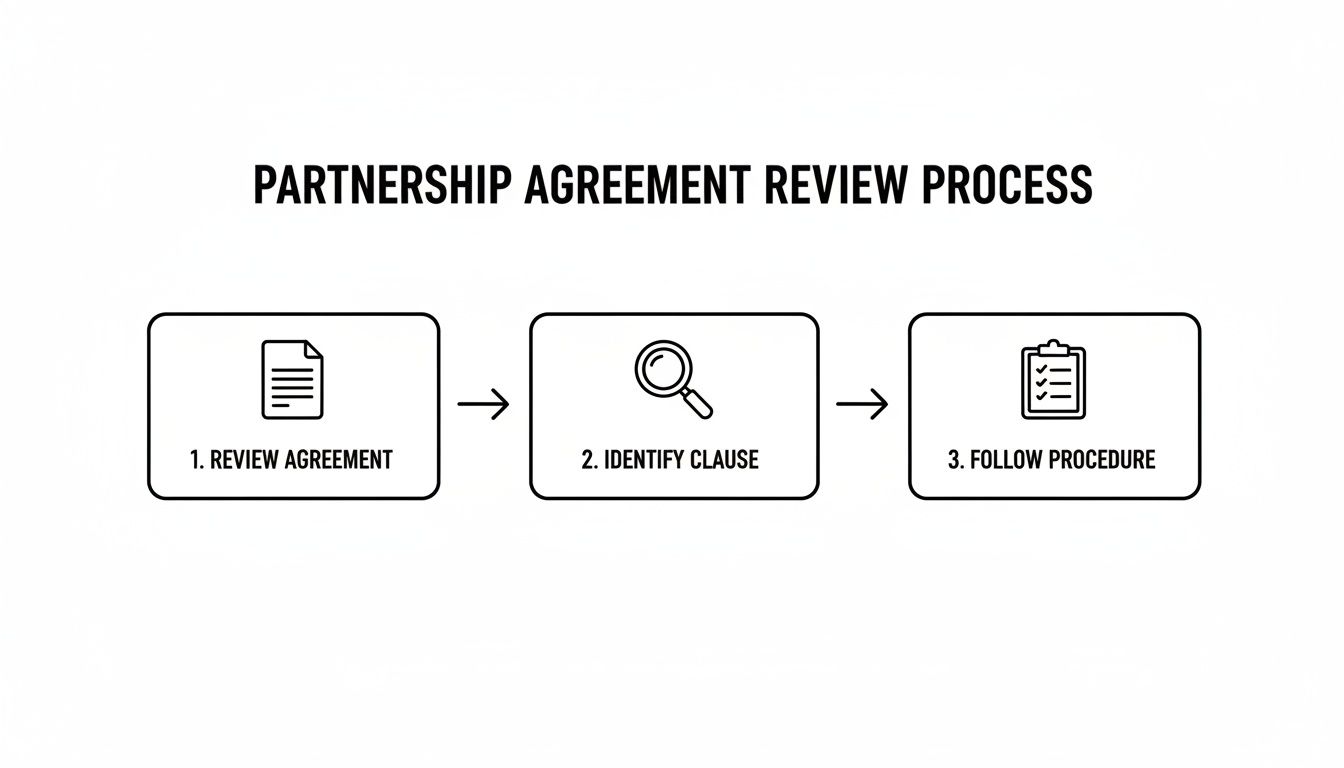
As you can see, a structured review of your initial agreement is the first step toward a compliant and orderly wind-down.
Notifying Creditors and Settling Debts
Before any funds can be distributed to the partners, all business debts must be paid. This is a non-negotiable requirement under Georgia law. You must compile a complete list of every creditor—suppliers, lenders, your landlord, and tax authorities—and formally notify them that the partnership is dissolving.
Settling these liabilities protects you from being held personally responsible for them later. If business assets are insufficient to cover all debts, partners in a general partnership may have to use personal funds to satisfy the obligations. Your Dissolution Agreement should specify exactly how that financial responsibility will be shared.
Failing to properly notify creditors and settle all known debts can expose you to personal lawsuits long after the business has closed. This is one of the most critical financial steps in the dissolution process.
Final Filings with the Georgia Secretary of State
The final legal step is to officially terminate your business's existence with the state. For most partnerships, this means filing a Statement of Dissolution with the Georgia Secretary of State. This document serves as public notice that the partnership is no longer in business.
Here is a quick look at the major phases involved in Georgia.
Key Stages of Partnership Dissolution in Georgia
A summary of the critical phases involved in legally dissolving a business partnership, from initial planning to final closure.
| Stage | Key Actions | Primary Goal |
|---|---|---|
| Pre-Dissolution | Informal partner discussions; review partnership agreement. | Align on the decision to dissolve and understand the contractual requirements. |
| Formal Initiation | Provide written notice of intent to dissolve; hire a neutral business appraiser. | Legally start the dissolution process and establish a fair business valuation. |
| Negotiation | Draft a Dissolution Agreement detailing buyout or liquidation terms, asset/debt allocation. | Create a legally binding roadmap for the entire separation. |
| Wind-Down | Notify all creditors, settle outstanding debts, and pay all final taxes. | Settle all financial obligations to protect partners from personal liability. |
| Final Filings | File Statement of Dissolution with the GA Secretary of State; cancel business licenses and close accounts. | Officially and legally terminate the business's existence. |
This table provides a high-level overview, but each step requires careful execution.
You will also need to cancel any state or local business licenses and permits and file final federal and state tax returns. Working with a business attorney in the Cumming or Alpharetta area can ensure all paperwork is filed correctly and on time, saving you from future administrative headaches. For more detail, you might find this step-by-step guide on how to dissolve a business partnership useful.
If you are dealing with an uncooperative partner, it is helpful to learn what happens when your business partner wants to leave and how to manage that situation legally.
Understanding the Financial Realities of a Partnership Split

Dissolving a business partnership is a major financial event that can impact your personal and professional life for years if not handled carefully. To make smart decisions and protect what you have built, you must have a firm grasp of these financial realities from the beginning.
This is not as simple as dividing the company bank account. You must account for legal fees, the cost of a professional business valuation, and the tax implications that arise from selling assets or buying out a partner. For entrepreneurs here in North Atlanta, from Alpharetta to Marietta, facing these costs with a clear understanding is the first step toward a clean break.
The True Costs of Dissolution
Many business owners are caught off guard by the costs associated with a partnership split. The expenses are not just immediate; they can continue, especially if the process becomes contentious and begins to harm the business's reputation or client relationships.
The financial fallout can be significant. A large percentage of business partnerships do not last, and when they dissolve, costs can mount quickly. Legal battles over business dissolutions have been known to cost individual partners tens of thousands of dollars or more in fees alone. You can read more about these potential issues in this in-depth look at why business partnerships fail.
The goal is not to cause alarm, but to prepare you. A well-managed dissolution with experienced legal guidance can actively reduce these financial risks and help preserve the value you worked hard to create.
Dividing Assets and Allocating Liabilities
Determining who gets what is one of the most difficult parts of any dissolution. This goes beyond cash and equipment. You must account for intangible assets like customer lists, intellectual property, and brand goodwill, all of which have real value.
At the same time, every business debt must be settled. This includes:
- Bank loans and lines of credit
- Vendor and supplier invoices
- Commercial lease obligations
- Outstanding tax liabilities
In a general partnership, partners are often personally liable for these debts. If the business assets cannot cover what is owed, creditors may be able to pursue your personal assets. This is a serious risk for business owners in Forsyth and Fulton County.
The Risk of a Poorly Handled Split
When a partnership dissolution is mismanaged, the financial damage can be severe. Disagreements in the Canton and Roswell areas have spiraled into long, draining, and expensive court battles.
While partners are fighting, the business itself often suffers. Key employees may leave due to the uncertainty, and long-time clients might take their business to a more stable company. The reputation you spent years building can be damaged in a matter of months.
As a result, by the time the partners reach an agreement, the business may be worth much less than when the process started. Proactive legal guidance is not just about paperwork; it is about protecting the core value of your business during a time of crisis.
Why You Need a Lawyer When Dissolving Your Business
Attempting to dissolve a business partnership on your own may seem like a way to save money, especially if the split feels amicable. However, this approach is filled with hidden risks that can lead to costly mistakes and future legal problems. Engaging an experienced business attorney is a critical investment in protecting your financial future.
A dissolution that starts friendly can turn contentious once money is on the table. An attorney brings a steady, objective perspective to the process, ensuring decisions are based on legal and financial reality, not emotion. This can prevent minor disagreements from escalating into a costly court battle.
Navigating Disputes and Protecting Your Interests
Even with a solid partnership agreement, disputes are common. Partners often clash over the true value of the business, the division of intellectual property, or responsibility for outstanding debts. This is where a skilled business attorney is invaluable.
An experienced lawyer can help you navigate common points of conflict, including:
- Disputes Over Asset Valuation: Your partner may have an inflated sense of their contributions or a different idea of the company's worth. An attorney ensures a neutral, professional valuation is conducted so the final numbers are both fair and legally defensible.
- Breach of Fiduciary Duty: If you suspect a partner has mismanaged funds or acted against the company's best interests, a lawyer can investigate and take appropriate steps to hold them accountable.
- Uncooperative Partners: Sometimes, a partner may refuse to negotiate, communicate, or sign necessary documents, bringing the dissolution to a halt. Legal counsel can apply pressure and use legal tools to compel cooperation.
When financial disagreements become particularly complex, your attorney may suggest bringing in outside experts. For example, they might recommend specialists to untangle complicated finances, similar to the role of forensic accounting in shareholder disputes. This level of professional diligence helps ensure every financial detail is handled correctly.
The Roles of Negotiator and Litigator
A business attorney adapts their strategy to fit your situation, acting as a skilled negotiator one day and a tough litigator the next. This flexibility is essential for business owners in our communities like Johns Creek and Roswell.
Initially, your lawyer's goal is to act as a mediator and negotiator. They will work to achieve a fair and private settlement, aiming for a mutually acceptable Dissolution Agreement that avoids court. This approach saves time and stress while helping to preserve the business's value.
However, if your partner is unreasonable or refuses to negotiate in good faith, your attorney is prepared to shift gears. They will pivot to the role of a litigator, ready to aggressively defend your rights in court and ensure your interests are represented with strength and experience.
Having an attorney skilled in both negotiation and litigation provides a significant strategic advantage. It sends a clear message that you are serious about achieving a fair outcome, whether at the settlement table or in a courtroom.
Ensuring a Clean, Final Break
Ultimately, the most valuable service a business attorney provides is certainty. They ensure every legal and financial loose end is properly addressed. From filing the final dissolution documents with the Georgia Secretary of State to notifying creditors and closing tax accounts, they manage the details that prevent future claims and liabilities.
Without that professional oversight, you could find yourself personally liable for old business debts or facing legal challenges years after you believed everything was settled. An attorney in Forsyth or Fulton County provides the peace of mind that comes from knowing your business dissolution is truly final, allowing you to move on to your next venture with confidence.
Common Questions About Dissolving a Partnership in Georgia
When a business partnership ends, it is natural to have many questions. We work with business owners across North Georgia, from Canton to Johns Creek, who face similar uncertainties and want to ensure they are protected. Here are some of the most common questions we hear, along with clear answers.
What happens if we never signed a partnership agreement?
If you do not have a written partnership agreement, Georgia's state laws govern the dissolution. These default rules dictate how assets are divided and debts are handled, and they may not align with what you and your partner intended. For example, state law could mandate a 50/50 split of assets, even if one partner contributed 90% of the capital. Engaging an attorney early is critical to understand your rights and obligations under the state's default rules.
Am I personally liable for business debts after the partnership ends?
Yes, in a general partnership, partners are typically personally liable for the business's debts. A well-structured dissolution agreement must specify how all liabilities will be paid. Creditors can pursue your personal assets for old business loans or unpaid rent if the dissolution was not handled correctly. Properly notifying creditors and formally winding down the business is your best protection against future financial trouble.
A dangerous myth is that closing a business makes its debts disappear. In reality, personal liability remains until every obligation is legally settled.
Can I force my partner to sell their share of the business to me?
Generally, you cannot force a partner to sell their share unless your partnership agreement contains a "buy-sell" or similar buyout clause. If such a provision does not exist, a buyout must be a mutual decision. If your partner will not agree, you may be facing litigation or the liquidation of the entire business. This highlights the importance of a comprehensive partnership agreement.
How do we value the business for a buyout or dissolution?
Determining the business's worth is a common point of contention. Standard valuation methods include looking at assets, analyzing cash flow, or comparing the business to similar companies. We strongly advise hiring a neutral, third-party professional appraiser. An appraiser provides an objective, defensible number that can serve as the foundation for a fair settlement, helping you avoid a costly dispute.
What is the difference between dissolution and winding up?
These terms are often used interchangeably, but they represent two distinct legal steps. Dissolution is the official decision to end the partnership; it is the event that starts the process. Winding Up is the process itself, which includes liquidating assets, paying creditors, filing final tax returns, and distributing any remaining assets to the partners. You must complete both steps to legally terminate the partnership in Georgia.
Navigating the end of a business partnership is filled with legal and financial complexities. At Miles Hansford, P.C., we provide the steady, experienced guidance that business owners across Fulton and Forsyth County need to protect their interests and achieve a clean resolution. If you are facing a partnership split, contact us to ensure the process is handled with the professionalism and care it deserves.