


Meta Title: Enforcing a Court Order in Alpharetta, GA
Meta Description: Need to enforce a court order in Alpharetta, GA? Learn Georgia contempt, garnishment, and Forsyth or Fulton County court options.
Suggested URL Slug: /enforce-court-order-alpharetta-ga
Schema Recommendations: Attorney, LegalService, FAQPage
Internal Link Suggestions:
- Georgia child support enforcement program
- How to collect on a judgment in Georgia
- When your ex is not abiding by divorce terms
- Child custody modifications in Georgia
- Divorce and contempt actions in Forsyth County
A court order is supposed to end the argument. Then the payments stop, parenting time is ignored, property isn't transferred, or a former spouse decides the judge's order is optional. If you're in Alpharetta, GA, North Fulton, Cumming, or nearby communities like Roswell, Milton, Johns Creek, or Sandy Springs, that kind of defiance can leave you angry, exhausted, and unsure what to do next.
Georgia law gives you real tools to respond. If you're searching for how to enforce a court order or looking for a family law attorney near me, the most important thing to know is this: enforcement is a process, and choosing the right process matters. In many family law cases, the best result doesn't come from filing the loudest motion first. It comes from using the tool that fits the violation, the evidence, and the court you're standing in.
Your Court Order Was Ignored. Here’s What Happens Next in Alpharetta.
A common North Fulton scenario looks like this. You have a signed court order from a divorce, custody, or child support case. You followed it. The other person didn't. Maybe support is late again. Maybe your child wasn't returned on time. Maybe a transfer of money or property that was clearly required still hasn't happened.
That reaction you're having is normal. People often feel both insulted and trapped. They already went through Fulton County Superior Court or another Georgia court, and now they're being forced back into conflict just to make the order mean something.
What usually helps first is narrowing the problem. Not every violation should be handled the same way. A missed child support payment may call for wage withholding and court action. A denied visitation exchange may call for a contempt filing built around texts, calendars, and the parenting plan. A failure to refinance a debt or turn over property may require a different enforcement approach.
Why this is more common than most people realize
Enforcement disputes are not unusual side issues. They are an inherent aspect of family law. The National Center for State Courts Court Statistics Project notes that domestic relations matters make up a significant share of court filings, and many cases are reopened when a party asks the court to enforce an earlier judgment.
Practical rule: Treat a violation as a legal problem, not just a personal insult. The sooner you document it correctly, the more options you preserve.
In Alpharetta and the broader North Georgia area, the next move is rarely to argue more by text or hope the other side suddenly cooperates. The next move is to identify the exact provision that was violated, gather proof, and decide whether the issue belongs in contempt, administrative enforcement, or another collection method.
If your order came out of a Georgia divorce, remember the larger context too. Georgia is a no-fault divorce state, there's a 30-day minimum waiting period in divorce cases after filing, and final orders often address equitable division, custody, support, and parenting plans all at once. Once those orders are entered, they are not suggestions.
Why Enforcing Your Order in Cumming is Critical for Your Family’s Future
In Cumming, GA, families often try to absorb noncompliance for months before taking action. They cover bills alone. They rearrange work schedules after missed exchanges. They wait for promised reimbursements that never come. That delay can make daily life harder and the legal case weaker.

In Cumming, delay changes the pressure on your household
When child support isn't paid, the problem isn't abstract. It affects groceries, school costs, activities, transportation, and housing stability. In a custody case, repeated violations can unsettle children who need consistency. In a divorce involving property division, inaction can allow records to get messy and disputes to grow more expensive.
Georgia family law is structured around stability. Courts in Forsyth County Superior Court and Fulton County Superior Court expect parties to follow orders while larger disputes are pending and after final judgment. That includes temporary orders entered after a temporary hearing, final custody terms, support obligations, and parenting plans required by Georgia courts.
What inaction often leads to
- Financial strain: Unpaid support and unreimbursed expenses usually don't stay isolated. They spill into every part of family budgeting.
- Parenting disruption: Children notice when exchanges become unpredictable or one parent treats the schedule as optional.
- Weakened position: Documents get harder to find, timelines blur, and a clear pattern of noncompliance becomes harder to present cleanly.
- More conflict: Informal deals made in frustration often create new disputes instead of solving the old one.
For many North Georgia families, enforcement isn't about punishment. It's about restoring order. That is especially true in communities like Suwanee, Dawsonville, Roswell, Canton, and Milton, where work schedules, school calendars, and co-parenting logistics already require discipline.
A strong enforcement case protects tomorrow, not just today.
If your issue involves support, it's also worth understanding Georgia's administrative collection tools alongside court remedies. This overview of Georgia’s child support enforcement program is a helpful starting point for seeing how court action and agency action can work together.
Mediation also matters here. North Georgia family courts often expect serious efforts toward resolution in the right cases, but mediation is not a substitute for enforcement when a valid order is being ignored. If the order is clear and the violation is ongoing, waiting too long can turn a manageable enforcement issue into a long-running court fight.
The Legal Path to Enforcement in Georgia A Step-by-Step Overview
A court order gets ignored. The next decision is not whether you are upset. Of course you are. The decision is which enforcement route gives you the best chance of getting compliance in Fulton or Forsyth County without wasting months on the wrong filing.
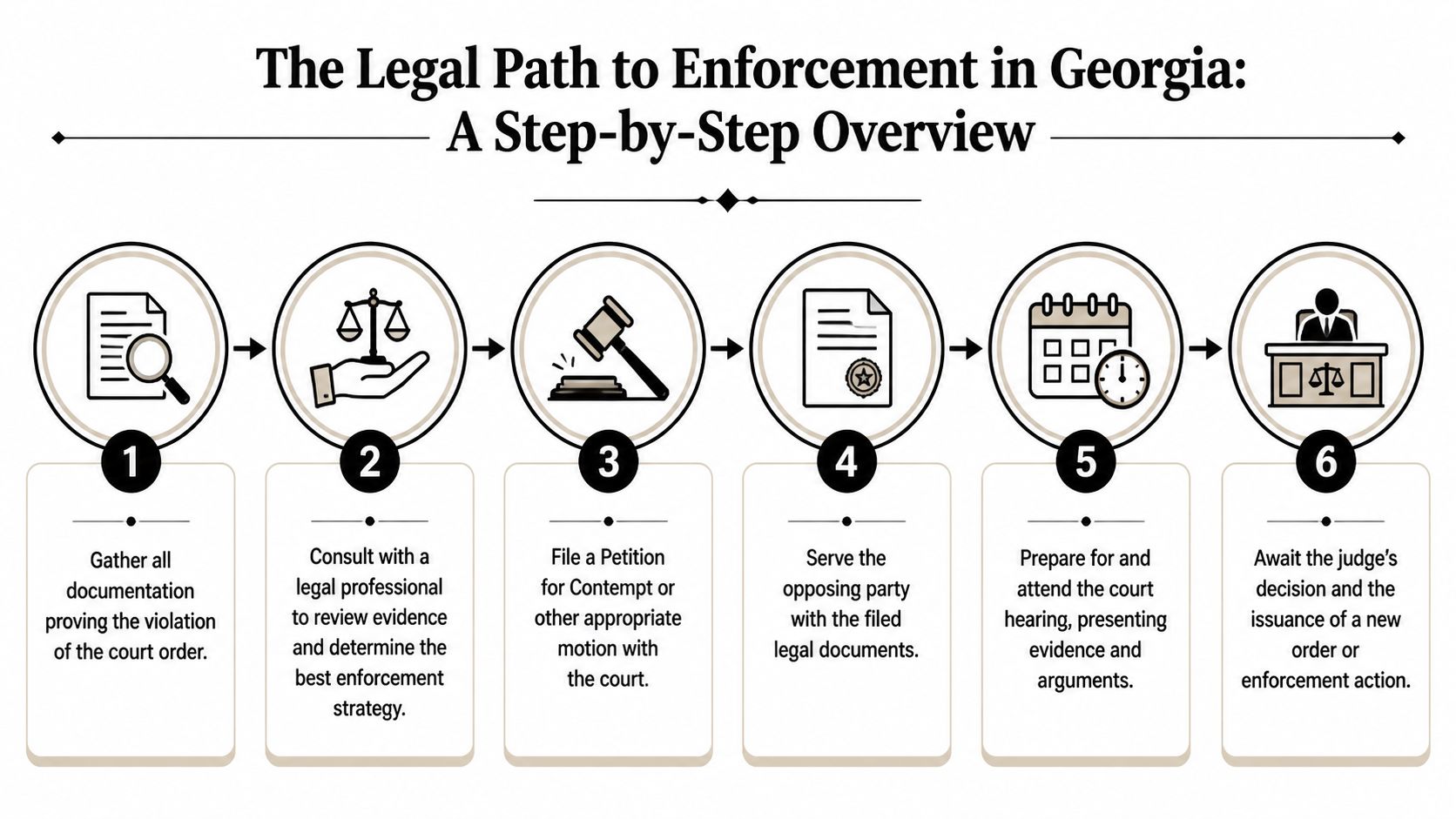
Start with the exact language of the order
Start with the signed order and read it line by line. The judge will focus on what the order requires, when it requires it, and whether the other side had clear notice of that duty.
That first review shapes the whole strategy. If the order says a parent "shall" pay, transfer property, reimburse an expense, or produce a child for a holiday exchange on a stated date and time, enforcement is usually straightforward. If the order is vague, the court may need clarification or a modification before it can punish noncompliance.
For contempt in Georgia, the core questions are familiar. Was there a valid order? Did the other party know about it? Was the violation willful? Those questions sound simple, but they drive nearly every practical decision that follows.
Build the file before you file the case
Strong enforcement cases are usually built before the petition is filed. In my experience, the clients who do best are the ones who can show the court a clean timeline instead of a stack of frustration.
Useful proof often includes:
- Payment records: bank statements, support ledgers, reimbursement requests, and proof of missed payments
- Communication records: text messages, emails, parenting app messages, and written admissions
- Parenting documentation: calendars, school records, pickup logs, travel details, and notes tied to specific dates
- Order copies: the final order, temporary orders, and any later modifications
One missing document does not ruin a case. A scattered presentation can.
Bring the paragraph that was violated, the date it happened, and the document that proves it.
Choose the enforcement tool that fits the violation
This is the part many people miss. Contempt is the main enforcement path in Georgia family law, but it is not always the only tool and it is not always the best first move.
If the problem is unpaid support or another money obligation, collection options may matter as much as contempt. A person can be held in contempt, but if income is available and reachable, collection remedies may produce results faster. If the order involves a financial award that functions like a judgment, this guide on how to collect on a judgment in Georgia explains the collection side of the process.
If the problem is a custody or parenting-time violation, contempt is often the pressure point because the court is addressing conduct, not just money. If the problem is repeated but the order is poorly drafted, filing for contempt without fixing the wording can turn into an expensive argument about what the order meant. In that situation, part of the strategy may be enforcement and part may be clarification or modification.
File in the right court and serve it correctly
Most enforcement actions are filed in the court that issued the original family law order. For many North Georgia families, that means Superior Court in Forsyth County or Fulton County, depending on where the case was entered.
Service matters. A strong contempt claim can stall if the other side is not served correctly or on time. That is not a technical side issue. It affects hearing dates, delay tactics, and your ability to get in front of the judge with momentum.
Prepare for the question the judge will care about most
At the hearing, the court usually wants to know whether the violation was willful. The judge is deciding whether the other party had the ability to comply and chose not to do it.
That is why context matters. A parent who lost a job and promptly sought modification presents a different case from a parent who stayed employed and ignored support obligations. A missed exchange caused by a true emergency looks different from a pattern of refusing to follow a holiday schedule. Good enforcement strategy accounts for those differences before anything is filed.
If the first attempt does not solve the problem
Some enforcement cases do not end with one hearing. That does not mean the effort failed. It often means the next step needs to be more targeted.
If contempt gets an order for compliance but payments still do not come in, collection remedies may need to follow. If the other side keeps exploiting vague wording, the order may need to be tightened. If new excuses appear each month, update the timeline, preserve the messages, and bring the court a clearer pattern the next time.
Georgia family law sits inside a larger framework. Parenting plans govern custody cases. Child custody decisions turn on the best interests of the child. Property division follows equitable division, not automatic equal division. Enforcement works best when the remedy matches the duty that was violated and the proof matches the remedy you are asking the court to impose.
Strategic Enforcement Tools for Your Alpharetta Family Law Case
The smartest enforcement strategy in Alpharetta, GA depends on what was violated, what proof you have, and whether you need pressure, collection, or immediate compliance. Many people assume every violation requires contempt. Sometimes it does. Sometimes that is only part of the answer.
In Alpharetta child support cases, start with the tool that reaches income
For child support, wage garnishment or income withholding is often the fastest practical pressure point. According to a Georgia child support enforcement overview, wage garnishment achieves partial or full compliance in roughly 65 to 75 percent of nonpaying cases, and combining it with contempt can improve the odds of restoring steady payments when the nonpaying parent has clear earning capacity, as explained in this discussion of enforcing or modifying child support in Georgia.
That doesn't mean garnishment solves every support case. It works best when income is traceable and employment is stable. If the other parent changes jobs often, works irregularly, or is actively hiding income, court enforcement usually needs to do more of the work.
In Alpharetta custody and divorce enforcement, contempt often carries the most weight
Contempt is usually the right tool when the violation is personal and direct. Missed exchanges. Ignored holiday schedules. Failure to refinance debt as ordered. Refusal to transfer assets. Nonpayment despite earning ability. It puts the issue in front of the judge who can evaluate conduct, credibility, and the order itself.
Possible outcomes vary by case and court order. In family law enforcement, judges may push parties toward compliance through payment structures, makeup parenting time, deadlines, or other corrective terms. In serious willful violations, contempt penalties can become much more severe.
If you're dealing with a former spouse who keeps breaking agreed divorce terms, this article on when your ex is not abiding by divorce terms gives useful context.
A strategic comparison helps
| Enforcement Tool | Best For | How It Works in Georgia | Key Consideration |
|---|---|---|---|
| Motion for contempt | Custody, visitation, support nonpayment, failure to follow divorce terms | Filed in the issuing court to prove a valid order, knowledge, and willful noncompliance | Strong when the order is clear and your records are organized |
| Wage garnishment or income withholding | Child support | Directs income toward support payment through administrative or court-backed channels | Best when the obligor has identifiable income |
| Tax intercepts and administrative enforcement | Support arrears | Used through child support enforcement systems to capture available funds and increase pressure | Useful, but not always enough by itself when avoidance is persistent |
| Writs and levy-based collection tools | Financial judgments and some property-related obligations | Targets assets or collection rights after money obligations are established | Better for monetary enforcement than parenting disputes |
| UIFSA interstate enforcement | Support when the other party moved out of Georgia | Uses interstate rules adopted by all states to enforce across state lines | Essential when the obligor leaves Alpharetta, Cumming, or North Georgia |
What works and what usually doesn't
- Use contempt when conduct matters: If the violation is willful and personal, judges need to see it directly.
- Use income-based collection when money is the issue: Support cases often move better when enforcement reaches payroll.
- Don't rely on warnings alone: Repeated texts saying “please follow the order” rarely create consequences by themselves.
- Don't file the wrong remedy: A parenting problem and a collection problem may arise from the same divorce, but they often require different legal tools.
A good enforcement plan in North Fulton or Forsyth County is rarely about choosing the harshest option. It is about choosing the option that fits the proof and puts the other side in the weakest position to explain away the violation.
Navigating the Fulton and Forsyth County Courts What to Expect in Your Hearing
People often fear the hearing because they expect drama. Most enforcement hearings in Fulton County Superior Court and Forsyth County Superior Court are more disciplined than dramatic. The judge usually wants a clean story tied to a clear order, not a broad history of every wrong thing the other side has done.

What the judge is usually looking for
In a contempt hearing, the court focuses on precision. Which order controls. What paragraph required what action. When compliance was due. What the other party knew. Why the failure should be treated as willful.
That local discipline matters in both Forsyth County and Fulton County because family dockets are busy, and judges expect attorneys and parties to be prepared. If your case also involves ongoing custody or modification issues, local procedure may pull in related topics such as mediation history, temporary orders, or the practical operation of the parenting plan.
The defense you should expect most often
A common defense is inability to comply. Courts examine the totality of the circumstances to decide whether the noncompliance was non-willful, which is why evidence matters so much, as explained in this discussion of what happens when someone ignores a court order and raises inability to comply.
That defense is not automatically bad faith. Sometimes people really cannot comply. But in Georgia family court, “can't” and “won't” are not the same, and the facts have to support whichever claim is being made.
If the other side says they couldn't comply, the next question is usually what they did when that became true. Did they seek modification, communicate promptly, and produce records, or did they simply stop following the order?
Practical expectations for Fulton and Forsyth County hearings
- Courtroom tone: Formal, time-conscious, and document-driven
- Best preparation: A short chronology, marked exhibits, and the exact order language
- Common weak point: Overstating conduct you can't prove
- Common strong point: Showing a consistent pattern tied to dates and records
In many North Georgia family law cases, mediation is part of the broader context, but contempt hearings are different from settlement sessions. The judge isn't there to redesign the relationship. The judge is there to decide whether a court order was violated and what should happen next.
That is also why temporary hearings matter so much. Temporary orders entered early in a divorce or custody case often shape the family's daily life for months. If those terms are ignored, waiting for the final hearing can create avoidable damage.
Why Choose Miles Hansford to Enforce Your Cumming Court Order
In Cumming, GA, enforcement work demands more than knowing the rules. It requires judgment about which tool to use, when to push, when to narrow the issue, and how to present the case so the court sees the violation clearly.
That matters in family law because enforcement cases sit close to everything else. A contempt issue may connect to a pending custody dispute. A support problem may overlap with modification questions. A property transfer issue may affect broader financial planning after divorce. In Forsyth County, Fulton County, and North Georgia generally, a lawyer handling enforcement needs to understand the whole case, not just the missed obligation.
Local experience changes the strategy
A lawyer who regularly works in Forsyth County Superior Court, Fulton County Superior Court, and the North Fulton courts understands the practical side of local family law. That includes how parenting plans are treated, how temporary orders shape later disputes, how mediation fits into the process, and how Georgia judges tend to separate confusion from willful defiance.
That local perspective is especially important for people in Alpharetta, Johns Creek, Milton, Roswell, Sandy Springs, Suwanee, Dawsonville, and Canton who need a clear plan quickly. A search for a divorce lawyer near me or family law attorney Cumming GA usually starts because something already went wrong. At that point, clarity matters more than general reassurance.
The right representation should feel steady
You shouldn't have to manage the legal pressure alone while also trying to protect your children, your finances, or your peace of mind. Strong enforcement counsel does two things at once. It applies pressure where the law supports it, and it removes avoidable chaos from your side of the case.
Enforcement is most effective when your lawyer stays calm, your records are clean, and the requested remedy fits the violation.
FAQs on Enforcing Court Orders in North Georgia
Q: How do I enforce a custody order in Alpharetta, GA?
A: In most Georgia family law cases, custody enforcement starts with a contempt filing in the court that entered the order, often Fulton County Superior Court for Alpharetta matters. The judge will look at the parenting plan, the exact language of the order, and your documentation of denied exchanges, missed returns, or other violations.
Q: What court handles enforcement in Cumming, GA?
A: Many family law enforcement actions in Cumming go through Forsyth County Superior Court, especially when the original divorce, custody, or support order was entered there. The enforcing court is usually the same court that issued the order, unless interstate or other jurisdiction issues require a different procedure.
Q: Can child support be enforced without filing contempt in Georgia?
A: Yes. Georgia support enforcement can include administrative tools such as income withholding, tax intercepts, and license-related pressure. Still, if the nonpayment is persistent or willful, a court-based contempt action may be necessary to create stronger consequences and restore reliable payment.
Q: What if the other parent says they couldn't comply?
A: Georgia courts examine whether the violation was non-willful. If someone claims inability to pay or comply, the court will look at the full circumstances, including employment history, communication, financial records, and whether that person sought a modification instead of violating the order.
Q: How long does enforcement take in Fulton or Forsyth County?
A: Timing depends on the court's calendar, service of process, and how contested the facts are. Some matters move faster than others, especially when the order is clear and the evidence is organized. Delays often come from improper service, incomplete records, or disputes about what the order required.
Q: Can I enforce a divorce property division order in Georgia?
A: Yes. If a former spouse refuses to transfer funds, property, or debt obligations required by a divorce decree, Georgia law may allow contempt or other collection remedies depending on the exact order. The correct choice depends on whether the issue is personal noncompliance, a money obligation, or asset recovery.
Q: Do I need a lawyer to enforce a court order near me?
A: You're not always required to have a lawyer, but enforcement cases are technical. In North Georgia courts, the result often turns on order language, service, proof of willfulness, and choosing the right remedy. A lawyer can help avoid filing the wrong motion or presenting a strong grievance in a weak legal format.
Q: Can a Georgia court enforce an order if the other party moved out of state?
A: Often, yes. Support enforcement may proceed through interstate procedures under UIFSA, which all states have adopted. If the person moved from Alpharetta, Cumming, or another North Georgia community, the strategy depends on whether the issue involves support, custody, or a financial obligation from the divorce decree.
If your former spouse or co-parent is ignoring a court order, you don't have to keep guessing what to do next. Miles Hansford Law Firm helps clients in Alpharetta, Cumming, Forsyth County, Fulton County, Johns Creek, Milton, Roswell, Sandy Springs, Suwanee, Dawsonville, and Canton take practical action under Georgia law. If you need to protect your parental rights, enforce support, or respond to violations of a divorce order, schedule a consultation and speak with a family law attorney who can build a focused enforcement plan for your case. Call today.