


Before you can file a single document in a Fulton or Forsyth County courthouse, there are two fundamental questions you need to answer. First, do you meet Georgia's residency requirement? Second, what is the legal reason, or "grounds," for your divorce? Getting these right from the beginning sets the stage for a much smoother process.
Meeting the Initial Requirements for a Georgia Divorce
Think of these as the gatekeepers to the Georgia divorce process. They are not just suggestions; they are mandatory legal standards. Failing to meet them can get your case delayed or even dismissed. Let's break down the two most important pieces: residency and your stated grounds for the divorce.
Proving Georgia Residency
To file for divorce in Georgia, at least one spouse must have been a resident of the state for a minimum of six consecutive months right before filing the paperwork. This is a strict rule. It does not matter if you were married in another state or country. What matters is where you live now.
For instance, if you lived in Alpharetta for years but moved to Tennessee last month, you cannot file in Georgia. On the other hand, if you moved to Cumming seven months ago, you can file in Forsyth County, even if your spouse still lives out of state. The court needs to have a direct connection to your case, and this residency rule establishes that connection.
This six-month requirement is non-negotiable. A judge in Fulton County Superior Court, for example, cannot legally hear your case if you have only lived in Roswell for four months, even if both you and your spouse agree to it.
Choosing the Grounds for Divorce
Georgia law has thirteen different grounds for divorce. Many are "fault-based," like adultery, desertion, or cruel treatment. In reality, the vast majority of divorces in North Georgia are filed on the state’s no-fault ground.
Legally, this is stated as the marriage being “irretrievably broken.” It is a simple but powerful phrase that means there is no hope for reconciliation. Crucially, you do not have to prove that one person’s bad behavior caused the marriage to end.
Opting for a no-fault divorce has real, practical advantages:
- Less Conflict: It keeps you from having to drag painful details of your marriage into a courtroom, which often makes a tough situation worse.
- More Privacy: You avoid airing personal matters in a public legal proceeding.
- A Smoother Process: No-fault cases tend to move more quickly because the focus is on resolving key issues, like assets and custody, rather than assigning blame.
While fault-based grounds are still an option, they are typically reserved for specific strategic situations because they can seriously complicate the case and drive up legal costs. For most people in our communities, from Johns Creek to Dawsonville, declaring the marriage "irretrievably broken" is the most sensible path forward.
Figuring out the best approach for your unique situation is exactly what the first conversation with a family law attorney is for. You can get a head start by learning more about preparing for your divorce consultation. This initial discussion will help you and your attorney map out a strategy, ensuring your case starts on the strongest possible footing.
Preparing and Filing Your Initial Divorce Papers
Once you have confirmed you meet Georgia’s residency rules, it is time to get the official process started by preparing and filing your initial divorce documents. This is a critical stage. The paperwork you file with the Superior Court in counties like Fulton or Forsyth sets the foundation for your entire case, so getting it right from the start is essential.
The first and most important document is the Complaint for Divorce, which some people refer to as a petition. This legal document officially tells the court you are seeking a divorce. It lays out the basic facts: who the spouses are, that you meet residency requirements, the grounds for the divorce (usually that the marriage is "irretrievably broken"), and a list of any minor children.
This initial filing is also your first chance to formally ask the court for what you need. Think of it as your opening statement. You will outline your requests for things like child support, a specific parenting plan, alimony, or how you believe your marital property should be divided. Precision here is key to avoiding unnecessary delays down the road.
Gathering the Core Documents for Filing
The Complaint for Divorce is just one piece of the puzzle. You will need a handful of other forms to get your case started. While the exact list can vary slightly between counties, the core documents are standard across Georgia.
A Summons is another essential form. This is the official notice that gets "served" to your spouse, letting them know that a divorce lawsuit has been filed and that they have a deadline to respond.
You will also need to complete Financial Affidavits. These forms provide a detailed, sworn snapshot of your entire financial life: income, expenses, assets, and debts. Both spouses must fill one out. They are absolutely crucial for any decisions the court will make about child support, alimony, and property division.
This flowchart breaks down those first few steps, showing how residency and grounds lead directly into the paperwork phase.
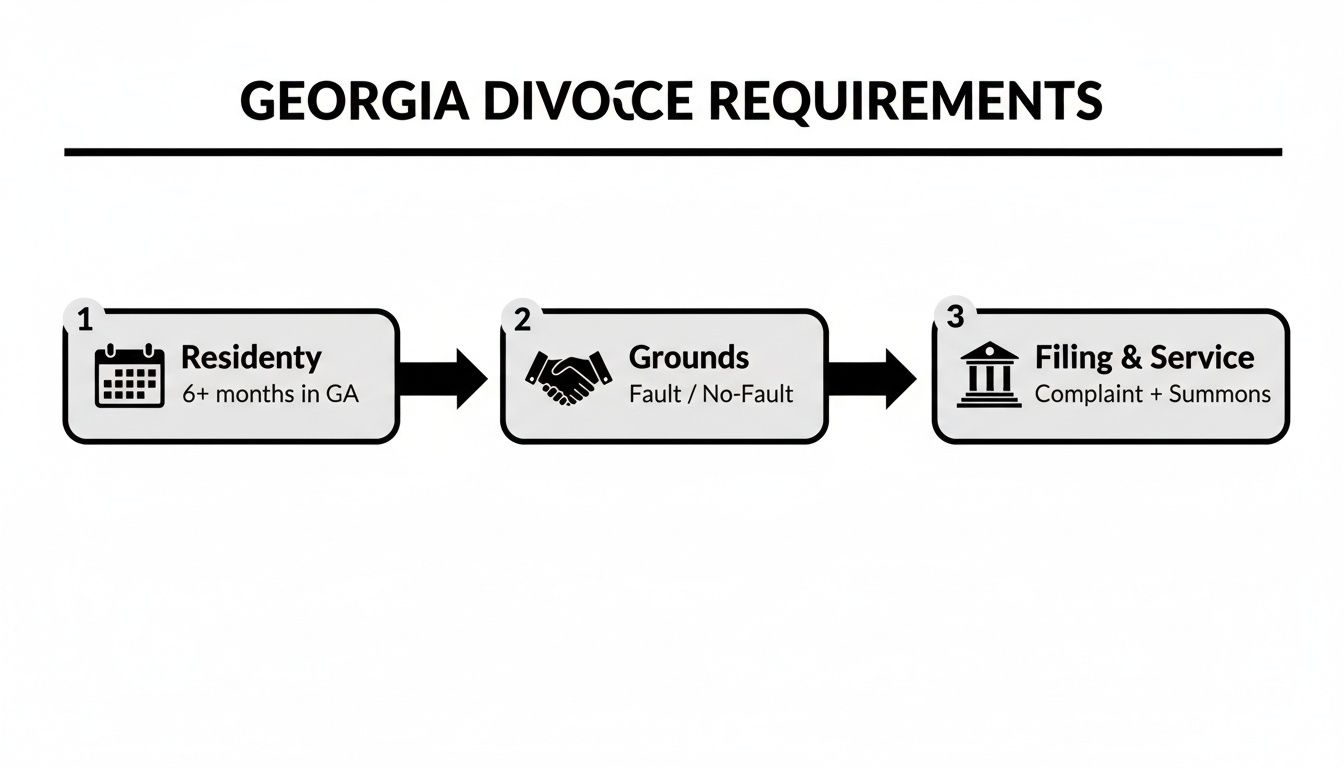
As you can see, confirming where you stand on the basics is the necessary first move before you can even think about assembling the official court filing.
Be warned: you must use the correct, up-to-date forms for the specific county where you file, whether that is the Forsyth County Superior Court in Cumming or the Fulton County Superior Court in Atlanta. Court clerks cannot give legal advice, and if you use the wrong forms, your entire filing can get rejected, forcing you to start over.
The shift toward no-fault divorce laws has had a major impact. Data from the United Nations shows that the percentage of adults aged 35–39 who are divorced or separated worldwide doubled from about 2% in the 1970s to 4% in the 2000s. This period aligns with when no-fault laws became common. For anyone in Georgia, this means the court's focus is less on who did what and more on the practical side of things, like your financial affidavits and parenting plan.
Let's break down the essential forms you will encounter.
Key Documents for Your Initial Divorce Filing in Georgia
This table outlines the primary legal documents needed to start the divorce process in Georgia, explaining the purpose of each form.
| Document Name | Purpose of the Document | Key Information to Include |
|---|---|---|
| Complaint for Divorce | Formally requests the divorce and outlines the basic facts and what you are asking the court to order. | Names of spouses, date of marriage/separation, names/ages of children, grounds for divorce, and your requests for relief (e.g., child support, alimony). |
| Summons | Officially notifies your spouse that a lawsuit has been filed against them and gives them a deadline to respond. | Case number, names of the parties, and the legal timeframe for filing an Answer (typically 30 days). |
| Verification | A sworn statement, attached to the Complaint, where you attest that the information provided is true and correct. | Your signature, notarized by a licensed Notary Public. |
| Domestic Relations Financial Affidavit | Provides a complete and detailed picture of your personal finances to the court and your spouse. | All sources of income, monthly expenses, lists of all assets (bank accounts, real estate, vehicles) and all debts (mortgages, credit cards). |
Having these documents filled out correctly and completely is the first major step toward a successful filing.
The Importance of Accuracy and Completeness
Filing for divorce is not just about checking boxes on a form. It is about presenting a clear, honest, and accurate picture of your life to the court. Any errors, forgotten assets, or misrepresentations, especially on your financial affidavit, can seriously damage your credibility and have a negative impact on the outcome of your case.
Take the time to gather everything you need. This is not something you can rush.
- Recent pay stubs and tax returns
- Bank and investment account statements
- Mortgage and loan documents
- Retirement account information
- A list of significant personal assets
For a more exhaustive list, you can check out our guide on what documents you should prepare when getting a divorce. Once every document is prepared and double-checked, you will file them with the Clerk of Superior Court in the correct county. This is the moment your case is officially opened, and the legal clock starts ticking.
Properly Serving Divorce Papers to Your Spouse

Filing your paperwork with the Superior Court Clerk in Fulton or Forsyth County is the first official step, but it is only half the battle. Your divorce case cannot begin until your spouse has been formally and legally notified that you have filed a lawsuit.
This crucial step is called service of process. It is a cornerstone of our legal system, ensuring everyone gets a fair chance to respond to legal action. You cannot just email the papers or hand them over yourself. Georgia has strict rules about how this must be done.
Getting this part wrong can bring everything to a halt. A mistake here could cause major delays or even get your case dismissed, forcing you to start all over again. The court needs official proof that your spouse received the Complaint for Divorce and Summons. Once they have, the clock starts ticking for them to file a response, which is typically within 30 days.
Choosing the Right Method of Service
So, how do you get this done? Georgia law gives you a few options, and the best one for you depends on how well you and your spouse are communicating.
The two main ways to handle this are personal service and an acknowledgment of service.
- Personal Service: This is the most common route, where a neutral third party physically hands the divorce papers to your spouse. It is the go-to method, especially when things are tense or communication has broken down.
- Acknowledgment of Service: If your divorce is on more amicable terms, this is a much simpler option. Your spouse can agree to waive the formality of being "served" by signing an Acknowledgment of Service form in front of a notary. It is faster, less confrontational, and saves you a little money.
If you and your spouse have already agreed to the divorce, the Acknowledgment of Service is the clear winner. But if the relationship is strained or you think your spouse might try to dodge the paperwork, personal service is the only way to guarantee the case moves forward correctly.
A common mistake we see is people assuming that because their spouse knows they filed, they have been legally served. That is not how it works. The court must have official, documented proof of service through one of the legally approved methods.
Personal Service by Sheriff or Private Process Server
For many people in the Alpharetta and Cumming area, personal service is the most direct path. You have two main choices for who actually delivers the documents: a Sheriff’s Deputy or a private process server.
Service by Sheriff: Every county Sheriff’s Department offers this service for a fee, usually around $50. You just give the Clerk of Court your spouse's address, and a deputy will attempt to deliver the documents. It is official and reliable.
Service by Private Process Server: You can also hire a certified private process server. These professionals are often more flexible and persistent than a deputy. They might make multiple attempts at different times of the day or week, which can be a huge advantage if your spouse is difficult to track down.
What Happens If You Cannot Find Your Spouse?
Sometimes, you genuinely do not know where your spouse is. If you have made a real effort to find them and have come up empty, you are not stuck.
Georgia law has a solution for this called service by publication. This is a last resort. It involves getting the court's permission to publish a notice of the divorce filing in a local newspaper. To do this, you will have to prove to the judge that you made every reasonable attempt to locate your spouse first. It adds time and expense to the process, but it ensures your case can still proceed.
Establishing Stability with Temporary Orders

The time between filing for divorce and getting a final decree can feel like a long, uncertain road. Life does not just stop because a case is pending. The mortgage still needs to be paid, the kids have to get to school, and your family needs some sense of routine. This is exactly where temporary orders come in.
A temporary order is a legally binding court directive that sets the ground rules for you and your spouse while the divorce is ongoing. Think of it as a set of guardrails for your family’s immediate future. These orders are not permanent, but they provide critical stability by answering the most urgent questions that pop up right after a separation.
What Temporary Orders Can Address
The main goal of a temporary hearing is to create a predictable and stable environment, especially when children are involved. A judge in Fulton or Forsyth County can issue orders that cover a wide range of these immediate needs.
Here are the key issues typically resolved at a temporary hearing:
- Temporary Child Custody: The court will decide on a temporary physical and legal custody arrangement that serves the children's best interests for the time being.
- Parenting Time Schedule: This order outlines a specific schedule for when each parent will have the children, which helps ensure consistency and minimize conflict.
- Temporary Child Support: A judge will calculate and order a temporary amount of child support based on Georgia’s official guidelines, making sure the children’s financial needs are met.
- Temporary Spousal Support (Alimony): If one spouse has a clear financial need and the other has the ability to pay, temporary alimony might be ordered.
- Exclusive Use of the Marital Home: The court can decide which spouse will stay in the family home and which one will need to move out.
- Financial Restraints: A judge can order both parties not to sell major assets, drain bank accounts, or take on significant new debt.
These orders are crucial for preventing one spouse from making big, unilateral decisions that could harm the other spouse or the children during this sensitive time.
Requesting a Temporary Hearing
To get these issues in front of a judge, your family law attorney will file a Motion for a Temporary Hearing. This is usually filed along with the initial Complaint for Divorce or very soon after. It is a formal way of telling the court that there are pressing matters that cannot wait for a final settlement or trial.
The court will then schedule a hearing, typically within a few weeks to a couple of months, depending on how busy the court calendars are in places like Cumming or Alpharetta. At the hearing, both you and your spouse will get the chance to present your side, primarily through your Financial Affidavits and testimony.
The judge’s decisions at a temporary hearing are based on a limited amount of information. Your Financial Affidavit and a clear, concise presentation of the facts are incredibly important. The judge’s goal is usually to maintain the status quo as much as possible to create stability for the children.
The process of filing for divorce has become more common over the last half-century, which has shaped how courts handle these initial steps. In the United States, the divorce rate was 2.5 per 1,000 people in 2021. This volume has led courts in metro areas like North Atlanta to develop efficient procedures for these early hearings, often relying on standardized forms to make decisions quickly. You can find more details about these trends by exploring research on global divorce rates.
Getting to the Finish Line: Finalizing Your Divorce
Filing the first round of paperwork is a huge step, but it is just the starting line. The next phase is about reaching a final, permanent agreement on all the big issues, from how you will divide retirement accounts to what the final parenting plan will look like.
The good news? The path to a final resolution does not always have to end in a dramatic courtroom battle.
Most divorces in Georgia, even in busy counties like Fulton and Forsyth, are resolved through negotiation and settlement. This is almost always the better route. It keeps you and your spouse in control, making the final calls that will shape your family’s future, instead of handing that power over to a judge who only knows the basic facts of your life.
The Power of a Negotiated Settlement Agreement
Think of a settlement agreement as the final, comprehensive contract for your divorce. It is a legally binding document that you and your spouse create to resolve every single aspect of your case. It is the end result of back-and-forth communication, which might happen directly between your attorneys or in a more structured setting like mediation.
A well-drafted agreement leaves nothing to chance. A solid one will clearly spell out:
- Division of Property: How every marital asset gets divided, from the house in Roswell to the 401(k) accounts.
- Division of Debts: Who is responsible for the mortgage, credit card balances, and any other liabilities.
- Alimony: If spousal support will be paid, how much, and for how long.
- Child Custody: The detailed parenting plan that outlines both legal and physical custody arrangements.
- Child Support: The specific, calculated amount of support, who pays it, and how things like healthcare and extracurriculars are handled.
Once you and your spouse sign this agreement and the judge signs off on it, its terms are officially incorporated into your Final Judgment and Decree of Divorce. At that point, it becomes a binding court order that both of you must follow.
Why Mediation Is So Important
In many North Georgia counties, including Forsyth, mediation is a required step before you can get a trial date. But even when it is not mandatory, it is almost always a good idea. Mediation is a confidential process where a neutral third party, the mediator, sits down with you and your spouse to help you work through your disagreements.
The mediator does not make any decisions for you. Their job is to facilitate a productive conversation, help you see the issues from a different angle, and guide you toward a solution you can both live with. It is an incredibly effective way to resolve disputes without the massive expense and stress of a trial. When mediation is successful, you walk away with a signed agreement ready to be submitted to the court.
The real goal of settlement talks, whether in mediation or through your lawyers, is to build a durable agreement that works for both of you long-term. This is how you avoid future conflict and the headache of going back to court.
When you are thinking about how to file for divorce, it is helpful to know how cases typically play out. The vast majority are resolved with paperwork, negotiation, or mediation, not a full-blown trial. National data suggests that only a tiny fraction of cases, often under 5%, require a judge to decide every single issue. In the busy metro Atlanta corridor, that means you are statistically far more likely to end up in a mediation room than in a courtroom.
When a Trial Is the Only Option Left
Sometimes, despite everyone's best efforts, you and your spouse cannot see eye-to-eye on one or more critical issues. If you have tried everything and are still at an impasse, your case will head to trial.
At trial, both sides will present their evidence and testimony to a judge, who then makes the final, binding decisions. While this does bring the case to a close, it is an expensive, time-consuming, and emotionally draining process. Most importantly, you lose all control over the final outcome.
Because trials are so intense, it is absolutely crucial to have an experienced family law attorney who knows how to effectively argue your case in front of a judge. A good lawyer can also help you handle the practical realities that come up during this stressful time, like the specifics of managing child visitation during a divorce while you are waiting for that final court date. Even if it seems a trial is inevitable, a settlement is almost always possible, sometimes right up until the moment you walk into the courtroom.
Common Questions About the Georgia Divorce Process
Deciding to file for divorce opens the door to a flood of questions and uncertainty. Getting a handle on the practical side of things can go a long way in reducing that anxiety and helping you make clear-headed decisions. We hear these same questions from clients all the time, from Roswell to Dawsonville, so let's clear them up.
How much does a divorce cost in Georgia?
The total cost of a divorce breaks down into a few key parts. First, you have the initial court filing fee, which usually runs between $200 and $220, though this can vary by county, like in Fulton or Forsyth. Then there is a smaller fee, typically around $50, for having a sheriff or private process server formally deliver the papers to your spouse. The real variable is what you will pay in attorney's fees. A simple, uncontested divorce where everyone agrees might only cost a few thousand dollars. But if your case is complicated or becomes a drawn-out fight, that number can climb significantly. The final cost hinges on how much time it takes to sort out property division, custody arrangements, and alimony.
It is worth knowing that if you truly cannot afford the court's filing fee, you can ask the court to waive it. This is done by filing a Pauper’s Affidavit, a sworn statement declaring you do not have the funds to cover court costs.
How long does it take to get a divorce in Georgia?
The timeline for a Georgia divorce can vary widely. The absolute fastest it can happen by law is 31 days after your spouse has been officially served with the paperwork. However, hitting that 31-day mark is very rare. It only happens in the simplest cases where both spouses have already agreed on absolutely everything. For a truly uncontested divorce, a more practical timeline is usually between 60 and 90 days. If your divorce is contested, meaning you and your spouse disagree on issues, the process will take longer. Cases with disputes over child custody, complex finances, or alimony can easily stretch out for six months to a year. If a trial becomes necessary, it can take even longer.
Do I have to have a lawyer to get a divorce?
Technically, no. You are legally allowed to represent yourself in a Georgia divorce, which is known as filing "pro se." While that is an option, it is not recommended unless your situation is as straightforward as possible: no children, no shared property, and zero disagreements. Divorce law is a maze of complex procedures and financial rules where one small misstep can have long-lasting, negative effects. A good family law attorney is there to make sure your rights are protected, all paperwork is filed correctly, and you end up with a fair settlement. This becomes essential if you have children, own a home or business, have retirement funds, or if your spouse has already hired their own lawyer.
What is the difference between an uncontested and contested divorce?
The distinction is simple, but it makes all the difference in how your case proceeds. An uncontested divorce means you and your spouse are in 100% agreement on every single issue before the divorce is even filed. You have already worked out property division, a parenting plan, child support, and any spousal support. A contested divorce means you and your spouse disagree on at least one thing. The disagreement could be small, like who gets a piece of furniture, or it could be a major issue, like who will have primary custody. A case is considered "contested" until every last issue is resolved through negotiation, mediation, or a judge's decision.
Navigating the steps to file for divorce can feel overwhelming, but you do not have to do it alone. The experienced attorneys at Miles Hansford, P.C. are here to provide the clear guidance and steady advocacy you need to move forward with confidence. If you are in Alpharetta, Cumming, or anywhere in North Georgia, contact us to discuss your situation. https://mileshansford.com