


As a father in Georgia, can you get full custody? The short answer is yes. But it’s not about winning a fight or what you think you deserve. It all comes down to proving to the court that having the child primarily with you is in their best interest.
Success here is not about gender. It is about showing you are the more stable, capable, and deeply involved parent through clear, compelling evidence. Our family law attorneys help fathers in Forsyth and Fulton County navigate this process with confidence.
Understanding Your Custody Rights as a Father in Georgia

Many fathers we work with across North Georgia feel like the deck is stacked against them from the start. While it’s true that old attitudes can sometimes linger, it is critical to know that Georgia law itself is gender-neutral.
Judges in counties like Forsyth and Fulton are legally bound to make decisions based on one single, powerful principle: the best interest of the child.
This means your entire case for full custody hinges on your ability to present a well-documented argument showing you are the parent best equipped to meet your child’s needs. This is not just about winning. It is about demonstrating to the court that your home provides the most stable and supportive environment for your child to thrive.
The Two Types of Custody
When most people say "full custody," they are often mixing two separate legal ideas. Getting these straight is the first step toward defining what you are actually aiming for. Before diving in, it is helpful to understand the key terms that will shape your case.
Key Custody Concepts for Georgia Fathers
| Custody Term | What It Means in Georgia | Impact on a Father's Rights |
|---|---|---|
| Legal Custody | The right to make major life decisions for your child (e.g., school, healthcare, religion). | With sole legal custody, you have the final say. With joint, you must consult the other parent. |
| Physical Custody | Determines where the child lives the majority of the time. | Primary physical custody means the child resides with you; the other parent typically has visitation. |
| Sole Custody | One parent has 100% of both legal and physical custody. | This is the highest bar to clear and is rare, usually only granted if the other parent is proven unfit. |
| Joint Custody | Both parents share in the rights and responsibilities. | This can mean shared legal rights, shared physical time (like a 50/50 split), or a combination of both. |
Understanding these distinctions is crucial because they allow you to set realistic and specific goals for your custody case.
It is entirely possible, and quite common, to have sole physical custody while sharing joint legal custody. However, securing sole legal and sole physical custody is a different battle. It means you become the exclusive decision-maker and the primary residential parent. This is a high bar that is typically only granted when the other parent is proven to be unfit or unable to parent safely.
For fathers who were never married to the mother, the first step is always to understand how to establish paternity in Georgia to even begin asserting these rights.
A common misconception is that mothers are automatically favored. The reality is that courts are looking for the parent who has consistently acted as the primary caregiver, regardless of gender.
Building a winning case requires a strategic, evidence-based approach right from the start. Whether you are in Cumming, Alpharetta, or anywhere else in the area, your focus has to be on objective facts that paint a clear picture of your child’s life and your central role in it. Your stability, your daily involvement, and your character are the pillars of a strong argument for why you should have full custody.
Demonstrating Your Role as the Primary Caregiver

When a Georgia court looks at a custody case, it cuts through the promises and gets right to the facts. Who has a consistent, proven history of parental involvement? If you are a father aiming for full custody, you have to show that you are far more than just a financial provider. You need to prove you are, in practice, the child’s primary caregiver.
This means painting a clear picture for the judge, showing that you are the one who handles the day-to-day work that is so critical to your child’s stability and well-being. Your goal is to build a detailed narrative, backed by real evidence, that shows you have been the central figure in your child's life long before any court papers were ever filed.
Documenting Your Daily Involvement
Courts in Forsyth County and Fulton County are moved by facts, not just feelings. Your memory of handling homework duty or late-night fevers is important, but it is the documented proof that carries the most weight. You need to create an undeniable record of your hands-on parenting.
A great place to start is by keeping a detailed journal or log. Think of this less like a diary and more like a crucial piece of evidence. This log should track all the specific tasks that make up modern parenthood.
Key activities to document include:
- Medical Care: Log every doctor, dentist, and specialist appointment you take your child to. Note who scheduled it, who drove, and who talked to the medical staff.
- School and Education: Keep track of every parent-teacher conference you attend, save emails you’ve exchanged with teachers in Roswell or Johns Creek, and document your direct involvement in homework. If you're the school's main point of contact, make sure that is noted.
- Daily Routines: Who wakes the child up? Who makes breakfast and packs lunch? Who handles dinner and the bedtime routine? These details show the court who provides daily stability.
- Extracurricular Activities: Keep a record of every practice, game, or recital you drive to and attend. If you volunteer to coach or help out with the team, that is a huge point in your favor.
Over time, this log transforms from a simple list into a powerful tool that demonstrates a consistent, unwavering pattern of care.
Gathering Supporting Evidence
Your personal log is the foundation, but you need to build on it with physical and digital evidence that backs up your claims. This is how you build a comprehensive case that becomes very difficult to argue against. You have to think like a historian of your child's life, collecting the artifacts that prove your central role.
The most compelling custody cases are built on a mountain of small, consistent details. A single photo of you at a school play is good; a collection of photos, report cards you signed, and emails from the teacher is what builds an undeniable case.
Your evidence file needs to be organized and thorough. To show your commitment and organizational skills, you might even consider using a co-parenting schedule app to manage responsibilities, which can itself serve as a record of your involvement.
Types of Evidence to Collect
You should start gathering these items right away to build the strongest possible case.
- Photographs and Videos: Collect pictures and videos of you engaged in everyday life with your child—helping with homework, playing in the park in Cumming, or just being present at family events.
- School and Medical Records: Get copies of school records listing you as a primary contact. Keep all medical documents, prescription receipts, and appointment summaries that show you were there.
- Communications: Save everything. Emails, text messages, and app communications with the other parent, teachers, doctors, and coaches often tell the real story of who handles the child's daily logistics.
- Witnesses: Make a list of people who can speak to your role as the primary caregiver. This could be teachers, neighbors in your Alpharetta community, your child's pediatrician, or family friends who have seen your dedication firsthand.
By presenting this kind of organized, detailed evidence, you are not just telling the court you are the primary caregiver—you are proving it. This methodical approach shows that your request for full custody is grounded in a deep and established commitment to your child's best interests.
Building Your Case Around Your Child's Best Interests
Being a great dad is one thing, but in a Georgia courtroom, that is just the starting point. The entire decision boils down to a single legal standard: the best interest of the child. Your job is to build a rock-solid case, backed by real evidence, that proves your home is the most stable, supportive, and nurturing place for them to thrive. This is not just about showing you are a "good father"; it is about demonstrating you are the parent best equipped to ensure your child's well-being for the long haul.
Judges in Forsyth and Fulton County need to see the complete picture of a child’s life. They will dig into each parent’s ability to provide for the child’s physical, emotional, and developmental needs. This means your financial footing, the safety of your home, and even how you support your child's relationship with their mother will be under a microscope.
Proving You Offer a Stable and Safe Home
A judge wants to see consistency and security. This is one of the most concrete ways to show you are focused on what is best for your child.
First, get your financial life in order. You will need to prepare a detailed financial affidavit, which is a sworn statement of your income, assets, expenses, and debts. This is not just about proving you can pay the bills; it shows the court you are responsible and have your life organized.
Where you live is also a big deal. It does not matter if you have a house in East Cobb or rent an apartment in Roswell. What matters is that it is a safe, clean, and suitable environment for a child. Be ready with photos, or even to accommodate a home visit if the court requests one. The goal is to paint a clear picture of predictability and security.
Why Supporting the Other Parent's Relationship Matters
This might feel backward when you are fighting for full custody, but it is critical. Demonstrating your willingness to support your child's relationship with their mother (assuming it is safe) is one of the most persuasive things you can do. Georgia courts overwhelmingly prefer custody arrangements that let a child keep a strong bond with both parents.
A father who constantly undermines the mother or bad-mouths her in front of the kids is often seen as putting his own agenda before his child's emotional health. Your maturity and ability to stay child-focused are always on display.
Show the court you can co-parent like an adult. This means communicating respectfully, making sure the kids can call their mom, and facilitating visits without creating drama. Keep a log of your cooperative efforts. It proves your motives are genuinely about your child’s welfare, not about "winning" a fight against your ex.
Getting Your Key Documents in Order
Your word alone is not enough to build a winning case. You need a well-organized file of documents that backs up every single claim you make. This is how you shift the conversation from emotional appeals to hard facts.
Here is a checklist of the documents you absolutely need to start gathering:
- Financial Records: Grab your recent pay stubs, tax returns, and bank statements to prove your financial stability.
- Proposed Parenting Plan: Draft a detailed, written plan that covers everything: schedules, holidays, decision-making on big issues, and communication rules. This shows the judge you have actually thought through the day-to-day reality of being the sole custodian.
- Witness List: Make a list of credible people who can speak to your parenting skills and your bond with your child. Think about teachers from your child’s school in Cumming, neighbors, sports coaches, or close family friends.
- Proof of Involvement: Gather all the documents you have collected that show you are the primary caregiver—things like school emails, medical records, and photos.
It is also crucial to understand the reality of the situation. Fathers pursuing full custody often face an uphill battle. To succeed, your case has to be airtight, proving that your stable home and deep involvement are clearly what is best for your child. Success often depends on having a mountain of evidence, from homework logs to expert testimony. You can find more by reviewing these insights on child custody facts for men.
By systematically building your case on these pillars—stability, a safe home, co-parenting maturity, and solid proof—you position yourself correctly: not as a father fighting for his own rights, but as a parent advocating for his child's future.
How to Navigate the Georgia Court Process
Stepping into the legal system can feel like learning a new language, but an understanding of the road ahead goes a long way. When you file for full custody in Fulton or Forsyth County, you are kicking off a very structured process. Its entire purpose is to figure out what is truly best for your child.
Knowing the stages helps you prepare and keeps your eyes on the goal.
Once the first papers are filed, the case enters a period of information gathering and, almost always, temporary decisions. The court’s immediate goal is to create stability for your child while the case unfolds, which can take several months. This is where your calm demeanor and solid preparation really start to pay off.
The image below breaks down the essential pillars you need to build a convincing case right from the start.
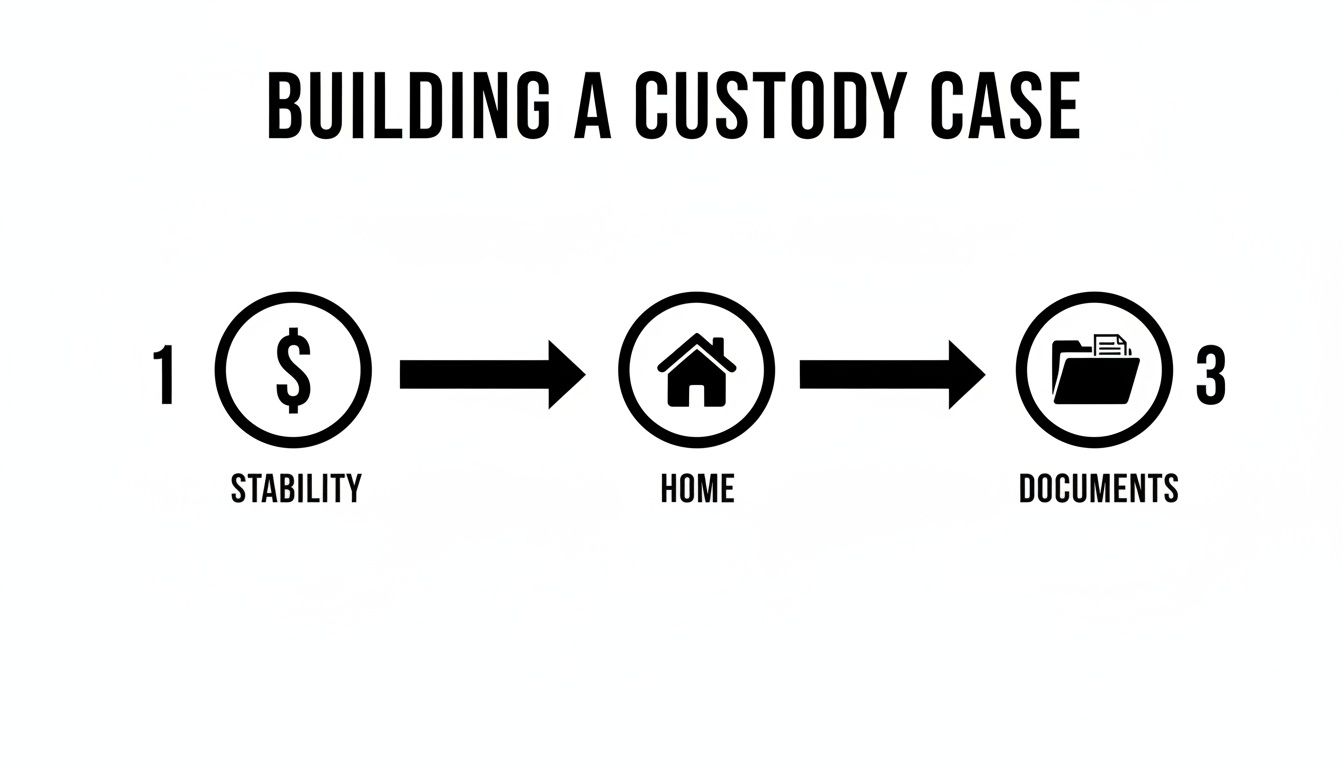
As you can see, a strong case is built on three simple things: proving your financial stability, providing a safe home, and having all your paperwork in order.
The Role of Temporary Hearings
Shortly after filing, it is common to have a temporary hearing. Think of this as the first, and arguably one of the most critical, hurdles. Its purpose is not to decide the final outcome, but to put temporary rules in place for custody, visitation, and child support until the case is fully resolved.
A judge will hear a condensed version of your case and look at initial evidence, like your financial affidavit and proposed parenting plan. The orders that come out of this hearing are incredibly important because they often set the tone—and sometimes the precedent—for the final ruling. A win here can give you a significant strategic advantage.
Understanding Mediation and Discovery
Here in North Georgia, most family law judges will require you and the other parent to try mediation before you can go to trial. Mediation is a confidential meeting with a neutral professional whose only job is to help you two find common ground. It is your chance to settle the case on your own terms, which is nearly always better than letting a judge make these life-altering decisions for you.
While mediation is required, success is not. If you cannot reach an agreement, the case moves forward, and the “discovery” phase kicks into high gear.
Discovery is simply the formal process of exchanging information. It is designed to make sure both sides have all the relevant facts before a trial. This part of the process involves a few key legal tools:
- Interrogatories: These are written questions that the other side must answer truthfully, under oath.
- Requests for Production of Documents: This is a formal demand for specific documents like bank statements, emails, text messages, or your child's school records.
- Depositions: This is out-of-court testimony given under oath, with a court reporter transcribing every word. Attorneys for both sides are there to ask questions.
Discovery can feel intrusive, but it is absolutely essential for building a case based on hard facts, not just accusations.
What Is a Guardian ad Litem?
In especially tough custody battles, particularly when there are allegations of a parent being unfit, a judge might appoint a Guardian ad Litem (GAL). A GAL is a specially trained attorney who does not represent you or the mother. They are appointed by the court to represent the child’s best interests.
The GAL acts as an independent investigator. They will interview you, the mother, your child (if they are old enough), and anyone else who might have insight, like teachers, therapists, or relatives. They review all the documents and often visit both parents' homes in places like Cumming or Canton to see the environment firsthand.
After this deep dive, the GAL writes a detailed report for the judge with their official recommendation for custody. A judge does not have to follow it, but that recommendation carries immense weight.
An experienced attorney can guide you through the GAL process and help you learn more about how to prepare for a custody hearing where the GAL's report will be a central piece of evidence. The court system is complex, but with the right guidance, you can face each step with confidence.
When and How to Address the Mother's Unfitness
Raising concerns about the other parent's fitness can be one of the most difficult parts of a custody case, but sometimes it is absolutely necessary. This is not a time for personal attacks or bringing up old arguments. It is a focused, evidence-based legal strategy that shows a judge why the mother’s behavior or home life puts your child's safety and well-being at risk.
Under Georgia law, an "unfit parent" is someone who cannot provide the proper care, training, and supervision a child needs. A Georgia court is not going to remove a child from their mother's care without a very good reason. Your entire argument has to be built on hard facts, not just your personal opinions.
What Qualifies as Parental Unfitness in Georgia
To have a real shot at full custody based on the mother’s unfitness, you need to bring clear, convincing evidence of serious problems. Just not liking her parenting style is not going to cut it. The court needs to see specific, harmful conditions that directly affect the child.
Here are the kinds of issues a judge will actually consider:
- Documented Substance Abuse: This has to be more than a rumor. It means evidence like court-ordered drug tests she failed or strong testimony from credible people who have seen her use drugs or alcohol in a way that endangers your child.
- Neglect: Is she failing to provide the basics? Things like food, a safe place to live, clean clothes, or getting the child to the doctor are non-negotiable. It also includes serious lapses in judgment, like leaving a young child unsupervised.
- Untreated Mental Health Conditions: If a mother has a diagnosed mental health issue that she is not managing, and it directly impacts her ability to be a safe parent, this could be grounds for unfitness. This usually requires expert testimony or medical records to prove.
- An Unsafe Home: A house with ongoing domestic violence, criminal activity, or genuinely hazardous conditions is a major red flag. If you think your child is in immediate danger, you should know when a family law attorney can help you file for a protective order.
At the end of the day, the judge has one question in mind: does the parent's behavior create a real risk of harm to the child? Every piece of evidence you present must connect back to that single point.
How to Properly Document Your Concerns
Walking into court with accusations but no proof is a fast way to lose credibility. You have to be methodical, focusing on official documents and what other people have witnessed. This approach not only strengthens your case but also protects you from being painted as a bitter ex trying to cause trouble.
You can build a strong case by gathering the right kind of evidence:
- Official Reports: Police reports and investigations from the Division of Family & Children Services (DFCS) are incredibly powerful because they are unbiased, third-party documents.
- Witness Statements: Teachers, neighbors here in Cumming, or even family members who have seen concerning behavior firsthand can provide persuasive testimony. Their accounts can back up what you are saying.
- Professional Evaluations: In certain situations, your attorney can ask the court to order a psychological evaluation or a substance abuse assessment for the mother. The results can provide the objective proof you need.
Navigating this part of your case really calls for professional legal help. An experienced family law attorney knows how to frame your concerns so they are taken seriously by the court, backed by solid proof, and always centered on your child's best interests.
Common Questions from Fathers Seeking Custody
When you are fighting for your kids, the path ahead can feel uncertain. We have sat down with countless fathers across North Georgia who all start with similar questions about their rights, the process, and what they can realistically expect. Getting straight answers is the first step to building a solid legal strategy.
Does Georgia Law Favor Mothers in Custody Cases?
Officially, no. Georgia law is written to be gender-neutral, focusing entirely on the "best interest of the child." A judge is legally obligated to look at both parents on a level playing field, assessing who can provide the most stable, safe, and nurturing home.
However, old-school thinking can sometimes creep into the courtroom. This is precisely why a father's case must be airtight. You cannot just assume the law's neutrality will carry you through. You have to actively prove you are the best choice with undeniable evidence of your involvement, your stability, and your bond with your child.
Can I Get Full Custody If I Was Never Married to the Mother?
Yes, absolutely. But there is a crucial legal step you have to take first: legitimation.
A fact that surprises many unmarried dads in Georgia is that even if your name is on the birth certificate, you do not automatically have legal rights to your child. The legitimation process is how the court formally recognizes you as the legal father. Once that petition is granted, you have the same standing as any married father to seek custody, and the same "best interest of the child" standard applies.
How Much Does a Custody Battle Cost in Forsyth County?
There is no single price tag on a custody case. It varies dramatically. The biggest factor, by far, is the level of conflict between you and the other parent.
An amicable case that settles quickly in mediation will always be significantly less expensive than a drawn-out fight that goes to trial. Costs start climbing when you add in things like hiring expert witnesses, the court appointing a Guardian ad Litem, a lengthy discovery process, or multiple hearings. The best way to get a clear picture is to discuss the specifics of your situation with an attorney.
The most effective way to manage costs is to stay focused on the facts and your child's best interests. Avoid getting pulled into emotionally-charged arguments that only prolong the fight and drive up legal fees.
What If My Teenager Wants to Live with Me?
In Georgia, a child’s preference carries significant weight once they reach a certain age.
A child who is 14 years of age or older can sign a formal document, called an affidavit of election, stating which parent they want to live with. A judge will almost always honor this choice, unless there is strong evidence showing that the chosen parent is unfit.
For kids between the ages of 11 and 13, the court will listen to their wishes, but their preference is not the final word. A judge will consider their maturity and reasoning as one of several factors in making the final decision.
Does the Mother's Adultery Affect My Chances of Getting Custody?
Generally, no. The family court is not interested in why the relationship ended; its focus is on who is the better parent.
However, her conduct can become relevant if you can show it directly and negatively impacted your child. For instance, if her actions exposed the child to inappropriate people, led to neglectful supervision, or created an unstable home environment, a judge would absolutely take that into account. The key is not to attack her character but to connect her behavior directly to your child's well-being.
Navigating the complexities of a custody case requires more than just determination; it requires a knowledgeable legal advocate. If you are a father in Alpharetta, Cumming, or anywhere in North Georgia, the team at Miles Hansford, P.C. can provide the clear guidance and experienced representation you need to protect your child's future. To discuss your case and understand your options, contact us through our website.