


Getting called for a deposition can be nerve-wracking, but understanding the process is the best way to feel in control. A deposition is not a trial or an ambush; it is a formal, out-of-court Q&A session where you answer questions under oath.
The entire point is to prepare, not to improvise. When you are well-prepared, your testimony comes across as clear, consistent, and supportive of your case.
What a Georgia Deposition Is Really Like
First, let's get rid of the courtroom drama image. There is no judge and no jury. You will most likely be in a conference room. Whether you are in Fulton County or Forsyth County dealing with a divorce in Alpharetta or a business dispute in Cumming, the goal is always the same: gathering information to build a factual record.
This process is a key part of "discovery," the phase of a lawsuit where both sides exchange information. You will be under oath, which means you have the same legal obligation to tell the truth as you would in court.
The Key Players in the Room
Walking into a deposition, you'll see a few key people. Knowing who is who and what they are there for can take a lot of the anxiety out of the room.
- Your Attorney: Your lawyer from Miles Hansford will be right there with you. Our job is to protect your interests, object to improper questions, and make sure everything is handled fairly. We will spend time preparing you beforehand and will be your guide throughout the day.
- The Opposing Counsel: This is the lawyer for the other side. Their goal is to get the facts from your point of view and, frankly, to find information that helps their client.
- The Court Reporter: This is a certified professional whose only job is to create a word-for-word transcript of everything said. Because of this, you have to answer verbally—a nod or a headshake will not make it into the official record. If you want to understand just how official this record is, it helps to know a bit about legal and court transcription services and the role they play.
The Purpose Behind the Questions
It is important to see depositions for what they are: a standard and necessary part of civil litigation in Georgia. They let the attorneys lock in your side of the story, see how you come across as a witness, and get a much clearer picture of the case. This clarity often opens the door to productive settlement talks, which can help you avoid a trial altogether.
Thousands of depositions happen every single day in the United States, and good preparation is what separates a smooth process from a difficult one. A survey of over 500 potential jurors found that 73% believe it’s appropriate for attorneys to prepare witnesses to testify. People understand this is not about coaching dishonesty, it is about delivering clear, honest testimony. That is exactly why our firm invests so much time in private prep sessions with our clients in civil and family law matters.
Building Your Deposition Preparation Timeline
Preparing for a deposition is not something you can cram into the night before. Rushing only creates stress and leaves you feeling exposed. From our experience helping clients across Cumming, Alpharetta, and North Georgia, the key to a confident performance is a structured timeline that lets you organize your efforts without feeling overwhelmed.
Meaningful preparation starts well before you ever walk into that conference room. Giving yourself plenty of time allows you to gather what you need without pressure and lets us work together to build a solid strategy for your testimony.
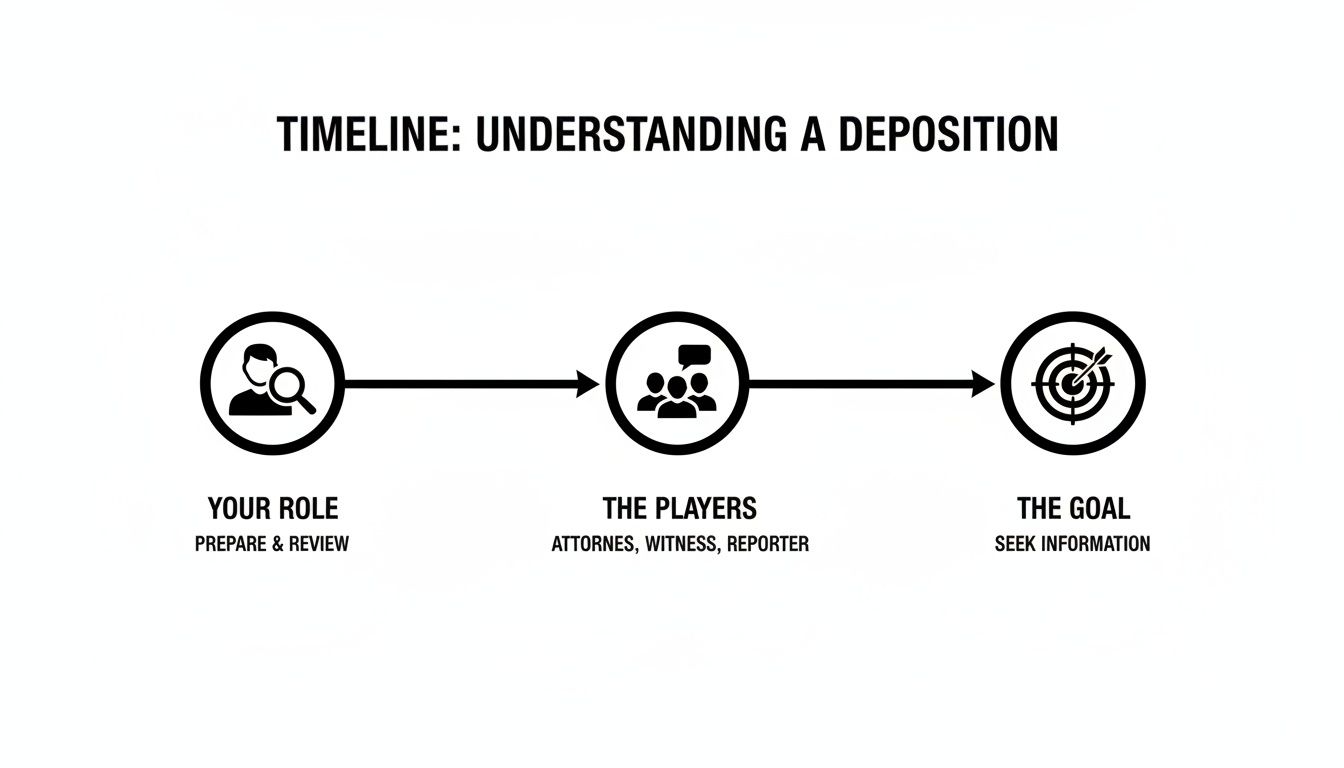
This process can feel complex, but breaking it down into these core stages helps you see exactly where your preparation fits into the bigger picture of your case.
To make things even clearer, we've put together a simple checklist to guide you as the date approaches. This framework turns a mountain of tasks into manageable steps.
Your Deposition Preparation Checklist and Timeline
A structured timeline to guide you through the key preparation steps as your deposition date approaches.
| Timeframe | Key Action Items | Why It's Important |
|---|---|---|
| 3-4 Weeks Out | Document Gathering: Collect every relevant document—contracts, emails, financial records, photos, etc. | This is the factual foundation. Providing these early gives your attorney time to anticipate questions and build a strong case narrative. |
| 1-2 Weeks Out | Strategy Session: Meet with your attorney to discuss case themes, potential tough questions, and the "rules of the road" for testifying. | This is not about memorizing a script. It is about understanding how to answer questions to protect your interests and support your case goals. |
| The Final 72 Hours | Final Prep & Logistics: Conduct a mock Q&A session. Confirm the time, location (in-person or virtual), and travel plans. Get a good night's sleep. | This final polish helps build muscle memory for answering questions and removes any last-minute logistical stress so you can stay focused. |
By following this timeline, you can walk into your deposition feeling prepared and in control, not anxious and rushed.
Three to Four Weeks Out: Document Gathering
The very first thing you need to do is round up all the relevant paperwork. This is the foundation of your entire preparation, because those documents hold the specific facts and details we will be talking about. Do not put this off; start gathering everything the moment your deposition is on the calendar.
What you'll need depends on your case type:
- Family Law and Divorce: Start pulling together financial statements, tax returns, property deeds, and even text messages or emails related to custody or alimony.
- Business and Contract Disputes: You will need every version of the contract, all related emails and correspondence, invoices, payment records, and any internal notes about the deal.
- Civil Litigation: This could include incident reports, photos from the scene, medical records, witness contact info, and any communications you've had with the other party.
Getting these documents organized and over to your attorney well in advance is critical. It allows us to get ahead of the evidence and anticipate the other side's line of questioning.
One to Two Weeks Out: Your Strategy Session
This is probably the most important meeting you will have before the deposition. About a week or two out, we will sit down for a dedicated strategy session. The goal here is not to give you a script to memorize—it is to make sure you understand the key themes of your case and how your testimony supports them.
During this meeting, we will talk honestly about the strengths and potential weaknesses of your case. We will also cover the crucial "rules of the road" for testifying, like the importance of listening carefully and answering only the question that was asked. You should bring any and all questions you have about the process.
Your deposition is a key moment to establish facts on the record. The strategy session is where we ensure the facts you present are communicated clearly, accurately, and in a way that supports the overall goals of your case.
This is also a great time to refresh your own memory. If the case involves events from months or even years ago, look back through your documents. Creating a personal timeline of key dates can help ensure your recollection is sharp and consistent.
The Final Few Days: Prepping for the Day
In the last couple of days, our focus shifts from big-picture strategy to day-of execution. This is often when we will do a mock Q&A session to simulate what it feels like to be questioned by opposing counsel. This practice run helps you get comfortable with the format and gives us a chance to refine your answers to any tough questions.
Logistics are also key at this stage. Double-check the date, time, and location—whether it is in person in Roswell or virtual on a platform like Zoom. Plan your travel, arrange for childcare if you need it, and prioritize getting a good night’s sleep. On deposition day, you need your mind to be clear and focused on the task at hand. By following a clear timeline, you can replace anxiety with a well-earned sense of readiness.
The Golden Rules for Answering Questions
How you answer questions during a deposition is just as critical as the information you provide. The opposing counsel is not just listening to your words; they are observing your demeanor, sizing up your credibility, and searching for any inconsistencies. Knowing the fundamental rules for answering questions will help you stay composed and give testimony that is clear, accurate, and helpful to your case.
When we prepare our clients, from Alpharetta to Cumming, we stress that a deposition is not a conversation. It is a formal question-and-answer session where your only job is to truthfully respond to the questions asked—and nothing more. One of the toughest but most important skills to learn is resisting the natural urge to explain yourself, justify your answers, or fill an uncomfortable silence.

Listen, Pause, Then Answer
This three-step process is the absolute cornerstone of effective testimony. It sounds simple, but it takes real discipline, especially when you are under pressure.
- Listen to the Entire Question: Do not try to guess where the question is headed or start thinking of an answer halfway through. Let the attorney finish speaking completely. This simple habit keeps you from answering a question that was not actually asked.
- Pause Before You Speak: Take a breath. This short pause does two things. First, it gives you a moment to make sure you fully understand what is being asked. Second, it gives your own lawyer a chance to object if the question is improper.
- Answer Only the Question Asked: Give a direct, truthful answer and then stop talking. If a question can be answered with a simple "yes" or "no," that is your answer. If it requires a specific fact, provide that one fact and nothing else.
Volunteering extra information is probably the most common mistake people make. It can open up whole new lines of questioning that are irrelevant or even damaging to your case.
Real-World Example: A Child Custody Case
Picture a child custody deposition here in Forsyth County. The other side's lawyer might ask, "Were you late picking up your child from school on Tuesday?"
An unhelpful, rambling response might sound something like this: "Yes, but it was because traffic on GA-400 was a nightmare, and my boss kept me late in a meeting that ran over, which almost never happens. I even called the school to let them know I was on my way, and my son was totally fine when I got there."
This answer just handed the other side a handful of new topics to dig into. A much better, more effective answer is simply: "Yes."
If the opposing lawyer wants to know why you were late, they will ask. By sticking to the facts, you stay in control of the information and avoid giving them ammunition they did not have before.
The most powerful answers are often the shortest. Your job is not to tell a story or win an argument during the deposition; it is to provide truthful, factual responses to direct questions.
The Power of "I Don't Know" and "I Don't Recall"
So many people feel like they have to have an answer for everything, but guessing or speculating under oath is a huge mistake. If you genuinely do not know the answer to a question, the correct response is, "I don't know." If you cannot remember a specific detail, the proper response is, "I don't recall."
These are complete, acceptable, and often very powerful answers. They are far better than guessing at a date, a time, or a conversation and getting it wrong. An incorrect guess can be used later to attack your credibility, making it seem like you are either dishonest or just careless with the truth. Always be precise and truthful—and that includes being truthful about the limits of your memory.
Beyond what you say, how you say it matters. Taking time to improve verbal communication skills can help you deliver your testimony with confidence and clarity. The goal is to be seen as a credible, steady witness. Your attorney at Miles Hansford will run you through mock Q&A sessions to practice these rules until they feel like second nature. This is a key part of our deposition preparation. And remember, what you say in a deposition can be just as public as what you put online; it is always wise to be mindful of social media during divorce and other legal battles.
Aligning Your Testimony with Your Case Strategy
A deposition is far more than a simple question-and-answer session. Think of it as a strategic event where your testimony helps build the very foundation of your legal case. Getting ready is not about memorizing a script; it is about deeply understanding the core themes of your case and making sure each of your answers reinforces that strategy.
Every civil lawsuit, whether it is a family law matter in Fulton County or a complex business dispute in Forsyth County, has a central theory. Your attorney develops this theory to tell a clear, persuasive story based on the facts. Your deposition is one of the first and best opportunities to lay down the factual groundwork that supports this narrative, long before you ever see a courtroom.
Connecting Your Answers to the Bigger Picture
Imagine your case is a puzzle. Your testimony provides key pieces that must fit perfectly into the overall picture. If we are handling a contract dispute for a client in Johns Creek, our case theory might center on proving the other party breached a specific performance clause. In that situation, our preparation together would focus your attention squarely on questions related to that clause.
We would guide you to give clear, factual testimony about things like:
- The initial negotiations surrounding that specific clause.
- What you understood the obligations to be for each party.
- The exact actions the other party failed to take as required by the contract.
- Any communications that happened once the failure to perform became obvious.
By keeping your answers focused on these key areas, your testimony consistently supports the central theme that a breach occurred. This kind of strategic alignment turns your deposition from a defensive chore into an offensive tool that strengthens your position.
Identifying and Sticking to Core Themes
A systematic approach to deposition prep is crucial. Analysis from legal training institutes often highlights how important it is to identify three to five core themes early on. This method helps organize the facts into a compelling story and prevents your testimony from becoming a scattered collection of unrelated details.
Studies have even shown that witnesses who do not prepare around core themes are 40% more likely to contradict themselves. You can discover more insights about this case theory approach on NAAG.org.
Your testimony is a building block for your case. Every honest, factual answer should serve the purpose of constructing a logical and consistent argument that supports your legal goals.
Our team at Miles Hansford works closely with you to pinpoint these core themes. We make sure you understand why certain facts are critical and how to present them clearly and confidently. This preparation helps you see the purpose behind the questions and answer with conviction. While the dynamics can differ, understanding the role of testimony is universal, much like grasping how expert witnesses contribute to civil cases.
This focused preparation ensures your testimony is not only truthful but also powerful. It allows us to present a unified front, whether we are heading into mediation to negotiate a settlement or preparing for trial in a North Georgia courtroom. By aligning your words with the case strategy from the start, you help build a stronger, more persuasive case.
Navigating a Remote Deposition with Confidence
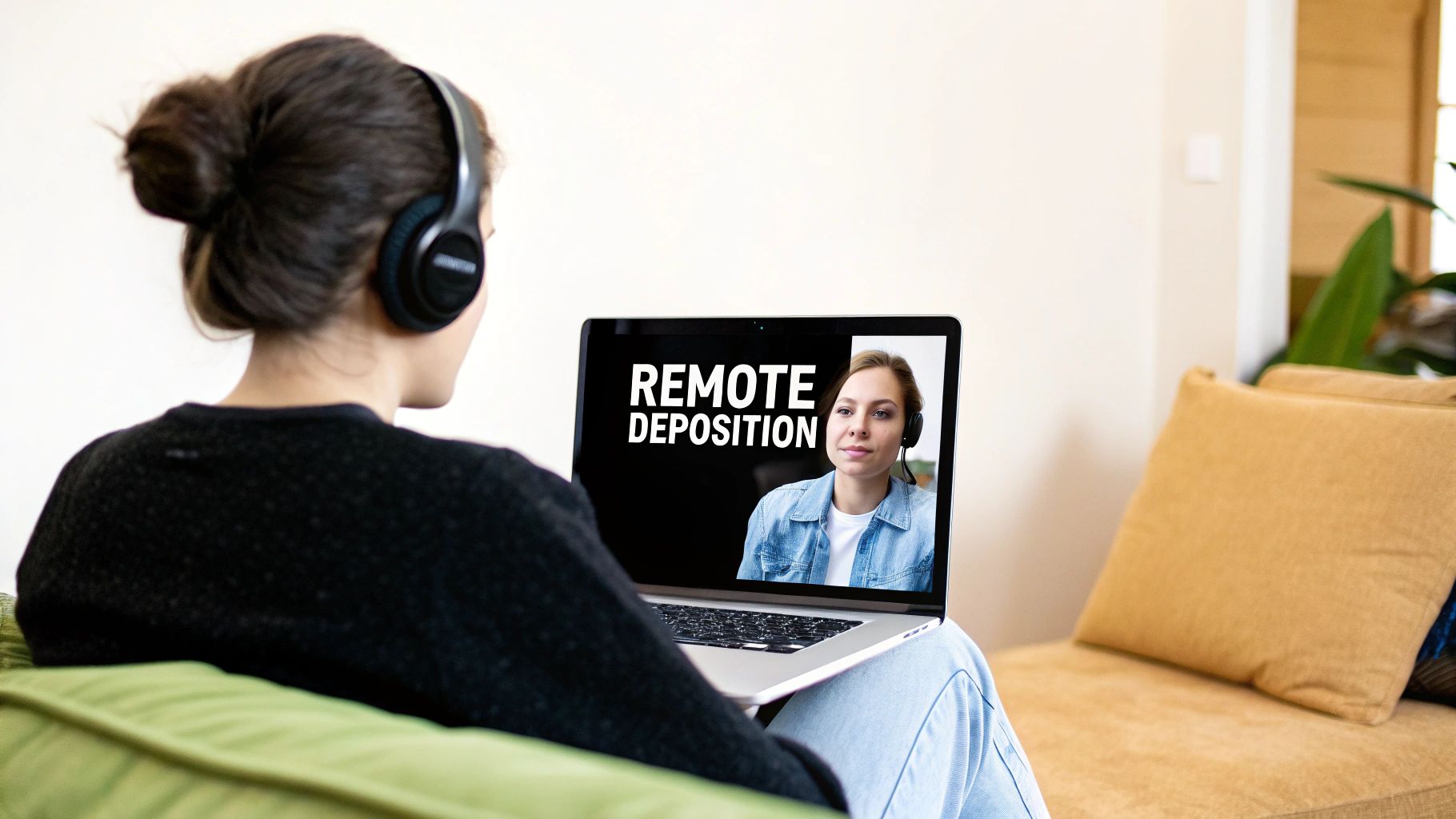
Depositions over platforms like Zoom are no longer a novelty; they have become a standard part of civil and family law cases across North Georgia. While the principles of giving good testimony have not changed, the virtual setting does bring its own unique challenges—and requires its own kind of preparation. Knowing what to expect and how to prepare ensures you can present yourself professionally and give clear testimony, even from your own home.
This shift to virtual proceedings has been massive. Back in 2020, at the height of the pandemic, remote depositions made up roughly 90% of all U.S. depositions. That trend has stuck around. Recent litigation surveys show that over a third of law firms expect their use of remote depositions to keep climbing. You can actually find quite a bit of data on these litigation support trends to see just how much the legal field has adapted.
Setting Up Your Space for Success
Your environment says a lot about you, and on video, it is magnified. A chaotic or unprofessional background can be distracting at best and, at worst, might unintentionally undermine your credibility. The goal here is simple: create a setting that feels as neutral and buttoned-up as a conference room.
Before your deposition, run through this quick checklist:
- Find a Quiet, Private Room: This is non-negotiable. You need a space where you can shut the door and will not be interrupted by family, pets, or the delivery person.
- Check Your Background: Position your camera so you have a neutral, clutter-free background. A plain wall or a neat bookshelf works perfectly. Steer clear of personal photos, windows that blast light into the camera, or anything else that could draw focus away from you.
- Test Your Lighting: Your face needs to be well-lit, ideally from the front. A bright window behind you will turn you into a silhouette, and harsh overhead lighting is not flattering. A simple desk lamp placed in front of you can make a world of difference.
Mastering the Technology and Virtual Etiquette
Nothing adds stress like a technical glitch in the middle of a crucial moment. A day or two before the deposition, you absolutely must test your equipment.
Start with your internet. If you have the option, a wired Ethernet connection is always more stable than Wi-Fi. Then, test your computer's camera and microphone to make sure they work and that you sound clear. We highly recommend using headphones or a headset—it prevents echo and makes it much easier to hear every question precisely.
When the deposition begins, a few rules of virtual etiquette are key:
- Look directly into the camera when you speak. This feels awkward at first, but it simulates eye contact with everyone on the call.
- Mute your microphone when you are not talking. This eliminates any accidental background noise from your end.
- Pause before you answer. Video platforms often have a slight lag, so wait until the attorney has completely finished their question before you start speaking.
A remote deposition demands the same level of seriousness as an in-person one. Your preparation should include not just what you will say, but how you will present yourself and manage your virtual environment effectively.
Handling digital exhibits is another important piece of the puzzle. The opposing lawyer will share documents on the screen for you to review. Take your time. Read the entire document before you answer a single question about it. Your attorney will also instruct you on how to communicate during breaks, which are just as vital in a virtual setting for staying focused. With the right prep, you can walk into a remote deposition with the same confidence you would in a traditional setting.
Common Questions About Georgia Depositions
Even the most well-prepared clients have questions as their deposition day approaches. It is completely normal. Below, we have answered some of the questions we hear most often from our clients here in Forsyth and Fulton counties. Our goal is to clear up any lingering anxieties and give you the straightforward information you need to walk in with confidence.
What Should I Wear to My Deposition?
Think of it like you are going to a professional meeting. For nearly any civil or family law deposition in Georgia, business casual is the way to go. It shows everyone in the room that you are taking the process seriously.
It is best to avoid anything that could be a distraction—this includes clothes with big logos, anything overly casual like a t-shirt, or flashy jewelry. The focus should be on your testimony, not your outfit. When you are not sure what to wear, it is always better to be a little overdressed than underdressed.
How Long Will My Deposition Take?
This really depends on the specifics of your case. A straightforward contract dispute here in Cumming might wrap up in just a few hours. On the other hand, a complex divorce case in Alpharetta with significant assets could easily last a full day, or sometimes even longer.
Your attorney will give you an idea of what to expect, but it is always a good idea to clear your schedule for the entire day. That way, you will not feel rushed or find yourself worrying about another appointment, allowing you to stay completely focused on the questions at hand.
Can I Talk to My Lawyer During the Deposition?
Yes, but the timing is important. You can absolutely speak with your lawyer during breaks. However, you cannot have a private chat while a question from the other attorney is waiting for an answer. The other side is entitled to hear your testimony without any coaching.
That said, you always have the right to ask for a break. If you are confused by a question or feel like you need a moment to speak with your attorney, you can simply request a short recess. We will go over all the ground rules for communication during our prep session so you know exactly what to do.
Your attorney is your guide and advocate through this entire process. While you cannot consult on an answer mid-question, we are right there to protect you, object to improper questions, and make sure the deposition is fair.
What Happens If I Make a Mistake?
It happens. Under pressure, it is easy to misremember a detail or misspeak. If you realize you have said something that is not quite right, the most important thing is to correct it as soon as you can.
Just get your attorney's attention, either during a break or by giving them a signal. They will help you get your clarification on the record, ensuring the final transcript is accurate. Honesty is everything in a deposition, and correcting a mistake right away actually strengthens your credibility.
What Is the Next Step After the Deposition?
Once you are done answering questions, the process is far from over. The court reporter will take all their notes and create a formal written transcript of everything that was said. This usually takes a few weeks.
You and your attorney will then get a copy to review. This is a critical step. You will read through your testimony and note any corrections on a document called an "errata sheet" before you sign it. That final, signed transcript becomes a powerful piece of evidence in your case, influencing everything that comes next:
- Settlement Negotiations: Your clear, consistent testimony can give you a much stronger hand in settlement discussions.
- Mediation: The transcript becomes a factual foundation for talks with a neutral mediator.
- Trial Preparation: Should the case go to trial, lawyers on both sides will use the transcript to prepare their questions and arguments.
Your deposition is a major milestone. The testimony gathered will heavily shape the legal strategy as we continue working toward the best possible resolution for your case.
Navigating a deposition takes more than just knowing your facts—it requires solid preparation and an experienced guide. At Miles Hansford Law Firm, we make sure our clients in Alpharetta, Cumming, and across North Georgia are ready to give clear, effective testimony that strengthens their case. If you have a deposition on the horizon, contact us to see how our attorneys can prepare you for success. Learn more at https://mileshansford.com.