


When you're facing a divorce in Cumming, GA, the immediate worry about your financial future is completely understandable. You've worked hard to build your assets, and the first thing to know is that Georgia law follows the principle of equitable division, not an automatic 50/50 split. The stress of what might happen to your home, savings, or business can feel overwhelming, but you are not powerless.
At Miles Hansford, our family law attorneys help clients across Cumming, Alpharetta, and North Georgia regain control by implementing calm, strategic plans to protect what they’ve built. The best defense for your finances is a proactive strategy, started well before any major decisions are made. Call us today to schedule a consultation and take the first step toward securing your future.
Why Asset Protection Matters in Cumming, GA
Losing a large part of your assets is one of the most stressful prospects of ending a marriage. For those living in Cumming, Alpharetta, and other North Georgia communities, this concern is very real, shaped by local economic factors and the procedures in Forsyth and Fulton County courts. It can feel overwhelming, but you can get back a sense of control by taking calm, informed, and strategic steps.
The entire foundation of asset protection in a Georgia divorce rests on understanding what "equitable division" actually means. It doesn’t mean equal; it means fair. A Forsyth County Superior Court judge has the authority to divide marital property in a way they find to be just.
They will consider several factors, including:
- The financial state and earning potential of each spouse.
- Each person’s contributions to the marriage, which includes work as a homemaker.
- The behavior of either party, especially if it led to the loss or waste of assets.
- How long the marriage lasted.
Because a judge has this discretion, having a well-prepared strategy isn't just helpful—it's essential. The financial moves you make right before and after filing can have a major impact on the final outcome.
Key Takeaway: The most important first step is to gather information and get legal advice. Do not agree to any terms, move out, or close joint accounts without first speaking with a family law attorney who practices in Cumming and Alpharetta.
The Legal Process of Protecting Assets in a Georgia Divorce
Before any legal papers are filed, your most powerful tool is knowledge. This means creating a complete inventory of your financial life. We often guide clients through this initial phase, helping them sort out what is marital property versus what could be considered separate property. An inheritance or a business owned before the marriage, for instance, might be separate. This distinction is a frequent point of conflict in divorces across North Georgia, from Johns Creek to Dawsonville.
Create A Complete Financial Inventory in Cumming
Your immediate goal is to build a complete snapshot of your marital estate. Down the road, a judge in Cumming or Alpharetta will require this exact information on a form called the Domestic Relations Financial Affidavit. Getting this done now gives you a massive head start.
Your inventory needs to cover everything:
- All Assets: Make a list of everything you and your spouse own. This includes the house in Milton, investment accounts, cars, and even valuable collections.
- All Debts: Don't forget the other side of the balance sheet. Mortgages, car loans, credit card balances, and personal loans all count. Remember, under Georgia’s equitable division rules, debts are divided just like assets.
- All Income Sources: Document every penny coming into the household, whether from salaries, bonuses, rental properties, or business revenue.
This exercise gives you and your attorney a clear understanding of the full financial picture. It's the bedrock of any sound asset protection strategy.
A Word of Warning: This is a fact-finding mission, not a license to move or hide money. Trying to conceal assets is one of the quickest ways to lose all credibility with a Forsyth County Superior Court judge, and the penalties can be severe.
This flowchart shows the simple, three-part process we recommend for protecting your assets in a Georgia divorce.
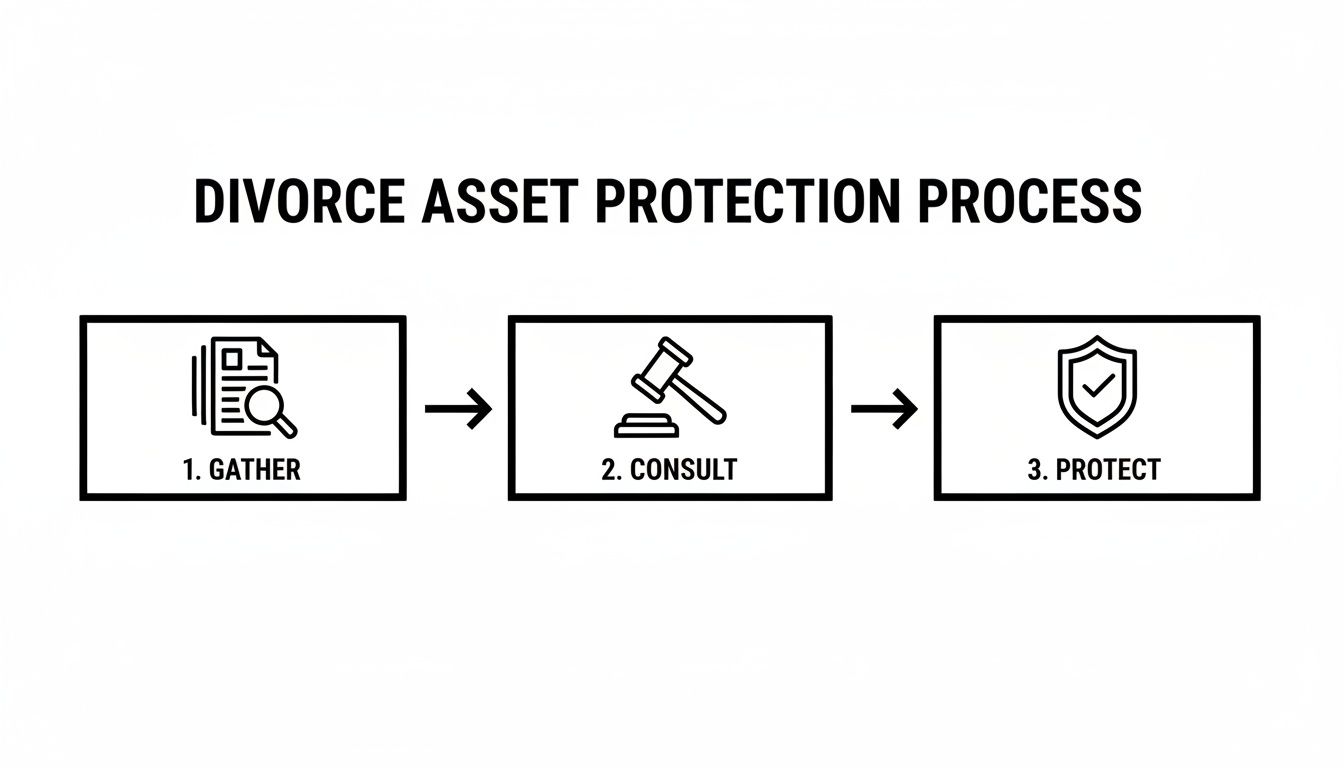
Moving from gathering documents, to consulting an attorney, and then to building a protective strategy is the most effective path you can take.
Gather and Secure Your Critical Documents
Having your paperwork in order is non-negotiable. You’ll need organized, accessible records to build your case and ensure a division of assets that is truly equitable. You can find more detail in our guide on what documents you should prepare for a divorce.
Before you do anything else, start locating the key financial records. The table below outlines what you need and why it's so important in a Georgia divorce case.
Critical Financial Documents for a Georgia Divorce
| Document Type | Why It's Critical in Forsyth & Fulton County Courts |
|---|---|
| Last 3-5 Years of Tax Returns | Shows historical income, investments, and business revenue streams. |
| Bank & Investment Statements | Establishes a baseline of liquid assets and helps trace movement of funds. |
| Deeds and Property Titles | Proves ownership and when real estate was acquired (marital vs. separate). |
| Loan and Credit Card Statements | Identifies all marital debts that must be equitably divided. |
| Business Financials (if applicable) | Necessary for professional valuation of a business interest. |
Gathering these documents now—while you still have easy access—can prevent major headaches and disputes later. Don't wait until accounts are frozen or passwords are changed. Acting now empowers your attorney to fight for you effectively from the very first day.
Our Strategy for Protecting Your Assets
Protecting your assets in a Georgia divorce requires a calm, strategic, and protective approach tailored to your specific situation. The emotional strain of a divorce can easily lead to quick decisions with long-lasting financial damage. Our role at Miles Hansford is to offer the steady, strategic counsel needed to get through this tough time. We help you understand the local court landscape, protect your rights, and aim for a resolution that secures your financial future. It all starts with a confidential consultation to build your protective strategy.
Marital vs. Separate Property in Forsyth County
In any Georgia divorce, the first step in protecting your assets is understanding the crucial difference between marital and separate property. This distinction is what gives a Forsyth County Superior Court judge the authority to divide certain assets but not others.
At its core, marital property includes almost anything you or your spouse acquired during the marriage. On the other hand, separate property is what you owned before you got married, or assets you received as a direct inheritance or personal gift while married.

While that sounds simple enough, we’ve seen countless cases where these lines get blurred over years of marriage. The burden of proving an asset is separate falls on the spouse making that claim, and it’s a tough battle to win without meticulous records.
The Problem of Commingling Assets in Cumming
One of the most frequent issues we encounter is commingling. This is what happens when separate property gets so mixed in with marital assets that it's impossible to tell them apart. It's an easy mistake to make, and it can unintentionally convert your separate assets into marital property that’s up for grabs in the divorce.
We see this play out in North Georgia all the time. Here are a few common scenarios:
- You inherit $50,000 from a grandparent and deposit that check directly into a joint savings account you share with your spouse.
- You sell stock you owned before the marriage and use the proceeds to pay for a new kitchen in your marital home in Johns Creek.
- You own a small business in Canton from before you were married, but you regularly transfer profits into your joint checking to cover family expenses.
In every one of these situations, those once-separate funds have been "commingled." A judge could easily decide that the entire bank account, or the added value to the home, is now part of the marital estate.
Transmutation and Appreciation of Separate Assets in an Alpharetta Divorce
Another key legal concept to know is transmutation. This is the process where a separate asset legally transforms into a marital one. It might happen because of an agreement, but more often, it’s based on how the asset was treated. For instance, if you own a home before the marriage and then add your spouse's name to the deed, you've likely just transmuted that entire property from separate to marital.
It gets even more complicated when a separate asset grows in value during the marriage. Any appreciation could be considered a marital asset, a frequent point of contention in high-asset divorces, especially for local business owners.
Local Example: Let's say you founded a tech startup in Alpharetta years before you got married. The company itself is your separate property. But if your spouse helped run the business, or you used joint marital funds to cover expenses, the growth in the company's value during the marriage is very likely marital property.
A judge will have to determine if that appreciation was "active" (caused by the efforts of either spouse) or "passive" (due to market trends). Making that distinction requires a deep financial dive, often with the help of a forensic accountant. Protecting these assets comes down to diligent tracing and a clear paper trail. This is why it’s critical to have an attorney who knows how judges in Forsyth and Fulton counties approach these complex situations.
The rules are detailed, but you can get a good overview by reading our guide to Georgia divorce laws. The most important takeaway is to start classifying your assets early and build a clear strategy. Your financial future truly depends on it.
What to Expect in Forsyth or Fulton County Courts
When going through a divorce in Alpharetta or Cumming, a few key assets usually form the foundation of your family's finances: the marital home, retirement accounts, and any businesses. Protecting these isn't about general advice; it requires specific, local strategies designed for each one. For families in Fulton or Forsyth County, understanding how to handle these high-value assets is critical.

The Marital Home in Alpharetta or Cumming
The house is often the most emotionally significant and financially valuable asset on the table. Many people worry that selling the home and splitting the cash is their only choice. While that is one option, it’s certainly not the only one.
Georgia's equitable division principles actually allow for some creative solutions. We frequently help clients work through alternatives like:
- A Buyout: One spouse can purchase the other’s share of the equity. This usually means the buying spouse has to refinance the mortgage in their name alone, which depends on having a solid individual credit profile.
- A Delayed Sale: You can create an agreement where one spouse and the children stay in the home for a specific amount of time—for instance, until the youngest child finishes high school. After that period, the house is sold, and you divide the proceeds.
- An Asset Trade: One spouse might keep the home entirely by trading other assets of equal value, such as a larger portion of an investment account.
The marital home is central to most divorces, but a poorly planned approach can erode significant wealth. With an estimated 95% of divorces settling outside of court, according to data from organizations like the American Academy of Matrimonial Lawyers, creative solutions are more viable than ever. An agreement could let one spouse take over the mortgage, but if they can't refinance within a certain timeframe, the house is automatically put up for sale.
Local Insight: A judge in the Forsyth County Superior Court will not force you to sell your home if you and your spouse can agree on a fair, workable plan. Mediation, which is a required step in most Georgia counties, is the ideal place to hammer out these kinds of custom solutions for homes in Cumming, Suwanee, or Dawsonville.
Securing Retirement Funds in a Georgia Divorce
For the many professionals in Alpharetta, Johns Creek, and Roswell, retirement funds like 401(k)s, 403(b)s, and pensions are often the largest asset besides the house. The portion of these accounts that grew during the marriage is considered marital property and is subject to division.
If you divide these accounts incorrectly, you can get hit with major tax penalties and early withdrawal fees. This is why a Qualified Domestic Relations Order (QDRO) is so important. A QDRO (pronounced "kwah-dro") is a specific court order, separate from your final divorce decree, that tells a retirement plan administrator how to properly divide the account.
You simply cannot divide a 401(k) or pension plan safely without a QDRO. If one spouse just takes money out to pay the other, the IRS will see it as a taxable distribution. On top of that, the plan administrator might tack on a 10% early withdrawal penalty. A properly written QDRO avoids all of that, letting the funds roll over into the other spouse's own retirement account without any tax consequences.
Protecting Your Business in a Fulton County Divorce
If you're a business owner, your company is probably your most valuable and complex asset. During a divorce, that business is vulnerable. Without a clear plan, you might be forced to sell it or give up a large ownership stake.
The first move is always to get a professional business valuation. You'll need a forensic accountant or a certified valuation analyst to determine the company's fair market value. This isn't a number you can just guess at; a Fulton County Superior Court judge will demand a defensible, expert report.
With a valuation in hand, you can start exploring ways to protect your business:
- Offer your spouse other marital assets of equal value to "buy out" their share.
- Propose a long-term payment plan that pays your spouse their share over several years.
- Negotiate to give your spouse a non-voting minority interest, which lets you keep full control of day-to-day operations.
For a detailed look at how this applies to businesses, you can read our guide on how to protect your business in a divorce.
Why Choose Miles Hansford?
When your financial future is on the line, you need a law firm that combines empathetic support with strategic, authoritative representation. At Miles Hansford, we are not just divorce lawyers; we are pillars of the North Georgia legal community, practicing daily in the Forsyth and Fulton County court systems. We know the local judges, procedures, and what it takes to protect our clients in Cumming, Alpharetta, Sandy Springs, and the surrounding cities.
Our approach is direct, protective, and built on years of experience handling complex property division, high-asset divorces, and business valuation cases. We provide the calm, seasoned guidance you need when feeling overwhelmed and unsure. We will work tirelessly to protect your assets, your rights, and your future.
The emotional toll of divorce can cloud your judgment and lead to costly financial mistakes. Seeking support for grieving from divorce and finding hope again can help you maintain the clarity needed to make sound decisions for your future.
Frequently Asked Questions About Protecting Assets in a Cumming Divorce
Q: What is the first step to protect my assets in a Cumming, GA divorce?
A: Your first step should be to confidentially consult with an experienced family law attorney near you before making any financial moves. They can advise you on Georgia’s equitable division laws and help you legally gather critical financial documents like bank statements and tax returns. This proactive approach is crucial before a Forsyth County court's automatic standing orders take effect.
Q: Is Georgia a 50/50 state for divorce?
A: No, Georgia is an equitable division state, not a community property (50/50) state. A Forsyth or Fulton County judge will divide marital property in a way they deem fair, not necessarily equal. Factors like each spouse's financial condition, contributions to the marriage, and conduct are all considered, making a strategic legal approach essential.
Q: Can my spouse empty our joint bank account before a divorce in Cumming?
A: Before a divorce is filed, either spouse can technically withdraw funds. However, this is a very poor strategic move. Once a divorce is filed in Forsyth County, an Automatic Domestic Standing Order immediately goes into effect, prohibiting such actions. A judge will view emptying an account as acting in bad faith, which can severely damage your case.
Q: How can I protect my inheritance from a divorce in Alpharetta?
A: In Georgia, an inheritance is typically considered separate property, but only if you do not "commingle" it. To protect it, you must keep the inheritance in a separate account under your name only. Do not use it for joint expenses or to pay down marital debt. Clear records tracing the funds are essential for proving its separate nature in a Fulton County court.
Q: How much does a divorce cost in Forsyth County?
A: The cost varies significantly. An uncontested divorce in Forsyth County, where both parties agree on all terms, might cost a few thousand dollars. However, a contested divorce, especially one involving disputes over high-value assets, business valuation, or custody, can cost much more due to litigation, discovery, and hearings in the Forsyth County Superior Court.
Q: Does having a prenuptial agreement help protect assets in Cumming?
A: Yes, absolutely. A valid prenuptial agreement is one of the strongest tools for protecting assets in a Cumming divorce. As long as it was entered into fairly, with full financial disclosure, and isn't grossly one-sided, Georgia courts will enforce it. It allows you to pre-determine how assets will be divided, bypassing much of the conflict and uncertainty of equitable division.
Q: How are debts divided in a Georgia divorce?
A: Under Georgia’s equitable division principle, marital debts are divided just like assets—fairly, but not always equally. Any debt acquired during the marriage, like mortgages, car loans, or credit card balances, is subject to division. A judge in Cumming or Alpharetta will consider who is better able to pay the debt when making a final determination.