


Proving parental alienation is one of the toughest challenges in Georgia family law. It’s not just about showing the court your child is angry or distant; you have to demonstrate a deliberate pattern of behavior from the other parent designed to damage your relationship with your child.
This isn’t about a few disagreements. It is a calculated campaign of manipulation that puts the child's well-being at risk. If you are facing this situation in North Georgia, building a clear, evidence-based case is essential.
Understanding Parental Alienation in Georgia Law
For families in places like Roswell, Cumming, or Johns Creek, the hardest part is often proving that what's happening isn't just a child's valid frustration, but a targeted effort to sever a parent-child bond.
Georgia courts operate under the "best interests of the child" standard. A judge in Fulton or Forsyth County will not make a decision based on isolated incidents. They need to see a clear, documented pattern of harmful behavior. This means your job is to build a case with concrete evidence like emails, text messages, and firsthand accounts from witnesses that, when put together, tell the whole story.
Key Indicators Of Parental Alienation vs. Justified Estrangement
It's crucial to distinguish between a child who has been manipulated and one who has legitimate reasons to be distant. This table breaks down some of the common behavioral signs to help you understand the difference.
| Behavioral Sign | Potential Sign of Alienation | Potential Sign of Justified Estrangement |
|---|---|---|
| Criticism of Parent | Child repeats vague, rehearsed, or nonsensical complaints about the targeted parent. | Child can provide specific, age-appropriate examples of why they are upset with the parent. |
| Source of Feelings | Child cannot provide independent reasons for their anger; they often parrot the alienating parent's words. | The child's feelings are based on their own experiences and observations of the parent's behavior. |
| Relationship History | The child had a positive and loving relationship with the parent before the separation or conflict. | The child has a history of a strained or difficult relationship with the parent due to that parent's actions. |
| Scope of Negativity | The negativity extends to the targeted parent's entire family (grandparents, cousins) without reason. | The child's negative feelings are focused specifically on the parent and their problematic behavior. |
| Lack of Guilt | Child shows no remorse or guilt for their cruelty or disrespect toward the targeted parent. | Child may still show love or feel conflicted despite being angry or hurt by the parent's actions. |
Looking at these behaviors side-by-side can provide clarity. If your situation aligns more with the "Alienation" column, it is time to start methodically documenting everything.
Common Signs of Alienating Behavior
The first step is recognizing the tactics. While every situation is unique, there are some common red flags that show up again and again:
- Constant Bad-Mouthing: The other parent is always making false or disparaging comments about you, directly to your child.
- Blocking Communication: They consistently interfere with your ability to talk to your child by blocking calls, monitoring texts, or "forgetting" to pass on messages.
- Forcing a Choice: The child is put in the middle and made to feel guilty for showing you affection or enjoying their time with you.
- Withholding Information: You're deliberately kept in the dark about your child’s school events, doctor's appointments, or extracurricular activities.
- Making False Accusations: The other parent invents stories about you, claiming you're neglectful, abusive, or dangerous, to make your child afraid of you.
This kind of behavior is alarmingly widespread. A recent study found that 35.5% of parents reported being the target of alienating behaviors, a problem that impacts an estimated 22 million American adults. You can read more about the study's findings on parental alienation prevalence.
Proving these behaviors in court takes more than just your side of the story. You need a well-organized collection of evidence that shows a clear and damaging pattern.
Gathering Compelling Evidence for Your Case
Proving parental alienation means building a case piece by piece, demonstrating a consistent, damaging pattern of behavior. A judge in Fulton County or Forsyth County will not make a life-altering decision based on your word alone. They need to see clear, compelling, and admissible evidence that tells the whole story.
Your goal is to shift the narrative from mere accusations to a factual account of the alienating parent's actions and the very real impact on your child. This involves meticulously collecting different kinds of proof. When pieced together, they can create an undeniable picture of manipulation that violates the "best interests of the child" standard, the cornerstone of Georgia family law.
Document Every Interaction and Incident
Your single most powerful tool is a detailed and consistent record. Start a journal or a secure digital log right away and document everything. The key is to be factual and objective. Focus on specific behaviors, dates, and direct quotes, not your emotional reactions.
What should you include in your log?
- Denied or Obstructed Parenting Time: Note every single time your scheduled visit is canceled, cut short, or interfered with. Log the date, time, and the exact reason given. For example, "March 15, 2024 – Son's mother said he was 'too sick' for my weekend, but I later saw photos on social media of him at a friend's birthday party that same day."
- Disparaging Remarks: If your child repeats negative comments the other parent has made about you, write them down. Quote your child directly whenever you can.
- Blocked Communication: Track every unanswered phone call, blocked text, or any other instance where you were prevented from speaking to your child.
- Missed Information: Record any school events, doctor’s appointments, or extracurricular activities in places like Alpharetta or Cumming that you were deliberately not told about.
A well-maintained log is not just a list of complaints. It is a timeline that can show a systematic effort to erase you from your child’s life, which is powerful evidence in a courtroom.
Preserve Digital and Written Communications
These days, a huge amount of evidence is digital. You have to preserve these communications carefully, as they often provide unfiltered proof of the alienating parent's true intentions and actions.
Save and screenshot everything. We are talking about:
- Text messages where the other parent makes flimsy excuses to deny visitation.
- Emails containing false accusations or derogatory language about you.
- Social media posts or comments that disparage you or twist the facts about your parenting.
- Voicemails that capture a hostile, uncooperative, or manipulative tone.
It's critical to preserve this evidence in its original format and make backups. Never alter or edit a screenshot. Your family law attorney can advise you on the proper way to authenticate this digital evidence so it’s admissible in court. The process is straightforward but essential.
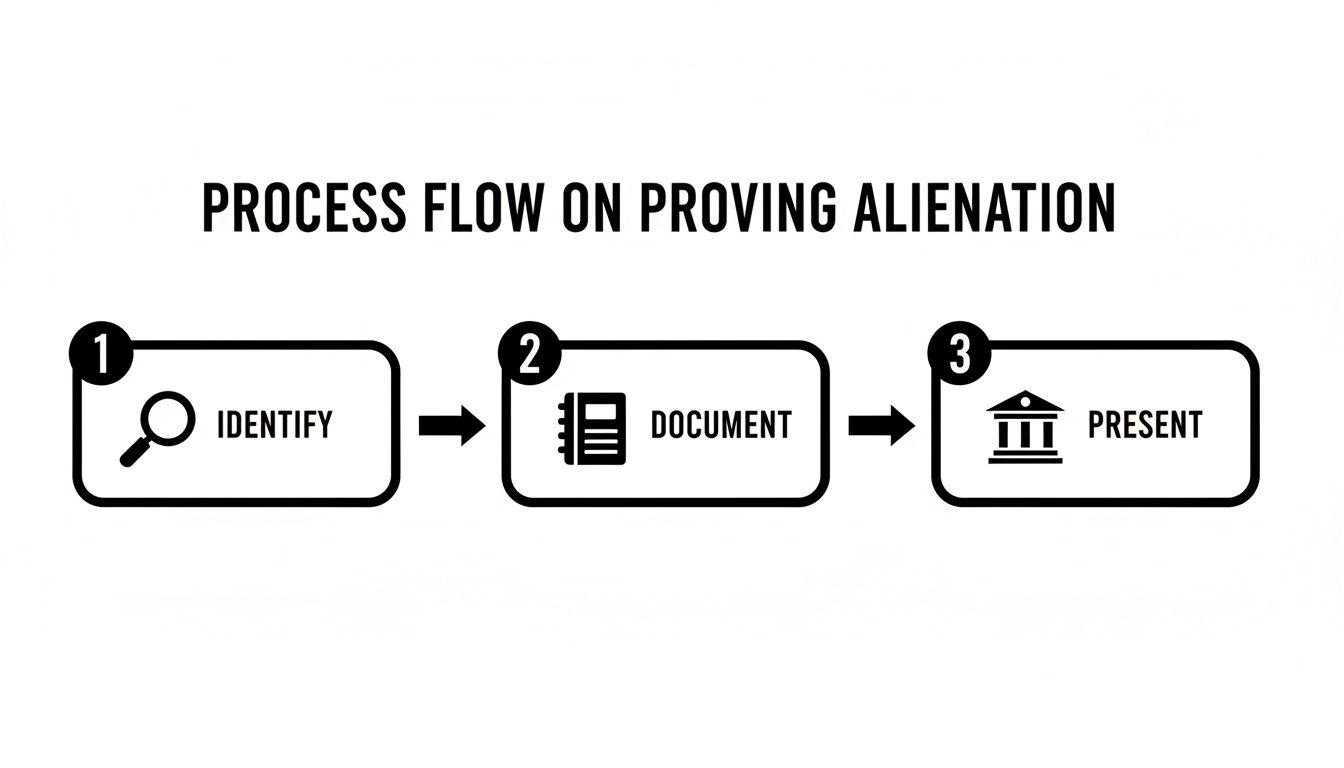
As this graphic shows, the path is clear: you must first identify the alienating behaviors, then meticulously document them, and finally, work with your lawyer to present them effectively to the court.
Collect Third-Party and Collateral Evidence
Evidence from neutral, third-party sources can dramatically strengthen your case. This kind of proof backs up your claims and shows that other people have observed the negative changes in your child or the alienating parent's problematic behavior.
Think about gathering records and statements from:
- School Officials: Report cards showing a sudden drop in grades, attendance records with unexplained absences, or emails from teachers in your Canton or Roswell school district about behavioral shifts.
- Coaches and Tutors: Statements from extracurricular leaders who have witnessed your child's attitude change or heard them repeat negative things about you.
- Therapists or Counselors: If your child is seeing a professional, their records could offer crucial insight into their emotional state and the source of their distress.
Don't underestimate how critical solid evidence is. An analysis of past cases found that fathers who made cross-claims of parental alienation against mothers alleging abuse nearly doubled their risk of losing custody. This highlights the high stakes and proves that judges need undeniable proof, not just a "he said, she said" battle.
Building this portfolio of evidence is a fundamental step. To get a better sense of the entire preparation process, check out our guide on what to do to get ready for a child custody case.
The Critical Role of Witnesses and Expert Testimony
While texts and emails create a paper trail, it is the human element that often leaves the biggest impression in a family law courtroom. When you're trying to prove parental alienation, credible witnesses can bring your timeline to life, showing a judge the real-world consequences of the other parent's destructive behavior.
Strategically chosen witnesses can offer objective, firsthand accounts that judges in Fulton, Forsyth, and surrounding counties find far more persuasive than a parent's own testimony.

This is where working with an experienced attorney is crucial. We can help you identify people who can speak to facts, not just their personal opinions, which is a key distinction in court.
Leveraging Lay Witnesses From Your Community
A lay witness is someone who has personally seen or heard things relevant to your case but is not offering a professional opinion. These are people from your everyday life in communities like Cumming or Alpharetta who can provide powerful, unbiased context.
Think about people who can talk about the "before and after."
- Teachers or School Counselors: They can testify to a sudden nosedive in your child's grades, new behavioral problems, or disturbing things the child has said about you.
- Coaches or Extracurricular Leaders: Maybe they noticed a stark change in your child's personality or even overheard the other parent badmouthing you during a soccer game.
- Family Friends or Neighbors: A trusted friend who has seen your warm, loving relationship with your child for years can speak to the sudden, confusing shift they have witnessed.
The point is that their testimony must be based on what they have personally observed. Their perspective as a neutral third party can lend significant weight to your claims of alienation.
The Decisive Impact of Expert Witnesses
While friends and teachers provide context, expert witnesses deliver the professional analysis that can make or break a parental alienation case. These are trained professionals who can evaluate the complex family dynamics and explain to the court exactly how the alienating behavior is damaging the child.
An expert witness translates the confusing and painful signs of alienation into a clear, clinical assessment that holds significant weight with the court. Their objective report can cut through the "he said, she said" and focus the judge's attention on the child's psychological well-being.
In these cases, the most effective expert witnesses are typically:
- Child Psychologists or Therapists: These professionals can evaluate the child and both parents to spot patterns of manipulation and its psychological toll. Their findings can draw a direct line from the alienating parent's conduct to the child’s emotional distress.
- Custody Evaluators: Whether appointed by the court or hired privately, these experts perform a deep-dive investigation into the family. They interview everyone involved before giving the court a detailed report and recommendation.
- Guardians ad Litem (GALs): A GAL is an attorney the court appoints specifically to represent the child’s best interests. They conduct their own independent investigation to recommend what's best for the child regarding custody and parenting time. To get a better handle on their role, you can learn more about what a Guardian ad Litem is in our detailed guide.
Understanding the role of medico-legal experts is also crucial when dealing with legal cases involving complex mental health issues, which often arise in parental alienation. Testimony from these qualified professionals gives the judge an impartial, evidence-based foundation for a ruling that truly protects your child. It elevates the case beyond simple accusations and into the realm of professional assessment.
Presenting Your Case in a Georgia Courtroom
Once you've painstakingly gathered all your documents, witness lists, and expert reports, the work of weaving everything into a clear, convincing story for the court begins. Presenting a parental alienation case, whether in Forsyth County or Fulton County, is not just about dumping a pile of evidence on the judge's bench. It’s about explaining what that evidence actually means for your child's well-being.
A seasoned family law attorney knows that the entire case strategy has to pivot on Georgia’s “best interests of the child” standard.
This focus shifts the narrative. Every text message, witness testimony, and legal motion is carefully framed to answer one question for the judge: how is the other parent's alienating behavior harming the child, and what can the court do to protect them? We move beyond simply listing bad acts to demonstrating their corrosive effect on your child and your relationship.

Taking Decisive Legal Action
To formally bring the issue of parental alienation to a judge's attention, your lawyer will need to file specific legal motions. These are formal requests asking the court to take a specific action. You cannot just show up to a hearing with accusations; the process has to be handled through the proper legal channels.
Here are the most common legal steps taken in these cases:
- Filing a Motion to Modify Custody: This is the most direct route. Your attorney will argue that the alienating parent's conduct is a "material change in circumstances" that negatively impacts the child, justifying a change to the current custody order.
- Requesting a Psychological or Custody Evaluation: This asks the court to appoint a neutral expert, often a psychologist, to evaluate the family dynamics. The resulting report provides the judge with an unbiased, professional opinion on whether alienation is occurring.
- Filing a Motion for Contempt: If the other parent is directly violating a court order by blocking visitation or communication, a contempt motion asks the judge to enforce the order. This can lead to penalties for the non-compliant parent.
These motions build the legal foundation for presenting your evidence. As things move forward, it can be helpful to understand how to track your case's progress through the court system, which gives you a clearer picture of timelines and what to expect next.
The table below outlines these key legal actions and what they aim to accomplish in an alienation case.
Common Legal Actions in Parental Alienation Cases
| Legal Action | Purpose in an Alienation Case | Potential Outcome |
|---|---|---|
| Motion to Modify Custody | To argue that the alienating behavior constitutes a significant change warranting a new custody arrangement that protects the child. | A change in the custody order, potentially awarding the targeted parent sole custody or supervised visitation for the alienating parent. |
| Request for Custody Evaluation | To obtain an objective, third-party assessment of the family dynamics and the psychological impact of the alienation on the child. | A detailed report from a court-appointed expert that supports the claim of alienation and recommends specific remedies. |
| Motion for Contempt | To hold the alienating parent accountable for violating existing court orders (e.g., denying court-ordered parenting time). | The court can enforce its order and impose sanctions, such as fines, make-up parenting time, or other penalties. |
Ultimately, these legal tools are what allow your attorney to formally introduce your evidence and arguments to the judge, forcing the issue into the open.
Maintaining Your Composure in Court
Your conduct in the courtroom is just as critical as the evidence you present. It is very likely the alienating parent has spent months, or even years, painting you as unstable, angry, or unreasonable. Your calm, factual, and respectful demeanor in court is the single best way to dismantle that false narrative.
Remaining composed under pressure is not a sign of weakness; it is a powerful demonstration of your strength and maturity. It shows the judge you are the stable, reasonable parent focused on your child's best interests, not on winning a fight.
When you are on the stand, stick to the facts. Answer the questions asked by your attorney and the opposing counsel directly and honestly. Try to avoid emotional outbursts, making accusations, or arguing. Let the evidence you have collected do the heavy lifting.
Your attorney will handle the legal arguments and cross-examination. Your job is to be a credible and composed witness. Your attorney's role is to pull all the threads together. They will present your witnesses in a logical order, cross-examine the other parent to expose inconsistencies, and deliver a closing argument that ties every piece of evidence back to one thing: protecting your child from emotional harm.
Anticipating Defenses and Avoiding Common Pitfalls
When you level an accusation of parental alienation, you can expect the other parent will respond forcefully. It's a serious claim, and it is almost always met with a serious defense. Understanding their likely arguments ahead of time is essential for building a case that will hold up in a Forsyth or Fulton County court.
You need to be ready to dismantle their story while making sure you do not make simple mistakes that could undermine your own. Remember, your own conduct is evidence. Staying calm and focused on your child creates a stark contrast to the alienating parent's behavior, showing the judge that you're the stable, reasonable one.
Anticipating Common Defenses
The other parent's attorney is skilled at framing their client's behavior as justified or even protective. If you are prepared for these arguments, your lawyer can effectively pick them apart using the evidence you have painstakingly collected.
Here are a few of the most common defenses we see:
- The "Justified Estrangement" Claim: This is the big one. They will argue the child's rejection of you is a natural reaction to your own bad parenting or neglect. The goal here is to flip the script and paint you as the problem.
- The "Child's Own Wishes" Argument: In this scenario, they claim to be simply respecting the child's independent choice to cut you out. This is a way to shift blame from themselves to the child, making them look like a passive observer rather than the instigator.
- The "Protective Parent" Narrative: The alienating parent might argue they are just trying to protect the child from your supposed bad influence, be it instability or something else. This tactic reframes their interference as a heroic act of good parenting.
This is where your detailed log, witness testimony, and communication records become your most powerful weapons. They give your attorney the ammunition needed to demonstrate that the child’s feelings are not based on your real-world actions, but on the other parent's calculated campaign against you.
Critical Pitfalls You Must Avoid
While you're fighting to prove alienation, it is incredibly easy to make missteps that can be twisted and used against you. Your actions are under a microscope.
Maintaining impeccable personal conduct is not just about taking the high road; it is a legal strategy. Every calm response and every followed court order demonstrates your fitness as a parent and undermines the other parent's narrative.
You have to avoid these common but damaging mistakes:
- Engaging in Heated Arguments: Do not get pulled into fights, especially over text or email. Those exchanges are easily taken out of context to make you look hostile or unhinged. Keep all communication brief, business-like, and focused on logistics.
- Speaking Negatively About the Other Parent: Never bad-mouth the other parent to your child or air your grievances on social media. That is alienating behavior, and it will torpedo your credibility in court.
- Failing to Exercise Your Parenting Time: You must attempt to use every single minute of your court-ordered visitation. It does not matter if the child is resistant or the visit is a struggle. If you stop trying, the other parent will argue that you are the one who abandoned the relationship.
- Ignoring Court Orders: Follow the parenting plan to the letter. This shows you respect the court and are the cooperative parent.
The harm here is not just theoretical; it has real, measurable consequences. Research into the mental health impacts of parental alienation shows that victims often suffer from high rates of PTSD and depression. You can discover more insights about the profound harm of parental alienation in research from Colorado State University. Sharing this kind of data can help a judge understand the true gravity of what you and your child are facing.
Frequently Asked Questions About Parental Alienation
When you’re dealing with parental alienation, the legal path forward can feel overwhelming and uncertain. Here in North Georgia, we hear many of the same questions from concerned parents, whether they're in Alpharetta or Dawsonville. Let's clear up some of the most common ones.
What is the first thing I should do if I suspect parental alienation?
The first thing you should do is start documenting everything immediately. Before calling an attorney, create a detailed, objective log of every denied visit, disparaging comment your child repeats, and blocked communication. Once you have a record started, contact an experienced family law attorney to discuss your situation.
How hard is it to prove parental alienation in Georgia?
Proving parental alienation in Georgia is challenging because the burden of proof is high. A judge in Fulton or Forsyth County needs to see a clear and convincing pattern of malicious behavior from the other parent that is directly harming the child. Isolated incidents are not enough; you need substantial, organized evidence.
Will the court make my child testify in a parental alienation case?
It is extremely rare for a child to testify on the stand in a Georgia custody case, as judges work to shield them from that stress. Instead, a court is much more likely to appoint a Guardian ad Litem (GAL), who is a neutral attorney representing the child's best interests. The GAL will speak to the child privately and report their findings to the judge.
How long does a parental alienation case usually take?
There is no set timeline, as each case is unique. A case could take several months or well over a year, depending on the need for expert evaluations, the court's schedule, and the complexity of the evidence. An experienced family law attorney can provide a more realistic timeline based on your specific circumstances.
Could I lose custody if I accuse the other parent of alienation?
Yes, making a false or unsubstantiated claim of parental alienation can seriously backfire. If a judge believes you are using the accusation as a tactic, they may view it as manipulative and not in the child's best interests. This could negatively impact your custody or visitation rights, so it is crucial that your claims are supported by strong evidence.
What happens if the court finds that alienation occurred?
If a Georgia judge finds that parental alienation is happening, they have several options to remedy the situation. The court might modify the custody order, order reunification therapy to repair the parent-child relationship, or appoint a parenting coordinator to manage conflict. In cases of direct court order violations, the alienating parent could also be held in contempt.
Is parental alienation considered a form of child abuse in Georgia?
While parental alienation is not defined as a crime in Georgia law, family court judges recognize it as a serious form of emotional and psychological abuse. They understand the profound and lasting harm it can cause a child. Presenting your case from the perspective of protecting your child from this emotional harm is a powerful legal strategy.
Proving parental alienation requires patience, meticulous work, and a legal strategy centered on your child’s well-being. If you are dealing with this in Forsyth County, Fulton County, or anywhere nearby, you do not have to face it by yourself. The experienced family law attorneys at Miles Hansford, P.C. are here to offer the calm, steady guidance you need. We can help you protect your rights and, most importantly, your relationship with your child. Contact us today to see how we can help.