


Being served with a stack of legal papers is a jarring experience. Whether it happens at your home in Cumming or your business in Alpharetta, this formal process, known as "service of process," officially begins a lawsuit and starts a very strict clock.
Knowing what to do in those first critical moments can make all the difference.
The single biggest mistake you can make is to do nothing. In Georgia, if you fail to respond within the legal timeframe, you will likely face a default judgment. This means the court can rule entirely in the plaintiff's favor without you ever getting a chance to tell your side of the story.
First Steps After Being Served with a Lawsuit
So, you are holding a stack of legal documents. What now? Your first job is to understand what you have received.
Deciphering the Legal Documents
Inside that stack, you will find two key documents: the Summons and the Complaint.
The Summons is an official order from the court. It is not a suggestion; it is a command that you must file a formal response.
The Complaint is the document from the person or company suing you (the Plaintiff). It lays out, usually in numbered paragraphs, exactly why they are bringing a legal claim against you (the Defendant). Read it carefully to get a clear picture of who is suing you and for what reason. Is it a business contract dispute in Fulton County, a property line disagreement in Forsyth County, or a family law matter?
What to Do Immediately
Before you do anything else, take a breath. The urge to immediately call the other person or their lawyer to argue is strong, but it is a poor decision. Anything you say can and often will be used against you later in the process.
Instead, your first actions should be calm and methodical. Focus on these practical steps.
To help you stay on track during this stressful time, here is a quick checklist of your immediate priorities.
Immediate Action Checklist When Served with a Lawsuit
| Action Item | Why It's Critical | Common Mistake to Avoid |
|---|---|---|
| Note the Date of Service | This starts the 30-day clock in Georgia for you to file a formal Answer. Missing this deadline has severe consequences. | Guessing or estimating the date. Be precise and write down the exact date, time, and how you received the papers. |
| Do Not Contact the Plaintiff | Anything you say can be used against you. A lawsuit is a formal process that requires a formal response. | Trying to "work it out" over the phone or via email. This rarely ends well and can damage your legal position. |
| Preserve All Evidence | You must collect and protect all related documents, emails, texts, and records. Destroying evidence can lead to serious sanctions from the court. | Deleting emails or throwing away documents you think might "look bad." Your attorney needs the full story to defend you. |
| Contact a Litigation Attorney | A lawyer can evaluate the claims, advise you on your options, and draft the legally required response to protect your rights. | Waiting until the last minute. Finding the right attorney and preparing a strong defense takes time. |
This checklist covers the absolute essentials. Following these steps helps ensure you do not make a critical error in the first few days after being served.
Document Everything
Write down the specific date, time, and method you were served. Was it a Forsyth County sheriff's deputy? A private process server? These details might seem small, but they can become crucial for procedural defenses later on.
Secure All Evidence
Start gathering every piece of information related to the dispute: contracts, emails, text messages, photos, and financial records. Do not delete, alter, or destroy anything. This initial fact-gathering is a cornerstone of what we call civil litigation, and getting it right from the beginning is vital.
The impulse to immediately "fix" the problem by contacting the other side is understandable but often counterproductive. A lawsuit is a formal legal process, and your response must be equally formal and strategic. Any informal communication can complicate your case and waive important rights.
Avoid Common Pitfalls
Do not post about the lawsuit on social media. Keep the details confidential, and do not discuss it with anyone other than your spouse or the attorney you hire.
Remember, the clock is ticking. Recognizing the seriousness of the situation and taking the right first steps is the key to protecting yourself and your assets. Your next move should be seeking professional legal guidance.
Understanding Your Strict 30-Day Response Deadline
The moment you are handed a lawsuit, a legal clock starts ticking. In Georgia, that clock is unforgiving. From the day you were served, you have exactly 30 days to file a formal, written response with the court, which is known as an “Answer.” This is not a friendly suggestion; it is a hard deadline with serious legal consequences.
If you miss that deadline, you are at immediate risk of a default judgment. This is a court order that essentially gives the plaintiff everything they asked for in their lawsuit, all because you did not respond in time. It effectively slams the door on your case before you even get a chance to tell your side of the story.
A default judgment can be devastating. It gives the plaintiff the green light to legally collect what they demanded, whether that is through garnishing your wages, levying your bank accounts, or putting a lien on your property. We have seen people right here in Alpharetta and Cumming lose significant assets simply because they underestimated the importance of that initial 30-day window.
This timeline breaks down the critical first steps and deadlines you face after being served in Georgia.
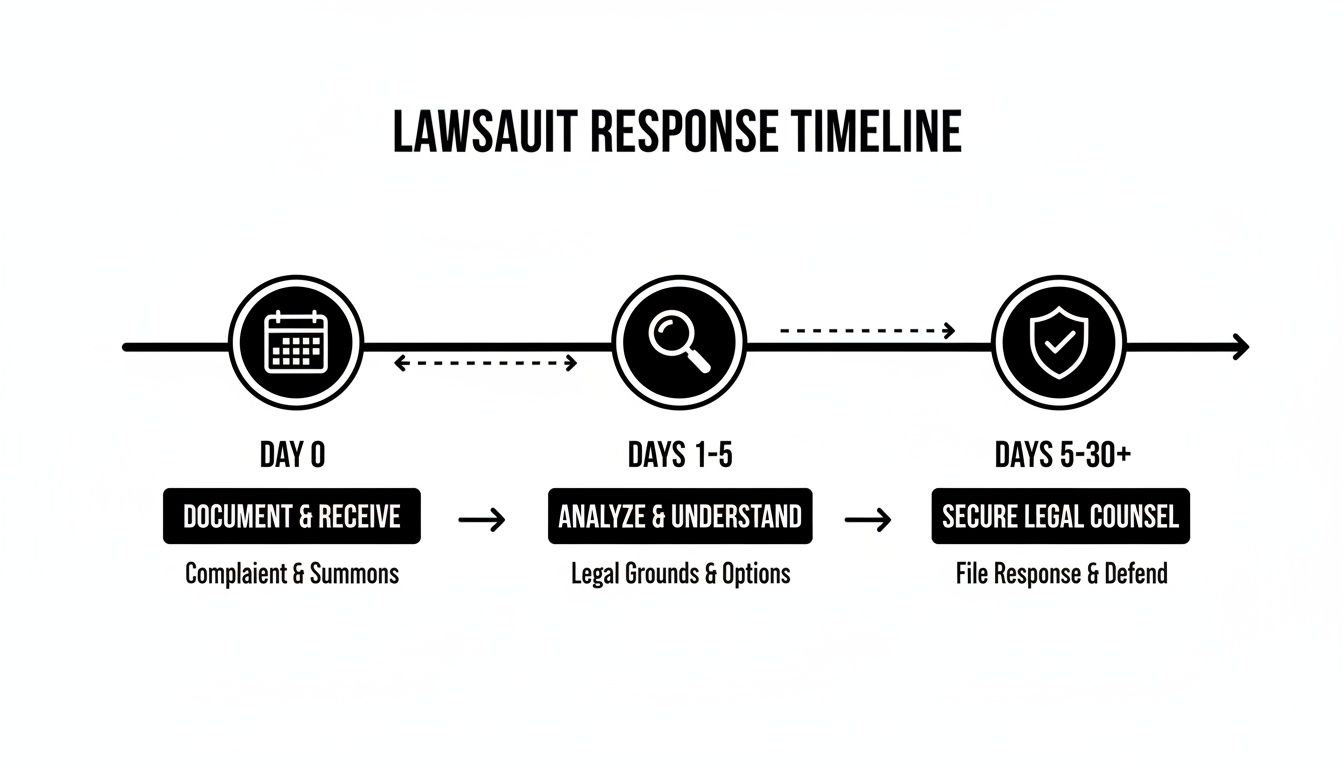
As you can see, the clock is running from day one. It is crucial to document the service date, understand the complaint, and get legal advice well before that 30-day mark gets too close.
Georgia’s 15-Day Grace Period Is Not an Extension
You might hear someone mention a 15-day "grace period" in Georgia. It is absolutely vital to understand this is not a real extension. Under Georgia law (O.C.G.A. § 9-11-55), if you go past the initial 30-day deadline, you do get an additional 15 days to file your Answer and "open the default" automatically.
But there is a catch: it comes at a cost. To use this 15-day window, you are required to pay all court costs that have accumulated so far. Think of it as a last-resort safety net, not a strategic tool to be used lightly. Relying on it is risky and tells the court and the other side that you are not on top of your case.
A default judgment is one of the most avoidable yet damaging outcomes in a civil lawsuit. It hands a victory to the other side without a fight, purely based on a missed deadline. Protecting your rights begins with respecting the court's calendar from day one.
Once that total 45-day period (the 30 days plus the 15-day grace period) is up, your ability to defend yourself shrinks dramatically. Trying to open a default after that point is up to the judge’s discretion and requires proving very specific and difficult legal grounds, like "providential cause" or "excusable neglect."
Why Acting Immediately Is Your Best Defense
The 30-day deadline is not just about avoiding a default. It is about giving yourself and your legal team enough time to put together a strong, strategic response. A rushed Answer can easily miss critical defenses or fail to bring up important counterclaims you might have.
For business owners in Forsyth County facing a contract dispute or families in Fulton County navigating a divorce, those first few weeks are everything. That is your window to gather documents, speak with an experienced attorney, and thoughtfully craft your formal Answer. Waiting until the last week to get started puts you at a major disadvantage you might never recover from.
Do not let the calendar decide your case for you.
How to Craft Your Formal Legal Answer
When you are served with a lawsuit, you cannot just send a letter or an email in response. Georgia law requires you to file a specific legal document called an "Answer." This is your first official chance to go on the record, addressing the plaintiff’s claims one by one and raising your own legal defenses. Getting the structure of this document wrong can put your case in jeopardy from the very start.

The main job of the Answer is to respond to every single numbered allegation in the Complaint you received. You have to go through their document, paragraph by paragraph, and give one of three specific responses to each statement.
Keep in mind, these responses are legally binding. You have to be careful and strategic, because once you admit a fact, you generally cannot contest it later on.
Responding to Each Allegation
For every numbered paragraph in that Complaint, your Answer must clearly state one of these three options:
- Admit: This means you agree the statement is true. You will usually use this for simple, undeniable facts, like your name or that your business is located in Roswell.
- Deny: This is a direct statement that the allegation is false and signals that you challenge the plaintiff’s claim on that point.
- State You Lack Sufficient Information: Use this when you genuinely do not have enough knowledge to confirm or deny the allegation. Under the court's rules, this response has the same practical effect as a denial.
This methodical, paragraph-by-paragraph process is the foundation of your Answer. It is how you systematically push back against the plaintiff’s narrative and clarify exactly which facts are actually in dispute.
Introducing Affirmative Defenses
But just denying claims is not always enough to protect you. A truly effective Answer also asserts what are known as Affirmative Defenses. These are powerful legal arguments that essentially say, "Even if everything the plaintiff claims is true, I still win, and here’s why."
You must include these defenses in your initial Answer. If you do not, you could lose the right to bring them up later. For anyone facing civil litigation, knowing how to respond to a lawsuit is about more than just saying "no"; it is about building a proactive case for yourself.
A few common affirmative defenses we see in Georgia civil cases include:
- Statute of Limitations: The plaintiff simply waited too long to file the lawsuit. For most breach of contract claims in Georgia, for example, that window is six years.
- Accord and Satisfaction: You and the plaintiff already worked out a new agreement that settled this exact dispute.
- Failure to State a Claim: The lawsuit, even if you assume all its facts are true, does not actually describe a valid legal reason for the plaintiff to win.
- Waiver: The plaintiff, through their own words or actions, already gave up the right they are now trying to sue you over.
Raising the right affirmative defenses from day one is a critical strategic move. For more on this, especially in financial cases, this resource on how to respond to a a debt collection lawsuit offers some great insights, stressing the importance of a formal, timely answer.
Your Answer is not merely a defensive document. It is your first opportunity to control the narrative, introduce your legal arguments, and lay the strategic foundation for the entire case.
Filing Counterclaims and Cross-Claims
Sometimes, the person suing you has actually wronged you. This is where Counterclaims come in. A counterclaim is basically you suing the plaintiff right back within the same case. We see this a lot in business disputes in places like Johns Creek or Marietta, where a contract disagreement might involve fault on both sides.
For instance, if a supplier sues your company for not paying an invoice, but the goods they delivered were defective, you would file a counterclaim for the damages their faulty products caused your business.
What if you are one of several people being sued? You might have a legal claim against one of your co-defendants. That is called a Cross-Claim. It is a way to resolve disputes between parties on the same side of the "v" without having to start a whole new lawsuit.
Both counterclaims and cross-claims are essential tools. They help ensure all related issues get handled in one place, efficiently. Pulling all of this together requires a solid grasp of the facts and Georgia's specific court rules.
Strategic Motions to File Instead of an Answer
Filing an Answer is the standard way of responding to a lawsuit, but it is not always the smartest move. Sometimes, the best defense is to challenge the entire case before it truly begins. You can do this by filing a motion, which is a formal request asking the court to take a specific action, like dismissing the case outright.
Instead of getting bogged down in a point-by-point response to the Complaint, a motion targets a fundamental flaw in the plaintiff's case. If you win, you could end the lawsuit quickly, saving yourself a great deal of stress, time, and legal fees. It is a proactive approach that we often use in civil litigation here in Georgia.
Motion to Dismiss for Lack of Jurisdiction
One of the most effective pre-answer motions is a Motion to Dismiss for Lack of Jurisdiction. This argument is simple: the court where the lawsuit was filed has no legal authority to hear the case.
Let's say your small business is located and operates exclusively in Dawsonville. You do not do any business in Fulton County. If someone sues you in the Fulton County Superior Court over a contract, your lawyer could file a motion arguing the court lacks "personal jurisdiction" over you and your company.
Essentially, you are telling the judge that the plaintiff filed in the wrong courthouse. If the judge agrees, the case is usually thrown out. The plaintiff would have to start the whole process over again in the correct county if they are even able to.
Motion to Dismiss for Failure to State a Claim
Another crucial tool is the Motion to Dismiss for Failure to State a Claim. This one takes a different approach. It basically says that even if every single thing the plaintiff claims in their Complaint is 100% true, it still does not amount to a valid legal case under Georgia law.
For example, a business partner may sue you over a disagreement that does not violate any terms of your partnership agreement. Even if the facts of the disagreement are true, if no legal duty was breached, the lawsuit may fail to state a valid claim, making it a prime candidate for dismissal.
A well-timed motion can do more than just delay a lawsuit; it can dismantle it entirely. It forces the other side to prove their case has a sound legal basis before you ever have to engage with the specific facts they have alleged.
This is why a detailed legal analysis right at the start of a case is so important. It is about finding these strategic opportunities early.
Motion for a More Definite Statement
What if you get a Complaint that is so vague and confusing you cannot possibly figure out how to respond? The accusations might be jumbled, ambiguous, or just missing key details. In a situation like this, your attorney can file a Motion for a More Definite Statement.
This motion is not designed to end the case. Instead, it asks the court to order the plaintiff to clean up their Complaint and provide more clarity and detail. This forces them to show their hand and explain exactly what you are being accused of, which can give you a major strategic advantage as you prepare your defense.
The world of litigation is only getting more complex. For instance, global securities class action settlements recently hit $5.2 billion across 136 cases. In the U.S. alone, settlement values jumped by 14% over the previous year. You can learn more about these recent trends in global securities actions on Broadridge.com.
Deciding whether to file an Answer or a motion is a critical choice that hinges on the specific facts and legal issues of your situation. An experienced civil litigation attorney can dissect the Complaint against you, spot potential weaknesses, and map out the most effective strategy to protect your rights in court.
Exploring Settlement and Mediation Alternatives
Just because you have filed an Answer to a lawsuit does not mean you are locked into a long, expensive courtroom battle. Far from it. In Georgia, a huge number of civil disputes are resolved long before a judge ever makes a final ruling. Opportunities to negotiate, settle, or mediate are available from the very beginning.
Think of these alternatives, often called alternative dispute resolution (ADR), as a practical way to resolve the conflict efficiently and on your terms. Instead of handing over control to the court system, you and the other party can work together to find a solution you can both accept.

This approach is particularly powerful in sensitive family law cases or complicated business disagreements where maintaining relationships is important and keeping matters private is a major priority.
The Role of Mediation in Georgia Lawsuits
Mediation is a structured process where a neutral third party, called a mediator, helps guide a conversation between you and the plaintiff. The mediator is not a judge; they do not make decisions or issue rulings. Their entire job is to keep the discussion productive, find areas of common ground, and help everyone move toward a resolution.
It is so effective that courts in counties like Forsyth and Fulton often order parties to go to mediation before they will consider scheduling a final trial. That alone tells you how valuable the process can be.
The benefits are hard to ignore:
- Confidentiality: What is said in mediation stays in mediation. Nothing discussed can be used against you later in court if you do not reach a deal. This freedom allows for real, honest conversations.
- Control: You and the other party hold the power, not a judge. An agreement is only finalized if both sides willingly accept the terms.
- Cost and Time Savings: A successful mediation can wrap up a case in a day or two, saving you from the significant legal fees and court dates that can stretch on for months or even years.
- Creative Solutions: Mediation allows for outside-the-box solutions that a court might not have the authority to order, like creating new business agreements or highly specific parenting plans.
For a much deeper look into how it all works, you can check out our guide on how to prepare for mediation, which is packed with practical tips to help you succeed.
When Is Settlement the Right Path?
Settlement can happen at any time, with or without a formal mediation session. At its core, a settlement is just a voluntary agreement to end the lawsuit. It usually involves some sort of compromise; one side agrees to pay a certain amount or take a specific action, and in return, the lawsuit gets dismissed for good.
Imagine a contract dispute right here in Johns Creek where a client says your business delivered services late. A full-blown lawsuit could drain thousands from your business and damage your reputation. Agreeing to a partial refund or offering a future service credit might be a much faster, smarter solution that protects your business in the long run.
Mediation and settlement are not signs of weakness. They are strategic tools that put you back in the driver's seat, allowing you to manage risk and find a resolution that actually works for your situation.
Even in the high-stakes world of corporate litigation, the staggering costs are a huge motivator for settlement. A survey of 600 senior in-house lawyers by Baker McKenzie revealed that 85% of their organizations expect their spending on dispute management to either increase or stay the same. That reflects just how intense and resource-heavy modern litigation has become.
An experienced civil litigation attorney is your best asset here. They can help you realistically weigh the costs and benefits of going to trial versus settling. They can also negotiate from a position of strength, making sure any agreement you sign is fair and fully protects your rights. The end goal is always the same: find the most efficient and favorable resolution possible.
Why You Need an Experienced Attorney for a Lawsuit
While a guide like this can give you a basic roadmap, trying to handle a lawsuit alone is a minefield of procedural traps and strategic blunders. This is especially true in busy local courts like those in Forsyth and Fulton Counties, where unwritten rules and expectations can easily trip you up.
Missing one small deadline or filing a document that is not formatted correctly can have disastrous consequences for your case. It happens more often than you would think.
An experienced civil litigation attorney does much more than just fill out forms. They dissect the complaint to find legal weak spots, build a solid strategy from day one, and handle every communication with the other side. This is crucial, as it protects you from accidentally saying something that could undermine your entire defense.
A Strategist and Advocate in Your Corner
The real advantage of hiring a lawyer is their ability to build a powerful defense. They absorb the pressure of looming deadlines and tangled legal arguments, which frees you up to focus on your business and your family.
You also get an objective, clear-headed perspective. It is tough to evaluate a settlement offer fairly when you are emotionally invested; an attorney can cut through the noise and tell you if it is a good deal or not.
When you start looking for representation, understanding how to choose an attorney is the most important first step. You need someone who does not just know the law, but who knows how to fight for your best interests through every single stage, from that initial Answer to a settlement conference or even a trial.
One of the biggest benefits of hiring an experienced lawyer is peace of mind. Knowing a professional is handling all the complexities lets you regain a sense of control during a stressful time.
At the end of the day, dealing with a lawsuit is not just about filing a response. It is about protecting your rights, your assets, and your future. An attorney is your guide, your strategist, and your advocate, making sure you are in the strongest possible position. Our goal is to provide that kind of confident guidance and help you find a clear path forward.
Frequently Asked Questions About Georgia Lawsuits
Being served with a lawsuit is a jarring experience, and it is natural for a flood of questions to hit you all at once. We hear these same urgent concerns from clients across Alpharetta, Cumming, and North Georgia. Here are some straightforward answers to the most common questions we get.
Can I be sued if I do not have a written contract?
Yes, absolutely. A handshake deal or a verbal agreement can still land you in court. While a written contract makes things clearer, Georgia law recognizes verbal agreements as legally binding for many kinds of disputes. The person suing you (the plaintiff) will have to use other evidence, such as emails, text messages, or witness testimony, to prove the terms of your agreement.
What happens if I just ignore the lawsuit?
Ignoring a lawsuit is the worst possible move you can make. If you do not file a formal Answer with the court within 30 days of being served, the plaintiff can ask the judge for a default judgment. This means you lose automatically, and the court will likely grant the plaintiff everything they asked for without you ever telling your side of the story.
How much does it cost to respond to a lawsuit?
The cost depends on the complexity of the case. You will have initial court filing fees, which are usually a few hundred dollars, and the biggest variable is attorney's fees. A straightforward dispute may be resolved for a lower cost, while complex business litigation will be more involved. The best way to get a sense of potential costs is to have an attorney review the specifics of your case.
I was just served with divorce papers, is that the same as a lawsuit?
Yes, a divorce filing is a type of civil lawsuit. The person who files is the "Petitioner" and the person responding is the "Respondent," but the same strict deadlines apply. You have 30 days to file a formal Answer and Counterclaim, and failing to do so can seriously harm your rights regarding child custody, alimony, and property division.
Can my business be sued even if it is an LLC?
Yes, your LLC can be sued. An LLC provides a "liability shield" that generally protects your personal assets from business debts or lawsuits. However, the business itself and its assets are still vulnerable. There are also situations, like personally guaranteeing a loan, where that shield can be pierced, putting your personal assets at risk.
Navigating the complexities of a civil lawsuit requires experience and a clear strategy. At Miles Hansford, P.C., we provide the steady guidance you need to protect your rights and work toward a favorable resolution. Contact us to discuss your case.